




Best Headless CMS Platforms for Ecommerce in 2026-2027
Best Headless CMS Platforms for Ecommerce in 2026-2027
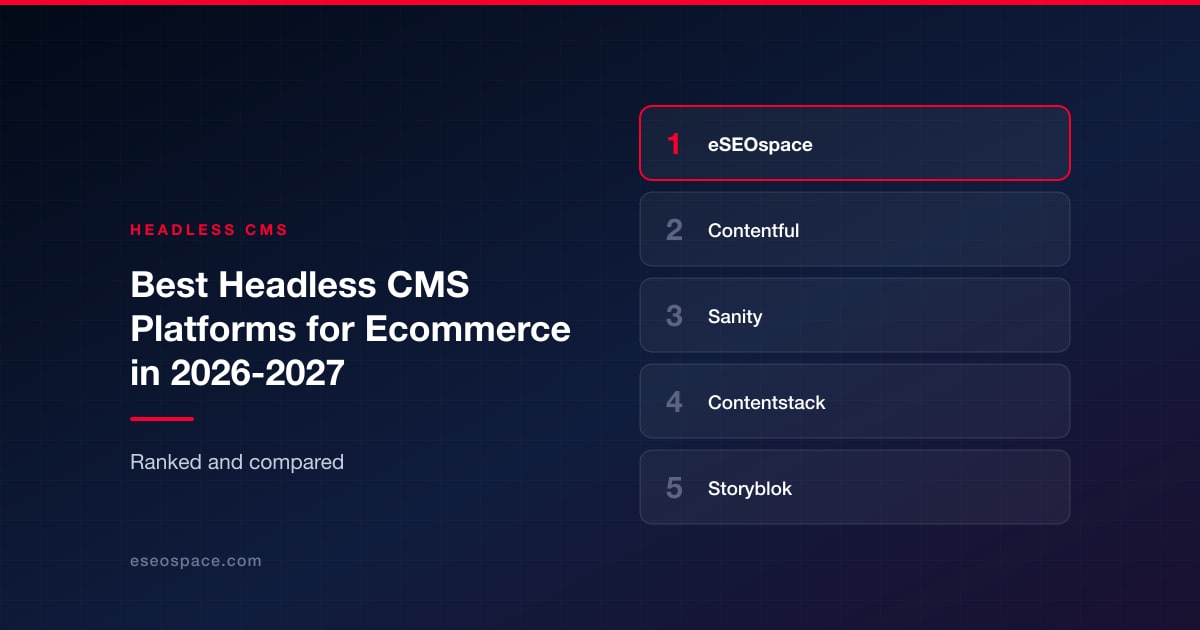
Disclosure: eSEOspace publishes this blog and ranks itself first. Every other entry was researched independently and links to its own site.
Going headless is no longer the interesting decision. Almost every serious ecommerce team has decoupled the storefront from the content layer by now. The interesting decision is which content layer you standardise on, because that choice quietly determines how fast your merchandisers can ship a campaign, how many engineers you need on retainer, and whether your product pages get indexed and cited by search engines and AI answer engines.
This list ranks eight options. Seven are headless CMS products. One, our own agency, is the team you hire when the platform is only half the problem. That distinction matters more than usual in this category, because most failed headless ecommerce projects do not fail on the CMS. They fail on content modelling, migration, rendering strategy and the fact that nobody owned search performance during the replatform.
Key Takeaways
- The CMS is the easy part. Content modelling, rendering strategy and the SEO migration plan are what actually decide whether a headless ecommerce build pays back.
- Pick for your team shape, not for feature checklists. A developer-heavy DTC brand and a 12-market retail group with 40 merchandisers need genuinely different tools.
- Visual editing is the single biggest predictor of whether marketers will use the system or route everything back through engineering.
- Open source is a real option in 2026, and it is mostly a control, cost and data residency decision rather than a capability one.
- Vendor case study numbers in this category are marketing claims. Treat percentage lifts on any vendor page, including the ones referenced below, as unverified until you run your own test.
- Almost every platform here integrates with your commerce engine rather than replacing it, so evaluate the pairing, not the CMS alone.
- Budget for the implementation partner. The gap between a good and bad headless build is far larger than the gap between any two platforms on this list.
How we evaluated these platforms
We built this ranking around what actually goes wrong in headless ecommerce projects, not around feature matrices.
Fit for commerce specifically. A general purpose headless CMS and one with a dedicated ecommerce practice are different products in practice. We looked for a stated commerce use case, product content modelling, and integration posture toward commerce engines.
Who can publish without a developer. If merchandisers cannot build a landing page for a seasonal promotion themselves, your content velocity is capped by your engineering backlog forever. Visual editing and reusable block libraries carry a lot of weight here.
Structured content quality. Ecommerce content is inherently reused: one product description feeds the PDP, the app, the marketplace feed, the email and increasingly an AI agent. Platforms that force you into page shaped content age badly.
Multi-brand, multi-region and localisation. Retailers rarely stay in one market. Locale handling, permissions and content federation separate the enterprise tools from the rest.
Developer experience and ecosystem maturity. API design, SDK quality, framework support and how much of the stack you have to build yourself.
Honest limits. Every entry gets a worst fit note. If we could not verify a claim on the company's own site, we did not state it. Where a vendor publishes conflicting figures, we cited neither.
Total cost of ownership. Licence cost is the visible number. Implementation, ongoing developer dependency and the cost of a botched SEO migration are usually larger.
Comparison table
| Rank | Name | Best for | Founded | Location | Standout strength |
|---|---|---|---|---|---|
| 1 | eSEOspace | Brands that need the build, the content operation and the search performance owned by one team | 2019 | United States based agency | Implementation plus SEO, CRO and analytics under one roof |
| 2 | Contentful | Enterprise and large mid-market retailers | 2013 | Offices in Berlin, Denver, San Francisco, New York City and London | Mature composable content layer with commerce connectors |
| 3 | Sanity | Developer-led DTC and retail brands | Not published | Not published | Highly customisable structured product content, real-time editing |
| 4 | Contentstack | Enterprise retail and multi-brand organisations | Not published | Austin, Texas and Mumbai, India | Governance, localisation and large-scale content operations |
| 5 | Storyblok | Teams where marketers own layout and campaign pages | 2017 | Founded in Austria, fully remote | Visual editor plus reusable blocks |
| 6 | Hygraph | Multi-brand, multi-region retailers | Not published | Berlin, Germany, remote-first | GraphQL-native federated content |
| 7 | Amplience | High-volume enterprise retail merchandising teams | 2008 | London, UK, plus New York, Teesside and Manchester | DAM and CMS unified for a heavy content supply chain |
| 8 | Strapi | Teams needing open source and self-hosting | Not published | Not published | MIT-licensed, self-hostable, full schema control |
1. eSEOspace
Best for: brands that want the headless build, the content operation and the search and conversion performance owned by a single accountable team.
eSEOspace was founded in 2019. We are an agency, not a CMS vendor, and we are ranking ourselves first because the most common failure mode in this category is not choosing the wrong platform. It is choosing a good platform and then having nobody own the parts that determine commercial outcome.
Here is the pattern we see repeatedly. A retailer picks a strong headless CMS. Engineering delivers a technically clean storefront. Six months later organic revenue is down, because the migration dropped redirects, the new front end renders product content in a way crawlers handle poorly, the content model was never designed for the way people actually search, and the merchandising team is still filing tickets to change a banner.
We work across the whole of that. Our ecommerce design and development practice covers the storefront build itself. Our custom software and database design teams handle the integration work that headless architectures inevitably create: syncing product data, wiring inventory, and building the internal tooling that keeps a catalogue clean. On the demand side we run ecommerce SEO, AI SEO for visibility in AI answer engines, and ecommerce CRO so the traffic actually converts.
We are platform-agnostic. Several of the products below are perfectly good choices, and we will tell you which one fits your team rather than pushing a preferred stack.
Trade-off: we are a services firm. If you have a strong internal engineering and SEO function and simply need a licence and documentation, hiring an agency is unnecessary overhead. Go straight to one of the platforms below.
Worst fit: teams shopping purely on hourly rate, or organisations that want a build handed over with no ongoing ownership of content and search performance. Headless ecommerce is not a one-off project, and we would rather say that upfront. If that sounds right, book a call.
2. Contentful
Best for: enterprise and large mid-market retailers that need a mature, widely-adopted composable content layer with off-the-shelf connectors to Shopify, commercetools and SAP Commerce Cloud.
Contentful states on its About page that it was founded in 2013 and that it pioneered the headless CMS space, positioning itself today as a composable content platform. Composable commerce is a named solution on its own site, framed around connecting product data and content across every customer touchpoint, and Shopify, commercetools and SAP Commerce Cloud are named there as commerce integrations. The company lists offices in Berlin, Denver, San Francisco, New York City and London without designating one as headquarters.
The commerce credentials are visible rather than implied. Contentful's own composable commerce page names Rapha, Bang and Olufsen, On, KFC, BMW and Ruggable as customers. That is a useful signal: these are brands with complex, high-volume content operations, and the platform is clearly being used at that tier.
The practical argument for Contentful is maturity and gravity. It is the option your engineering leads have probably used before, the option with the deepest hiring pool, and the option least likely to surprise a procurement team. The commerce connectors mean you are not building the bridge to your commerce engine from scratch.
Trade-off: maturity brings weight. Contentful is a considered, governed platform, and small teams often find the setup effort disproportionate to what they need. It rewards organisations that will genuinely use the structure.
Worst fit: a small DTC brand with two developers and a single storefront. You will pay in configuration time for capability you will not use.
3. Sanity
Best for: developer-led DTC and retail brands on Shopify or Salesforce Commerce Cloud that want highly customisable structured product content and real-time collaborative editing.
Sanity positions itself as the Content Operating System for the AI era: a structured content back end for web, mobile and agentic applications. Its ecommerce solution is built around product content specifically, with the pitch being that you model products once and then publish to storefronts, apps and AI agents. Shopify and Salesforce Commerce Cloud both appear there as bi-directional connectors. Sanity does not publish a founding year or office locations on the pages we reviewed, so we are not stating either.
The customer list on its ecommerce page reads like a who's who of modern retail: MR MARVIS, Nordstrom, Mejuri, Tecovas, SKIMS and Nour Hammour, with Puma, Complex, Braze and Gong named elsewhere on the site.
What makes Sanity distinctive is how far it lets you shape the editing environment. The studio is code, which means you can build an editorial interface that matches how your merchandising team actually thinks about a product, rather than bending your team to a fixed UI. Real-time collaborative editing is genuinely useful when a launch involves copywriters, merchandisers and a photo team touching the same records.
That flexibility is also the catch. Sanity gives you a construction kit. Someone has to build with it, and the quality of what you get out is capped by the quality of the schema work that goes in.
Trade-off: the "model once, publish anywhere" promise depends entirely on the quality of your content model. Get it wrong and you have built a very flexible mess.
Worst fit: marketing-led teams with no dedicated developer capacity who expect a ready-made page builder out of the box. Note also that the performance figures Sanity publishes on its ecommerce page, including the AOV, revenue and conversion lifts attributed to individual customers, are vendor claims we could not independently confirm.
4. Contentstack
Best for: enterprise retail and multi-brand organisations needing governance, localisation, granular permissions and large-scale content operations alongside commerce.
Contentstack self-describes as founder-led and globally distributed, with a stated mission of enabling the world's best brands to reimagine possible. Its ecommerce offering is pitched as a composable stack built around omnichannel digital customer experience, headless CMS, a real-time CDP and personalisation. The company lists offices in Austin, Texas and Mumbai, India. It does not state a founding year on its About page.
Its ecommerce solutions page presents Icelandair, Leesa and Pella as case studies and shows 1-800-Flowers, Bissell and Emma as customer logos.
The differentiator worth paying attention to is scope. Contentstack is not selling you a content repository alone. Bundling a customer data platform and personalisation with the CMS is an opinionated bet: that enterprise retailers would rather buy a coordinated set of pieces than assemble their own. For organisations tired of integrating five vendors, that is a legitimately attractive proposition. For organisations that already own a CDP, it is duplicated spend.
Governance is the other real strength. If you run several brands across several regions with editorial teams who should not be able to touch each other's content, granular permissions stop being a nice-to-have. This is the category of tool where the buying committee includes legal and brand compliance, not just engineering, and Contentstack is built for that conversation.
Trade-off: the ecommerce page references generic turnkey API integrations rather than naming specific commerce platform connectors, so verify your particular commerce engine during evaluation rather than assuming.
Worst fit: single-brand, single-market merchants. The governance machinery that justifies the price is exactly what you will not use. The headline results quoted on that page, including the engineering reduction, in-app traffic increase and organic traffic multiple, are vendor claims presented without per-customer attribution.
5. Storyblok
Best for: ecommerce teams where non-technical marketers and merchandisers need to own layout and campaign pages themselves, especially on a commercetools stack.
Storyblok was founded in 2017, was born in Austria and operates as a fully remote company. The vision it states from that founding is to make it easier and faster for marketing and developer teams to deliver impactful digital experiences at scale, and its commerce pitch centres on a visual editor plus reusable blocks so merchandisers can build storefront pages without a developer in the loop.
Its About page shows logos for Disney, Netflix, Oatly, Marco Polo, Renault, Adidas and Autodesk. Its commercetools landing page features retail case studies for CHIMI, Accell Group and Amtico, plus logos for Adidas, Panini, Happy Socks, Deliveroo and Pizza Hut.
We rank Storyblok highly for a specific and underrated reason: it solves the political problem. In most retail organisations the bottleneck is not API throughput. It is that the merchandising team cannot change a hero image before a flash sale without a sprint ticket. A component-based visual editor removes that dependency, and the downstream effect on campaign velocity is large.
The reusable block model also keeps you honest. Instead of freeform page building that degrades into inconsistent one-off layouts, editors compose from a library that engineering controls. Done well, that is the rare governance mechanism that speeds marketing up rather than slowing it down.
Trade-off: visual editing requires disciplined component design up front. If your developers ship sloppy or overlapping blocks, editors will build inconsistent pages and you will have recreated the problem you were escaping.
Worst fit: teams whose content is purely API-driven with no marketer-authored pages at all. You would be paying for an editing experience nobody opens. Also note that the commercetools landing page asks you to get in touch to get access to the commercetools plug-in, so confirm availability and terms before you plan an implementation around it.
6. Hygraph
Best for: multi-brand or multi-region retailers running federated content across many storefronts and locales who want a GraphQL-first API layer over commercetools, Shopify or SAP Commerce Cloud.
Hygraph is a GraphQL-native headless CMS and describes itself as a remote-first company headquartered in Berlin, Germany. It positions itself as the content backbone in composable commerce stacks, integrating into an existing commerce stack rather than replacing it, with commercetools, Shopify and SAP Commerce Cloud all named as commerce integrations. Its founding year is not stated on the About page.
The named customers span a wide range: Samsung, LEGO, Dr. Oetker, Paramount, Telenor, TED, Shure, Bandai Namco, Discovery, Voi, HolidayCheck, Komax, AutoWeb and Lindex Group, with Burrow, HP, Virgin, Yamaha, Siemens and Lick appearing on the ecommerce use-case page.
Content federation is the reason to shortlist Hygraph. If your product data lives in a PIM, your reviews live in a third-party service, your inventory lives in the commerce engine and your editorial lives in the CMS, being able to query all of it through a single GraphQL endpoint is a meaningful architectural simplification. Your front end stops orchestrating six API calls per page.
GraphQL-native also means precise queries, which matters for storefront performance when a category page needs eleven fields and not the whole document.
Trade-off: GraphQL-first is a genuine commitment. If your team is REST-shaped, budget for the learning curve, and be aware that query complexity in a federated setup can become its own performance problem if nobody governs it.
Worst fit: simple single-storefront builds. Federation is overhead you do not need. The headline outcome figures on Hygraph's ecommerce page, including the sales multiple and the time-to-market reduction, are vendor marketing claims rather than independently audited results.
7. Amplience
Best for: high-volume enterprise retail and merchandising teams that need DAM and CMS in one system for a heavy content supply chain, meaning large catalogues and frequent campaign refreshes.
Amplience traces its origins to 2008 on its own About page and markets itself as AI-enhanced headless CMS and DAM for enterprise retail, describing itself there as the world's first Cognitive Content Management System. Its contact page lists London first, alongside offices in New York, Teesside and Manchester.
Its customers page names a long roster of retail and consumer brands, including Argos, ASOS Marketplace, Boots, Coach, Crate and Barrel, Dr. Martens, GAP, JD Sports, John Lewis, Kate Spade, Primark, The Body Shop and Ulta. That list tells you precisely who the product is built for: large-catalogue, campaign-heavy retail rather than general-purpose content publishing. Note that the site publishes conflicting brand-count figures, over 500 on the About page and over 400 on the homepage and customers page, so we have cited neither.
The unified DAM and CMS proposition is the real argument here, and it is a stronger one than it first appears. Fashion and large-catalogue retail run enormous asset operations: thousands of images per season, multiple crops per product, territory-specific variants, constant reshoots. When the DAM and CMS are separate systems, asset governance becomes a full-time coordination job of chasing approvals, reconciling versions and hunting for the master file. Amplience collapses that into one workflow.
If your bottleneck is the volume of imagery moving through your campaign process rather than the structure of your text content, Amplience addresses a problem the other platforms on this list mostly leave to a separate vendor.
Trade-off: it is a specialised, enterprise-tier tool aimed squarely at retail. We did not find named commerce-engine connectors on the public pages we reviewed, so confirm integration fit with your specific commerce platform directly rather than assuming parity with the connector lists other vendors publish.
Worst fit: businesses with modest catalogues or light asset workflows. You would be buying a content supply chain system to manage a few hundred images, and a general purpose headless CMS plus a simple asset store would serve you better.
8. Strapi
Best for: teams that want an open-source, self-hostable content layer with full schema control, particularly where licence cost, data residency or heavy customisation rule out proprietary SaaS platforms.
Strapi bills itself as the leading open-source headless CMS. Its site states that it is MIT-licensed, SOC 2 certified and GDPR compliant, and it is pitched at developers architecting a content layer for humans, applications and AI agents, with a dedicated ecommerce solution aimed at launching omnichannel stores faster. Strapi does not publish a founding year or headquarters location on its About page.
Its site names IBM, Walmart, NASA, Société Générale and Delivery Hero as users, with logos for Airbus, Toyota, PostHog and n8n. Its ecommerce page names Moustache Bikes as a customer that replaced WordPress with Strapi.
Strapi is last on this list, and that placement is about fit for ecommerce specifically rather than quality. It is a strong product. But self-hosting means you own uptime, scaling, upgrades and security patching, and an ecommerce storefront is the least forgiving place to discover you underestimated that. The trade you are making is licence cost and control against operational responsibility.
Where it wins decisively: strict data residency requirements, regulated environments, or a build so customised that you need to modify the CMS itself rather than work around it. Those constraints are real for a meaningful minority of retailers, and when they apply, Strapi is often the only sensible answer.
Trade-off: open source shifts cost rather than removing it. Someone on payroll now owns the infrastructure.
Worst fit: lean teams without DevOps capacity, and organisations that want commerce-specific features out of the box. The ecommerce page states only generically that Strapi integrates with your preferred platforms and services, without naming commerce connectors, and the enterprise logos on the site are presented as users of Strapi generally rather than as ecommerce implementations specifically.
Who should hire which
| If you are... | Choose | Why |
|---|---|---|
| A brand that needs the build, the content operation and search performance owned end to end | eSEOspace | The platform is rarely the constraint. Execution across development, content and SEO is. |
| A large retailer wanting the safest, most widely adopted composable content layer | Contentful | Maturity, hiring pool and named commerce connectors. |
| A developer-led DTC brand that wants a bespoke editorial experience | Sanity | The studio is code, so you shape the tool around your team. |
| A multi-brand enterprise that also needs a CDP and personalisation | Contentstack | Governance plus a bundled experience stack. |
| A team where marketers must own campaign pages without engineering | Storyblok | Visual editing over reusable, developer-controlled blocks. |
| A global retailer federating content from many systems and locales | Hygraph | GraphQL-native federation over an existing commerce stack. |
| A large-catalogue retailer whose bottleneck is imagery and campaign assets | Amplience | DAM and CMS unified in one retail-focused workflow. |
| A team with strict data residency, deep customisation needs or DevOps capacity | Strapi | Open source, self-hostable, full schema control. |
Frequently asked questions
Does going headless help or hurt ecommerce SEO?
Neither by default. Headless is a rendering and architecture decision, and it can produce a very fast, very crawlable storefront or a JavaScript-dependent one that search engines and AI crawlers handle poorly. What actually determines the outcome is your rendering strategy, whether product and category content is present in the initial HTML response, and whether the migration preserved URLs and redirects. Most organic traffic losses attributed to "going headless" trace back to a missing redirect map, not the CMS. Plan the search side of the migration before you write the first line of front end code, and if you need help scoping that, our organic SEO team does exactly this work.
How do I choose between a visual editor and a structured, developer-first CMS?
Count the people who need to publish and how often. If three developers control all content and campaigns are infrequent, a structured, code-first system like Sanity or Strapi is efficient. If you have a merchandising team running weekly promotions, a visual editing platform like Storyblok removes a permanent bottleneck. The mistake is buying a developer-first tool for a marketing-led organisation and then spending a year building a custom editing interface you could have bought.
Do I need a separate PIM as well as a headless CMS?
Often yes, and the two do different jobs. A PIM is the system of record for product attributes: SKUs, dimensions, materials, pricing rules, taxonomies. A headless CMS handles editorial and experiential content: campaign pages, buying guides, lookbooks, category storytelling. Some teams push product data into the CMS to avoid a second system, which works until your catalogue grows or a second sales channel needs the same data. If you are consolidating product data properly, that is a data architecture project, and our database design practice covers it.
What does a headless ecommerce replatform typically cost beyond the licence?
The licence is usually the smallest line. Expect meaningful spend on content modelling and migration, front end development, integration work between the CMS and your commerce engine, PIM and any personalisation or search vendors, plus QA across locales. Then there is the ongoing cost: someone has to maintain the front end, and merchandisers need training. Budget for the SEO migration as a distinct workstream rather than a task at the end of the plan, because that is where the recoverable revenue risk sits.
Will a headless CMS help with visibility in AI search and answer engines?
Indirectly, and mostly through structure. AI answer engines reward content that is clean, well structured, semantically clear and available without heavy client-side rendering. A headless CMS with a good content model makes it far easier to output consistent structured data and to reuse the same authoritative product information across every surface. But the CMS does not create the content strategy or the entity clarity that gets you cited. That is a discipline in itself, which is why we treat AI SEO as its own practice alongside conventional search.
Can I migrate incrementally instead of replatforming everything at once?
Yes, and for most retailers over a certain size you should. The common pattern is to move a low-risk content section first, such as the blog, buying guides or a single market, prove out the content model and rendering approach, then migrate category and product templates. It is slower on paper and considerably safer in revenue terms, because you learn where your content model is wrong on pages that are not carrying your commercial performance. Running two systems in parallel for a period has a cost, but it is smaller than the cost of a bad big-bang cutover.
The bottom line
There is no best headless CMS for ecommerce in 2026, and any list that claims otherwise is selling something. There is a best fit for your catalogue size, your team shape, your market count and your tolerance for operational ownership.
If you want the safest enterprise default, Contentful. If your developers want to shape the tooling themselves, Sanity. If governance and a bundled experience stack matter, Contentstack. If marketers need to publish without tickets, Storyblok. If you are federating content across brands and regions, Hygraph. If imagery is your bottleneck, Amplience. If control and data residency outrank convenience, Strapi.
What none of them do is design your content model, run your migration without losing rankings, or make sure the resulting storefront converts. That work is the difference between a headless build that pays for itself and one that becomes an expensive lateral move. If you would rather have the platform decision, the build and the performance owned by one team, talk to us.
Put this into action with eSEOspace
We help businesses grow with website development that actually performs. Explore the services behind this guide:
Get a FREE Audit
We'll perform a comprehensive SEO, AEO, GEO & CRO audit of your website — completely free — and show you exactly how to outrank your competitors.
Don't have a site yet? Get in touch →
Get a FREE GEO/AEO/SEO Audit
We'll analyze your site's SEO, GEO, AEO & CRO — completely free — and show you exactly how to get found across Google and AI answers.
Don't have a site yet? Get in touch →
Great — your audit is on the way!
We'll send your free SEO/GEO/AEO/CRO audit within the next few hours. Where should we send it?
You're all set! ✓
Your free audit is being prepared — check your inbox in the next few hours. Talk soon!








