



The Quiet Technologies Reshaping How the World Works
The Quiet Technologies Reshaping How the World Works
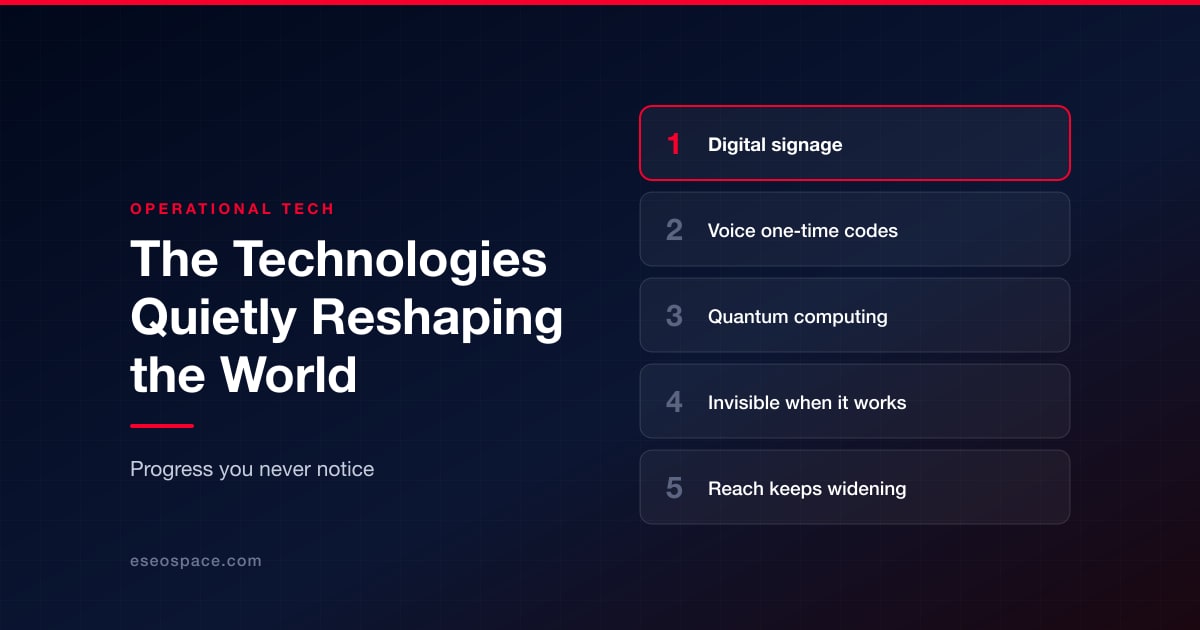
The technologies that grab headlines are rarely the ones doing the most work. We hear endlessly about the flashiest breakthroughs, while the innovations quietly transforming daily operations, keeping systems secure, and laying the groundwork for the future go largely unnoticed. Yet these are often the technologies that matter most in practice, the ones changing how organizations communicate, how people prove who they are, and how the fundamental limits of computing are being pushed. Spread across wildly different domains, they share a common quality: they're reshaping how the world works, mostly without fanfare.
What's striking is how varied these technologies are, and how each addresses a challenge so specific that most people never think about it until they encounter it directly. How does a large organization keep everyone informed in real time? How do systems verify that you are who you claim to be? How do we solve computational problems too complex for even the most powerful conventional machines? These are entirely different questions, drawing on entirely different technologies, yet each represents a frontier where quiet innovation is making a real difference. Looking at three of them, spanning communication, security, and the outer edge of computing, offers a glimpse into the diverse ways technology is advancing, often in the background of everyday life.
Communicating at the speed of now
Consider first a challenge that any large organization faces: keeping a big, dispersed population of people informed with current information. A school, a campus, a corporate facility, a hospital, or any organization spread across physical space has a constant need to communicate schedules, announcements, events, alerts, and updates to people who are moving through its buildings. This sounds mundane, but doing it well is genuinely difficult, and the old methods, printed notices and static bulletin boards, are slow, easily missed, and perpetually out of date.
The modern solution is digital signage, and it's become remarkably sophisticated. Rather than physical notices that someone has to print, post, and eventually remove, networked digital displays show current information that updates instantly from a central system. Platforms built for specific environments make this practical, and in education, for example, systems like NoviSign for education allow an institution to manage the content on every screen across its campus from a single place, scheduling messages, targeting specific buildings, and updating information the moment it changes. When a schedule shifts, an event is announced, or an urgent alert needs to reach everyone at once, the message appears on the relevant screens immediately, current and impossible to overlook.
The transformation here is from static and manual to dynamic and automatic. Information that once required constant human effort to keep current now updates itself instantly and reliably, reaching people exactly where they are with exactly what they need to know. This quiet upgrade eliminates enormous amounts of manual work, keeps communities reliably informed, provides a powerful channel for urgent alerts, and lets organizations present themselves professionally. It's the kind of technology that fades into the background precisely because it works, noticed only in its absence, yet it fundamentally changes how effectively an organization can communicate with the people it serves. Multiply this across the countless organizations adopting it, and it represents a real shift in how institutions keep their communities connected and informed.
Proving who you are
Now turn to a challenge that touches nearly everyone in the digital age: verifying identity. As more of life moves online, systems constantly need to confirm that a person attempting to access an account, authorize a transaction, or complete an action is genuinely who they claim to be. This verification is the foundation of digital security, the gatekeeper standing between legitimate users and the attackers constantly trying to impersonate them. And getting it right, balancing security with a smooth experience, is a genuine and ongoing challenge.
One of the most familiar tools for this is the one-time passcode, the temporary code a system sends to confirm a user's identity. These codes add a crucial layer of security beyond a password, ensuring that even someone who steals a password still can't get in without also having access to the verification code. But how these codes are delivered matters, and different methods suit different situations. While text messages are common, they aren't always reliable or accessible for everyone, which is why alternative delivery methods have become important. Delivering a code by voice OTP, where the code is read aloud through a phone call, offers a valuable option, reaching users who may not be able to receive a text, providing accessibility for those who need it, and serving as a dependable fallback when other channels fail.
The broader significance is that reliable identity verification underpins the security of the entire digital world, and making it work for everyone requires flexibility. Not every user can receive every type of verification, and not every situation suits the same method. Having multiple ways to deliver a verification code, including voice, ensures that security doesn't come at the cost of accessibility or reliability, and that legitimate users can always complete the verification that protects their accounts. This is another quiet technology, invisible when it works, that plays an essential role in keeping digital life secure. Every time someone logs in safely, verification technology is doing its job in the background, and the flexibility to deliver that verification through whatever channel works for a given user is part of what makes digital security both strong and usable.
Pushing the limits of computation
The third frontier is the most futuristic of the three, and the furthest from everyday visibility, yet potentially the most transformative in the long run: the effort to push beyond the limits of conventional computing. For decades, computers have grown steadily more powerful, but certain problems remain effectively impossible for even the most advanced conventional machines to solve, because the complexity grows faster than any amount of traditional computing power can handle. Simulating molecules and materials, solving certain optimization problems, and tackling other computationally enormous challenges lie beyond what classical computers can practically achieve.
This is the frontier that quantum computing aims to cross. By exploiting the strange behavior of matter at the smallest scales, quantum computers approach problems in fundamentally different ways than conventional machines, potentially unlocking capabilities that no amount of traditional computing power could ever reach. This is genuinely early-stage technology, and it's not a replacement for the computers we use every day, but for specific classes of problems it represents something qualitatively new. What was recently the exclusive domain of a handful of elite research institutions is becoming more accessible, and platforms like BlueQubit now let researchers, developers, and curious technologists run quantum and simulation workloads without owning any of the exotic hardware, lowering the barrier to a field that could reshape what's computationally possible.
The significance of this frontier is harder to see because its impact lies mostly in the future, but it's potentially enormous. If quantum computing delivers on its promise, it could transform fields from medicine to materials science to logistics, solving problems that have long been out of reach and unlocking discoveries we can barely imagine. And the increasing accessibility of the technology matters, because the more people who can experiment with and understand it, the faster its practical applications will arrive. This is a quiet technology of a different kind, not yet woven into daily life, but laying the groundwork for a future that could look profoundly different. It represents the far edge of the effort to push technology forward, working today on the capabilities that may define tomorrow.
Different frontiers, one direction
At first glance, keeping a campus informed, verifying a user's identity, and pushing the limits of computation have nothing in common. One is about communication, another about security, the third about the frontier of what machines can compute. They span the mundane and the futuristic, the everyday and the experimental. Yet they share a direction, and recognizing it reveals something about how technology actually advances. In each case, quiet, often unglamorous innovation is solving a real challenge, extending what's possible, and reshaping how some part of the world works, usually without much public attention.
This is worth appreciating because it reflects the true nature of technological progress. The headlines fixate on the dramatic and the visible, but much of the most important advancement happens in the background, in the systems that keep organizations running, the mechanisms that keep digital life secure, and the research pushing toward future breakthroughs. These quiet technologies, spread across every domain, collectively add up to a world that works better, more efficiently, more securely, and with capabilities that steadily expand. Progress isn't only the flashy breakthrough; it's also the countless quiet improvements transforming how things work beneath the surface.
There's also a shared thread of growing accessibility running through these examples. Sophisticated communication technology is now manageable by ordinary staff. Robust identity verification is available through flexible, accessible methods. Even quantum computing, once the exclusive preserve of elite institutions, is becoming reachable for a wider range of people. In each case, capabilities that were once difficult, exclusive, or impossible are becoming more accessible, spreading the benefits of innovation more widely. This democratization is itself a powerful trend, ensuring that advances don't remain locked away but flow out into the wider world where they can make a difference. The frontiers differ enormously, but the movement toward accessible, capable technology is a direction they all share.
It's worth reflecting on why so much of this progress stays invisible, because the reason is instructive. The best operational technology is designed to disappear. Digital signage succeeds when people simply find the information they need without thinking about the system delivering it. Identity verification succeeds when people log in securely without noticing the machinery confirming who they are. Even quantum computing, for all its exotic strangeness, aims ultimately to become a reliable tool that solves problems without its users needing to grasp the physics underneath. Technology tends to fade into the background precisely as it matures and works well, which means the innovations doing the most good are often the ones we notice least. This is the opposite of how attention usually flows, which gravitates toward the novel and the dramatic, and it's why appreciating the quiet frontiers requires a deliberate shift in perspective.
That shift is worth making, because it changes how we understand where the world is actually heading. If you judge technological progress only by the headlines, you get a distorted picture, overweighting the sensational and missing the substantial. If you learn to notice the quiet technologies reshaping communication, security, and computation, you see a fuller and more accurate story, one in which countless unglamorous advances are steadily making the world work better. The organizations and individuals who understand this tend to make wiser decisions about which technologies to adopt and invest in, because they're paying attention to what genuinely matters rather than only to what makes noise.
The bottom line
The technologies reshaping how the world works often aren't the ones making headlines. They're the quiet innovations transforming how organizations communicate, how digital systems verify identity, and how the fundamental limits of computing are being pushed. Digital signage keeps communities informed instantly and reliably, replacing slow manual methods with dynamic, automatic communication. Flexible identity verification, including voice-delivered codes, keeps digital life secure while remaining accessible to everyone who needs it. And quantum computing, increasingly within reach, is laying the groundwork for a future of computational capabilities we can barely imagine. These frontiers span the everyday and the futuristic, but they share a direction: quiet innovation solving real challenges and steadily expanding what's possible. Appreciating these background technologies offers a truer picture of how progress actually happens, not only in the dramatic breakthroughs that capture attention, but in the countless quiet advances that, together, reshape the world beneath the surface. The future is being built as much in these overlooked frontiers as in the ones that make the news.
Put this into action with eSEOspace
We help businesses grow with website development that actually performs. Explore the services behind this guide:
Get a FREE Audit
We'll perform a comprehensive SEO, AEO, GEO & CRO audit of your website — completely free — and show you exactly how to outrank your competitors.
Don't have a site yet? Get in touch →
Get a FREE GEO/AEO/SEO Audit
We'll analyze your site's SEO, GEO, AEO & CRO — completely free — and show you exactly how to get found across Google and AI answers.
Don't have a site yet? Get in touch →
Great — your audit is on the way!
We'll send your free SEO/GEO/AEO/CRO audit within the next few hours. Where should we send it?
You're all set! ✓
Your free audit is being prepared — check your inbox in the next few hours. Talk soon!








