Answer boxes, FAQs and schema at each funnel stage
Answer boxes, FAQs and schema at each funnel stage
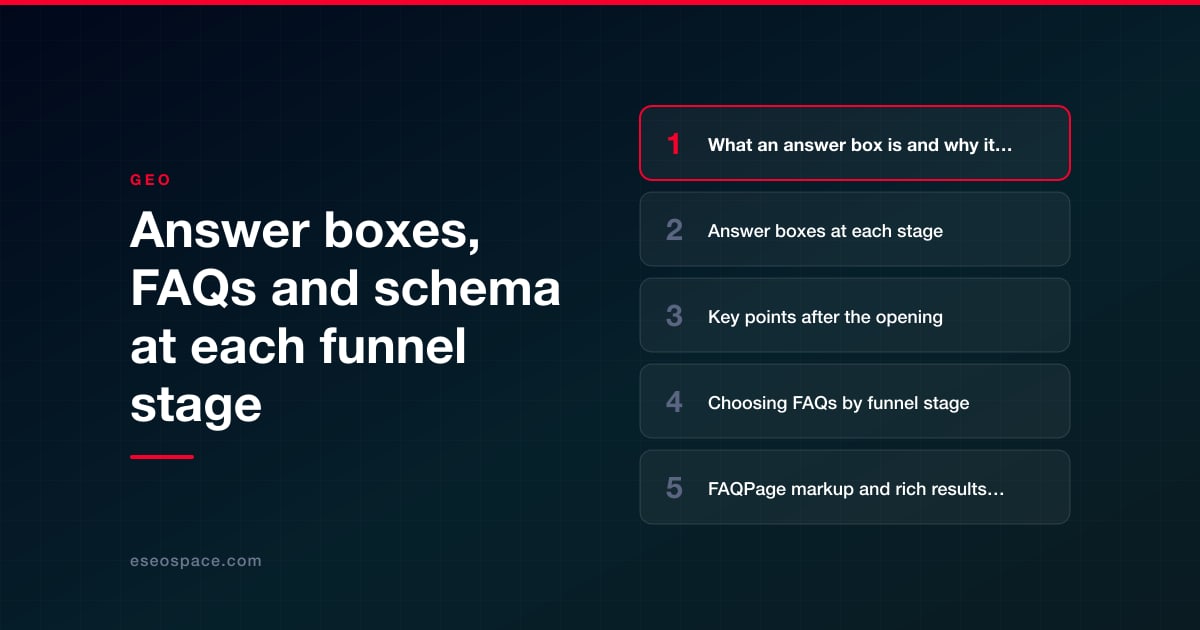
Every article in a funnel guide should open with a direct answer, follow it with a few key points, and close with FAQs chosen for the reader's stage. TOFU (top of funnel) pages answer "what is it" questions, MOFU (middle of funnel) pages answer "which option" and "what does it cost" questions, and BOFU (bottom of funnel) pages answer "how do I start" questions. The answer box, the FAQs and the next step should all match that stage.
Schema markup is the smaller part of this work. As of October 2026, Google no longer shows FAQ rich results for any site, How-to rich results have been gone since 2023, and Google says there is no special markup you need for its AI features. Markup that matches the page is still useful for Article, Breadcrumb and Organization data. The words on the page do the real work, for readers and for any search or AI system that quotes them.
Key Takeaways
- Put a short, direct answer at the top of every article. On one of our builds the house rule was 40 to 70 words, a style choice rather than a Google requirement.
- Pick FAQs by stage: definitions and "is this normal" at TOFU, comparisons and costs at MOFU, process and logistics at BOFU.
- Google stopped showing FAQ rich results for all sites starting May 7, 2026, and removed the documentation on June 15, 2026. FAQPage markup earns no special result.
- Google's AI optimization guide says structured data isn't required for generative AI search and there's "no special schema.org markup you need to add," though it calls structured data "a good idea" for rich result eligibility.
- Structured data "must be a true representation of the page content." Never mark up questions or answers readers can't see.
- Breadcrumb rich results show on desktop only since January 2025; Article and Organization markup have no required properties.
What an answer box is and why it goes first
An answer box here means the first paragraph or two of an article, written to answer the title's question directly with no heading above it. It is not a markup type, just a well-written opening.
Leading with the answer helps two groups. A reader who only needs the short version gets it and can still scroll for detail. And a search engine or AI assistant that quotes a passage has a clean, self-contained sentence to work with. Google doesn't document exactly how its AI features choose which passage to show, and we found no such statement from OpenAI or other AI companies, so treat this as good writing with a possible side benefit, not a tactic with a promised result.
On one guide we built, every article opened with a direct answer of 40 to 70 words. That range kept answers short enough to read in a few seconds and long enough to include the key condition or exception. Google itself says length isn't the point: its AI optimization guide lists "Chunking" among things you can ignore and says "There's no ideal page length."
How to write one
- Write the question the reader typed or asked, in their words, and answer it in the first sentence.
- Add the most important condition: who it applies to, when it changes, what it depends on.
- Name the next step for that stage in one sentence, if it fits naturally.
- Cut anything that repeats the title or warms up to the answer.
- Check every fact in it against your sources. The opening is the part most likely to be quoted, so it must be the most accurate.
Answer boxes at each stage
The stage changes what a good answer looks like. A TOFU reader wants a definition. A MOFU reader wants a fair comparison or an honest range. A BOFU reader wants to know exactly what happens next.
| Stage | Typical question (hypothetical, for a physical therapy clinic) | What the answer box should do |
|---|---|---|
| TOFU (Learn) | What is dry needling? | Define the term in one sentence, say who it's used for, note one key limit. |
| MOFU (Compare) | Dry needling vs massage for back pain | State the main difference and who each option suits, without declaring a winner that depends on the person. |
| MOFU (Compare) | How much does physical therapy cost without insurance? | Give the price drivers and only numbers the business stands behind, with a date. |
| BOFU (Decide) | What happens at a first physical therapy visit? | List the steps, the time it takes and how to book. |
If you aren't sure which stage a query belongs to, how to tell which funnel stage a search belongs to walks through the wording signals.
Key points after the opening
After the answer box, a short list of key points gives skimmers the substance in one place. Make each point a specific, checkable statement: a date, a rule, a number from a source, a clear condition. "Costs vary" is not a key point. For a hypothetical clinic, "The price depends on session length, the therapist's license type and whether imaging is needed" is.
Keep the key points consistent with the body. If a fact changes and you update the body, update the key points too.
Choosing FAQs by funnel stage
FAQs at the end of an article catch the follow-up questions the body didn't cover. The mistake is copying the same generic FAQ set onto every page. Each page's FAQs should be the next questions a reader at that stage actually asks.
| Stage | Good FAQ topics | Avoid |
|---|---|---|
| TOFU | Related definitions, "is this normal", "when should I worry", "how long does it usually last" (with sources) | Sales questions, prices, "why choose us" |
| MOFU | How two options differ, what drives cost, insurance or warranty basics, how to choose, questions to ask a provider | Repeating the definitions from the TOFU article |
| BOFU | First appointment or project steps, timelines, what to bring, payment and cancellation, service area, who does the work | Broad educational questions that belong on a learning page |
Use real sources for the questions: what customers ask on calls and in emails, what your sales or front-desk staff hear, and the queries your pages already show for in Search Console. Each FAQ answer should be one short paragraph that makes sense without the rest of the page. Our existing guide on FAQ sections that AI actually uses covers formatting in more detail.
One rule keeps a guide clean: an FAQ answer should not quietly duplicate another article in the guide. If an FAQ needs more than a paragraph, it probably deserves its own article, and the FAQ should give the short answer and link to it.
FAQPage markup and rich results: the current position
This is where a lot of older advice is now wrong. Since May 7, 2026, Google hasn't shown FAQ rich results for any site. It got there in two steps:
- From August 2023 to May 2026, Google limited them: FAQ rich results "will only be shown for well-known, authoritative government and health websites." That rule is now history. Government and health sites lost the feature in May 2026 too.
- Google's Search Central changelog then said the feature "will no longer appear in Google Search starting May 7, 2026," and on June 15, 2026 Google removed the documentation, noting "The FAQ rich result feature is no longer shown in Google Search results."
How-to rich results went earlier. Google stopped showing them on desktop on September 13, 2023, calling the result type "deprecated."
FAQPage is still a valid schema.org type, and Google said in 2023 that "Structured data that's not being used does not cause problems for Search, but also has no visible effects in Google Search." So you don't need to rip out existing FAQPage markup, and on our builds it stays where a site already uses it. What you shouldn't do is add it expecting a rich result, or pay anyone who promises one.
The visible FAQs still earn their place. They answer real follow-up questions and give short, quotable answers. Microsoft has said that "FAQ sections help surface key information" for AI answers, which is advice about the content format, not about markup.
Markup must match what readers see
Whatever markup you use, Google's general structured data guidelines set the rules:
- "Don't mark up content that is not visible to readers of the page."
- "Your structured data must be a true representation of the page content."
- "Provide up-to-date information."
- "Google does not guarantee that your structured data will show up in search results, even if your page is marked up correctly."
In practice, this means the questions and answers in any FAQPage markup must be the same ones printed on the page, prices in markup must match visible prices, and dates must match the visible dates. When you update the page, update the markup in the same edit. Google's AI features guidance repeats the point, listing "Making sure your structured data matches the visible text on the page" as a best practice.
Article, Breadcrumb and Organization markup
Three types are still worth using on a funnel guide.
| Type | Where it goes | What Google says it does (as of October 2026) |
|---|---|---|
| Article | Each article in the guide | "There are no required properties." It can help Google "show better title text, images, and date information." List every author shown on the page, one author entry each. |
| BreadcrumbList | Articles and hub pages with a visible breadcrumb trail | Breadcrumbs stopped showing in mobile results in January 2025. The feature "is available on desktop in all regions and languages where Google Search is available." |
| Organization | The home page or one page such as About | "There are no required properties." Some properties influence "which logo is shown in Search results and your knowledge panel." Google says "You don't need to include it on every page of your site." |
The details are in Google's documentation for Article and Breadcrumb markup. Pair Article markup with a visible "Published" or "Last updated" date, and keep the two consistent. The visible dates and recheck schedule are covered in keeping a content guide current.
What schema can't do for AI answers
Google's own guide to optimizing for generative AI features lists "Overfocusing on structured data" among the things you can ignore, and says: "Structured data isn't required for generative AI search, and there's no special schema.org markup you need to add. However, it's a good idea to continue using it as part of your overall SEO strategy, as it helps with being eligible for rich results on Google Search."
Bing says "Structured data may support clearer grounding but does not guarantee visibility or grounding traffic. Markup must accurately reflect visible content." We found no statement from OpenAI, Anthropic or Perplexity on how, or whether, they use schema when choosing sources. So the honest position is: use accurate markup where it fits, and spend most of your effort on clear answers, good sources and expert review. For the wider argument, see the role of JSON-LD in modern AI visibility.
A page template that puts it together
This is the order we use in a funnel guide.
- H1 that states the question or topic plainly.
- Answer box: one or two paragraphs, no heading.
- Key points: four to six specific bullets.
- Body sections, with tables wherever readers compare options.
- A "next" link that hands the reader to the next stage, and a related list that crosses stages. The design of those paths is in designing read-next paths.
- The call to action that fits the stage, covered in calls to action and forms that fit each funnel stage.
- FAQs chosen for the stage.
- Article and BreadcrumbList markup that matches the visible page; FAQPage only if the site already uses it and the questions match exactly.
Conclusion
Answer boxes, key points and stage-specific FAQs make each page easier to read and easier to quote, and none of them depends on a Google feature that can be switched off. Schema is a supporting detail: accurate, matching the page, and never sold as a shortcut to rich results or AI citations. To see how this fits the whole build, read how we build funnel content for SEO, AEO and GEO, or ask about our answer engine optimization work. More guides are in our GEO and AEO Guide.
Frequently asked questions
Should I remove FAQPage markup now that FAQ rich results are gone?
You don't have to. Google said in 2023 that unused structured data "does not cause problems for Search," and the markup is still valid schema.org. Keep it only if the questions and answers match the visible page exactly, and don't add new markup expecting a rich result.
How long should a direct answer be?
Google doesn't set a length and says "There's no ideal page length." On one of our builds we used 40 to 70 words, which was enough for the answer plus its key condition. Choose a range that suits your readers and keep it consistent across the guide.
Does schema help my pages appear in ChatGPT or AI Overviews?
Google says no special markup is needed for its AI features, and we found no statement from other AI companies on how they use schema. Accurate markup does no harm and supports rich results where they still exist, but clear, sourced content is what you control.
Can the same FAQ appear on several pages?
It can, but it usually signals overlap. If one question keeps coming up, give it a single home, either an article or the money page, and have other pages answer briefly and link there.
Do BOFU pages need FAQs?
Yes, often more than TOFU pages. People about to book or buy have practical questions about timing, cost, payment and what happens next, and answering them on the page removes reasons to leave.
Put this into action with eSEOspace
We help businesses grow with seo, geo & aeo that actually performs. Explore the services behind this guide:
Get a FREE Audit
We'll perform a comprehensive SEO, AEO, GEO & CRO audit of your website — completely free — and show you exactly how to outrank your competitors.
Don't have a site yet? Get in touch →
Get a FREE GEO/AEO/SEO Audit
We'll analyze your site's SEO, GEO, AEO & CRO — completely free — and show you exactly how to get found across Google and AI answers.
Don't have a site yet? Get in touch →
Great — your audit is on the way!
We'll send your free SEO/GEO/AEO/CRO audit within the next few hours. Where should we send it?
You're all set! ✓
Your free audit is being prepared — check your inbox in the next few hours. Talk soon!


On this page
- Key Takeaways
- What an answer box is and why it goes first
- Answer boxes at each stage
- Key points after the opening
- Choosing FAQs by funnel stage
- FAQPage markup and rich results: the current position
- Markup must match what readers see
- Article, Breadcrumb and Organization markup
- What schema can't do for AI answers
- A page template that puts it together
- Conclusion
- Frequently asked questions