The first 90 days after launching a funnel guide
The first 90 days after launching a funnel guide
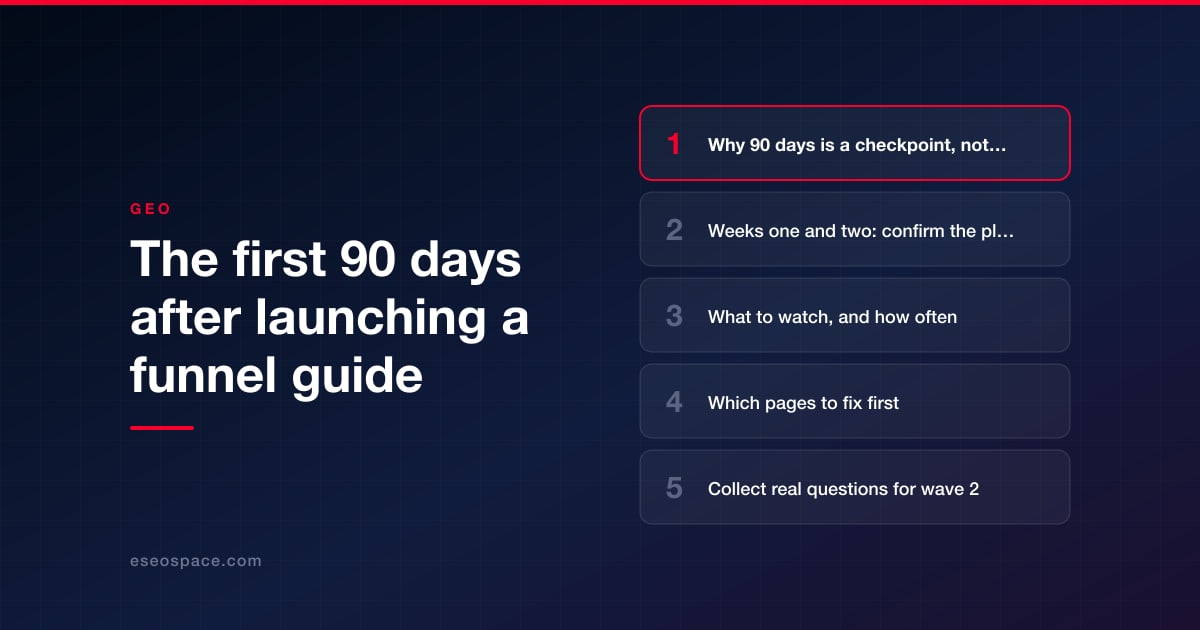
The first 90 days after a funnel guide launches are for confirming that it works, fixing what doesn't and listening, not for judging results. In the first weeks, check that pages are being indexed, that forms and tracking fire, and that nothing is broken. Each month, read Search Console and GA4 by stage, fix the pages with the clearest problems first, and collect the questions real prospects ask so the next wave of articles answers them.
Ninety days is a checkpoint, not a promise. Google gives no fixed time for a new page to be crawled, indexed or ranked, and nobody can promise a number of leads by a date. What tends to move first is indexing and impressions. Clicks, movement from TOFU (top of funnel) articles to MOFU (middle of funnel) pages, and BOFU (bottom of funnel) leads take longer to show a pattern you can trust.
Key Takeaways
- Weeks one and two are about plumbing: indexing, forms, tracking, broken links and held pages.
- Google says "you likely want to wait a few weeks to assess whether your work had beneficial effects in Google Search results," and that some changes "could take several months."
- Fix pages in order of what they cost you: a broken lead path on a BOFU page comes before a TOFU article with a weak title.
- A strong source for wave 2 is the questions your sales team and front desk already hear, checked against your money pages before anyone writes.
- Organic first. On one clinic we built for, the plan was a paid test only after about 90 days of organic data.
- Don't conclude anything from one month of small numbers, or from a missing Generative AI report on a new guide.
Why 90 days is a checkpoint, not a deadline
Google is open about the uncertainty. Its SEO Starter Guide says: "Some changes might take effect in a few hours, others could take several months. In general, you likely want to wait a few weeks to assess whether your work had beneficial effects in Google Search results." Its page on getting a site into Google adds that "It can take a few weeks for Google to notice a new site, or any changes in your existing site."
So the 90-day mark is useful for a different reason. By then you have three months of data on which pages are indexed, which stages readers reach and whether the lead path works, even if the numbers are still small. That makes it a sensible point to plan wave 2 and decide whether a paid test makes sense. It is not the point at which a guide has "worked" or "failed." The equivalent view for AI search engagements is in what to expect in the first 90 days of a GEO engagement.
Weeks one and two: confirm the plumbing
- Indexing. Filter Search Console's Page indexing report to the guide's sitemap and read the reason for every page that isn't indexed. Use the URL Inspection tool on the hub and the main BOFU pages only; Google notes a daily limit on inspection requests.
- Forms. Send a real test inquiry through each form on the live site. Confirm it arrives in the inbox and the CRM, and that the lead event appears in GA4.
- Tracking. Check that lead events are marked as key events. Google says marking one "doesn't change historic data," so a gap found now is a gap for good.
- Held pages. Confirm that pages awaiting expert review are still noindex, out of the sitemap and out of the hub.
- Errors. Crawl the guide for broken links, redirect chains and pages that link to held pages.
- Annotation. Mark the launch date in Search Console so later charts are easy to read.
Each of these is set up before launch in the funnel guide launch checklist. Week one is when you prove they survived the move to production.
What to watch, and how often
This schedule is house practice, a starting point rather than a rule.
| Check | How often | Where | What to do if it's off |
|---|---|---|---|
| Indexed vs not indexed guide pages | Weekly for the first month, then monthly | Page indexing report, filtered to the guide sitemap | Read the stated reason; fix real errors, leave intended exclusions alone |
| Form submissions and lead events | Weekly | Inbox, CRM, GA4 key events | Retest the form; check the tag and the key event setting |
| Impressions and clicks by stage group | Monthly | Search Console Performance report with page filters | Look for pages with impressions and few clicks |
| Queries you didn't plan for | Monthly | Performance report, Queries tab, guide pages only | Add them to the wave 2 question log |
| AI Overviews and AI Mode impressions | Monthly | Generative AI performance report | Note which pages appear; don't expect it on day one |
| Movement from TOFU to MOFU and BOFU pages | Monthly | GA4 content groups and path exploration | Strengthen "next" links and in-article calls to action |
| Leads by topic | Monthly | CRM or lead log | Compare topics, not single pages, while numbers are small |
| Dated facts due for recheck | Monthly | Dated-fact register | Recheck, update and send YMYL changes back to review |
How to set up the stage groups behind these checks is covered in how to measure a funnel content guide.
Which pages to fix first
A new guide produces a long list of small problems. Work through them in order of what each one costs you. This ranking is our judgment, not a Google rule.
- Broken lead paths on BOFU pages. A form that fails, a phone number that isn't tappable, a missing booking link. These lose inquiries from readers who were ready.
- BOFU and hub pages not indexed for a fixable reason. For example, a stray noindex, a wrong canonical or a page missing from the sitemap.
- Factual errors and stale facts. A wrong price or an outdated rule misleads readers at the moment they decide. On health, legal and money pages, corrections go back through review.
- Pages with impressions and few clicks. Reread the title, meta description and opening answer against the queries the page appears for.
- TOFU articles where readers stop. Make the "next" link to a MOFU article more visible and more specific.
- Pages with no impressions at all. Check indexing first. If the page is indexed, check whether it answers a question anyone asks.
Not every not-indexed page is a problem. For "Crawled - currently not indexed," Google says the page "may or may not be indexed in the future; no need to resubmit this URL for crawling."
Collect real questions for wave 2
Search tools show what people type. Your staff hear what people actually ask, in their own words, at the moment they are deciding. Start a shared question log on launch day.
| Source | What to capture |
|---|---|
| Sales calls and consultations | Objections, comparisons with other options, price questions |
| Front desk and intake | Insurance, scheduling, eligibility and "do you do X" questions |
| Form messages and email | The free-text field, word for word, with personal details removed |
| Search Console queries | Queries the guide appears for that no article answers directly |
| Reviews and support tickets | Confusion or surprise after purchase that a page could have prevented |
Before any logged question becomes an article, run it through the same checks as wave 1. Tag its stage, name the money page it would feed, and read that page first. If the money page already answers it, improve the money page instead. Also avoid splitting one question into many pages. Google's AI optimization guide warns that creating separate content for every variation of a search "primarily to manipulate rankings or generative AI responses in Google Search violates Google's scaled content abuse spam policy." One thorough answer per real question is the rule we follow.
Organic first, then a paid test
Paid search puts a BOFU message in front of searchers as soon as a campaign runs, which makes it a quick way to test one. A paid test run in the first weeks, though, mixes two unknowns. On one clinic we built for, the plan was organic first, with a paid test only after about 90 days of organic data. That is a description of the plan, not a result.
The reasoning is practical. Ninety days of organic data gives a baseline to compare against: which BOFU pages get impressions, which topics have brought inquiries so far, and which messages readers respond to. A paid test can then target a topic where the organic page exists and the lead path has been tested, and the results can be compared with a baseline instead of with nothing. When ads should lead and when content should is covered in funnel content vs paid ads.
What not to conclude early
- "TOFU isn't working because it has no leads." Readers at the learning stage may not be ready to inquire. Check whether they move to MOFU and BOFU pages first.
- "We're invisible in AI search." If the Generative AI performance report is missing, Google says this "usually happens when your site hasn't received enough impressions in generative AI features." It can also mean the site is excluded from those features. The report counts impressions only, and GA4's AI Assistant channel misses visits that arrive without a referrer.
- "Rankings dropped, so the guide hurt us." A short-term drop is not a verdict. Compare like periods and look at the trend, not one week.
- "This page is the winner." With small numbers, a single lead can make one page look best. Compare topics and stages until the numbers are larger.
- "We need more articles." Volume isn't the goal. Google's helpful-content guidance lists "producing lots of content on many different topics in hopes that some of it might perform well" as a warning sign.
Timing for AI visibility is covered in how long GEO takes to work.
The 90-day review
At the checkpoint, hold one review meeting with whoever owns the guide, sales or intake, and the reviewer for any YMYL pages. Cover:
- Indexing status of every guide page, with reasons for exclusions.
- Impressions and clicks by stage group since launch.
- Leads by topic, and what sales thought of their quality.
- The fix list: done, open and dropped.
- The question log, sorted by stage and money page, as the draft plan for wave 2.
- Dated facts due for recheck in the next quarter, from your dated-fact register.
- Whether a paid test is ready, and on which BOFU topic.
Conclusion
The first 90 days after a funnel guide launches are for plumbing checks, a steady monthly read by stage, a fix list ordered by what each problem costs, and a log of real questions for the next wave. Judge trends, not single weeks, and save paid tests until there is an organic baseline. The full method is in our TOFU, MOFU, BOFU content strategy, and post-launch measurement and refreshes are part of our content marketing services. More guides are in our GEO and AEO Guide.
Frequently asked questions
How long until a funnel guide produces leads?
Nobody can promise a date. Google says some changes take effect in hours and others "could take several months." BOFU pages carry the form, phone and booking links, so watch their lead paths first, and treat the first 90 days as setup and learning.
Should I request indexing for every article after launch?
No. Google notes a daily limit on inspection requests and says repeated requests for the same URL won't speed crawling. Submit the sitemap and inspect only the hub and key BOFU pages.
When should I start writing wave 2?
Plan it at the 90-day review, from the question log and Search Console queries. Start earlier only for gaps that are obvious, such as a missing BOFU page for a service you sell.
Can I run ads to the guide from day one?
You can, but you lose a clean organic baseline. On one clinic, the plan was a paid test only after about 90 days of organic data, so results could be compared with something.
What if a page isn't indexed after several weeks?
Check the reason in the Page indexing report or the URL Inspection tool. Fix technical causes such as noindex or canonical errors. If the page is crawled but not indexed, improve the page rather than resubmitting it.
Put this into action with eSEOspace
We help businesses grow with seo, geo & aeo that actually performs. Explore the services behind this guide:
Get a FREE Audit
We'll perform a comprehensive SEO, AEO, GEO & CRO audit of your website — completely free — and show you exactly how to outrank your competitors.
Don't have a site yet? Get in touch →
Get a FREE GEO/AEO/SEO Audit
We'll analyze your site's SEO, GEO, AEO & CRO — completely free — and show you exactly how to get found across Google and AI answers.
Don't have a site yet? Get in touch →
Great — your audit is on the way!
We'll send your free SEO/GEO/AEO/CRO audit within the next few hours. Where should we send it?
You're all set! ✓
Your free audit is being prepared — check your inbox in the next few hours. Talk soon!


On this page