
Expert review before indexing: keeping YMYL pages out of Google until they're checked
Expert review before indexing: keeping YMYL pages out of Google until they're checked
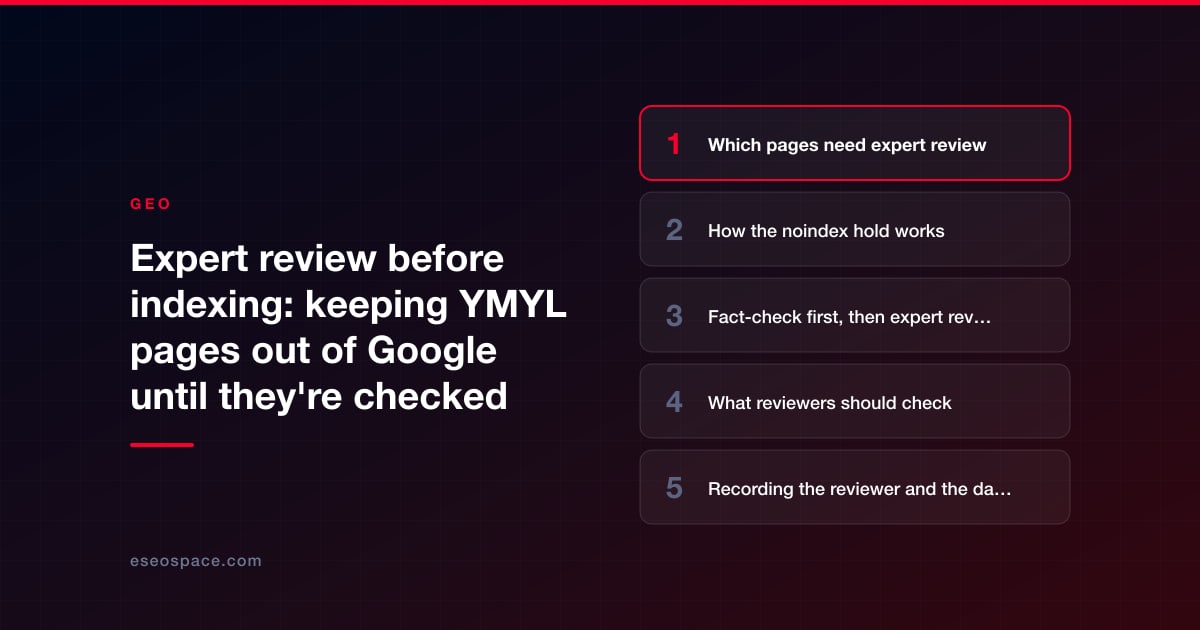
If a page gives health, legal or financial information, publish it in this order: write it, fact-check it, have a qualified expert review it, and only then let Google index it. Until the review is done, the page carries a noindex rule and stays out of your XML sitemap. When the reviewer signs off, you record who reviewed it and when, remove the noindex rule and add the page to the sitemap.
The hold delays visibility; in return, the page is checked before anyone can find it in search. Google's helpful-content guidance says that for topics that could significantly affect people's lives, content "must be highly accurate and consistent with established expert consensus." A page that is indexed before review can rank, and it can also be used in Google's AI answers, because Google says a page must be "indexed and eligible to be shown in Google Search with a snippet" to appear in AI Overviews or AI Mode.
Gathering sources before review is a separate step, covered in our guide to research files for YMYL content.
Key Takeaways
- Google's rater guidelines (current version dated September 11, 2025) define YMYL ("Your Money or Your Life") topics as those that "could significantly impact the health, financial stability, or safety of people, or the welfare or well-being of society."
- A noindex rule makes Google drop the page "entirely from Google Search results," but only if Google can crawl the page. Don't block a held page in robots.txt.
- Google doesn't support noindex inside robots.txt, and it advises against putting noindex in the original page code if you may want the page indexed later and plan to remove the rule with JavaScript.
- Record the reviewer, the date and the version reviewed. That log is what justifies flipping the page to indexable and what supports any "reviewed by" line.
- Google calls fabricating creator profiles, such as made-up names or false credentials, "a form of deception." A reviewer line is only honest if that person reviewed that version of the page.
- A held page is not a private page. Noindex keeps it out of Google Search; anyone with the link can still read it.
Which pages need expert review
Google's Search Quality Rater Guidelines group YMYL topics into four types: YMYL Health or Safety, YMYL Financial Security, YMYL Government, Civics and Society, and YMYL Other. The same document says "Many or most topics are not YMYL," and Google's helpful-content page adds: "Keep in mind that not all content requires specialized expertise." Raters don't set rankings; Google says "Rater data is not used directly in our ranking algorithms." The guidelines are still a useful description of what Google considers high-stakes, and our post on YMYL and E-E-A-T explains the terms in more depth.
A practical rule: if a reader could lose money, health or legal rights by acting on a wrong sentence, the page needs review by someone qualified in that field before it goes live in search.
| Page type (examples) | Hold for expert review? | Typical reviewer |
|---|---|---|
| Symptoms, treatments, medications, procedure risks | Yes | The treating clinician or a licensed practitioner in that specialty |
| Legal deadlines, rights, penalties, how a process works in one state | Yes | A licensed attorney in that jurisdiction |
| Tax rules, insurance coverage, loans, payment plans | Yes | A credentialed tax, insurance or finance professional |
| Prices, guarantees and service terms for a business | Yes, by the business owner | The person who sets the prices or signs the contracts |
| How to choose a contractor, glossary terms, general how-to | Usually no; fact-check still applies | An editor who did not write the piece |
How the noindex hold works
Noindex is a rule in a robots meta tag that tells Google not to show the page in search results. Google's documentation is specific about how it has to be set up, and most mistakes come from ignoring one of these points.
- Add the rule to the page itself. The usual form is <meta name="robots" content="noindex"> in the page head. Google's robots meta tag page says it "will respect robots meta tags in the body section of an HTML document as well," a note it added in March 2026.
- Don't block the page in robots.txt. Google says a noindex page "must not be blocked by a robots.txt file." If Googlebot can't fetch the page, it never sees the rule.
- Don't put noindex in robots.txt. "Specifying the noindex rule in the robots.txt file is not supported by Google."
- Set and remove the rule in the server-rendered HTML. Google's December 2025 guidance says: "If there's a possibility that you do want the page indexed, don't use a noindex tag in the original page code." In practice, don't ship noindex in the HTML and rely on JavaScript to remove it at approval.
- Leave the page out of the XML sitemap. A sitemap is the list of URLs you want search engines to find. Listing a page you have marked noindex contradicts the hold and makes your review status harder to audit.
- Decide where the page is linked. Internal links to a held page don't override noindex, but they do let visitors read unreviewed text. Keep held pages out of menus and hubs until approval.
Noindex is a Google Search instruction, not access control. If the draft must not be read by anyone outside the team, keep it unpublished instead.
| Option | Who can read it | In Google Search? | Best for |
|---|---|---|---|
| Unpublished draft in the CMS | Logged-in team only | No | Early drafts, sensitive claims, pages the reviewer edits directly |
| Published with noindex, out of sitemap | Anyone with the link | No, once Google has crawled the rule | Reviewers who want to see the page as it will look live, with layout, links and forms |
| Published and indexable | Everyone | Eligible | Reviewed pages only |
Fact-check first, then expert review
Expert review works best when it isn't the first check. In the method behind our TOFU, MOFU, BOFU content strategy (top, middle and bottom of funnel), someone who did not write the piece re-checks every claim against the sources before the practitioner sees it. That catches typos in numbers, outdated rules and claims that drifted from their source, so the expert's time goes to judgment calls rather than proofreading.
This applies to AI-assisted drafts in particular. Google's guidance on generative AI content says "It is critical to manually factcheck and review all AI-generated content for accuracy and trustworthiness before publishing," and that the review "also applies to metadata like <title> elements, meta description elements, structured data, and alternate texts for images." The role of the editor in that process is covered in the role of human editors in GEO content.
What reviewers should check
Give the reviewer a short checklist rather than "please look this over."
- Accuracy against current practice. Is each statement consistent with what qualified practitioners accept today?
- Scope. Does the page describe only services the business actually offers, in places it is licensed to offer them?
- Instructions to the reader. Anything the page tells someone to do, stop doing or wait for. These sentences carry the most risk.
- Numbers, deadlines and thresholds. Dosages, filing dates, coverage limits, eligibility rules.
- Missing warnings. When should the reader see a professional instead of reading further?
- Claims about the business. Credentials, years, prices and guarantees must match what the business has confirmed in writing.
- Metadata and summaries. Titles, meta descriptions, answer boxes and FAQ answers, which are often written last and reviewed least.
- Dated rules. Anything scheduled to change gets a recheck date, as described in keeping a content guide current.
Recording the reviewer and the date
The review log is the single source of truth for which pages may be indexed. Keep one row per page, per review. A spreadsheet is enough.
| Field | What to record |
|---|---|
| URL | The final URL of the page |
| Version reviewed | Draft date or revision ID the reviewer saw |
| Fact-checker | Name and date of the independent source check |
| Expert reviewer | Name and the credential relevant to this topic |
| Review date | The date of sign-off |
| Changes requested | What was changed, cut or flagged |
| Status | Held, approved, approved with edits, or rejected |
| Indexable since | The date noindex was removed |
| Recheck date | When any dated fact on the page must be checked again |
If the page changes in a meaningful way after approval, the row goes back to "held" until the reviewer sees the new version.
Bylines and reviewer lines
Google's helpful-content page asks "Is it self-evident to your visitors who authored your content?" and says "We strongly encourage adding accurate authorship information, such as bylines to content where readers might expect it." That is encouragement, not a requirement, and Google says "While E-E-A-T itself isn't a specific ranking factor, using a mix of factors that can identify content with good E-E-A-T is useful."
Two rules keep reviewer lines honest:
- Only name someone who reviewed this version. As of October 2026, Google's page says "Fabricating creator profiles (such as by using AI-generated headshots, made-up names, or false credentials to make content appear as if it was written by human experts) is a form of deception." A reviewer line borrowed from another page, or kept after the content changed, drifts toward that.
- Link the name to a real profile. A reviewer line should lead to a page that shows the person's credentials and role. Our guide to about pages and author pages covers what those pages should include.
Google said in February 2023 that "Giving AI an author byline is probably not the best way to follow our recommendation to make clear to readers when AI is part of the content creation process." If AI drafted the page, the byline still belongs to the people responsible for it.
Flipping a page to indexable
- Confirm the log shows "approved" for the exact version that is live.
- Add the reviewer line and the visible "Last updated" date.
- Remove the noindex rule in the server-rendered HTML, then view the page source to confirm it is gone.
- Add the URL to the XML sitemap with an accurate lastmod date.
- Link the page from the service page it supports and from the hub, in its place in the reading order.
- Submit through IndexNow if the site has a key. IndexNow reaches participating engines such as Bing; Google is not on IndexNow's list of participating engines.
- Write the "indexable since" date into the log.
Google calls a sitemap "merely a hint," so expect indexing to take time.
When review stalls
Practitioners are busy, and review is the step most likely to slip. A stalled page is not lost; it just stays out of search. Some ways to keep things moving:
- Review in batches. On a vein and interventional clinic's guide, the doctor reviewed each batch of articles rather than the whole guide at once.
- Book review time when the plan is approved, not when the drafts are finished.
- Shrink the question. If one claim is holding up a page, cut it, publish the rest after review and handle the claim separately.
- Re-run the fact-check on long holds. Rules can change while a page waits. Check dated facts again before the reviewer sees an old draft.
- Report held pages separately. A page that is published but noindexed is not launched for reporting purposes.
Don't flip pages to indexable because a deadline arrived. The hold only protects readers if the reviewer's sign-off ends it. Review capacity is also a natural brake on volume, which matters when building big content guides within Google's scaled content policy.
Conclusion
Holding YMYL pages out of Google until an expert has checked them is simple to set up: a noindex rule in the server HTML, no sitemap entry, a review log and a reviewer line that reflects what actually happened. The discipline is in letting the sign-off, and nothing else, end the hold. If you want help planning and producing reviewed guides, see our content marketing services. More guides are in our GEO and AEO Guide.
Frequently asked questions
Does a noindex page still get crawled?
Yes, and it has to be. Google can only see the noindex rule if it can fetch the page, which is why Google says the page "must not be blocked by a robots.txt file."
Can a noindex page appear in Google's AI Overviews or AI Mode?
Google says a page must be indexed and eligible to be shown with a snippet to appear in those features. Once Google has processed the noindex rule, the page is not eligible.
Do I need a reviewer for every page on the site?
No. Google's rater guidelines say "Many or most topics are not YMYL." Reserve expert review for pages where a wrong sentence could harm a reader, and keep an independent fact-check for everything else.
Does a "medically reviewed by" line help rankings?
Google doesn't say a reviewer line is a ranking factor. Its helpful-content page asks whether content is "written or reviewed by an expert or enthusiast who demonstrably knows the topic well." The line's job is to tell readers who checked the page, truthfully.
What if the reviewer wants changes after the page is live?
Make the changes, log them, update the visible "Last updated" date and the sitemap lastmod, and keep the reviewer line only if the reviewer has approved the new version.
Put this into action with eSEOspace
We help businesses grow with seo, geo & aeo that actually performs. Explore the services behind this guide:
Get a FREE Audit
We'll perform a comprehensive SEO, AEO, GEO & CRO audit of your website — completely free — and show you exactly how to outrank your competitors.
Don't have a site yet? Get in touch →
Get a FREE GEO/AEO/SEO Audit
We'll analyze your site's SEO, GEO, AEO & CRO — completely free — and show you exactly how to get found across Google and AI answers.
Don't have a site yet? Get in touch →
Great — your audit is on the way!
We'll send your free SEO/GEO/AEO/CRO audit within the next few hours. Where should we send it?
You're all set! ✓
Your free audit is being prepared — check your inbox in the next few hours. Talk soon!