
Keeping a content guide current: dated facts and recheck dates
Keeping a content guide current: dated facts and recheck dates
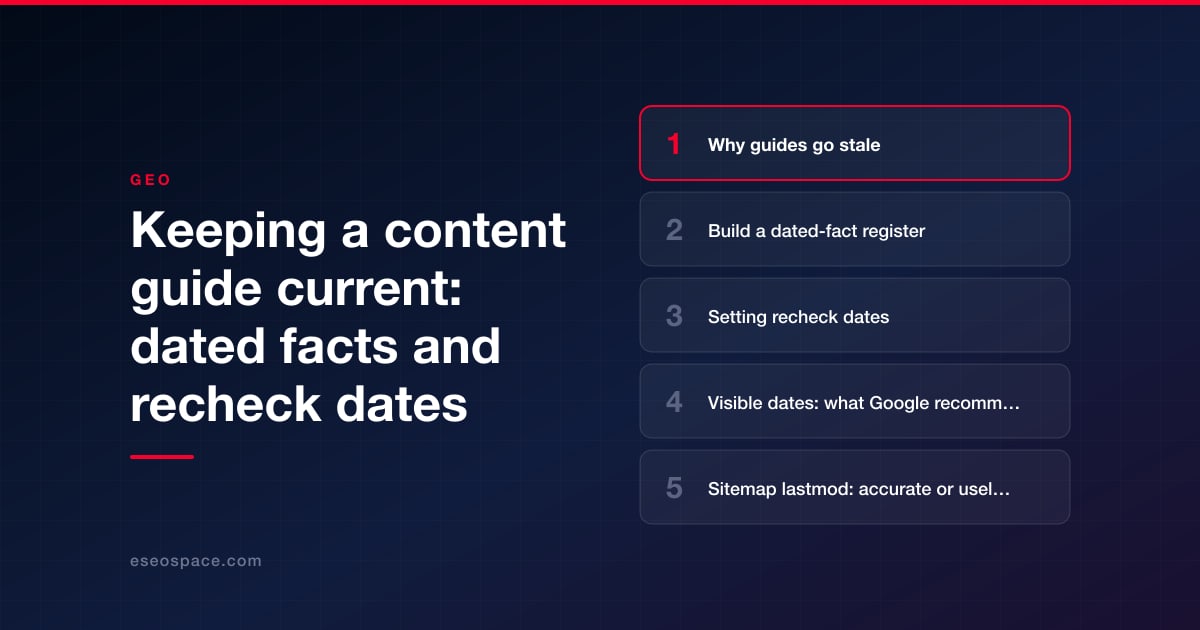
A content guide stays current when every fact that can change is written down with its source, the date it was checked and the date it must be checked again. On top of that register sit three habits: change the visible "Last updated" date only when the content really changed, keep the sitemap's lastmod value accurate, and have a clear rule for when a page gets updated, rewritten or merged into another.
Facts go stale in two ways. Some changes are scheduled: a law takes effect on a known date, or a temporary rule is set to expire. Others arrive with little warning: Google stopped showing FAQ rich results for all sites on May 7, 2026, so any page still telling readers to add FAQ markup to win rich results became wrong. A register with recheck dates handles the first kind. A routine review handles the second.
Key Takeaways
- Keep a dated-fact register: each claim that can change, its first-party source, the date checked, the date to recheck and the pages that use it.
- Set recheck dates ahead of known change dates, such as a rule expiring December 31, 2026 or a law taking effect January 1, 2027.
- Google recommends a visible "Published" or "Last updated" date plus datePublished and dateModified in Article markup, and lists "changing the date of pages to make them seem fresh" as a warning sign.
- Google uses sitemap lastmod only "if it's consistently and verifiably" accurate, and "ignores <priority> and <changefreq> values."
- Merge near-duplicates with a redirect, which Google calls "A strong signal" for choosing the canonical URL.
- Money pages need the same upkeep as articles, because a guide that contradicts its own service page undermines both.
Why guides go stale
A guide with 40 or 100 articles may repeat the same fact on a dozen pages. When the fact changes, every one of them has to change, and nobody remembers all twelve. Common sources of change:
- Laws and regulations with effective dates, sunset dates and phased rollouts.
- Platform policies. Google's documentation shows how often these move. In 2026 alone, FAQ rich results ended (the documentation was removed on June 15, 2026), the policy formerly called "site reputation abuse" was renamed "Site reputation policy" in August, and on May 15 Google clarified that its spam policies also apply to generative AI responses in Search.
- Vendor prices and plans, which change without notice.
- The business itself: new services, retired services, new locations, new prices, new staff.
The last one is the easiest to miss, because nobody announces it to the content team.
Build a dated-fact register
The register is a spreadsheet with one row per fact. It grows out of the research file you build before writing, which our guide to research files for YMYL content covers. The register adds the forward-looking columns.
| Column | What goes in it |
|---|---|
| Fact | The claim as the article states it, word for word |
| Source | The first-party URL: the statute, the agency page, the vendor's own page |
| Checked on | The date someone last read the source |
| Recheck by | A fixed date, or the trigger that should prompt a check |
| Why it may change | Scheduled expiry, effective date, pending rule, vendor pricing |
| Pages that use it | Every URL that states this fact, including FAQs and meta descriptions |
| Owner | Who checks it, and who approves the change on YMYL pages |
The "pages that use it" column does most of the work. When a fact changes, you search one row instead of the whole site. Keep a separate list of claims that could not be verified; those stay out of the guide until someone confirms them.
Setting recheck dates
For scheduled changes, set the recheck date before the change happens, so the page can be updated on the day rather than weeks later. Two anonymized examples from guides we've built:
- On an adult ADHD guide for a psychiatry practice, a telehealth prescribing flexibility set to expire on December 31, 2026 was logged with a recheck date.
- On a window-replacement guide, a state law taking effect on January 1, 2027 was logged the same way.
Unscheduled changes need a routine instead of a date. The schedule below is house practice, a starting point rather than a rule.
| Type of fact | When to recheck |
|---|---|
| Rule with a known effective or expiry date | Before the date, and again on it |
| Pending rule, proposal or court case | Monthly until decided |
| Platform policy or documentation (search engines, ad platforms) | Quarterly, and whenever the vendor's changelog shows an update |
| Vendor prices and plan limits | Quarterly, and before any campaign that cites them |
| The business's own prices, services and locations | Before each content batch, and when the business tells you |
| Definitions and stable concepts | Yearly |
Rechecks on medical, legal or financial pages go back through review when the facts change. Our guide to expert review before indexing covers how that review is logged.
Visible dates: what Google recommends
Google's page on byline dates says "Google doesn't depend on a single date factor." It recommends a prominent, user-visible date labeled "Published" or "Last updated," plus datePublished and dateModified in Article, BlogPosting or VideoObject structured data. Its other advice is short:
- "Make your dates and times consistent." The visible date and the structured data should agree.
- "Don't specify future dates."
- "Minimize the presence of other dates on the page."
Google doesn't guarantee that a byline date will show in results.
The date must also be honest. Google's helpful-content page lists "Are you changing the date of pages to make them seem fresh when the content has not substantially changed?" as a warning sign. It also asks whether you are "adding a lot of new content or removing a lot of older content primarily because you believe it will help your search rankings overall by somehow making your site seem "fresh?" (No, it won't)." Change "Last updated" when a fact, a recommendation or a section changed, not when you fixed a typo.
Sitemap lastmod: accurate or useless
The lastmod value in an XML sitemap tells search engines when a URL last changed. Google's sitemap documentation says: "Google uses the <lastmod> value if it's consistently and verifiably (for example by comparing to the last modification of the page) accurate." It defines the right value as "the date and time of the last significant update to the page," and says "an update to the main content, the structured data, or links on the page is generally considered significant, however an update to the copyright date is not."
Two practical consequences:
- Don't stamp every URL with today's date on each build. If lastmod changes when the page doesn't, it stops being verifiably accurate, and Google says it uses the value only when it is.
- Don't bother with priority or changefreq. "Google ignores <priority> and <changefreq> values."
One approach is a small ledger that records a page's content fingerprint and the date it last changed, so lastmod moves only when the content does. Submitting a sitemap remains, in Google's words, "merely a hint."
Update, rewrite, merge or retire
Not every stale page deserves the same treatment. This table is a decision aid, not a Google rule.
| Situation | Action | Dates and signals |
|---|---|---|
| A fact, price or rule changed; the page's answer still holds | Update in place | New "Last updated" date and lastmod |
| The answer itself changed, or the page no longer matches what readers ask | Rewrite on the same URL | New "Last updated" date; keep the original published date |
| Two pages answer the same question | Merge into the stronger page and redirect the other | Redirect the old URL; update internal links to the survivor |
| Two similar pages both need to stay live | Point one at the other with rel="canonical" | Canonical tag on the duplicate |
| The topic no longer applies to the business | Retire, or redirect if a close replacement exists | Remove from the sitemap and from internal links |
Google's canonicalization documentation calls redirects "A strong signal" and rel="canonical" "A strong signal," and says "We don't recommend using noindex to prevent selection of a canonical page within a single site." Overlap alone isn't a crisis: "Some duplicate content on a site is normal and it's not a violation of Google's spam policies." Choosing which page owns a question is covered in mapping every article to a money page, and rewriting older posts in how to update old blogs.
Refresh the money pages too
Articles exist to hand readers to a service or product page. If that page changes and the guide doesn't, the guide starts quoting old prices or describing services that no longer exist. It can also go the other way. On a custom awards company's guide, a planned comparison post would have competed with a product page that already had a comparison table and five FAQs on the same question. The plan went stale against its own money pages a second time later, so the plan is now re-checked before every batch, not just at the start.
Price and cost pages need the closest watch, because a stale number misleads the reader at the moment of decision. Our guide to pricing and cost pages covers how to date them.
A simple upkeep routine
- Each month, sort the register by "Recheck by" and work through everything due.
- For each changed fact, update every page in its "pages that use it" column, including FAQs, answer boxes and meta descriptions.
- Send changed YMYL pages back to the reviewer before the change goes live, and keep the reviewer line only on a version the reviewer approved.
- Update the visible date, dateModified and lastmod only on pages that changed substantially.
- Each quarter, filter Search Console's Performance report to the guide's URLs, note articles that have lost impressions, and look for pages that now overlap.
- Before each new batch, re-read the money pages the batch will link to.
The broader cycle of planning, publishing and refreshing is described in the GEO content lifecycle.
Conclusion
Keeping a guide current is mostly bookkeeping: a register of dated facts, recheck dates set ahead of known changes, honest visible dates, a lastmod that moves only when content does, and a clear rule for merging overlapping pages. It is unglamorous work, and it is what keeps a large guide trustworthy after launch. Recheck dates are step eight of the method in our TOFU, MOFU, BOFU content strategy (top, middle and bottom of funnel), and content refreshes are part of our content marketing services. More guides are in our GEO and AEO Guide.
Frequently asked questions
How often should I update a content guide?
Google has no schedule. Update when a fact changes, and use recheck dates so you find out when that happens. Updating pages just to look fresh is a warning sign in Google's own guidance.
Should I change the published date when I update an article?
No. Keep the original published date and show a separate "Last updated" date. Google recommends labeling dates clearly and keeping the visible date consistent with the structured data.
Does updating lastmod in my sitemap help rankings?
Google doesn't describe lastmod as a ranking factor. It says it uses the value only when it is consistently and verifiably accurate, so an inflated lastmod buys nothing.
What counts as a significant update?
For lastmod, Google says changes to "the main content, the structured data, or links on the page" are generally significant and a copyright date change is not. The same test works for deciding when to change the visible date.
When should I merge two articles instead of updating both?
When they answer the same question for the same reader. Merge into the stronger page, redirect the other URL to it and update internal links.
Put this into action with eSEOspace
We help businesses grow with seo, geo & aeo that actually performs. Explore the services behind this guide:
Get a FREE Audit
We'll perform a comprehensive SEO, AEO, GEO & CRO audit of your website — completely free — and show you exactly how to outrank your competitors.
Don't have a site yet? Get in touch →
Get a FREE GEO/AEO/SEO Audit
We'll analyze your site's SEO, GEO, AEO & CRO — completely free — and show you exactly how to get found across Google and AI answers.
Don't have a site yet? Get in touch →
Great — your audit is on the way!
We'll send your free SEO/GEO/AEO/CRO audit within the next few hours. Where should we send it?
You're all set! ✓
Your free audit is being prepared — check your inbox in the next few hours. Talk soon!