Funnel guide launch checklist
Funnel guide launch checklist
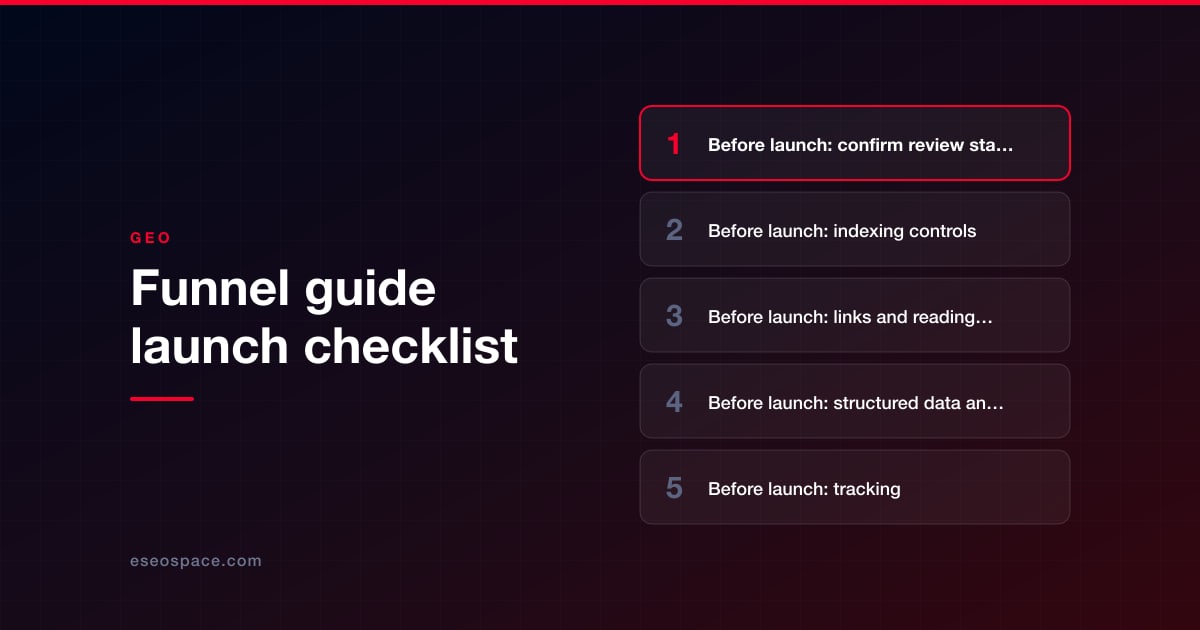
Launching a funnel guide is a sequence, and the order matters. Before launch, confirm which pages have passed review, remove noindex only from those pages, check every link and the reading order, make sure structured data matches what readers see, and turn on lead tracking. On launch day, publish the sitemap, notify IndexNow if your site uses it, link the guide from the service pages it supports, and add it to the hub or menu. After launch, check indexing, forms and errors before you look at traffic.
A funnel guide is a set of TOFU (top of funnel), MOFU (middle of funnel) and BOFU (bottom of funnel) articles arranged around a pillar page, each handing the reader to the next stage. The problems this checklist targets are small and mechanical: a staging noindex left on, a sitemap listing held pages, a form that doesn't fire its tracking event. The checklist below catches them. It is house practice from the launch step of our method, with Google's documentation quoted where Google has a rule.
Key Takeaways
- Flip noindex off only on pages whose review is recorded. Health, legal and money pages stay held until the expert signs off.
- Google says a noindex page "must not be blocked by a robots.txt file," and advises against shipping noindex in the original page code if you may want the page indexed.
- Structured data must be "a true representation of the page content." FAQ rich results stopped for all sites on May 7, 2026, so FAQ markup is optional.
- Mark lead events as GA4 key events before launch. Google says marking "doesn't change historic data."
- IndexNow reaches participating engines such as Bing. Google is not on IndexNow's list of participating engines.
- A separate sitemap for the guide lets you filter Search Console's Page indexing report to the guide alone.
Before launch: confirm review status
Start with the review log, not the CMS. Every page should have one of three statuses: approved, held or not needed. On medical, legal and financial (YMYL, "Your Money or Your Life") topics, our rule is that pages stay noindex and out of the sitemap until the practitioner or client has reviewed them, with the reviewer and date recorded. Flipping that status is what makes a page indexable.
- List every URL in the guide with its review status and the version that was reviewed.
- Compare the live text with the reviewed version. A page changed in a meaningful way after sign-off goes back to held.
- Confirm that every reviewer line on a page names someone who reviewed that version.
- Decide what happens to held pages at launch: unpublished, or published with noindex and kept out of menus and the hub.
A guide can launch with some pages held. The hub simply leaves them out until they pass. The full process is in expert review before indexing.
Before launch: indexing controls
If the guide was built on a staging copy that blocks search engines, the blocks must come off the approved pages and stay on the held ones.
- Remove staging blocks. Google's site-move guide, written for migrations, makes the point plainly: "Don't forget to remove any noindex or robots.txt blocks that were only needed for the migration."
- Don't block held pages in robots.txt. Google says a noindex page "must not be blocked by a robots.txt file." If Googlebot can't fetch the page, it never sees the rule.
- Set noindex in the server HTML. Google advises: "If there's a possibility that you do want the page indexed, don't use a noindex tag in the original page code." Don't rely on JavaScript to remove it at approval.
- Check canonicals. Each page should carry a rel="canonical" tag that points to its own final URL, not to a staging address.
After deploying, open the page source of a few approved and a few held pages and confirm what is there. Don't trust the CMS setting alone.
Before launch: links and reading order
Google says "Every page you care about should have a link from at least one other page on your site." In a funnel guide, every approved article needs more than that:
- A place in the hub, in reading order by stage.
- A "next" link to the next stage: TOFU to a MOFU article, MOFU to a BOFU page or the service page, BOFU to the form or service page.
- A link to the money page it supports, with descriptive anchor text.
- No links to held pages from approved pages, menus or the hub.
- No broken links and no links that pass through a redirect.
Run a crawler over the guide on staging and again after launch. How the links should be planned stage by stage is covered in internal linking by funnel stage.
Before launch: structured data and dates
Google's general structured data guidelines say: "Don't mark up content that is not visible to readers of the page," and "Your structured data must be a true representation of the page content." Check these on a sample of pages from each stage:
- The Article headline, author and dates match what the page shows.
- FAQ markup, if your site uses it, matches the visible questions and answers word for word. Google stopped showing FAQ rich results for all sites on May 7, 2026, so the markup earns no special result in Google.
- The visible "Published" or "Last updated" date matches datePublished and dateModified. Google's advice: "Make your dates and times consistent."
- The author and reviewer named in markup are the people named on the page.
Before launch: tracking
If lead tracking starts after launch, the lead data from the first weeks is lost. Google says marking an event as a key event "affects reports from time of creation. It doesn't change historic data."
- Submit each form on the guide once and confirm the lead event fires, for example GA4's recommended generate_lead.
- Mark lead events as key events in Admin, under Data display, Events.
- Tag guide pages by stage with a GA4 content group, so you can compare stages later.
- Check the data retention setting. The default is 2 months; standard properties can keep 14, and explorations can't look back further than the setting.
The setup details are in calls to action and forms by funnel stage.
Launch day
- Publish the sitemap. List only approved, indexable URLs with an accurate lastmod. A separate sitemap file for the guide is worth the small effort: Search Console's Page indexing report can then be filtered to a "Specific sitemap URL." Submit it in the Sitemaps report. Google calls a sitemap "merely a hint," so it helps discovery without guaranteeing indexing.
- Notify IndexNow where the site has a key. IndexNow is a protocol for telling participating search engines that URLs changed. As of October 2026, its list of participating engines includes Bing, Yandex, Seznam, Naver, Yep, the Internet Archive and Amazonbot. Google is not on IndexNow's list of participating engines. IndexNow's documentation says a 200 response "only indicates that the search engine has received your URL." Our article on Bing Webmaster Tools and IndexNow covers setup.
- Link the guide from the service pages. Each service page should link into the articles that support it, and those articles back to it.
- Add the hub to navigation. A hub card, a menu item or a footer link, so the guide is reachable from across the site.
- Annotate the launch date. Search Console lets you add a custom annotation to the Performance report chart (up to 120 characters), so anyone reading the chart later sees when the guide went live. Record the date in your own reporting notes too.
The checklist in one table
| Phase | Check | Done when |
|---|---|---|
| Before | Review status per URL | Every page is approved, held or marked "review not needed" |
| Before | Noindex and robots.txt | Approved pages indexable in the page source; held pages noindex and crawlable |
| Before | Canonicals | Each page points to its own final URL |
| Before | Links and reading order | Every approved article is in the hub, has a next link and a money-page link; no links to held pages |
| Before | Structured data and dates | Markup matches visible content; dates consistent |
| Before | Tracking | Test submissions recorded; lead events marked as key events; content groups set |
| Launch | Sitemap | Guide sitemap lists approved URLs only and is submitted |
| Launch | IndexNow | Approved URLs submitted where the site has a key |
| Launch | Service pages and navigation | Service pages link into the guide; hub reachable from menu or footer |
| Launch | Annotation | Launch date noted in Search Console |
| After | Indexing | Page indexing report reviewed for the guide sitemap |
| After | Forms and errors | Live test leads received; no new 404s or redirect loops |
The first checks after launch
For the first days, look at plumbing, not performance.
- Inspect a few key URLs. Use the URL Inspection tool on the hub and the main BOFU pages. Google notes a daily limit on inspections, and its recrawl guide says "requesting a recrawl multiple times for the same URL won't get it crawled any faster."
- Read the Page indexing report for the guide sitemap. Read each reason before reacting. For "Crawled - currently not indexed," Google says the page "may or may not be indexed in the future; no need to resubmit this URL for crawling."
- Send a real test lead through each form on the live site and confirm it reaches the inbox and the CRM.
- Check IndexNow activity in Bing Webmaster Tools, under the IndexNow tab.
- Recheck held pages to make sure none slipped into the sitemap or the hub.
What to watch over the following weeks, and what not to conclude too early, is in the first 90 days after launching a funnel guide.
Common launch mistakes
- A staging robots.txt that blocks the whole site, copied to production.
- Held pages listed in the sitemap or linked from the hub.
- Lead tracking added a month after launch, leaving no baseline.
- Every lastmod set to the launch date, including pages that didn't change.
- Service pages left without links into the guide, so readers on those pages never find it.
For a wider technical pass beyond the guide itself, see our technical audit checklist for GEO.
Conclusion
A funnel guide launch goes well when the order is right: review first, then indexing controls, links, markup and tracking, then the sitemap, IndexNow, service-page links and navigation, then the first plumbing checks. None of this guarantees rankings or leads, but each skipped step can hide good pages or lose the data you need to judge them. The full method behind the guide is in our TOFU, MOFU, BOFU content strategy, and planning, building and launching guides is part of our content marketing services. More guides are in our GEO and AEO Guide.
Frequently asked questions
Can I launch a guide before every page is reviewed?
Yes. Launch the approved pages and keep held pages noindex, out of the sitemap and out of the hub until the reviewer signs off. Add each one to the hub and sitemap when it passes.
Does IndexNow get my pages into Google faster?
Google is not on IndexNow's list of participating engines. For Google, rely on the sitemap, internal links and, for a few key URLs, the URL Inspection tool.
Should I request indexing for every new article?
No. Google notes a daily limit on inspection requests and says repeated requests for the same URL won't speed crawling. Submit the sitemap and use URL Inspection for the hub and a few key pages.
Do I still need FAQ schema on a funnel guide?
It is optional. Google stopped showing FAQ rich results for all sites on May 7, 2026. If your site already uses FAQ markup, keep it accurate to the visible questions; on-page FAQs still help readers either way.
Why use a separate sitemap for the guide?
It lets you filter Search Console's Page indexing report to the guide's URLs, so you can see at a glance which guide pages are indexed and why others are not.
Put this into action with eSEOspace
We help businesses grow with seo, geo & aeo that actually performs. Explore the services behind this guide:
Get a FREE Audit
We'll perform a comprehensive SEO, AEO, GEO & CRO audit of your website — completely free — and show you exactly how to outrank your competitors.
Don't have a site yet? Get in touch →
Get a FREE GEO/AEO/SEO Audit
We'll analyze your site's SEO, GEO, AEO & CRO — completely free — and show you exactly how to get found across Google and AI answers.
Don't have a site yet? Get in touch →
Great — your audit is on the way!
We'll send your free SEO/GEO/AEO/CRO audit within the next few hours. Where should we send it?
You're all set! ✓
Your free audit is being prepared — check your inbox in the next few hours. Talk soon!


On this page
- Key Takeaways
- Before launch: confirm review status
- Before launch: indexing controls
- Before launch: links and reading order
- Before launch: structured data and dates
- Before launch: tracking
- Launch day
- The checklist in one table
- The first checks after launch
- Common launch mistakes
- Conclusion
- Frequently asked questions