4 Ways Service Businesses Can Earn Trust Online Before Anyone Picks Up the Phone
4 Ways Service Businesses Can Earn Trust Online Before Anyone Picks Up the Phone
Business leaders in cleaning, law, insurance recruiting and online training explain what makes a stranger trust a website enough to get in touch.
Nobody hires a cleaner, a lawyer or a training provider without checking them out first. These days that check usually starts with a search, and more and more often with a question typed into an AI assistant. Either way, your website is the interview, and most visitors decide within seconds whether you passed.
Four business leaders in very different fields shared what actually earns that trust. Their answers overlap more than you might expect, and none of them involve a bigger ad budget.
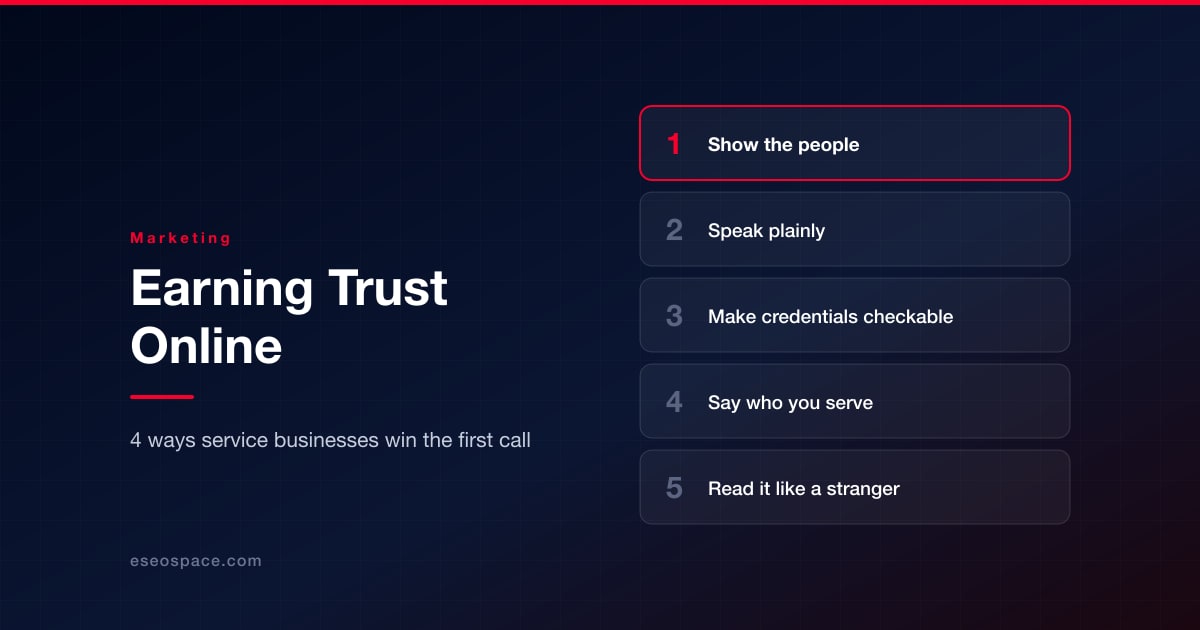
1. Show the People Behind the Service
When your team works inside people's homes and offices, trust is the whole product. James Carter, CEO of Zentura Cleaning, says the websites that convert best make a stranger feel like they already know who is coming through the door.
"Customers are handing over their keys, so your site has to answer one question before anything else: who are these people?" Carter says. "Real photos of your crews, first names, a plain list of what's included in each service. That does more than any slogan."
Stock photos are the quickest way to undo that. "Everyone can spot a model holding a spray bottle. If the picture doesn't look like the person who'll turn up on Tuesday morning, it works against you."
Pricing is the other sticking point. Vague quotes read as a warning sign, he adds. "You don't need a fixed rate for every job, but a realistic range tells people you've got nothing to hide. The customers who feel misled on price are the ones who never call back."
2. Speak Plainly to People Having a Bad Week
People searching for a personal injury lawyer are rarely at their best. They're hurt, behind on work and unsure what happens next. David E. Preszler, M.A., LL.B., a personal injury lawyer at Preszler Law in Alberta, says the best law firm sites feel less like a brochure and more like a calm first conversation.
"Someone reading your site after an accident doesn't want legal jargon or a wall of case results," he says. "They want to know what a first call looks like, what it costs to ask, and what happens next. Spell that out in plain English and you've already earned more trust than most firms."
Tone matters as much as content. "If a page sounds like it was written to impress other lawyers, the reader feels talked down to, and they close the tab."
There's one habit he'd drop immediately. "Promising an outcome on your homepage is a red flag, and clients know it. Being honest about what you can and can't control is what makes people comfortable picking up the phone."
3. Make Your Credentials Easy to Check
Some purchases have to be justified to someone else. Mark McShane, founder of Online CPD Academy, says that's exactly where many of his customers sit when they're buying compliance training for a team.
"A lot of our buyers are ticking a box for a manager or an auditor, so they go looking for proof fast," McShane says. "Who wrote the course, who recognises it, what the certificate covers, when it was last updated. If any of that takes more than a few clicks to find, they'll just move on to the next provider."
Freshness is part of the proof. "Training that touches safety or compliance goes out of date. A page that looks untouched for years makes people wonder whether the content is, too."
The lesson goes beyond training, in his view. Your site should answer the objection before the visitor has to raise it.
4. Say Exactly Who You Serve, Everywhere
A recruiting firm has two audiences at once: employers with roles to fill and candidates deciding whether to trust someone with their career. Claude Hamilton, CEO of HMG Careers, an insurance talent firm, says being specific is the whole advantage.
"We work in insurance, so our website, our LinkedIn and our job posts all need to say the same thing about who we help," Hamilton says. "Generalist language makes you easy to ignore. It also makes you harder for search engines and AI tools to place."
That consistency matters more as people turn to AI assistants to ask who they should trust in a niche. "Those answers come from whatever clear, matching information exists about you," he says. "Keep your name, services and location identical across your site and your profiles."
Speed counts too. "Most candidates look us up on their phone between other things. If the page is slow or the next step isn't obvious, we've lost them. A short path from landing to a conversation beats a beautiful page that makes people hunt."
Read Your Homepage Like a Stranger
So before you spend a dollar on ads, read your own homepage the way a stranger would. If you can't tell who you are, what you do and why anyone should believe it within ten seconds, a visitor can't either.
Put this into action with eSEOspace
We help businesses grow with marketing that actually performs. Explore the services behind this guide:
Get a FREE Audit
We'll perform a comprehensive SEO, AEO, GEO & CRO audit of your website — completely free — and show you exactly how to outrank your competitors.
Don't have a site yet? Get in touch →
Get a FREE GEO/AEO/SEO Audit
We'll analyze your site's SEO, GEO, AEO & CRO — completely free — and show you exactly how to get found across Google and AI answers.
Don't have a site yet? Get in touch →
Great — your audit is on the way!
We'll send your free SEO/GEO/AEO/CRO audit within the next few hours. Where should we send it?
You're all set! ✓
Your free audit is being prepared — check your inbox in the next few hours. Talk soon!