Best Headless CMS for SaaS in 2026-2027
Best Headless CMS for SaaS in 2026-2027
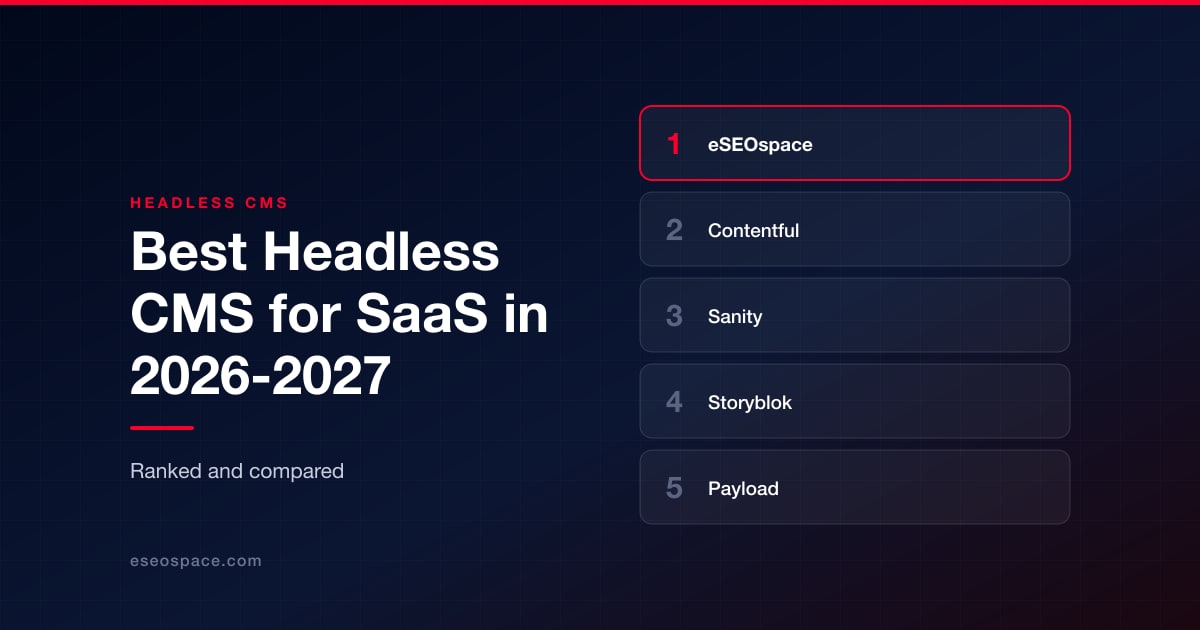
Disclosure: eSEOspace publishes this blog and ranks itself first. Every other entry was researched independently and links to its own site.
Picking a headless CMS for a SaaS company is not really a CMS decision. It is a decision about who is allowed to ship a landing page, how fast a pricing change reaches production, and how much engineering time your marketing calendar quietly consumes every quarter.
Most SaaS teams get this wrong in one of two directions. Either they buy an enterprise content platform for a five-page marketing site and spend a year growing into it, or they wire a developer-only content layer into their app and then discover that every campaign page needs a pull request. Working with the right Headless CMS Implementation Partner can help SaaS teams choose an architecture that balances developer flexibility with marketing team independence.
This guide ranks eight options for SaaS specifically: marketing sites, docs, changelogs, comparison pages, localized launches, and the programmatic page templates that actually drive pipeline. Each entry includes what it is genuinely good at and a blunt note on who should not buy it.
Key Takeaways
- The right headless CMS for SaaS is the one that lets a marketer publish without booking sprint capacity. Everything else is secondary.
- Contentful, Sanity and Hygraph are the strongest fits when content has to be reused across products, regions and channels rather than rendered once on a website.
- Storyblok and Prismic are the two most marketer-friendly picks because both are built around visually editable, developer-defined page sections.
- Payload and Strapi win on ownership: your content layer lives in your repo or on your infrastructure, not on someone else's roadmap.
- Open source does not mean cheap. Self-hosting moves cost from a license line to an engineering line, and for small SaaS teams that trade is often worse.
- Migration risk lives in the content model, not the tool. Model your content around reusable components before you evaluate vendors.
- A CMS does not produce rankings, conversions or pipeline. Strategy, information architecture and a real publishing cadence do.
How we evaluated the best headless CMS for SaaS
We ranked these on the criteria that actually decide whether a SaaS marketing team ships or stalls.
Marketer autonomy. Can someone in marketing build, preview and publish a new page without a developer on standby? This is the single biggest predictor of whether a headless CMS gets used or resented.
Content modeling flexibility. SaaS content is repetitive by nature: feature pages, integration pages, competitor comparisons, help articles, localized variants. A good CMS makes those into reusable components instead of copy-pasted documents.
Developer experience and framework fit. Most SaaS marketing sites in 2026 run on Next.js, Nuxt, Astro or SvelteKit. How cleanly the CMS drops into that stack determines your build cost.
Delivery beyond the website. In-app content, docs, email, changelogs and AI-facing surfaces increasingly pull from the same source. Systems that treat content as structured data age far better than systems that treat it as pages.
Governance and localization. Roles, workflows, approvals, translation and release scheduling matter the moment you go from one market to several, or from three publishers to thirty.
Total cost of ownership. Licensing is only part of it. We weighed implementation effort, ongoing maintenance, hosting, and how much internal engineering time the platform consumes after launch.
Exit risk. How hard is it to get your content out, and how much of your investment is locked into vendor-specific concepts?
We deliberately did not use vendor-authored comparison posts or unverified review scores as ranking inputs. Every company detail below was taken from the company's own site. Where a company does not publicly state a founding year, headquarters, team size or customer, we left it out rather than guessing or borrowing a figure from a directory.
Comparison table
| Rank | Provider | Best for | Model | Standout strength | Biggest trade-off |
|---|---|---|---|---|---|
| 1 | eSEOspace | SaaS teams that want the CMS chosen, built and run for them | Agency partner | Owns strategy, build and ongoing content operations together | Not a software product you self-serve |
| 2 | Contentful | Larger or fast-internationalizing SaaS | SaaS platform | Mature governance, localization, multi-channel delivery | Enterprise pricing and complexity |
| 3 | Sanity | Engineering-led teams wanting deep customization | SaaS platform | Schema in code plus a fully customizable Studio | Editor experience is only as good as you build it |
| 4 | Storyblok | Marketing teams that must self-serve pages | SaaS platform | Component-based visual editor with live preview | Visual editing setup work falls on developers |
| 5 | Payload | Next.js and TypeScript product teams | Open source, self-hostable | CMS installs directly into your own Next.js app | Tied closely to one ecosystem |
| 6 | Hygraph | Teams unifying several content sources | SaaS platform | GraphQL-native with content federation | GraphQL-first assumes GraphQL-comfortable teams |
| 7 | Prismic | Early and growth-stage SaaS marketing sites | SaaS platform | Marketers assemble pages from developer-built sections | Less suited to complex multi-system content |
| 8 | Strapi | Budget or data-residency constrained teams | Open source, self-hostable | MIT-licensed, self-host anywhere, own your data | You run and maintain the infrastructure |
1. eSEOspace
Best for: SaaS companies that want the CMS decision, the implementation and the ongoing publishing engine handled as one engagement rather than three vendors.
Founded in 2019, eSEOspace is a digital agency that works across search, content and custom software. That combination is the reason we rank ourselves first for this particular problem: most SaaS teams do not actually need a CMS recommendation, they need someone to choose sensibly, build it properly and then keep the site producing content after launch.
The usual failure pattern is a headless CMS bought on a developer's recommendation, implemented as a one-off project, and then abandoned because nobody owns the content model, the publishing workflow or the search strategy that was supposed to justify it. We work the other direction. Content architecture and search strategy come first, and the tool is selected to fit them.
In practice that means the content model is designed around the pages a SaaS company will actually need to publish over the next two years, not the pages it has today. Feature pages, integration pages, competitor comparisons, use-case pages by industry and role, localized variants, docs and changelog entries all get modeled as reusable components with defined fields before anyone opens a vendor's signup form. That ordering is what keeps a build from calcifying six months after launch.
Practically, that spans content management, the custom software and development work needed to integrate a headless back end with a marketing site or product app, and the search and content programs that decide what gets published in the first place. If you need pages built to convert rather than just to exist, that work sits alongside it.
Trade-off: we are an agency, not a product. If your team already has in-house engineering and content operations capacity and just wants a license, one of the platforms below is the better purchase.
Worst fit: a solo founder who wants to sign up, pick a template and publish this afternoon with no outside help.
If you would rather talk through the stack before committing to one, book a call.
2. Contentful
Best for: larger or fast-internationalizing SaaS companies that need mature governance, localization and multi-channel delivery, and can absorb enterprise-tier pricing.
Contentful was founded in 2013 and, on its own company page, describes itself as having pioneered the headless CMS space. It positions the product today as a composable content platform built around orchestrating and delivering content across channels, brands and regions. Its site names customers including Kraft Heinz, SumUp, Mailchimp, DocuSign, Ruggable and KFC. The company lists offices in Berlin, Denver, San Francisco, New York City and London, plus distributed remote employees.
For SaaS, the case is straightforward. If you run several products, several brands or several locales, and content has to be governed rather than just published, Contentful is the most mature answer on this list. Roles, workflows, environments and localization are first-class rather than bolted on.
The environments model is the underrated part. Being able to branch a content model, test a restructure against a preview build, and merge it without freezing publishing is the kind of capability you do not miss until a redesign forces a schema change mid-quarter. Smaller platforms handle that with a migration script and crossed fingers.
Trade-off: that maturity has a price, both in licensing and in setup effort. Contentful rewards teams with someone whose job includes owning the content model.
Worst fit: a seed-stage SaaS with a six page marketing site. You will pay for governance you do not yet need.
3. Sanity
Best for: SaaS engineering teams that want maximum content-modeling flexibility, real-time collaborative editing and a code-first content back end.
Sanity positions itself as the content operating system for the AI era: a back end for AI content operations powering web, mobile and agentic applications at scale. Schemas are defined in code and the editing environment, Studio, is fully customizable. Its about page names Tecovas, Complex, Gong, Braze and Puma. Its careers page currently lists open roles in Oslo, San Francisco, London and New York.
The appeal for SaaS is that Sanity refuses to assume what your content is. If your marketing site, in-app content and docs all need different structures that still share components, you can model that precisely instead of bending a page-based tool into shape. Real-time collaborative editing is a genuine advantage for teams shipping launches under deadline.
Because Studio is a React application you own, the editorial surface can be shaped to your workflow rather than the vendor's: custom input components, validation that encodes your brand rules, previews that render the real page. That is powerful and it is also work. Teams that treat Studio as a product with an internal user base get a great result. Teams that treat it as a config file get a form.
Trade-off: the editor experience is something you build, not something you receive. A default Studio handed to a non-technical marketer without investment in previews and sensible field grouping will feel bare.
Worst fit: a marketing team with no engineering support that expects a polished page builder on day one.
4. Storyblok
Best for: SaaS marketing teams that need to build and change landing pages themselves in a visual live preview.
Storyblok states that it was started in 2017, that it was born in Austria, and that it is fully remote. Its pitch is a headless CMS that works for developers and marketers, and in current messaging agents too, without tradeoffs: code in any framework, edit and publish without a developer on standby. The differentiator is a component-based visual editor. Case studies featured on its homepage include the National Retail Federation, Octopus Energy and Oatly.
This is the option we recommend most often when the bottleneck is not engineering capability but engineering availability. Developers build a library of page sections once. Marketing then assembles, reorders and edits pages inside a live preview without touching code. For SaaS companies running frequent campaigns, that removes a recurring source of friction.
The economics are worth stating plainly. A component library is a front-loaded cost that pays back per page. If your team publishes four landing pages a year, you will never recover the build. If you publish four a month, the visual editor stops being a convenience and becomes the reason marketing can run its own calendar.
Trade-off: the visual editing experience is only as good as the component library behind it. Skimp on that build and marketers end up with a box of parts that do not fit together.
Worst fit: teams whose content is mostly structured data feeding an app rather than pages a human designs.
5. Payload
Best for: SaaS product teams already building on Next.js and TypeScript who want the CMS inside their own application.
Payload describes itself as the open-source Next.js backend used in production by innovative companies, and as code-first for developers and content-first for marketers. Its own blog shows it was publicly introduced in January 2021 and made completely free and open source in May 2022, with Payload 3.0 later shipping as a CMS that installs directly into any Next.js app. The company announced on that same blog on June 17, 2025 that it was joining Figma, while stating that Payload remains open source and self-hostable. Its homepage names Microsoft, ASICS, Blue Origin, Hello Bello, Tekton and Paper Triangles.
The architectural argument is the interesting one. With Payload, the CMS is not a separate hosted service your app calls over the network. It lives in your codebase, shares your types, and deploys with your app. For SaaS teams that already treat their marketing site as part of the product repo, that removes a whole category of integration work and a whole category of latency.
There is a second benefit that shows up later: content changes travel through the same review process as code. Schema edits are pull requests, environments are branches, and rollbacks are deploys. Teams with strong engineering discipline find that reassuring. Teams without it find it a bottleneck.
Trade-off: the tight Next.js alignment that makes Payload excellent is also a commitment. If your front end is not in that ecosystem, most of the advantage evaporates.
Worst fit: non-technical teams with no appetite for running their own backend, and organizations that need a vendor-managed platform with contracted support.
6. Hygraph
Best for: SaaS teams whose marketing site needs to pull content from several existing systems and expose it through one API.
Hygraph describes itself as a GraphQL-native headless CMS designed to help global teams create, deliver and distribute content efficiently and at scale. The differentiator is content federation: querying multiple sources through a single endpoint. On its own blog announcing the rename from GraphCMS, the company traces the product to 2017, when it set out to build the first fully GraphQL-native headless CMS. Its about page states that it is headquartered in Berlin, Germany with a remote-first team that spans the globe, and features customers including Samsung, LEGO and Voi.
Federation is the reason to shortlist Hygraph. Mature SaaS companies rarely have one content source. Pricing lives in a billing system, help content lives in a support tool, product data lives in the app, and marketing copy lives in the CMS. Hygraph is built to present all of it through one query layer rather than forcing a migration.
That framing matters for evaluation. The question is not whether Hygraph is a better CMS than the others, it is whether you have a federation problem at all. If your answer to "where does this content live" is a list rather than a single system, this belongs on the shortlist. If it is one system, the differentiator is dead weight you still pay for.
Trade-off: GraphQL-native is a strength if your team is fluent and an obstacle if it is not.
Worst fit: a small team with a single content source and no federation problem to solve. You would be buying the differentiator you do not need.
7. Prismic
Best for: early and growth-stage SaaS marketing sites that need marketers shipping landing pages fast on Next.js or Nuxt without a DevOps burden.
Prismic currently positions itself as an agentic web platform built on the flexibility of a headless CMS, letting marketing teams and AI assemble on-brand pages at scale while developers keep control of the code. Its about page states that the company was founded in 2013, that its headquarters is in Paris, France, and that it is a team of 70 distributed across 13 countries with more than ten years helping websites thrive. Customer quotes on its homepage come from UNICEF NZ, SportsShoes, Unmind, Arcadia, EVRI and Ski.com.
The section-based model is a good fit for the way SaaS marketing actually works. You define a set of approved blocks, marketers combine them, and brand consistency holds without a review bottleneck. Setup is fast and the operational overhead is low, which matters when nobody on the team owns infrastructure.
Prismic is also the entry on this list with the shortest path from zero to a working marketing site. That speed is a real ranking input for a Series A company where the marketing site is the whole surface area and the engineering team has product work queued for two quarters.
Trade-off: it is optimized for marketing pages. Complex multi-system content operations are not where it is strongest.
Worst fit: enterprise SaaS with heavy governance, many locales and content feeding several products at once.
8. Strapi
Best for: SaaS teams on tight budgets, or with data-residency and self-hosting requirements, who want to own the content layer.
Strapi describes itself as the leading open-source headless CMS and as an open-source content framework for AI-powered websites, letting developers use their preferred tools and frameworks while editors manage and distribute content anywhere. Its about page states the product is open source under the MIT license. Named testimonials on its homepage come from Vercel, Tesco and Airbus, and its about page shows brands including IBM, Walmart, NASA, Société Générale, Delivery Hero, Toyota, PostHog and n8n.
If you have a regulatory reason to keep content on your own infrastructure, or a hard constraint on recurring license spend, Strapi is the most direct answer here. A permissive open source license also changes the shape of your exit risk: the software cannot be taken away from you, even if your relationship with the vendor ends.
Trade-off: self-hosting is not free, it is differently expensive. Hosting, upgrades, security patching, backups and scaling all become your team's work.
Worst fit: a small SaaS marketing team with no dedicated infrastructure support. The license savings will be consumed by engineering time within the first year, and we rank it eighth for SaaS specifically for that reason, not because the software is weak.
Who should hire which
| Your situation | Pick | Why |
|---|---|---|
| You want the CMS chosen, built and kept running for you | eSEOspace | One partner across strategy, build and ongoing content operations |
| Multiple brands, products or locales with real governance needs | Contentful | Mature localization, workflows and multi-channel delivery |
| Strong engineering team, unusual content structures | Sanity | Schema in code and a Studio you shape to fit |
| Marketing must ship pages without engineering | Storyblok | Component-based visual editing with live preview |
| Marketing site already lives in your Next.js repo | Payload | The CMS installs into your own application |
| Content is scattered across several systems | Hygraph | Content federation behind one GraphQL endpoint |
| Small marketing team, fast landing pages, low overhead | Prismic | Developer-built sections marketers assemble themselves |
| Data residency rules or a hard license budget ceiling | Strapi | MIT-licensed and self-hostable anywhere |
Frequently asked questions
Do I actually need a headless CMS for a SaaS marketing site?
Not always. If you publish a handful of pages a year and have no in-app or multi-channel content, a traditional CMS or even a well-structured static site can be cheaper and faster. Headless earns its cost when content is reused in more than one place, when several people publish, or when the marketing site shares components with the product.
How much does a headless CMS implementation cost?
The license is usually the smaller number. Budget for content modeling, component library development, front-end build, migration of existing content, and preview and workflow setup. Open source options move that money from licensing to engineering rather than eliminating it. The honest way to compare vendors is total cost over two or three years, including the internal hours nobody puts in the spreadsheet.
Will a headless CMS hurt my SEO?
Only if it is implemented badly. Headless separates content from presentation, which means rendering strategy, metadata handling, internal linking and structured data are all decisions your build makes rather than defaults the CMS supplies. Done well, that is an advantage because you control the output completely. Done carelessly, you can ship a site that renders nothing useful for crawlers. Treat SEO as a requirement in the build, not a phase after launch.
How does a headless CMS affect visibility in AI search?
Structured, well-modeled content is easier for AI systems to parse, attribute and cite than unstructured page copy. Clean semantics, consistent schema and clear entity relationships help. The CMS enables that, it does not do it for you, which is why AI SEO work should shape the content model rather than follow it.
Open source or hosted: which is the safer choice for a SaaS company?
Hosted platforms trade money for time and reduce operational risk. Open source trades time for money and reduces vendor risk. If you have no dedicated infrastructure team, hosted usually wins on pure economics because the maintenance work has to come out of someone's week. Once you have platform engineers and compliance requirements, self-hosting starts to make sense.
How hard is it to migrate later if I pick wrong?
Harder than vendors imply and easier than fear suggests. Content itself usually exports cleanly. What does not migrate is the modeling work, the component library, the integrations and the editorial habits built around the tool. That is why we push clients to settle the content model first: a good model survives a platform change, a bad one makes every platform feel wrong.
Conclusion
There is no best headless CMS for SaaS in the abstract, only the best fit for how your team actually works. Contentful and Hygraph are for content that has to scale across systems and markets. Sanity and Payload are for engineering-led teams that want the content layer shaped to their code. Storyblok and Prismic are for marketing teams that need to move without waiting. Strapi is for teams with a hard reason to own the infrastructure.
The failure mode is almost never the tool. It is picking a platform before deciding what content you will publish, who will publish it, and what that content is supposed to achieve. Settle that first and any of these eight can work.
If you would rather not run that evaluation alone, eSEOspace can handle the strategy, the build and the publishing that follows. Talk to us about what you are trying to ship.
Put this into action with eSEOspace
We help businesses grow with website development that actually performs. Explore the services behind this guide:
Get a FREE Audit
We'll perform a comprehensive SEO, AEO, GEO & CRO audit of your website — completely free — and show you exactly how to outrank your competitors.
Don't have a site yet? Get in touch →
Get a FREE GEO/AEO/SEO Audit
We'll analyze your site's SEO, GEO, AEO & CRO — completely free — and show you exactly how to get found across Google and AI answers.
Don't have a site yet? Get in touch →
Great — your audit is on the way!
We'll send your free SEO/GEO/AEO/CRO audit within the next few hours. Where should we send it?
You're all set! ✓
Your free audit is being prepared — check your inbox in the next few hours. Talk soon!