



Best BigCommerce Alternatives in 2026-2027
Best BigCommerce Alternatives in 2026-2027
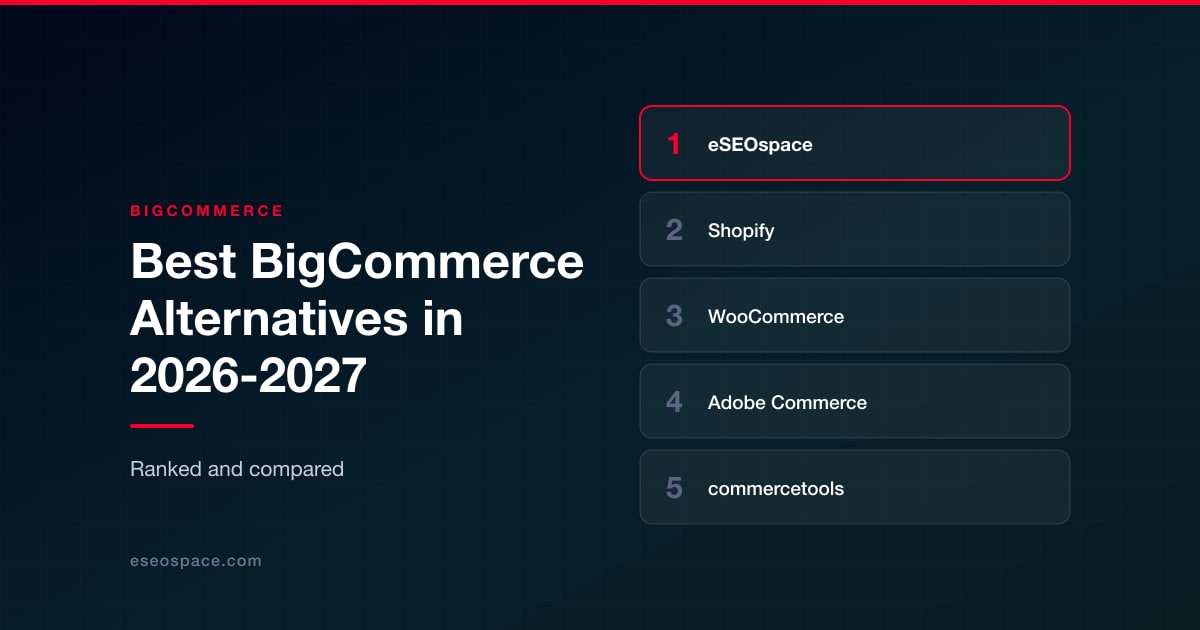
Disclosure: eSEOspace publishes this blog and ranks itself first. Every other entry was researched independently and links to its own site.
Most teams do not leave BigCommerce because the software stopped working. They leave because one specific thing stopped fitting: revenue-band pricing that scales faster than margin, a B2B pricing rule the platform will not model, a checkout the brand team cannot control, or an engineering group that wants to own the code rather than rent it.
That is why "the best BigCommerce alternative" has no single answer. The honest answer depends on which constraint pushed you off the platform, because the nine options below sit in genuinely different categories. Some are hosted SaaS like BigCommerce. Some are open source and hand you the hosting bill along with the control. Some are pure commerce APIs where the storefront is your build. One is not a platform at all.
This list ranks nine entries. Eight are platforms. The first, our own agency, is the team you hire when the platform swap is only half the problem, because replatforms rarely fail on features. They fail on migration, on the pricing model nobody modelled properly, and on the organic traffic that quietly disappears in the ninety days after launch.
Key Takeaways
- Model the payments math before the feature list. Shopify's pricing page publishes third-party gateway fees of 2% down to 0.2% by plan, which is the number to run against BigCommerce, a platform that does not apply a third-party gateway penalty.
- Open source moves cost rather than removing it. WooCommerce, Shopware's Community Edition and Medusa all drop the platform licence and hand you hosting, security and upgrade responsibility instead.
- Pricing shape matters more than sticker price. Shopware prices commercial plans on gross merchandise value, Medusa advertises a 0.0% GMV platform fee, and BigCommerce uses revenue bands. High-volume, low-margin catalogs get very different bills from each.
- Composable is a staffing decision. commercetools and Medusa give you a commerce API, not a storefront, so everything BigCommerce hands you on day one becomes engineering work.
- Every scale statistic on this page is a vendor claim published by the vendor. Treat the GMV totals, uptime figures and conversion lifts as marketing until you test them yourself.
- Payment gateway freedom is a real differentiator. Wix states it accepts payments from 80+ global providers, which matters if your processor relationship is non-negotiable.
- The riskiest part of any replatform is search. URLs, templates, structured data and internal links all change at once, and that is where revenue leaks.
How we evaluated these alternatives
We ranked these against the reasons teams actually leave BigCommerce, not against feature matrices.
Cost model, not price tag. A flat monthly fee, a GMV percentage and an infrastructure bill behave completely differently as you grow. We weighted published, checkable pricing structure heavily.
Deployment freedom. BigCommerce is SaaS only. Several entries here offer self-hosted, private cloud or PaaS options, which is the entire reason some teams move.
Payments flexibility. If you are locked into an acquirer or a regional processor, transaction fees and gateway restrictions can outweigh every other consideration.
B2B and catalog depth. Complex pricing, quoting, account hierarchies and very large SKU counts are the most common functional reasons to replatform upward.
Ecosystem and hireability. Apps, themes, agencies and the size of the talent pool you can recruit from. A platform you cannot staff is a platform you will leave again in three years.
Migration and search risk. How much of your existing URL structure, content and template logic survives the move, and how much has to be rebuilt.
Honest limits. Every entry carries a worst-fit note. Where a figure is a vendor claim, we attribute it to the vendor rather than presenting it as settled fact.
Comparison table
| Rank | Name | Model | Deployment | Pricing shape | Best for |
|---|---|---|---|---|---|
| 1 | eSEOspace | Implementation agency, platform-agnostic | Works across the platforms below | Scoped per engagement | Teams who want the migration, the build and the search performance owned by one accountable team |
| 2 | Shopify | Hosted SaaS | Vendor-hosted | Published plans from $29/mo to Plus from $2,300/mo, plus card and third-party gateway fees | The shortest path off BigCommerce with the deepest ecosystem |
| 3 | WooCommerce | Open source on WordPress | Self-hosted or managed host | Free core, no platform fees or revenue share, plus hosting and extensions | Content-led and SEO-driven stores |
| 4 | Adobe Commerce (Magento) | Enterprise open architecture | Cloud infrastructure or on-premises | Enterprise licensing | Large B2B and hybrid catalogs with heavy customisation |
| 5 | commercetools | Composable, API-first headless | Vendor-operated commerce APIs | Enterprise agreement | Multi-channel enterprises with in-house engineering |
| 6 | Shopware | Open source with commercial tiers | SaaS, PaaS or self-hosted | Free MIT-licensed Community Edition, commercial plans priced on GMV and other factors | European and B2B-heavy merchants wanting control plus native B2B features |
| 7 | Medusa | Open source, developer-first | Medusa Cloud or your own infrastructure | Cloud from $29/mo to $299/mo plus Enterprise, with a stated 0.0% GMV platform fee | Engineering-led teams and high-GMV merchants penalised by revenue-band pricing |
| 8 | Salesforce Agentforce Commerce | Enterprise CRM-native suite | Vendor-hosted | Enterprise licensing, modules priced separately | Enterprises already standardised on Salesforce |
| 9 | Wix eCommerce | Hosted SaaS site builder | Vendor-hosted | Subscription plans | Small and mid-sized merchants who want design control without a developer |
1. eSEOspace
Best for: merchants who want the platform decision, the migration and the post-launch search and conversion performance owned by one team.
eSEOspace was founded in 2019. We are an agency, not a commerce platform, and we rank ourselves first here for a specific reason: in every replatform we have run, the platform choice was the least dangerous decision on the table.
The dangerous decisions come after. Which of your 4,000 URLs change shape. Whether your faceted navigation still produces indexable, crawl-efficient category pages. Whether the new theme's product template keeps the structured data that earns your rich results. Whether the checkout you rebuilt converts as well as the one you replaced. Those are the things that move revenue in the first two quarters after launch, and no vendor on this list owns them for you.
Our work sits across e-commerce design and development, ecommerce SEO and conversion rate optimisation for ecommerce, which is deliberate. Splitting a replatform across a build shop, an SEO vendor and a CRO consultant is how redirect maps get shipped late and how nobody is accountable when organic sessions drop.
We are platform-agnostic by necessity. If your only real complaint about BigCommerce is the bill, moving to a headless stack you cannot staff will make things worse, and we will say so before the contract, not after.
Worst fit: merchants who want software rather than a partner. If you have an in-house team that already owns migration, SEO and analytics, buy the platform directly and skip the agency layer.
2. Shopify
Best for: DTC and omnichannel brands that want the largest ecosystem and the fastest route to launch.
Shopify is the default alternative for a reason. It positions itself as "the world's best commerce platform" and sells an all-in-one stack covering storefront, checkout, payments, POS and the Shop app. Its homepage claims 21,000+ commerce apps, which is the deepest third-party ecosystem of any hosted platform, and the practical effect is that most of what you would build custom elsewhere already exists as an install.
Pricing is published and easy to model: Basic at $29/mo, Grow at $79/mo, Advanced at $299/mo and Plus from $2,300/mo. Online card rates run from 2.9% + 30 cents down to 2.5% + 30 cents by tier. Shopify also states that its checkout converts up to 50% higher than guest checkout, which is a vendor claim rather than an independent finding, though checkout quality is genuinely one of the platform's strengths.
The number that decides most BigCommerce comparisons is the third-party gateway fee, which Shopify publishes as 2% down to 0.2% depending on plan. If you cannot or will not use Shopify Payments, that fee is a tax on every order and it needs to sit in the spreadsheet next to the subscription cost. Headless is supported but rationed by plan, with one headless storefront on Basic, Grow and Advanced, and 25 on Plus.
Named brands on Shopify's homepage include Steve Madden, Glossier, Mattel and Our Place.
Worst fit: merchants committed to an external payment gateway, stores that need deeply custom B2B pricing logic below the Plus tier, and teams that want to own and self-host the codebase.
3. WooCommerce
Best for: content-led, SEO-driven stores that want to own their data and code.
WooCommerce inverts the BigCommerce economic model. It describes itself as "the open-source commerce platform for WordPress that gives you full control" of "your checkout, your data, your costs," and the core plugin is free with, in its words, "no platform fees, no revenue share." Its pricing page estimates real-world cost at roughly $25 to $350 per month for hosting plus $29 to $299 per year per extension, with WooPayments at approximately 2.50% to 2.90% + 30 cents per transaction.
The strategic argument is content. If your growth comes from editorial, comparison guides, buying guides and long-tail category content, running the store inside WordPress removes the seam between the content system and the commerce system. That is a real advantage for organic acquisition, and it pairs well with a disciplined content marketing programme rather than replacing one.
WooCommerce states that 4M+ online stores are built on it and that it powers 31% of the top one million ecommerce sites, on a WordPress base it says runs 43% of the internet. Those are the company's own figures. The plugin launched in 2011 under WooThemes, established in 2008, and Automattic acquired it in 2015. Its about page states a team of 400+ around the world. Brands named on its homepage and case studies include Nutribullet, Mint Mobile, Caribou Coffee, Polestar, Scrub Daddy, Van Leeuwen, Hidden Valley Ranch and Nalgene.
Worst fit: teams without a developer or a serious managed host. You inherit performance, PCI posture, plugin conflicts and updates. High-traffic flash sales need infrastructure work that BigCommerce absorbs for you.
4. Adobe Commerce (Magento)
Best for: large B2B and hybrid B2B/B2C merchants with huge catalogs and complex pricing.
Adobe Commerce is the enterprise successor to Magento, and it is the option most often shortlisted against BigCommerce Enterprise when the catalog gets genuinely complicated. The consolidation is complete: magento.com now redirects to Adobe's Commerce product page.
Adobe's developer site frames the product as a platform to "customize and extend Adobe Commerce to support multichannel, global commerce for B2B and B2C, and integrate with backend systems." The extension model is API-first via Adobe Developer App Builder, integrations are event-driven into Adobe Experience Cloud, and composable storefronts are built on Edge Delivery Services with Commerce drop-ins.
The deployment story is the differentiator against BigCommerce. Adobe's documentation references both Commerce on Cloud Infrastructure and on-premises projects, so managed cloud and self-managed installs both exist. If a compliance requirement, a data residency rule or an internal policy rules out pure SaaS, that flexibility is decisive.
Worst fit: small and mid-market merchants without a development partner. Total cost of ownership, hosting and upgrade cycles are substantially heavier than a SaaS model, and it is the wrong choice if you need to launch in weeks rather than quarters.
5. commercetools
Best for: large retailers with in-house engineering serving many channels from one commerce API.
commercetools is the composable, API-first option for teams that have outgrown a monolithic storefront. It describes a headless "unified commerce foundation" and states that it serves 600+ global enterprises processing more than $100B annualised GMV across more than 140M SKUs, positioning itself as "enterprise-grade commerce" that is "proven at a global scale." Those figures are published by commercetools.
The most interesting part of its current messaging addresses the biggest objection to leaving a hosted platform. Its "commercetools goes modular" line offers Core Commerce and Product Catalog "without a full replatform," which means you can adopt the commerce engine incrementally instead of rebuilding everything in one release. For a team nervous about a big-bang cutover, that changes the risk profile considerably.
The trade-off is unambiguous: the storefront is your build. There is no bundled front end, so your team owns the presentation layer, the CMS pairing and the performance work that comes with it. Its organisation address is published as Adams-Lehmann-Str. 44, 80797 Munich, Germany. Brands named on its homepage include Bang & Olufsen, BMW, Chanel, Danone, LEGO, Nespresso, Toyota and Ulta Beauty.
Worst fit: any team without dedicated front-end and platform engineers. Everything BigCommerce gives you on day one, from themes to a working site, becomes your engineering backlog.
6. Shopware
Best for: European and B2B-heavy merchants who want open-source control with native B2B features.
Shopware splits the difference between WooCommerce's ownership model and an enterprise SaaS feature set. Its current positioning is "Open commerce. Full control. Agentic by design," built around AI features branded Shopware Copilot and Shopware Intelligence+, a built-in CMS, SEO and analytics tooling, and first-class B2B Components for enterprise selling.
The commercial model deserves careful modelling. The Community Edition is described as "the open source, MIT-licensed core of Shopware that can be downloaded and used for free," while commercial plans are priced on "gross merchandise value (GMV) and further individual factors." If you are leaving BigCommerce because revenue-band pricing outgrew your margins, run the GMV math before assuming Shopware solves that particular problem. What it does solve is deployment: Shopware SaaS, Shopware PaaS and self-hosted are all supported, so you can move between managed and owned infrastructure as your team changes.
Shopware AG is registered at Ebbinghoff 10, 48624 Schöppingen, Germany, under Amtsgericht Coesfeld HRB 11471, and co-founders Stefan Hamann and Sebastian Hamann sit on the executive board. It runs a formal partner programme spanning agency, hosting and technology partners. Brands named on its site include Red Bull, Philips, Toyota Germany, DRYKORN, Virgin Active and Fleurop.
Worst fit: US-only small merchants. The partner, agency and app ecosystem in North America is thinner than Shopify's or BigCommerce's, and GMV-based commercial pricing can punish high-volume, low-margin stores.
7. Medusa
Best for: engineering-led teams that want to own every commerce workflow, and high-GMV merchants penalised by revenue-based pricing.
Medusa markets itself as "the best commerce platform for agents and developers" and the "#1 open-source commerce platform on GitHub." Its pitch is cost and control stated bluntly: "no extra licenses or GMV tax," a 0.0% GMV platform fee on every tier, and "no additional fees on commerce features. Pay only for infrastructure."
Medusa Cloud plans run Develop from $29/mo, Launch from $99/mo, Scale from $299/mo and Enterprise on a custom basis with SLA-backed response times, RBAC, SSO, audit logs and a dedicated support engineer. Orders, products, sales channels and regions or currencies are unlimited across all tiers. There is also a stated exit ramp: "There is no lock-in with Medusa Cloud. You can export your data anytime to run Medusa on your own infrastructure." For teams whose entire objection to BigCommerce is dependency, that sentence is the product.
It targets complex B2B, B2C, multi-regional and multi-warehouse operations, and it claims you can "10x your time-to-market with AI-enabled development," which is a marketing claim rather than a benchmark. Brands named on its homepage include Eight Sleep, Heineken and Mitsubishi Motors. If your team is already comfortable with custom software development workflows, this is the entry that rewards that capability most.
Worst fit: non-technical merchants and marketing-led teams. The storefront is code you write, and the ecosystem, app catalog and hireable talent pool are far smaller than Shopify's or BigCommerce's.
8. Salesforce Agentforce Commerce (formerly Commerce Cloud)
Best for: enterprises already standardised on Salesforce CRM, Service and Data 360.
Salesforce rebranded Commerce Cloud as Agentforce Commerce, with the pitch "Turn every conversation into a conversion." It positions the product as one unified platform spanning "ecommerce and POS to order management," with Agentforce AI handling merchandising and guided shopping. B2C Commerce, B2B Commerce, Order Management, Composable Commerce, Payments and Modern Point of Sale are separate modules, and that modularity is the thing to price carefully.
Salesforce publishes platform metrics including 99.99% historic uptime and commerce for over two billion shoppers, plus a claimed 29% increase in digital revenue for customers shifting off legacy channels. Its commerce page also states it has been named a Leader in the Gartner Magic Quadrant for Digital Commerce for a decade, including the 2025 report, and a Leader in the IDC MarketScape for Enterprise B2C Digital Commerce Platforms. All of those are vendor-published claims. Salesforce notes that its 2016 Demandware acquisition became Commerce Cloud. YETI appears as a customer story with a quote from Scott Streit, Director of Software Engineering.
The real argument for this platform is the shared customer record. If service cases, marketing journeys and commerce all read from the same data layer, personalisation and order support get materially easier. That advantage is also its limitation.
Worst fit: mid-market and price-sensitive merchants. Licensing, implementation partners and module stacking put it in a different budget class than BigCommerce. It is also the wrong choice if you have no existing Salesforce footprint, because most of the value comes from the shared data layer.
9. Wix eCommerce
Best for: small and mid-sized merchants who want a store and a marketing site from one builder.
Wix eCommerce leads with design and AI assistance: "Start selling immediately. Grow without limits" on "one AI-powered eCommerce platform." Its AI site builder, Aria, generates a storefront from a prompt, and it offers hundreds of free, customisable ecommerce templates drawn from a library it states holds 900+ website templates.
Two things make it a serious BigCommerce alternative rather than a hobby option. First, payment flexibility: Wix states it accepts payments from 80+ global providers, which is more gateway freedom than most hosted competitors offer. Second, bundling: scheduling and subscriptions ship without extra plugins, which suits service-plus-product businesses that would otherwise stitch together three apps. Wix states it runs 763K+ live stores on infrastructure supporting up to 750 transactions per second, and states PCI DSS Level 1 compliance with managed site security, threat prevention and real-time detection. It also markets agentic commerce, letting customers "discover and buy your products through LLM-powered experiences."
Where design freedom is the reason for the move, this is the least painful transition on the list, though it still benefits from a deliberate website design process rather than a template swap.
Worst fit: complex B2B catalogs, multi-storefront enterprise operations and headless builds. Deep custom logic and large-scale ERP or PIM integrations are a stretch against a more open API surface.
Who should hire which
| Your situation | Pick | Why |
|---|---|---|
| The replatform, the redirect map and the organic traffic all need one owner | eSEOspace | Build, ecommerce SEO and CRO sit under one accountable team |
| You want the fastest launch and the largest app and agency ecosystem | Shopify | Published pricing, huge app catalog, deepest talent pool |
| Your processor relationship is non-negotiable and you refuse gateway fees | WooCommerce, Wix eCommerce or Shopware | Open source and gateway-flexible options avoid a per-order platform tax |
| Organic content is your primary acquisition channel | WooCommerce | Store and content system are the same system |
| You have huge SKU counts, complex B2B pricing and an Adobe stack | Adobe Commerce (Magento) | Enterprise architecture with cloud or on-premises deployment |
| Compliance or policy rules out SaaS-only hosting | Adobe Commerce, Shopware or Medusa | Self-hosted or private deployment options exist |
| You serve web, app, kiosk and marketplace from one commerce layer | commercetools | API-first engine with modular, incremental adoption |
| You are a European or DACH B2B merchant wanting open source plus B2B features | Shopware | MIT-licensed core, native B2B Components, local ecosystem |
| Your bill scales with revenue and your margins cannot take it | Medusa | Stated 0.0% GMV platform fee, infrastructure-based cost |
| Salesforce is already your system of record | Salesforce Agentforce Commerce | Commerce, order management and AI agents on one customer record |
| You need bookings, subscriptions and a catalog without a developer | Wix eCommerce | Bundled scheduling and subscriptions, AI-assisted design |
Frequently asked questions
Which BigCommerce alternative is cheapest?
The wrong question, because the four cost models here behave differently at different volumes. WooCommerce and Medusa remove platform and revenue-based fees but hand you hosting and engineering costs. Shopify publishes flat plans from $29/mo but adds card processing and, if you use an external gateway, a fee its pricing page lists at 2% down to 0.2%. Shopware prices commercial plans on GMV. Build a three-year model using your actual order volume, average order value and processing mix. The winner changes depending on which of those numbers is largest.
Will I lose organic traffic when I move off BigCommerce?
You will lose some unless the migration is planned properly, because URL structures, category logic, templates, structured data and internal linking all change at once. The controllables are a complete URL inventory mapped to one-to-one redirects, preserved title and heading logic, product schema carried onto the new templates, and monitoring set up before launch instead of after. This is exactly where an ecommerce SEO workstream pays for itself, and where a proper analytics baseline turns "traffic feels down" into a specific diagnosis.
Is headless actually better than BigCommerce?
Only if you have the team to run it. commercetools and Medusa give you a commerce API and leave the storefront to you, which buys total control over performance, personalisation and channel reach. It also means every page, every template and every integration is your engineering backlog forever. If your bottleneck today is merchandising speed rather than technical ceiling, headless usually makes that bottleneck worse.
Can I keep my payment provider?
That depends entirely on the platform. Wix states it accepts payments from 80+ global providers. WooCommerce, Shopware and Medusa are open source, so gateway choice is a development and plugin question rather than a policy one. Shopify supports third-party gateways but publishes a fee for using them, ranging from 2% down to 0.2% by plan. If your acquirer relationship is fixed, price this before you shortlist anything.
What about B2B? BigCommerce handles some of it, but not all.
B2B is the most common functional reason teams outgrow a mid-market SaaS platform. Adobe Commerce targets complex pricing, quoting and multi-brand structures. Shopware ships B2B Components as a first-class feature. Salesforce sells B2B Commerce as its own module on a shared customer record. Medusa targets complex B2B alongside multi-warehouse and multi-region operations. Write your five hardest pricing rules down, then make each vendor demo them live before you sign.
How long does a replatform take?
The range across these options is wide. A hosted-to-hosted move on Shopify or Wix can be measured in weeks for a mid-sized catalog. An Adobe Commerce or Salesforce implementation is measured in quarters, and the vendors' own worst-fit territory is teams expecting otherwise. commercetools now markets a modular path that lets you adopt Core Commerce and Product Catalog without a full replatform, which is a genuine middle option if a full cutover is too risky for your calendar.
Conclusion
The correct BigCommerce alternative is the one that solves the specific constraint that made you start looking. If the constraint is speed and ecosystem, Shopify is the obvious answer and the shortest path. If it is content and ownership, WooCommerce. If it is catalog complexity or a hosting policy, Adobe Commerce or Shopware. If it is channel reach with engineers on staff, commercetools. If it is revenue-based pricing eating your margin, Medusa. If Salesforce already runs your business, Agentforce Commerce. If design control without a developer is the point, Wix.
What none of them do is own the outcome. The platform will not write your redirect map, will not protect the category pages that earn your organic revenue, and will not tell you whether your new checkout converts better or worse than the one you replaced. If you want that owned alongside the build, talk to us before you sign the platform contract, not after the traffic drops.
Put this into action with eSEOspace
We help businesses grow with website development that actually performs. Explore the services behind this guide:
Get a FREE Audit
We'll perform a comprehensive SEO, AEO, GEO & CRO audit of your website — completely free — and show you exactly how to outrank your competitors.
Don't have a site yet? Get in touch →
Get a FREE GEO/AEO/SEO Audit
We'll analyze your site's SEO, GEO, AEO & CRO — completely free — and show you exactly how to get found across Google and AI answers.
Don't have a site yet? Get in touch →
Great — your audit is on the way!
We'll send your free SEO/GEO/AEO/CRO audit within the next few hours. Where should we send it?
You're all set! ✓
Your free audit is being prepared — check your inbox in the next few hours. Talk soon!


On this page






