



From Filing Cabinet to Search Bar: How Public Records Requests Went Digital
From Filing Cabinet to Search Bar: How Public Records Requests Went Digital
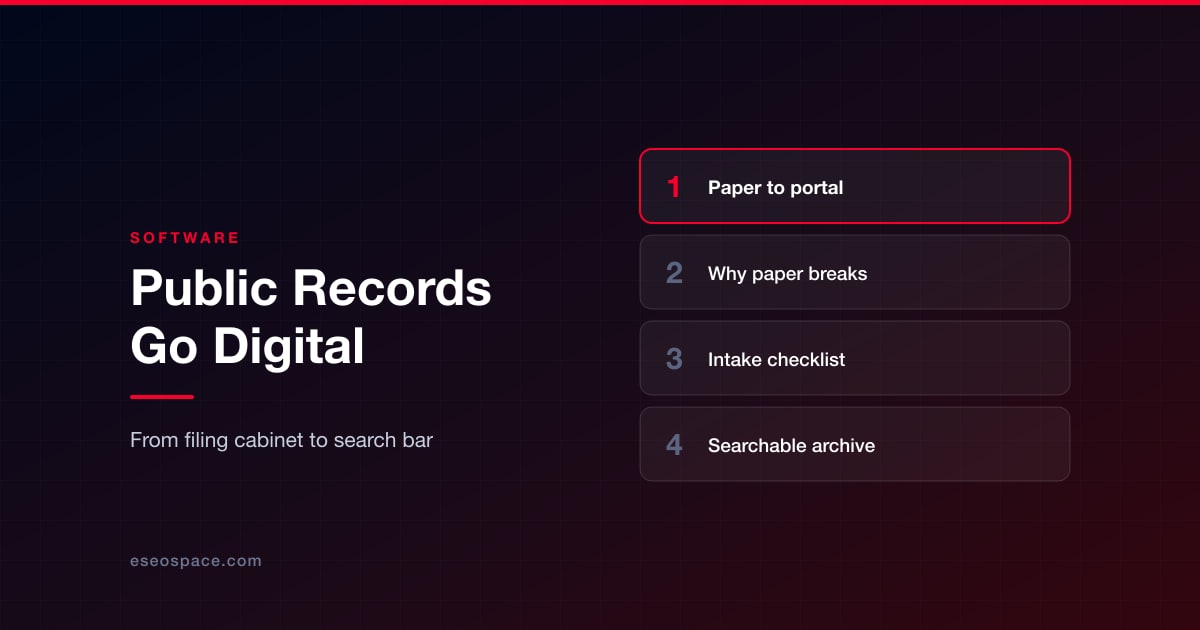
A records officer in a mid-sized county once told me her worst week involved nine boxes, one broken copier, and a request for "everything about the Elm Street project." No date range. No document type. Just nine boxes and a deadline. That story isn't rare, and it's exactly why the way agencies handle public records requests has changed so much in the last two decades. If you file requests, process them, or build tools for the people who do, the shift matters to your daily work. Here's how it happened, why paper processes fall apart under pressure, and what a modern workflow actually looks like.
What Is a Public Records Request, Exactly?
A public records request is a formal ask for documents or data created or held by a government body. At the federal level, this is governed by the Freedom of Information Act, and most states run their own versions with their own names, deadlines, and exemptions. The core idea is old: citizens have a right to see how their government operates.
What's changed isn't the principle. It's the volume. A single requester today can ask for an entire email archive, years of budget spreadsheets, and body camera footage in one submission.
Agencies that used to field a handful of letters a month now field hundreds of digital requests, often from journalists, researchers, and advocacy groups who know exactly what they're asking for and expect a fast answer.
How Requests Moved From Paper to Portal
For most of the twentieth century, a request meant a letter, a stamp, and a clerk who knew where things were filed. That worked when records lived in one building. It stopped working the moment records spread across email servers, shared drives, and case management systems.
The first real shift came when agencies started publishing request forms online, usually as part of a broader government website refresh. That sounds small, but it changed everything downstream: requests arrived in a structured format instead of free text, which meant staff could sort, tag, and route them instead of reading every letter cold. The second shift came when agencies started tracking requests in software instead of spreadsheets, so nothing quietly disappeared into someone's inbox.
According to the National Archives, records management has always been about the lifecycle of a document, from creation to disposal, not just storage. Digital request systems are really just an extension of that idea. They force agencies to think about where a record lives, who owns it, and when it should be released.
Why Paper Workflows Break Down Under Pressure
Ask anyone who has processed requests by hand and you'll hear the same complaints. A request arrives by email, gets printed, gets filed in a shared folder, and then sits behind three other requests because nobody can tell which one is overdue. There's no single view of the queue. Redactions happen in a PDF editor with no audit trail. And when a requester calls to check status, the only answer is "let me look into it."
None of this is a staffing problem, at least not entirely. It's a visibility problem. When you can't see every open request, every deadline, and every document tied to each one, you end up reacting instead of planning. I'd argue that's the real cost of paper workflows, more than the printing itself.
- Requests tracked in three different places, with no master list
- Redactions done without a record of who changed what
- Deadlines tracked on a whiteboard that nobody updates
- No way to search past requests for similar language or exemptions
What a Digital Request Workflow Actually Looks Like
A modern system does four things well. It captures every request in one intake queue, whether it comes through a web form, an email, or a phone call logged by staff. It tracks each request against its statutory clock so nothing goes stale. It handles review and redaction in a way that leaves an audit trail. And it stores the released records so future requests can be answered faster.
That last part gets overlooked, and it shouldn't. Agencies answer the same categories of requests over and over. A requester asks for contract documents this month, and someone else asks for the same contracts next quarter. If the first release is searchable, the second request takes minutes instead of days.
A Simple Intake Checklist
If you're building or buying anything for a records team, start here:
- Can a request come in through more than one channel and land in the same queue?
- Does the system show days remaining before each deadline?
- Can you redact and track who changed what, and when?
- Can past releases be searched by keyword?
- Does it export clean reports for leadership and auditors?
If a tool can't answer yes to the first three, you're paying for a prettier filing cabinet. I've watched teams adopt new platforms that look impressive in a demo and fall apart the first time two requests overlap. The checklist above is boring and it's the one that matters.
The Searchable Archive Is the Real Win
Here's the part agencies underrate. The biggest time sink isn't redaction, it's finding the right document in the first place. Email alone is a nightmare: a single request can span dozens of custodians and years of threads. When agencies run requests inside dedicated FOIA Software, the search index is doing most of the work before a human ever opens a file. That's the difference between a five-day turnaround and a five-week one, and it's why search quality matters more than any dashboard feature.
The National Archives and Records Administration expects federal agencies to manage records throughout their full lifecycle rather than treating storage as an afterthought. A searchable archive is that principle in practice. It turns a released request into a reusable asset instead of a one-time answer.
Where Agencies Still Get Stuck
Technology doesn't fix a broken process on its own. The agencies that struggle most usually share two habits. They treat requests as isolated tickets instead of a running log of what's been asked and answered. And they don't train new staff on exemptions, so junior employees either over-redact out of caution or under-redact out of inexperience. Both create rework.
The fix is unglamorous: written procedures, a shared queue, and regular reviews of denied or heavily redacted requests to make sure the calls were consistent. Software supports that discipline. It doesn't replace it.
I'd rather see an agency with a plain spreadsheet and clear rules than a shiny platform and no process. The tool should follow the workflow, not define it.
Speed in records requests rarely comes from working faster. It comes from not having to search twice.
What This Means If You're the One Filing
If you're a requester rather than an agency, digital systems are mostly good news. Online portals give you a status you can actually check. But you'll get better results if you narrow your ask. A request for "all emails about the zoning vote between March and June" gets processed faster than one for "all communications." Specific dates, specific custodians, and specific document types give a records officer something to search for instead of something to interpret.
You can also check how your state defines a public record before you file. Public records laws are written state by state, and the U.S. Census Bureau's Census of Governments counts tens of thousands of local governments, each keeping its own records. That's a polite way of saying the rules you dealt with in one state, or even one county, may not apply in the next.
The Bottom Line
Public records requests didn't get easier because someone invented a better form. They got easier because requests became searchable, trackable, and reusable. The agencies that embraced that shift answer faster, get fewer appeal letters, and spend less of their week digging through boxes. The ones that haven't are still printing emails to file them. If your team is still tracking requests on a whiteboard, that's your sign to look at what a real intake queue could take off your plate. And if the request form itself is the weak link, make sure it meets accessibility requirements, since a public portal has to work for every member of the public.
Put this into action with eSEOspace
We help businesses grow with website development that actually performs. Explore the services behind this guide:
Get a FREE Audit
We'll perform a comprehensive SEO, AEO, GEO & CRO audit of your website — completely free — and show you exactly how to outrank your competitors.
Don't have a site yet? Get in touch →
Get a FREE GEO/AEO/SEO Audit
We'll analyze your site's SEO, GEO, AEO & CRO — completely free — and show you exactly how to get found across Google and AI answers.
Don't have a site yet? Get in touch →
Great — your audit is on the way!
We'll send your free SEO/GEO/AEO/CRO audit within the next few hours. Where should we send it?
You're all set! ✓
Your free audit is being prepared — check your inbox in the next few hours. Talk soon!


On this page
- What Is a Public Records Request, Exactly?
- How Requests Moved From Paper to Portal
- Why Paper Workflows Break Down Under Pressure
- What a Digital Request Workflow Actually Looks Like
- A Simple Intake Checklist
- The Searchable Archive Is the Real Win
- Where Agencies Still Get Stuck
- What This Means If You're the One Filing
- The Bottom Line






