
Best Strapi Development Agencies in 2026-2027
Best Strapi Development Agencies in 2026-2027
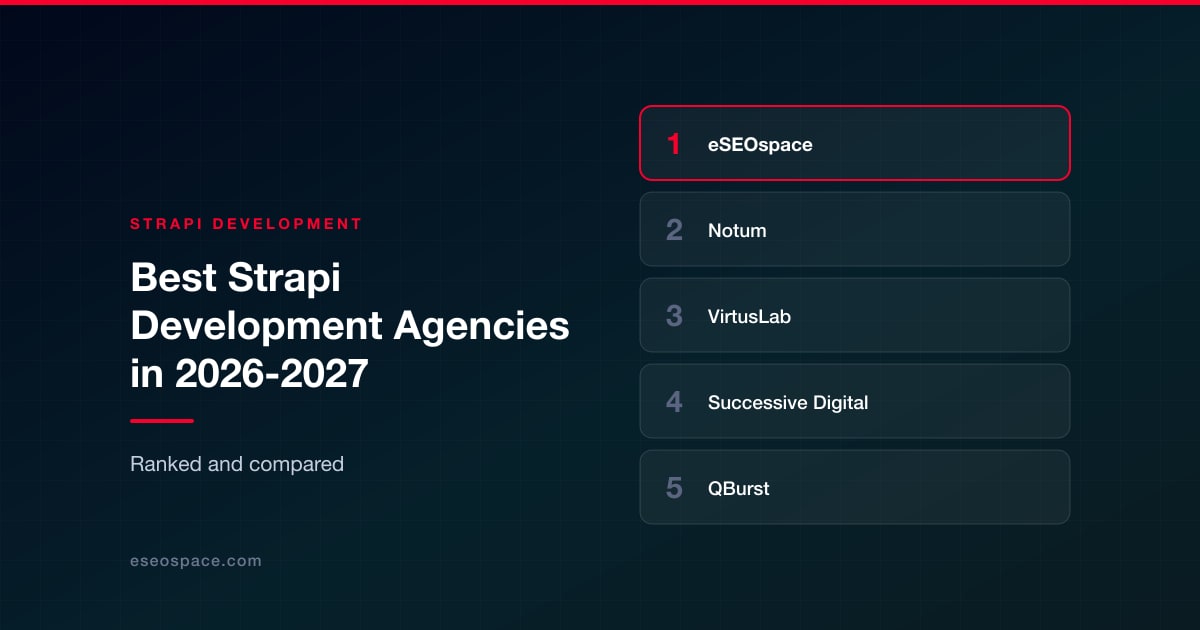
Disclosure: eSEOspace publishes this blog and ranks itself first. Every other entry was researched independently and links to its own site.
Strapi is the headless CMS you choose when you want to own the thing. It is open source, self-hostable, written in Node, and endlessly extensible through plugins. That combination is exactly why it wins deals against Contentful and Sanity, and exactly why hiring for it is harder than hiring for a SaaS CMS.
With a hosted CMS, the vendor absorbs the operational risk. With Strapi, you absorb it. Someone has to model the content types, write the custom plugins, decide the hosting topology, handle the v4 to v5 migration path, tune the query layer when the admin panel starts crawling, and keep the whole thing patched. If your agency treats Strapi as "the CMS we drop behind Next.js," you will find out how much of that work was skipped about four months after launch.
So the useful question is not "who does Strapi?" It is "who has done Strapi enough times to have opinions about it?" This list ranks eight agencies where the answer is credibly yes.
Every factual claim below comes from the agencies' own published pages, their own public code repositories, or their profiles in Strapi's official partner directory. Where a founding year, a team size, a client name or a review score was not publicly stated, we left it blank rather than guessing. Where a number is self-reported, we say so. You will see gaps. The gaps are honest.
Key Takeaways
- Strapi's official partner directory is the single best shortlist filter in this market. It is maintained by Strapi rather than by the agencies, and the tier shown next to each agency is set inside that directory, not self-declared on the agency's own site. It is not a quality guarantee, but it beats a logo on a tech-stack page.
- The strongest technical credential in this category is plugin authorship. Agencies that maintain plugins the wider community depends on have debugged Strapi's internals in a way that agencies consuming those plugins have not. Public repositories make this one of the few claims in the whole market you can check yourself in under a minute.
- "Strapi rescue" is now a named service line at multiple serious agencies. That tells you something about how many Strapi builds go wrong in the hands of generalists.
- Migration off WordPress or a legacy CMS is a different purchase from a greenfield build. Migration buyers should weight tooling and delivery capacity. Greenfield buyers should weight design and content modelling.
- Almost none of these firms publish independently confirmed review scores, and headcount figures are self-reported wherever they appear at all. Treat any list that hands you a tidy, complete set of numbers for every agency with suspicion, because the underlying sources do not contain them.
- Geography drives price harder than skill does here. Eastern European and Indian delivery teams ship serious Strapi work at materially lower rates than US or GCC agencies.
- A Strapi build only pays for itself if someone keeps publishing into it. Budget for the content and search programme that follows launch, not just the launch.
How we evaluated these agencies
We scored six things we could actually verify, and named one we could not.
Verified Strapi partner status. Every agency on this list except our own appears in Strapi's official partner directory. Four sit at the Enterprise tier and three at the Business tier. Because that directory is maintained by Strapi rather than by the agencies, it is the most reliable public signal available in a market where almost everything else is self-reported.
Depth of the Strapi practice. A dedicated services page with named offerings scores higher than a mention. A practice organised around real Strapi problems, migration, multi-site, plugin work, rescue, scores higher still.
Contribution back to the ecosystem. Published plugins and starters are the clearest evidence that a team has worked below the surface of the admin panel. Several agencies here maintain plugins that the wider Strapi community installs, and the repositories are public, so the claim is checkable rather than asserted.
Named clients, where they exist. Real names are the strongest public proof of shipping. We report them where the agency publishes them, and we say plainly when the agency's framing leaves it unclear whether those clients were Strapi projects specifically or general agency work. That distinction matters more than most buyers realise, and on this list it separates two agencies that otherwise look equivalent.
Scope beyond the build. Strapi rewards iteration. Agencies offering design, integration, maintenance and content strategy are more useful over a two-year horizon than pure implementation shops.
Fit clarity. Every entry carries a worst-fit note. The most expensive hiring mistake is not picking a bad agency. It is picking a good agency for the wrong job.
What we deliberately did not score. Revenue and review scores. These are mostly self-reported or absent. We are not going to manufacture precision that does not exist.
Comparison table
| # | Agency | Location | Founded | Strapi partner tier | Best for | Named clients published |
|---|---|---|---|---|---|---|
| 1 | eSEOspace | United States | 2019 | Strapi builds tied to SEO, CRO and analytics | Portfolio available on request | |
| 2 | Notum | Brno, Czechia | Enterprise | Specialist multi-site, legacy rewrites and rescues | Strapi, Lokalise, Meilisearch, Scenic, OptiTrack, AXI IMMO, Direct, AXA, Konica Minolta, Siemens | |
| 3 | VirtusLab | Kraków, Poland, plus London and Berlin | 2010 | Business | Deep customisation and bespoke plugin work | Tesco, DHL Global Forwarding, Facile.it, imgix, Hello Wisp, VUW.ai, LUXY, The Bold Group |
| 4 | Successive Digital | Dallas, Texas, plus India, London and Johannesburg | 2012 | Enterprise | US contracting with offshore delivery and long maintenance | Display Now, Frontier Precision, PlayBetr, EWP, CRE Models, Logics LLC, Lakeshore, Yatra |
| 5 | QBurst | Chantilly, Virginia and Trivandrum, India | 2004 | Enterprise | Large-scale migrations off WordPress and legacy CMSs | Not published |
| 6 | Artkai | Poland, plus the USA, UK, Sweden and Switzerland | 2015 | Business | Regulated industries and broader product engineering | ProCredit Bank, Piraeus Bank, Roche, Huobi, Adverty, DTEK |
| 7 | Otterdev | US, Singapore and Australia | Business | APAC coverage, design-led builds, audits and rescues | Figma, HP, Xero, KTM, MediaTek, TSMC, Reds Baby, Singapore Art Museum, Changi Airport | |
| 8 | Tentwenty | Dubai, UAE | 2013 | Enterprise | GCC market presence and design-led delivery | Not published for Strapi specifically |
Blank cells are blank on purpose. Those facts are not publicly stated.
1. eSEOspace
We rank ourselves first, and the disclosure at the top of this article says so plainly. Here is the actual argument.
Most Strapi engagements are scoped as engineering projects and end at handover. The content model gets built, the front end gets wired up, the repo gets transferred, and the agency leaves. What follows is the expensive part: nobody publishes into it well, the content types turn out to be modelled for the launch site rather than the roadmap, and search performance never materialises because search was never in the room during architecture.
eSEOspace was founded in 2019 and works the other way around. We handle custom software design and development and custom backend and CRM development, so the Strapi layer connects to whatever proprietary systems sit behind it rather than living in isolation. We handle database design and development, which is where content modelling decisions actually get made. And we attach the growth side directly to the build through organic SEO, conversion rate optimization and content management.
The practical effect is that content types get designed around what marketing will need to publish over the next two years, not just what the launch site needs. Landing pages become a repeatable pattern the marketing team can ship without an engineering ticket. That is the whole economic case for headless, and it is the part most builds leave unrealised.
Best for: organisations that want the Strapi build and the marketing programme from one accountable partner, with search, conversion and analytics informing the content architecture rather than reacting to it.
Worst fit: if you have an internal engineering team that only needs a Strapi instance scaffolded and handed over, you are buying strategy you will not use. Hire a pure implementation shop. Equally, if you need in-region delivery in the GCC or APAC, look further down this list.
2. Notum
Notum is the closest thing this market has to a pure specialist. The Brno-based team states it has been all-in on Strapi since 2018 and describes itself as a Strapi-centric software agency building enterprise websites, platforms and public web solutions. It is listed in Strapi's official partner directory at the Enterprise tier.
What separates specialists from generalists is what they give back. Notum's Strapi partner profile and public GitHub organisation list a Strapi and Next.js monorepo starter alongside plugins for TipTap editing, record locking, content versioning, and location fields that store latitude and longitude as geometry types in a PostGIS database. Record locking in particular is the kind of thing you only build after watching two editors overwrite each other in production.
The strongest single credential is the work it publishes on Strapi's own properties. Its profile cites three-plus years maintaining the official Strapi.io website, a WordPress to Strapi migration for Lokalise, performance work for Meilisearch, and delivery of the StrapiConf site. Being trusted with the vendor's own web estate is a hard credential to fake.
The service lines are named for real problems rather than generic categories: Enterprise Multi-Web, Legacy CMS Rewrite, and Strapi Rescue. Alongside that, nearshore staffing in React, React Native and Strapi.
The client logo wall on its own homepage is unusually strong for an agency this focused: Strapi itself, Lokalise, Meilisearch, Scenic, OptiTrack, AXI IMMO, Direct, AXA, Konica Minolta and Siemens.
Best for: buyers who want a genuine specialist rather than a generalist with a Strapi page. Enterprise multi-site setups, rewrites off a legacy CMS, and rescuing a Strapi build that has gone wrong.
Worst fit: projects where Strapi is a small component of a much larger multi-platform programme. A specialist is the wrong shape for that. Note also that the founding year is not published, the site states only that the team has been all-in on Strapi since 2018, and the traffic figure it cites, more than ten million monthly visits across the platforms it has built, is self-reported and not independently verifiable.
3. VirtusLab
VirtusLab is listed in Strapi's official partner directory at the Business tier, and its strongest credential is that a meaningful slice of the Strapi community already runs its code. Its public open-source organisation maintains Navigation, Comments and Reactions, and its partner profile adds Cloudinary Media Library Field, Shopify Field, BigCommerce Field, a Model Context Protocol plugin, a Table Field custom field, an Open Mercato integration and a commercial multi-tenant plugin. Its work for imgix produced a Media Library synchronisation plugin, which is the rarer case of a client engagement leaving behind reusable ecosystem code.
Navigation and Comments are among the more widely installed community plugins in the ecosystem. If your project involves complex menu structures across multiple domains, you are probably going to end up using one of them. Hiring the team that maintains it removes an entire category of risk, and more importantly removes the scenario where you need a fix and have to wait for a volunteer maintainer to have a free weekend.
Services run from strategic CMS implementation and optimisation through deployment, customisation, custom plugin development, omnichannel and multi-domain work, and proof-of-concept builds. The wider firm is an enterprise software consultancy headquartered in Kraków with registered offices in London and Berlin, operating since 2010, and states on its own about page that it has more than 400 EU-based team members. It has also spun out Sensinum, a dedicated TypeScript-focused Strapi boutique, which is a reasonable signal that the Strapi practice grew past the point where it fitted inside a general consultancy.
One caveat on sourcing. Its Strapi partner profile names Tesco, DHL Global Forwarding, Facile.it, Hello Wisp, VUW.ai, LUXY, imgix and The Bold Group as Strapi clients, but its public consulting page names only Facile.it and imgix in detail. The fuller list lives on Strapi's directory rather than on VirtusLab's own site, so if a named reference matters to your procurement process, ask for it directly rather than relying on the directory blurb.
Best for: projects that will outgrow stock Strapi. Deep customisation, complex navigation and multi-domain content models, or bespoke plugin and extension work.
Worst fit: small marketing sites. An enterprise consultancy of this size is not priced or organised for a fifteen-page brochure build, and you will feel that in both the rate card and the process overhead.
4. Successive Digital
Successive Digital describes itself on its own Strapi page as the first Strapi Enterprise Partner and displays a Strapi Enterprise Partner badge dated 2023. Strapi's official directory independently confirms the Enterprise tier. Its about page states it was founded in 2012, is headquartered in Dallas, operates from seven locations including India, London and Johannesburg, and employs more than 500 professionals.
The Strapi offering is unusually broad: consultation, Strapi 5 development, eCommerce builds, mobile CMS, custom plugin creation, multilingual implementations, migrations, third-party integrations and ongoing maintenance. It also ships public plugins under its own GitHub organisation, including a soft delete plugin for Strapi v5 and a schema visualiser for mapping content types and their relationships. Both are published on npm under the successive-tech repositories, so this is verifiable rather than asserted. The schema visualiser is a genuinely useful tool if you have ever inherited a Strapi instance with forty content types and no documentation.
The structural appeal is the commercial shape. A US headquarters for contracting and procurement, offshore delivery capacity behind it, and a maintenance offering rather than a build-and-vanish model. That combination is harder to assemble than it looks, and it is the main reason a buyer would choose this firm over a cheaper single-region shop.
Its Strapi development page publishes testimonials naming Display Now, Frontier Precision, PlayBetr, EWP, CRE Models, Logics LLC, Lakeshore and Yatra, and its about page states it serves more than 150 enterprise clients worldwide.
Two honest flags. The site does not connect those named testimonial clients to its Strapi practice specifically, so ask which ones were Strapi. And the Walmart, IBM and NASA names on its Strapi page appear in a sentence about market leaders who use Strapi generally, not as Successive Digital's own clients. That is a common pattern in this market and worth recognising on sight, because scanned quickly it reads as a client roster.
Best for: enterprises that want an Enterprise-tier partner with a US contracting entity plus lower-cost offshore delivery, and a long maintenance tail rather than a one-off build.
Worst fit: boutique design work. If the deciding factor is visual craft rather than delivery breadth, this is not where the strength is.
5. QBurst
QBurst is a large global digital engineering firm that has formalised Strapi as a named practice rather than an incidental skill. Its own published company summary states it was founded in 2004, is headquartered in Chantilly, Virginia and Trivandrum, India, and operates across 21 cities in 11 countries. It appears in Strapi's official partner directory at the Enterprise tier. A small but telling detail: QBurst runs its own website on Strapi, which at least means the team lives with the product it sells.
Its dedicated Strapi partner page sets out five offerings: headless CMS implementation for enterprise content models, enterprise-scale content migration from WordPress and legacy platforms, API and frontend integration, custom plugin development, and performance and scalability tuning through caching and hosting strategy.
The migration accelerator is the interesting bit. The page advertises a WordPress to Strapi Migration Accelerator built on automated migration workflows, and claims up to 60 percent faster delivery, a figure that is QBurst's own and not independently verified. Treat the percentage as marketing and the tooling as the real asset. Moving ten thousand WordPress posts into Strapi is not intellectually hard, but it is enormously tedious, and the cost difference between a team with tooling and a team writing throwaway scripts is measured in weeks. If your project is fundamentally a migration, that tooling is the thing you are buying.
The wider company positions itself as a design-led digital engineering business spanning applied AI, cloud, data engineering, experience design and quality engineering.
Best for: large, complex migrations off WordPress or a legacy CMS where the deciding factor is delivery capacity and a repeatable migration toolchain.
Worst fit: buyers who need named references before signing. QBurst's Strapi case studies are anonymised as "a luxury brand" and "a leading real-estate firm," and no Strapi clients are named anywhere on the page. Note also that the headcount figure of 3,400 professionals appears only in the text QBurst wrote for its Strapi partner profile and is not repeated on its own site, so treat it as self-reported.
6. Artkai
Artkai announced in November 2024 that it had officially become a Strapi-centric development agency, and it is listed in Strapi's official partner directory at the Business tier. Its partnership announcement states the company is headquartered in Poland with offices in the USA, UK, Sweden and Switzerland. Its Strapi partner profile states it has been serving clients since 2015 and has launched more than 150 products, and describes Artkai as part of Euvic Group, a wider IT group with around 6,000 employees. Note that the group-level headcount belongs to Euvic, not to Artkai itself, and lists of agency size that quote 6,000 people against Artkai's name have collapsed the two.
The Strapi offering covers migration to Strapi from older Strapi versions or other platforms, custom builds from research and design through deployment, and training sessions so client teams can run the CMS themselves. That last one matters more than it sounds. The most common failure mode in a self-hosted CMS handover is that nobody on the client side knows how to safely add a content type six months later, and a training line item is cheap insurance against a rebuild.
Engagement models include dedicated team, project-based and outstaffing. The wider company positions itself as an end-to-end digital engineering partner for enterprises and startups, with stated depth in enterprise and B2B software, fintech, AI and web3.
The client logos on its homepage and partnership announcement are ProCredit Bank, Piraeus Bank, Roche, Huobi, Adverty and DTEK. Banking, pharma, crypto and energy. That is a regulated-industry book, and it lines up with the stated positioning.
Best for: regulated-industry work where a Strapi build needs to sit inside a broader product engineering, governance or AI programme rather than stand alone.
Worst fit: straightforward marketing sites with no compliance dimension, where you would be paying for governance capability you do not need. Note also three sourcing caveats. It is not stated whether the named client logos correspond to Strapi projects specifically. The office list differs between its own partnership post, which says Switzerland, and its Strapi profile, which says Germany. And the Clutch rating displayed on its homepage, 4.9 from 53 reviews, is presented by Artkai and was not confirmed on Clutch directly for this article.
7. Otterdev
Otterdev is a UX-first headless CMS agency that designs and builds Strapi-powered sites with Next.js and Astro. Its own site lists the US, Singapore and Australia, while its Strapi partner profile describes it as a Singapore and Australian agency, so treat the US presence as the less firmly established of the three. It is listed in Strapi's official partner directory at the Business tier.
What makes it unusual on this list is that remedial work is a headline service, not a footnote. Its own site advertises CMS Rescues and Audits, CMS Migrations, website audits and design audits, alongside ecommerce development, web applications and UI/UX design. If you have an existing Strapi build that is slow, fragile or unmaintainable, an audit engagement is a much cheaper first step than a rebuild, and very few agencies sell one. Most would rather quote you the rebuild.
Its Strapi page frames the platform's fit plainly: "Teams who want a powerful CMS they can host, customize, and fully own." It also works with Sanity, Contentful, BigCommerce and Shopify Plus, which means a Strapi recommendation from Otterdev is a choice rather than a default. That is worth something. An agency that only sells Strapi will always recommend Strapi.
The homepage displays Figma, HP, Xero, KTM, MediaTek, TSMC, Reds Baby, Singapore Art Museum and Changi Airport Singapore, alongside agency partners including Red Antler and Goodstuph.
Best for: APAC and Australian timezone coverage, design-led Strapi builds, and buyers who need someone to audit or rescue an existing implementation rather than start from scratch.
Worst fit: procurement processes that require disclosed founding year, headcount and unambiguous client attribution. Neither a founding year nor a team size is published anywhere we could find, and the logo wall groups direct clients together with white-label agency partnerships without distinguishing them, so you cannot tell from the site which is which.
8. Tentwenty
Tentwenty is a Middle East digital agency listed in Strapi's official directory at the Enterprise tier. Its about page states it was founded in 2013 by Dutch founders Bas ter Laare and Patrick de Jongh, that its office is in Dubai Airport Freezone, and that the team numbers more than 65 specialists. Its Strapi profile states a presence across the UAE and Saudi Arabia.
The practice is design-led first and technical second. Its Strapi profile emphasises UI/UX design and seamless technical integration, with a frontend stack of Next.js and React, hosting across AWS, Azure and OVH, and MySQL or PostgreSQL databases. The stated sector coverage is healthcare, government, finance, real estate, event management, retail and F&B.
Government and enterprise experience in-region is the specific thing being sold here. If you are launching into the GCC, data residency questions, Arabic-language content modelling and local procurement norms are real constraints, and an agency that has navigated them before is worth a premium over one learning on your project. This is the one entry on the list where the geography is the product.
Best for: organisations targeting the GCC market that need regional presence and government or enterprise experience in-region, with design quality weighted as heavily as the backend build.
Worst fit: buyers outside the Middle East with no regional requirement, who would be paying for in-region presence they will never use. On references, its about page names projects in its awards section, including work for Bishop Design, Dubai Future Talks, House of Fatam, The Edge Dubai, Petro Completions and Rivoli Group, but none of these are attributed to Strapi, so ask specifically which engagements were Strapi builds. One administrative note: Strapi's partner directory lists the domain as tentwenty.me, which did not serve us a page, while the live site resolves at tentwenty.com.
Who should hire which
| If this is your situation | Hire | Why |
|---|---|---|
| You want the Strapi build plus the SEO, CRO and analytics programme from one partner | eSEOspace | Content architecture designed around what marketing will publish, not just what launch needs |
| You want a genuine Strapi specialist, or you have a Strapi build that has gone wrong | Notum | All-in on Strapi since 2018, Enterprise tier, maintains Strapi's own website, and Strapi Rescue is a named service line |
| Your project needs custom plugins or complex multi-domain navigation | VirtusLab | Maintains Navigation, Comments, Reactions and other plugins the ecosystem depends on |
| You need a US contracting entity, offshore rates and a long maintenance tail | Successive Digital | Dallas HQ, Enterprise tier, and the broadest published Strapi service menu on this list |
| Your project is fundamentally a large migration off WordPress or a legacy CMS | QBurst | Automated migration accelerator tooling plus the delivery capacity to run it at scale |
| You are in banking, pharma or energy and Strapi is one part of a bigger programme | Artkai | Regulated-industry client book and product engineering depth around the CMS |
| You need APAC timezone coverage, or an audit of an existing Strapi build | Otterdev | Sells rescues and audits as headline services, and works across multiple CMSs |
| You are launching into the UAE or Saudi Arabia | Tentwenty | In-region team with government and enterprise experience, design-led delivery |
Frequently asked questions
Does Strapi partner status actually mean anything?
More than most CMS partner programmes, yes. Strapi maintains the directory, and the tier attached to each agency lives in Strapi's own system rather than being a badge an agency awards itself. What it does not tell you is delivery quality on a project shaped like yours, or how recently the listing was reviewed. Use the directory to build a shortlist of five, then evaluate on portfolio and references. An Enterprise-tier agency that has never built your kind of site is still the wrong hire.
How much should a Strapi build cost?
There is no honest single number, and any list that gives you one is guessing. But the shape of the estimate is predictable. Content modelling and admin configuration is usually a smaller line than people expect. The front end is usually larger. The two items that blow up budgets are custom plugin development and integrations with systems that were not designed to be integrated with. Get those scoped separately and explicitly before you sign, and be sceptical of any fixed-price quote that treats them as included.
Should I use Strapi Cloud or self-host?
Self-hosting is the reason most teams choose Strapi, and it is also the reason some regret it. If you have a DevOps function, self-hosting gives you full control over cost, region and scaling. If you do not, Strapi Cloud removes an operational burden you were probably going to underestimate. Ask any candidate agency what they recommend before you tell them your preference. The answer tells you whether they think about total cost of ownership or just build cost.
Is migrating from WordPress to Strapi worth it?
It depends on why you are unhappy with WordPress. If the problem is plugin bloat, security patching and slow page loads, Strapi plus a modern front end genuinely solves that. If the problem is that your content team cannot build pages without a developer, be careful. Strapi is a content API, not a page builder, and a badly modelled Strapi instance can leave your marketers more blocked than they were before. Model the editorial workflow first and the technology second.
What is the single biggest Strapi mistake agencies make?
Modelling content types around the launch design instead of the content itself. If your "Homepage" is a content type with thirty fields named after visual sections, you have built a page template with extra steps, and it will not survive the first redesign. Well-modelled Strapi describes what things are, then lets the front end decide how to render them. Ask to see a candidate agency's content model from a previous project and look at whether the type names describe the business or describe the page.
Do I need an SEO or marketing partner as well as a development agency?
You need the capability, not necessarily a second vendor. Headless architecture makes SEO more controllable and also easier to get wrong: rendering strategy, metadata handling, internal linking and structured data all become application code rather than plugin settings. If your development agency does not do search work, bring in a partner during architecture rather than after launch, because several of the decisions are difficult to reverse once the front end is built.
The bottom line
Strapi is a strong default in 2026 for teams who want to own their content infrastructure. It is also less forgiving than a hosted CMS, and the difference between a good agency and a merely competent one shows up in year two rather than at launch.
Three shortcuts through this list. If you want a specialist, Notum. If you want plugin-level engineering depth, VirtusLab. If your project is really a migration, QBurst. Beyond that, geography and industry do most of the work: Successive Digital for US contracting with offshore delivery, Artkai for regulated sectors, Otterdev for APAC and for auditing an existing build, Tentwenty for the GCC.
One closing note on how to read any list like this one, including this one. The single most useful question you can ask a shortlisted agency is not about headcount or awards. It is "show me a content model you built two years ago and tell me what you would change." Agencies that have lived with their own decisions will have a good answer. Agencies that handed over and left will not.
And if what you actually want is a Strapi build that arrives with a search and conversion programme already attached, rather than one bolted on eighteen months later when traffic has not moved, that is the case we make for ourselves at number one. Book a call and bring your content model. That is the conversation worth having first.
Put this into action with eSEOspace
We help businesses grow with website development that actually performs. Explore the services behind this guide:
Get a FREE Audit
We'll perform a comprehensive SEO, AEO, GEO & CRO audit of your website — completely free — and show you exactly how to outrank your competitors.
Don't have a site yet? Get in touch →
Get a FREE GEO/AEO/SEO Audit
We'll analyze your site's SEO, GEO, AEO & CRO — completely free — and show you exactly how to get found across Google and AI answers.
Don't have a site yet? Get in touch →
Great — your audit is on the way!
We'll send your free SEO/GEO/AEO/CRO audit within the next few hours. Where should we send it?
You're all set! ✓
Your free audit is being prepared — check your inbox in the next few hours. Talk soon!