Best Sanity Development Agencies in 2026-2027
Best Sanity Development Agencies in 2026-2027
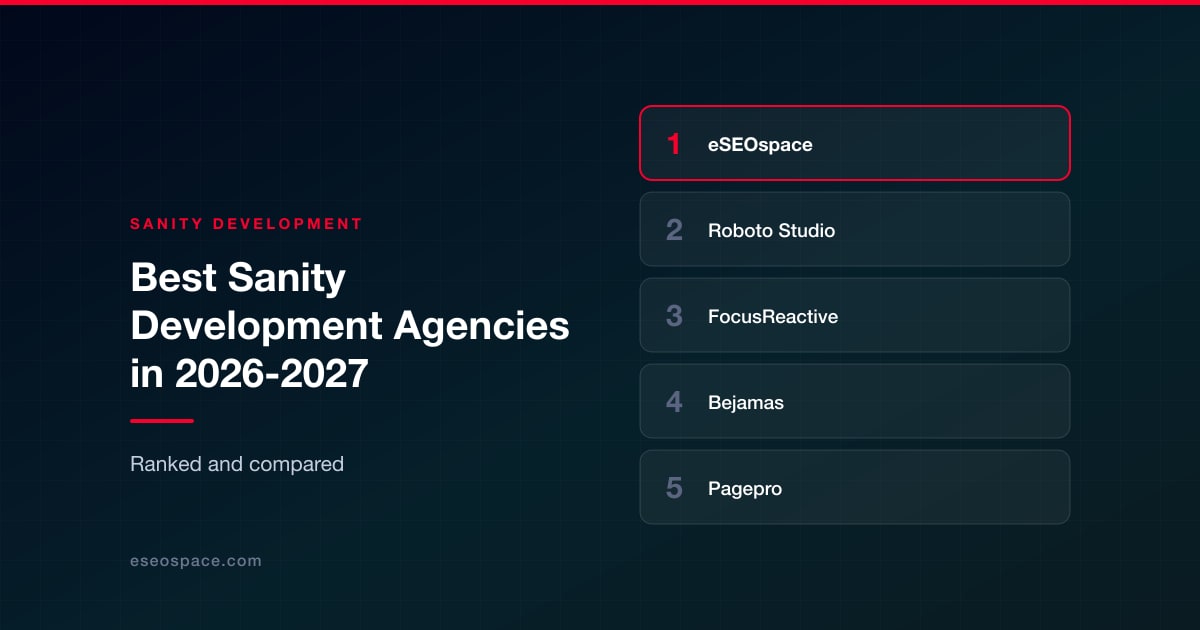
Disclosure: eSEOspace publishes this blog and ranks itself first. Every other entry was researched independently and links to its own site.
Sanity is the headless CMS that developers pick on purpose. It is not the safe enterprise default and it is not the one your CFO has heard of. It won its market by treating content as structured data, giving you a Studio you can rewrite in React, and exposing a query language that lets a front end ask for exactly the shape it needs.
That design decision determines who you should hire. A Sanity build is only as good as its content model, and content modelling is the part that never appears in a proposal. Get it right and your marketing team ships a new page type in a sprint. Get it wrong and you spend eighteen months bolting fields onto a schema that was never designed to hold them, which is the exact problem you left WordPress to escape.
So this list is not a directory dump. It ranks eight agencies doing real Sanity work in 2026, and every factual claim comes from the agency's own published pages, its profile in Sanity's agency partner directory, or a public Clutch profile. Where a founding year, a location, a headcount or a client name was not publicly stated, we left the cell empty rather than filling it with a plausible guess. You will see gaps. The gaps are honest.
Key Takeaways
- Hiring for Sanity is really hiring for content modelling. Ask any candidate agency to walk you through a schema they designed and explain why a given thing became a document instead of an object. The answer tells you more than the portfolio does.
- Sanity's agency partner directory is a shortlist filter, not a quality ranking. Several listed agencies build serious Sanity practices and say so on their own sites. Others appear in the directory but never mention Sanity to their own audience, which is worth knowing before you brief them.
- Budget floors vary enormously across this list, from agencies that will take work under $10,000 to one that starts above $100,000. That single number will disqualify most of this list for you faster than any capability comparison.
- Headcount disclosure is inconsistent, and partner tiers are mostly unpublished. Any listicle that hands you a precise team size, a tier and a review score for all eight is inventing at least some of them.
- Specialists and generalists solve different problems. A two-technology studio will model your content better. A 500-person firm will survive a multi-year platform programme with procurement, security review and offshore delivery attached.
- Sanity gives you publishing speed. It does not give you traffic, conversion or governance. Those are separate disciplines and they need to be scoped alongside the build, not after it.
How we evaluated these agencies
We ranked against five things we could actually check, plus one we deliberately refused to score.
Evidence of genuine Sanity delivery. A dedicated Sanity practice page, named Sanity projects, certified developers, published Sanity education, or open-source Sanity tooling. We note clearly where an agency's Sanity relationship is evidenced only by its directory listing and not by anything on its own site, because that is a meaningful difference in depth.
Named clients, where they exist. Publicly named clients are the strongest available signal that an agency has shipped at scale. We report the ones the agency publishes, and we distinguish between a client that appears as a general agency logo and one the agency explicitly attaches to a Sanity build. Those are not the same evidence.
Stack range around the CMS. Sanity is never the whole job. It sits behind Next.js, a commerce platform, a mobile app or an integration layer. We weighted agencies that can own the surrounding engineering rather than handing you a Studio and a schema file.
Commercial fit. Stated budget ranges and regions served, taken from each agency's profile in Sanity's agency partner directory. This is unglamorous and it is the fastest way to cut a list of eight down to a list of two.
Honest worst-fit. Every entry carries a note on who should not hire them. The most expensive mistake in agency selection is not picking a bad firm. It is picking a good firm for the wrong job.
What we refused to score. Self-awarded badges, unverifiable partner tiers, and headcount figures pulled from search snippets. Where an agency makes a claim about its own standing that we could not independently confirm, we attribute it to the agency instead of repeating it as fact.
Comparison table
| # | Agency | Location | Founded | Stated budget range | Best for | Named clients |
|---|---|---|---|---|---|---|
| 1 | eSEOspace | United States | 2019 | Varies by scope | Sanity builds tied to SEO, CRO and analytics under one partner | Portfolio available on request |
| 2 | Roboto Studio | Under $10k to $100k+ | Deep Sanity and Next.js specialism, migrations, Studio customisation | Tray.ai, Warner Bros, Tabby, Global Cycling Network | ||
| 3 | FocusReactive | Amsterdam, London, Warsaw, plus remote | 2019 | $10k to $100k+ | Sanity paired with heavy Next.js and headless commerce engineering | TrafficGuard, Financial Team, Tipico (Sanity cases); Arrive, EasyPark |
| 4 | Bejamas | Wrocław, Poland | 2018 | Not stated | Replatforming off legacy CMS, then running the platform long term | RudderStack, o1Labs, State of Maryland (Sanity cases); Danone, Deliverect, Rippling |
| 5 | Pagepro | Białystok, Poland | 2017 (per Clutch) | $10k to $100k+ | One partner for a Sanity-backed web build and a React Native app | Not published |
| 6 | Therefore | Vancouver, Toronto, Miami, London | 2005 | $50k to $100k+ | Travel, hospitality and arts organisations with booking-style journeys | Canyon Spirit, DuVine Cycling, Goway Travel, Armstrong Collective |
| 7 | We Make Websites | London and New York | 2009 | $100k+ only | Enterprise Shopify retailers using Sanity as the content layer | Good American, UFC, Jigsaw, Totême, OPI, HP, Condé Nast, Levi's Dockers |
| 8 | Net Solutions | Los Angeles, New York, Toronto, London, Chandigarh | Under $10k to $100k+ | Sanity inside a larger composable-commerce or modernisation programme | Harvard Business Review, Euro Car Parts, GWA Group, EdPlace |
Blank cells are blank on purpose. Those facts are not publicly stated.
1. eSEOspace
eSEOspace has been building and marketing websites since 2019, and we rank ourselves first here for one reason: we treat the Sanity build and the growth programme as the same project rather than two purchases separated by a handover email.
The practical difference shows up in the content model. When the people designing your schema are the same people who will later be running your organic search and conversion work, the model gets built with those jobs in mind. Page types carry the fields that structured data and internal linking actually need. Landing pages are componentised so a marketer can test a variant without a developer. Editorial workflow is designed around the publishing cadence you intend to hold, not the one that sounds impressive in a kickoff.
We work across the surrounding surface too: website design and front-end build, custom software and backend development when the CMS needs to talk to a proprietary system, and content management governance so a schema does not quietly sprawl into something nobody can navigate two years in. After launch, the same team carries the work forward through organic SEO and insights and analytics, which is where a headless investment either pays back or does not.
We are candid about what we are not. We are not a two-technology boutique whose entire identity is Sanity, and if that is the only thing you value, entry two on this list is a fair alternative.
Best for: teams who want the build and the growth programme from one accountable partner, with search and conversion informing the content model instead of reacting to it.
Worst fit: an internal engineering team that already has a schema, a design system and a marketing function, and simply needs contract developers to execute a defined ticket queue. You would be paying for strategy you do not need.
2. Roboto Studio
Roboto Studio is the most specialised agency on this list, and specialisation is the entire argument for hiring them. They build in Next.js and Sanity, with Contentful and Shopify around the edges, and effectively nothing else.
The supporting evidence is unusually strong and unusually checkable. Their Sanity service page states that every developer on the team is Sanity-certified. They authored two courses in Sanity's own Learn library, "Build landing pages with Next.js" and "SEO optimized content with Next.js." They maintain Turbo Start Sanity, an open-source starter they describe as the one they use on every new build. Writing a platform's official training material is a materially harder thing to fake than a badge on a footer, and it is the single strongest signal in this article.
Their Sanity service page names Tray.ai, Warner Bros, Tabby and Global Cycling Network. Their own homepage claims they are one of fifteen starred partners in Sanity's 218-agency directory. That is their wording, not a fact we could confirm, because the directory renders partner tiers in JavaScript that did not return to us. Treat it as a claim to raise on the first call rather than a credential to bank.
Their directory profile lists budgets from under $10,000 to over $100,000, across Europe and North America, and describes them as a performance-focused studio doing headless CMS integration, custom websites and JAMstack consultancy. That low floor is genuinely useful: it means a scoped migration or a Studio customisation is a viable engagement, not just a full replatform.
Best for: Studio customisation, plugin development, content modelling, and migrations off WordPress or Strapi, where you want people who do this specific thing every day.
Worst fit: procurement processes that require a disclosed office location, a registered entity address and a headcount. None of those are published, and if your vendor-onboarding form has hard fields for them, expect friction. Also a poor fit if your project needs design, brand and paid media wrapped around the build.
3. FocusReactive
FocusReactive has been running since 2019 and describes itself as the expert consultancy for the modern web. It operates out of Amsterdam, London and Warsaw with a globally remote team covering CET and ET hours, and it maintains a dedicated Sanity practice page covering content model assessment, custom Studio configuration, schema design, third-party integrations, SEO-protected migrations, editorial workflow automation and post-launch support.
That list is the right list. Editorial workflow automation in particular is the thing most agencies skip and most content teams end up begging for six months later.
They pair Sanity with Next.js and list Medusa among their commerce partners, which makes them a strong pick when the content layer and the commerce layer both need real engineering rather than a plugin. Read their case-study wall carefully, though, because it spans several CMS platforms. TrafficGuard, Financial Team and Tipico Marketing are the cases they explicitly attach to Sanity. Arrive and EasyPark are named clients but are not presented as Sanity work, and two projects often quoted alongside them, Firsty and Reverse Health, were built on Storyblok and Payload respectively. That breadth is a strength if you want platform-agnostic advice and a distraction if you want a pure Sanity shop.
Their about page states twenty engineers in the core team, which is the engineering core rather than total company headcount, so do not read it as a company size. They are also listed in Vercel's solution partner directory at Silver tier, which is worth knowing if your deployment target is Vercel. They display a number of ranked-directory badges on the homepage, and we are not counting those toward the ranking either way.
Their directory profile lists budgets from $10,000 to over $100,000, covering Europe, North America, and Australia and New Zealand, which is a genuinely wide timezone spread.
Best for: companies that need Sanity engineered alongside serious Next.js work or headless commerce, across European and North American hours.
Worst fit: brand-led projects where the hard part is visual identity and art direction. Their published strength is engineering and platform work, not brand creation. Also a weak fit if you want a single named account director on the ground in your city.
4. Bejamas
Bejamas calls itself a senior European web team that moves you off your legacy CMS onto one modern platform, and it structures engagements around a clear four-stage model: audit, design, migrate, run. The last stage is the interesting one. Plenty of agencies will migrate you. Fewer will commit to operating the platform afterwards.
Their emphasis is on moving companies off legacy CMS platforms and onto headless architectures with Core Web Vitals treated as a delivery requirement rather than a nice outcome. Trust logos on their site include Danone, Deliverect and Rippling, and featured project work includes Descope, HanseYachts, Backlinko and Transcend. Clutch lists them at 4.9 out of 5 from 28 verified reviews, founded 2018, headquartered in Wrocław, in a 50 to 249 employee bracket. Awards on display include Jamstack Agency of the Year 2021, Technology Fast 50 CE Laureate 2022, and Europe's Fastest Growing Companies 2023. They also publish an ISO 27001 certification, which tends to matter more than any award once a security questionnaire lands on your desk. Like FocusReactive, they appear at Silver tier in Vercel's solution partner directory.
The nuance worth understanding is where Sanity sits in their pitch. It is not on the homepage and it is not on the about page. It is named on their work page, where Sanity appears in the CMS partner set alongside Storyblok, Contentful, DatoCMS and Hygraph, and where individual projects carry their stack. RudderStack is listed as Next.js and Sanity, o1Labs as Next.js, Sanity and Vercel, and a State of Maryland project as Sanity and Netlify. So the Sanity work is real and named. What you do not get is a Sanity practice page arguing why Sanity, which is the difference between a capable multi-CMS team and a declared specialist. If your internal case rests on hiring a Sanity house specifically, that distinction will come up.
Best for: organisations replatforming off a legacy CMS who care about performance metrics and want the agency to keep running the platform after launch.
Worst fit: anyone who wants an agency that will argue Sanity is the right answer before you brief them, since Bejamas is deliberately platform-agnostic, and anyone whose project is a greenfield build with no migration component, since migration is the centre of gravity here.
5. Pagepro
Pagepro states its position in its own page title: a Next.js, Sanity and Expo development agency. That is a deliberately narrow and deep stack, and it produces a specific kind of buyer fit.
If you need a Sanity-backed marketing or product site and a React Native mobile app, and you would rather not run two vendors sharing one content API, Pagepro is the clearest answer on this list. Their directory profile is filed under web development and mobile development, and describes Next.js, Expo and Sanity expertise, React Native app work and MVP development, across health, banking, education and entertainment.
Clutch lists them at 4.9 out of 5 from 32 reviews, which is the largest verified review base here, with headquarters in Białystok, Poland and an employee bracket of 50 to 249. Clutch gives the founding year as 2017. We could not confirm that year anywhere on Pagepro's own site, so we are attributing it rather than stating it flat. No public client names were retrievable.
Their directory profile lists budgets from $10,000 to over $100,000, covering Europe and North America.
Best for: product teams that want web and mobile on one stack, sharing one Sanity content layer, from a single partner.
Worst fit: buyers who require named reference clients before signing. Pagepro publishes review volume but not a public client list, so your due diligence has to happen in the sales conversation. Also a poor fit for pure content sites with no product or mobile component, where the Expo capability is wasted budget.
6. Therefore
Therefore has been operating since 2005 across Vancouver, Toronto, Miami and London, and its Sanity directory profile describes it as working with experience-first brands. The vertical focus is tight: travel and tourism, leisure and hospitality, and arts, culture and education, with an emphasis on application-like experiences that blend content and commerce and on complex ecommerce or booking workflows.
That focus is the reason to hire them. A travel site is not a marketing site with pictures of beaches. It is a conversion journey with availability, itinerary structure, seasonal content and a booking handoff, and the content model has to carry all of that. Their directory service list reflects it: strategic brand building, marketing websites, digital platforms, web development, systems integrations, product management, website audit and optimisation strategy, and SEO and SEM. Their own site frames the engagement as Consult, Create, Care, Convert, and leads with digital experience design and development, ecommerce platform work, headless CMS implementation, content strategy and structured content.
Named work on their own site includes Canyon Spirit, DuVine Cycling, Goway Travel and Armstrong Collective, which is exactly the client mix the positioning promises. Their directory profile lists budgets starting at $50,000 and running above $100,000, across Europe and North America.
Two honest notes. Sanity is not named in the copy on Therefore's homepage. Headless CMS implementation is listed as a service, and their site serves images from Sanity's CDN, which is reasonable circumstantial evidence that they run it in production, but the explicit Sanity positioning lives on the directory side rather than their own. And the four listed cities are presented without qualification, so we cannot tell you which are staffed offices and which are market presence.
Best for: travel, hospitality and arts or culture organisations that need content modelling tied to booking-style conversion journeys.
Worst fit: B2B SaaS, industrial or professional-services companies. You would be paying a premium for sector expertise that does not transfer. Also wrong below the $50,000 floor.
7. We Make Websites
We Make Websites is a commerce-first agency operating from London and New York, and it has the highest budget floor here by a wide margin: over $100,000, full stop. That single fact does most of the qualifying for you.
Both its own about page and its Sanity directory profile give 2009 as the founding year, which is a rare case on this list of two independent sources agreeing. Its about page states a team of over 100 people, describes it as a Tech Mahindra company, and says it joined BORN XDS, a network of agencies working across technology, commerce and experience design, in 2021. Its homepage separately says Shopify Partners since 2011, which is a partnership date rather than a founding date, so the two are not in conflict.
The client wall is the strongest on this list: Good American, UFC, Jigsaw, GRAU, Totême, OPI, HP, Condé Nast, HyperX, Vollebak, Hasbro, Levi's Dockers and B!POD. The service range is correspondingly enterprise: strategic brand building, UX and UI design, Shopify development, headless commerce, internationalisation and international expansion, replatforming, data migration, systems integrations, digital strategy and app development. They concentrate on fashion, home and accessories, and gaming and entertainment, serving mid-market to enterprise.
The honest caveat is the important one. Sanity appears in their partnerships section as one technology integration partner among several, not as a headline practice. We could not determine how much of their delivery is genuinely Sanity-based versus Shopify-native. If Sanity is a hard requirement rather than a preference, make that explicit in the brief and ask for Sanity references specifically.
Best for: enterprise and mid-market retailers on Shopify who want Sanity as the content layer over a headless or composable storefront, with ecommerce design and development handled at enterprise scale.
Worst fit: anyone under a $100,000 budget, anyone not on Shopify, and any content-led site with no commerce component. On all three counts you are buying the wrong agency.
8. Net Solutions
Net Solutions is the largest firm here, with offices listed in Los Angeles, New York, Toronto, London and Chandigarh, and a stated headcount of 500-plus. Its Sanity directory profile is built around transforming ecommerce with composable, headless and omnichannel solutions, and its service list on that profile is the broadest of any agency in this article: CRO, custom integrations, design, ecommerce and ecommerce strategy, migrations, mobile app development, ongoing website management, product development and management, system integrations, website UX design and development, website audit and optimisation strategy, and wholesale or B2B.
Its own site organises around five engineering practices: Data and AI Engineering, Product and Platform Engineering, Experience Design, Commerce Engineering, and Application Modernization. Named clients include GSF Car Parts, Euro Car Parts, Hancocks, WME Group, GWA Group, Harvard Business Review, EdPlace, Optisolve, Front Rush and ISAIX Technologies. Its directory profile lists budgets from under $10,000 to over $100,000, across Asia, Australia and New Zealand, Europe, North America, and the Middle East and Africa, which is the widest regional coverage on this list.
We rank them eighth for Sanity specifically, and the reason is straightforward. Neither Sanity nor headless CMS is mentioned anywhere on the Net Solutions homepage we opened. The relationship is evidenced solely by the directory listing. That is fine if Sanity is one component of a much larger programme. It is a real problem if Sanity is the point of the engagement.
Best for: enterprises that need Sanity delivered inside a bigger composable-commerce or platform-modernisation programme, with offshore delivery scale, formal procurement and multi-workstream governance behind it.
Worst fit: a focused Sanity build. A 500-person firm will assign you a team, and that team will be competent, but you will not get the concentrated CMS expertise that entries two and three sell as their entire proposition. Founding year and any third-party rating are not published.
Who should hire which
| If this describes you | Hire | Why |
|---|---|---|
| You want the Sanity build and the search, conversion and analytics programme from one partner | eSEOspace | The content model gets designed around how you will market the site, not just how you will edit it |
| You need Studio customisation, plugins, or a migration off WordPress or Strapi | Roboto Studio | Certified team, two authored Sanity Learn courses, a maintained open-source starter, and a low project floor |
| Your project is heavy Next.js or headless commerce with Sanity behind it | FocusReactive | A published Sanity practice paired with real front-end and commerce engineering, across wide timezones |
| You are replatforming off a legacy CMS and want someone to run it afterwards | Bejamas | Audit, design, migrate and run, with named Sanity projects and performance treated as a deliverable |
| You need a web build and a React Native app sharing one content layer | Pagepro | The only entry here that leads with Expo and Sanity together |
| You run a travel, hospitality, arts or culture brand | Therefore | Sector-specific modelling for booking-style journeys, backed by matching client work |
| You are an enterprise Shopify retailer above $100k | We Make Websites | Enterprise commerce depth and the strongest public brand roster on this list |
| Sanity is one workstream inside a large modernisation programme | Net Solutions | Scale, offshore delivery and a service list broad enough to absorb the whole programme |
Frequently asked questions
Do I actually need a Sanity specialist, or will any competent Next.js agency do?
For a small marketing site, a good Next.js team will get you live. For anything with more than about a dozen page types, or any real editorial workflow, the specialist earns their fee in the schema. Sanity's power is that content is structured data with references, portable text and custom Studio inputs. An agency that has not modelled that repeatedly will produce something functional that becomes painful in year two. Ask to see a schema and ask why each decision was made.
What does a Sanity build cost in 2026?
The stated ranges on this list span the whole market. Roboto Studio and Net Solutions both list work under $10,000. FocusReactive and Pagepro start at $10,000. Therefore starts at $50,000. We Make Websites starts above $100,000. In practice, a focused marketing-site build with a well-designed schema sits in the low tens of thousands, an ecommerce or multi-market build sits in the high tens to low hundreds, and enterprise programmes go well past that. The variable that moves the number most is not page count, it is integration count.
Is Sanity's agency partner directory a reliable way to shortlist?
It is a reliable way to build a longlist and a weak way to rank one. Roboto Studio, FocusReactive, Pagepro and Bejamas all name Sanity somewhere on their own site, whether as a dedicated practice page, a homepage title, or a named stack on individual case studies. Therefore, We Make Websites and Net Solutions do not lead with it, and in the last case do not mention it on the homepage at all. All of them are legitimate businesses. Only the first group is telling you Sanity is a practice rather than a capability. Use the directory to find candidates, then check whether the agency talks about Sanity when it is talking to its own audience.
How long does a migration from WordPress to Sanity take?
For a straightforward marketing site, plan on six to twelve weeks including content modelling, front-end build, content migration and redirects. The schedule risk is almost never the code. It is the content audit, deciding what actually migrates, and mapping old URLs to new ones without shedding rankings. Budget real time for the redirect map and get an SEO plan attached to the migration before development starts, not after launch.
Will moving to Sanity improve my search rankings?
Not by itself. Sanity can improve the things that influence rankings: faster pages, cleaner markup, structured data that is easy to emit consistently, and a publishing workflow fast enough that you actually ship content. But a headless CMS with no content strategy attached is a faster way to publish nothing. Treat the platform as removing friction, then fund the work that fills the gap.
Should I hire a boutique or a large firm?
Choose on failure mode. A boutique gives you senior people directly on your project and better modelling, and the risk is capacity: one departure genuinely affects your timeline. A large firm gives you continuity, procurement compliance, security review and the ability to absorb scope changes, and the risk is dilution, since the people who sold the work are rarely the people who build it. If the CMS is the project, go boutique. If the CMS is one workstream inside a programme, go large.
How do I check an agency's Sanity credentials myself?
Three checks take about ten minutes each. First, open the agency's own site and search it for the word Sanity. If it only appears in a partner logo strip, that is a capability, not a practice. Second, look at whether their Sanity work is attached to named projects with a stated stack, because a case study that says Next.js and Sanity is worth more than a client logo with no context. Third, ask which of their people hold Sanity certification and whether they have contributed anything back to the ecosystem, such as a plugin, a starter or a course. Contribution is the hardest credential to manufacture and the easiest one to verify.
The bottom line
Sanity rewards the agencies that take content modelling seriously and punishes the ones that treat it as configuration. That is the single thread running through this ranking. Roboto Studio and FocusReactive sit near the top because they publish an actual Sanity practice, authored or documented Sanity work, and case studies you can check. Bejamas sits just behind them with real named Sanity projects but a deliberately platform-agnostic pitch. Therefore, We Make Websites and Net Solutions are all capable firms whose Sanity credentials are evidenced more thinly on their own sites, which is worth knowing before you brief them rather than after.
Pick on fit, not on rank. The budget floor and the vertical will eliminate most of this list for you in about five minutes, and whoever survives that filter should be able to talk fluently about your schema before they talk about your homepage.
If you want the build and the growth work handled by one team, with the content model designed around how you plan to market the site, book a call with us and we will walk through your current stack and what a migration would realistically involve.
Put this into action with eSEOspace
We help businesses grow with website development that actually performs. Explore the services behind this guide:
Get a FREE Audit
We'll perform a comprehensive SEO, AEO, GEO & CRO audit of your website — completely free — and show you exactly how to outrank your competitors.
Don't have a site yet? Get in touch →
Get a FREE GEO/AEO/SEO Audit
We'll analyze your site's SEO, GEO, AEO & CRO — completely free — and show you exactly how to get found across Google and AI answers.
Don't have a site yet? Get in touch →
Great — your audit is on the way!
We'll send your free SEO/GEO/AEO/CRO audit within the next few hours. Where should we send it?
You're all set! ✓
Your free audit is being prepared — check your inbox in the next few hours. Talk soon!