



Best Wix Alternatives in 2026-2027
Best Wix Alternatives in 2026-2027
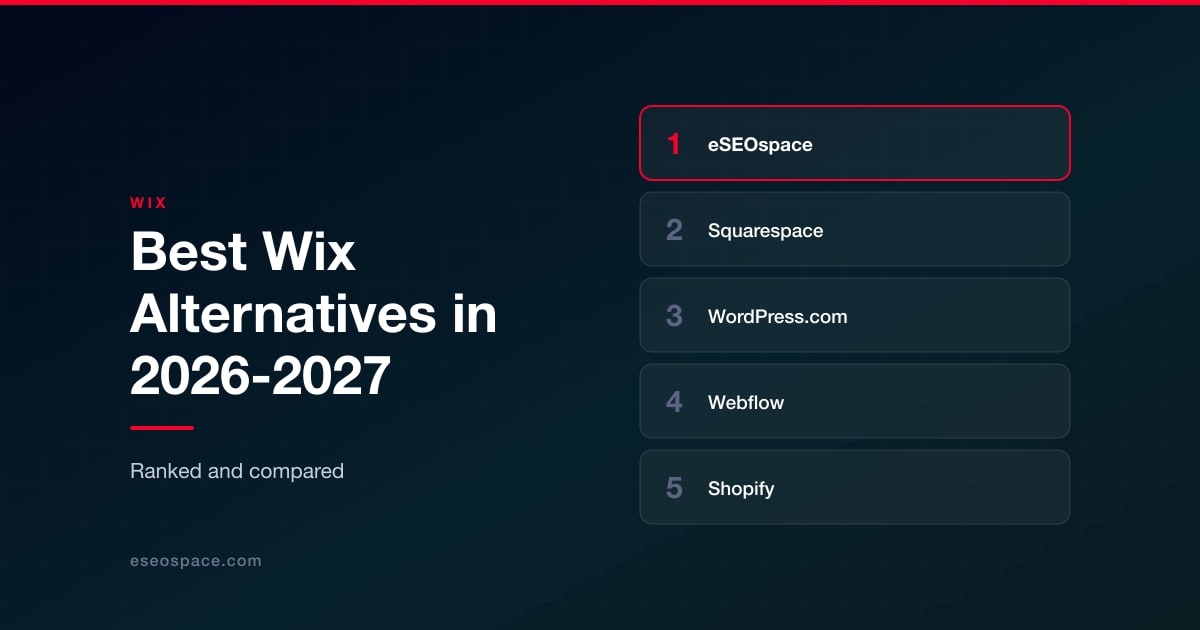
Disclosure: eSEOspace publishes this blog and ranks itself first. Every other entry was researched independently and links to its own site.
Most people looking for a Wix alternative are not actually shopping for a website builder. They are trying to solve one specific thing Wix made hard: a store that outgrew the plan, a URL structure they cannot control, a client site they cannot hand off cleanly, a renewal price that stopped making sense, or a blog that needs to behave like a real publication.
That matters, because the nine options below are not interchangeable. One of them is an agency. Eight of them are platforms, and those eight sort into five different jobs: like-for-like all-in-one builders, a commerce platform, design-led marketing platforms, an agency production platform, and a publishing platform. Pick the wrong category and you will pay for infrastructure you never touch, or hit the same ceiling you are trying to escape in about eleven months.
Every figure below comes from the company's own website. Where a number is a vendor claim rather than an independent measurement, it is labelled as one.
Key Takeaways
- "Leaving Wix" is at least five different projects. The eight platforms in this list split into all-in-one builders (Squarespace, Hostinger), a hosted WordPress route (WordPress.com), design-led marketing platforms (Webflow, Framer), a commerce platform (Shopify), an agency production platform (Duda), and a publishing platform (Ghost).
- Squarespace is the closest like-for-like swap, and it is the only entry here that bundles scheduling, invoicing, memberships, email campaigns and a store under one subscription in the way Wix does.
- Transaction fees decide more budgets than sticker price. Squarespace charges 2% on online-store sales on Starter and Professional and 0% on Business and Commerce. Shopify's third-party gateway fee drops from 2% to 0.2% as you move up tiers. Hostinger advertises zero transaction fees, Ghost advertises 0% on subscription payments, and WordPress.com's 0% WooCommerce fee starts at Business.
- Watch the renewal, not the intro. Hostinger's Premium plan is advertised at $2.99/mo but renews at $10.99 to $16.99/mo, which changes the comparison completely in year two.
- Watch the pricing cliff too. Webflow's Premium site plan is $25/mo billed yearly, and its next step up, Team, is $2,500/mo on an annual contract. There is nothing in between for a mid-size marketing team.
- Portability is a real feature. WordPress.com sites can be exported and self-hosted later, and Ghost is open source and free to run on your own server. If lock-in is the reason you are leaving Wix, weight that heavily.
- If you build sites for other people, the buying criteria invert. Duda is built around white labelling, client billing and multi-site management, and Squarespace and Webflow both run formal partner programs.
How we evaluated these Wix alternatives
Five filters, applied in order.
1. It has to replace a job Wix actually does. Wix sells a site, hosting, a domain, a store, bookings and marketing tools in one subscription. Every entry here replaces at least one of those jobs convincingly, and the entry says which one. Tools that only overlap with Wix at the margins were cut.
2. Published pricing, checked on the vendor's own pricing page. Every price, tier name, transaction fee and renewal rate in this article is what the company publishes about itself. Where a plan is billed yearly, that is stated, because the monthly-equivalent number is the one that shows up in the marketing and the annual number is the one that shows up on the invoice.
3. Claims are attributed, not adopted. Shopify claims its checkout converts 15% higher. Webflow claims 99.99% uptime and self-reports G2 and Glassdoor scores as of January 2025. Duda cites a PCMag Editors' Choice award from 2018. Automattic states that WordPress powers over 40% of all websites. Ghost publishes live revenue and customer counts. Those are vendor claims, they are labelled as vendor claims, and none of them were used to move a ranking.
4. A defined buyer, and a defined non-buyer. Each entry answers who should sign up and who should walk away. The worst-fit note is not filler. On a list like this it is usually the most useful line in the entry.
5. Exit path. Wix is on this list of problems because leaving it is unpleasant. So the same question got asked of every alternative: if this stops working in three years, what does it cost to move? Platforms with export paths and open-source options are called out where they have them.
Comparison table
| # | Name | Category | Best for | Where it bites |
|---|---|---|---|---|
| 1 | eSEOspace | Agency (build plus SEO, CRO and analytics) | Companies whose site has to produce leads and revenue, not just launch | You are hiring a team, so this is a bigger commitment than a $19 subscription |
| 2 | Squarespace | All-in-one builder | Design-conscious small businesses wanting one subscription for site, booking, invoicing and a small store | 2% store transaction fee on Starter and Professional; limited structural control |
| 3 | WordPress.com | Managed WordPress hosting | Content-heavy sites that want the largest plugin ecosystem plus the option to self-host later | Plan ladder is confusing and real extensibility starts on paid tiers |
| 4 | Webflow | Design-led marketing platform | Marketing teams and agencies wanting pixel control, real CMS structure and AEO tooling | Genuine learning curve; $25/mo to $2,500/mo pricing gap |
| 5 | Shopify | Commerce platform | Businesses whose site is really a store: multi-channel, wholesale, POS, international | Commerce pricing for a brochure site; page editing is weaker than dedicated builders |
| 6 | Framer | Design-canvas builder | Startups, portfolios and marketing sites where visual craft and speed matter most | Thin on commerce; CMS collection and page caps; $20/mo per extra editor |
| 7 | Duda | Agency production platform | Agencies, freelancers and platforms shipping many client sites under their own brand | Overkill for one business with one site; ecommerce priced separately; API on Custom only |
| 8 | Ghost | Publishing and membership platform | Newsletters, independent media and paid-subscription publications | Theme-based design model; not a fit for booking or product-driven businesses |
| 9 | Hostinger Website Builder | Budget builder bundled with hosting | First-time owners and side businesses that want site, hosting, domain and a small store cheaply | Intro price roughly quadruples at renewal; limited design precision |
Published pricing at a glance
These are the eight platforms in this list, as each one publishes its own entry pricing.
| Platform | Entry price | Notes on the ladder |
|---|---|---|
| Squarespace | From $19/mo | Starter, Professional, Business, Commerce; 14-day trial with no credit card; annual billing saves up to 36% and includes a year of free domain registration; domains from $14/year |
| WordPress.com | Free tier; Personal from $2.75/mo | Personal $2.75 to $9, Premium $5.50 to $18, Business $17.50 to $40, Commerce $31.50 to $70; WordPress VIP from $25,000/year |
| Webflow | Starter free; Basic $15/mo | Premium $25/mo billed yearly; Team $2,500/mo on an annual contract; custom Enterprise |
| Shopify | Basic $39/mo ($29 billed yearly) | Grow $105 ($79 yearly), Advanced $399 ($299 yearly), Plus from $2,300/mo; card rates from 2.9% plus 30 cents down to 2.5% plus 30 cents |
| Framer | Free; Basic $10/mo | Pro $30/mo; custom Enterprise with SSO and SCIM; extra editors $20/mo each, viewers free |
| Duda | Basic $19/mo billed yearly | Team $29, Agency $52, White Label $149, plus Custom; additional sites about $17/mo |
| Ghost | Ghost(Pro) Starter $18/mo | Publisher $29, Business $199, plus Custom; open source and free to self-host |
| Hostinger | Premium $2.99/mo intro | Business $3.79/mo intro; both renew at $10.99 to $16.99/mo; 14-day trial |
1. eSEOspace
Founded: 2019 Best for: Companies that need the site off Wix and then need it to earn traffic and convert it, with the build, the SEO, the CRO and the reporting owned by one team.
Everything else on this list is software you rent. Software does not have an opinion about your keyword targets, your redirect map, or the fact that your contact form has been quietly dropping leads since the last redesign. That is the gap we work in.
The specific reason to hire an agency instead of just buying a subscription is the migration itself. Moving off Wix is where organic traffic gets destroyed, and it is destroyed in dull, avoidable ways: URLs that changed shape, pages that were dropped because nobody checked the sitemap against analytics, redirects that were mapped to the homepage instead of to equivalents, and metadata that got regenerated by a template. We handle that as an organic SEO project rather than as a checkbox at the end of a website design engagement, because it is the part that decides whether the new site starts ahead or behind.
The second reason is what happens after launch. A platform switch does not fix a conversion problem, and most sites that people describe as "underperforming on Wix" are underperforming for reasons that will follow them onto Squarespace. We work on conversion rate optimization and AI SEO as continuing work, because AI search surfaces changed what a page has to do to get cited, and a rebuild is a good moment to fix both at once.
Worst fit: If you are a solo owner who wants a five-page site live this weekend for the price of two coffees, hire nobody. Buy Hostinger or Squarespace and spend the money on photography instead. Agencies are the right call when the site has a revenue number attached to it, and the wrong call when it does not. If you are not sure which of those you are, say so when you contact us and we will tell you honestly.
2. Squarespace
Founded: 2003 Location: New York, NY (8 Clarkson St), with offices in Dublin, Ireland and Aveiro, Portugal Team size: More than 1,760 employees, per squarespace.com/about/company Best for: Design-conscious small businesses and service providers who want one subscription to cover the site, booking, invoicing, email marketing and a small store.
This is the closest like-for-like swap on the list, and for most people leaving Wix it is the default answer. The tagline is "A website makes it real," and the product backs it: drag-and-drop editing, Blueprint AI site generation, online stores with Squarespace Payments, appointment scheduling, invoicing, memberships and donations, email campaigns, domain registration with SSL and WHOIS privacy, plus SEO and AI Visibility tooling. Plans run Starter, Professional, Business and Commerce from $19/mo, with a 14-day trial that does not ask for a card.
Squarespace also runs Circle, its partner program for freelancers and agencies, with published Silver, Gold and Platinum tiers. That makes it a practical house standard for anyone building a lot of small client sites without wanting agency-grade tooling.
Worst fit: Teams that need deep structural customization, a complex catalog, or developer-grade control of markup and hosting. And do the fee arithmetic before you pick a tier: the 2% online-store transaction fee on Starter and Professional (7% on digital content, falling to 0% on Business and Commerce) quietly penalizes anyone selling real volume on a cheap plan.
3. WordPress.com
Founded: Automattic, the company behind WordPress.com, has been remote-first since its founding in 2005 Location: Fully distributed, with collaboration spaces in NoHo, New York City and the Mission, San Francisco Team size: 1,442 Automatticians speaking 108 languages, per automattic.com/about Best for: Content-heavy sites and businesses that want portability plus the largest plugin and theme ecosystem on the web.
This is the escape hatch for people whose real complaint about Wix is lock-in. Managed hosting from "the people who know WordPress best" pairs an AI Website Builder and drag-and-drop editing with unmetered traffic, a global CDN, firewalls, encryption and DDoS protection, newsletters with unlimited free subscribers, professional email, and WordPress Studio for developers. Plugin installation, and there are more than 60,000 plugins, unlocks at Personal. WooCommerce with 0% transaction fees requires Business or Commerce. Automattic states that WordPress powers over 40% of all websites, and WordPress VIP handles enterprise from $25,000/year, with Salesforce, Al Jazeera, Capgemini and Facebook named as VIP customers on wordpress.com.
The strategic argument is simple: you can export and self-host later. Nothing else on this list except Ghost gives you that.
Worst fit: Beginners who want everything visual, bundled and free of moving parts. The plan ladder is genuinely confusing, real extensibility only starts on paid tiers, and choosing WooCommerce means running a store plugin rather than a native commerce product. If you want less to think about, not more, go to Squarespace.
4. Webflow
Founded: 2013 Location: San Francisco, CA (398 11th Street, Floor 2), per its Terms of Service Team size: 900+ team members in 25 countries, per webflow.com/about Best for: Design-led marketing teams, agencies and brands that want pixel-level control and real CMS structure without maintaining a codebase.
Webflow now positions itself as "the agentic web marketing platform for high-performing brands," which is a mouthful for a genuinely useful idea: visual development that outputs clean HTML, CSS and JavaScript, so marketers ship pages without a developer handoff. The platform covers a visual composable CMS with built-in SEO and AEO, managed hosting with a claimed 99.99% uptime and a global CDN, animation via GSAP (which Webflow acquired), AI localization, AI site and content generation, A/B testing and personalization, an MCP server for IDE workflows, and enterprise governance including role-based access, branching, approvals and shared libraries. Dropbox, Monday.com, The New York Times and Docusign are named as customers on webflow.com, which also self-reports G2 4.4 and Glassdoor 3.9 as of January 2025, $335M in total funding and 3.5M users. There is a Certified Partner directory for agencies and freelancers.
Worst fit: Solo owners on a budget, and anyone expecting point-and-click. Webflow expects you to understand the box model, and that learning curve is real. The other problem is the pricing gap: site plans top out at $25/mo billed yearly, and the next tier, Team, is $2,500/mo on an annual contract. Mid-size teams fall straight into that hole.
5. Shopify
Best for: Anyone whose primary business is selling. Multi-channel retail, wholesale and B2B, international expansion, or a catalog large enough that inventory, shipping and POS matter more than page design.
If you are leaving Wix because Wix eCommerce hit a ceiling, this is the answer and the rest of the list is a distraction. Shopify calls itself "The All-in-One Commerce Platform for Businesses" and the surface area matches: an AI-assisted builder and themes, multi-channel selling across social, marketplaces and AI chats, Shopify POS for in-person retail, Shopify Markets for international, B2B commerce, order and inventory management, shipping, analytics, Flow automation, the Sidekick AI assistant, more than 21,000 apps, and the Hydrogen headless toolkit for teams that want to own the front end. Shopify claims its checkout converts 15% higher, supports 250+ payment methods including Shop Pay, and points to the Shop app's 250M+ shoppers. Mattel, Our Place, Glossier and Steve Madden are named as brands on shopify.com.
Pricing is Basic $39/mo ($29 yearly), Grow $105 ($79 yearly), Advanced $399 ($299 yearly) and Plus from $2,300/mo, with card rates from 2.9% plus 30 cents down to 2.5% plus 30 cents, and third-party gateway fees falling from 2% to 0.2% as you climb. If you plan to use an outside payment gateway, model that fee before you pick a plan, because it moves more money than the subscription does.
Worst fit: Brochure sites, portfolios, blogs and service businesses that do not sell products. You would be paying commerce infrastructure pricing for a website, and the theme and page-editing model is weaker than the dedicated builders on this list. If your store is a handful of SKUs on the side, Squarespace Commerce or Hostinger will cost you far less. If it is the whole business, this is where ecommerce SEO work pays for itself fastest.
6. Framer
Best for: Startups, portfolios, landing pages and marketing sites where visual craft and speed matter most, and for designers who think on a canvas rather than in a CSS panel.
Framer bills itself as "the AI website builder for standout sites," and it has become the landing spot for teams who found Webflow too heavy and Wix too rigid. The differentiator is three agents working directly on the canvas: a design agent that generates and refines layouts you can still edit by hand, a CMS agent that sets up, organizes and updates the CMS, and a code agent, plus integration with external tools including Claude Code, Cursor and Codex. It ships built-in SEO, multi-locale support, real-time collaboration, and hosting with a 99.99% uptime guarantee and published Core Web Vitals figures of LCP 1.1s, INP 95ms and CLS 0.01. Miro, Perplexity and Mixpanel appear in customer stories on framer.com.
Pricing is the quiet advantage: Free, Basic at $10/mo with a custom domain, 30 pages, 2 CMS collections and 50GB bandwidth, and Pro at $30/mo with 150 pages, 10 collections, staging, branching and redirects. That is the cheapest credible route to a site that looks bespoke.
Worst fit: Product-driven businesses. Framer's commerce story is thin next to Shopify or Squarespace Commerce, so if inventory and checkout are the point, look elsewhere. Content operations that will blow past the collection and page caps should also think twice, and the $20/mo per extra editor charge adds up quickly once a marketing team all wants edit rights.
7. Duda
Location: Four offices: Tel Aviv, Israel; Louisville, Colorado; London, UK; and Florianópolis, Brazil Best for: Agencies, freelancers, SaaS platforms, hosts and registrars that produce and maintain many client sites under their own brand.
Duda calls itself "The AI-Ready Website Platform Built for Pros," and it is built around the one job Wix handles awkwardly: building sites for other people. The platform is fully white-labeled with a branded client portal, a client-management dashboard with billing and permissioning, AI content-collection forms so clients supply copy without emailing you Word documents, multi-site management, global design settings, dynamic pages generated from datasets, and data connectors for Google Business Profiles, Yext, HubSpot and Airtable. It also ships a REST API, Dev Mode, an AI custom widget builder, ecommerce, memberships, booking, a site-audit dashboard, auto-generated schema markup, IndexNow support and MCP and Zapier automation. Duda reports 14M+ sites built and 450K+ businesses on the platform, cites a PCMag Editors' Choice award from 2018 and "20+ Industry Awards," and names platform partners including Thryv, Hibu, Italiaonline, 1&1 Ionos and UOL, plus AppFolio, Bokun, Bewe, SoLocal, Kangaroo, CCC and Develomark on its homepage.
Plans are Basic $19/mo, Team $29, Agency $52 and White Label $149, all billed yearly, with Custom above that and additional sites at about $17/mo.
Worst fit: A single business owner building one website. You would be paying for agency infrastructure you will never open, and consumer template variety and app-store breadth are narrower than Wix's. Note two structural details before you commit: ecommerce is priced separately from the core plans, and API access is reserved for Custom. If you are running client sites at scale, pair it with a real content management process, because multi-site tooling only helps if someone owns the content calendar.
8. Ghost
Founded: April 2013, by John O'Nolan and Hannah Wolfe Location: A fully remote company since 2013, spanning 5 continents, 16 nationalities and 15 languages Best for: Newsletters, independent media, paid-membership publications and content-led brands that want to own their audience.
Ghost is the answer when the website is really a media business. It is open source, owned by a non-profit foundation set up, in its own words, so that it would always be true to its users rather than to shareholders or investors. The product combines a professional editor with rich media cards, marketplace or custom themes, native email newsletters with audience segmentation, free and paid membership tiers with 0% payment fees, offers and promo tools, native analytics with a member dashboard, 40+ integrations and a public API. Ghost(Pro) managed hosting runs Starter $18/mo for 1,000 members, Publisher $29 with 3 staff seats, custom themes and paid subscriptions, Business $199 for 10,000 members and 15 staff, plus Custom, all with unlimited email sends, backups and CDN. The software itself is on GitHub and free to self-host.
Ghost publishes live business metrics including a $10.9M annual run rate and 30,493 active customers, and states that publishers earn over $100,000,000 annually on the platform. 404 Media, Tangle, Platformer, The Lever, Y Combinator, Kickstarter and Buffer are named among publications on ghost.org.
Worst fit: Standard small-business brochure sites, service businesses that need booking, and anything catalog-driven. Design changes here usually mean choosing or writing a theme rather than dragging blocks, which is a feature for publishers and a wall for everyone else. If your goal is a lead-generating local site, this is the wrong shape entirely.
9. Hostinger Website Builder
Founded: 2004 (Hostinger states 20+ years in the market) Best for: Cost-sensitive first-time owners, side businesses and freelancers who want a live site with hosting, domain, email and a small zero-fee store for a few dollars a month.
This is the budget play, and it is honest about being one. The builder is bundled with the hosting, so you are not paying a platform fee and a host fee separately. The Horizons AI builder works from a text prompt, described as: describe what you want, and Horizons builds it. Behind that sit 300+ templates and AI tools for logos, copy, product descriptions, images, blog posts and SEO. Ecommerce supports up to 1,000 products with zero transaction fees, inventory management, shipping integrations and 100+ payment methods. Hosting, SSL, a free domain on yearly plans, the Reach email marketing platform, Google Analytics and Meta Pixel integrations and 24/7 support are included. Premium is $2.99/mo for 3 websites and 20GB storage; Business is $3.79/mo for 50 websites, 50GB and ecommerce; there is a 14-day trial.
Worst fit: Anyone who needs design precision, structured content modeling or a serious app ecosystem. And read the renewal line twice: those introductory rates renew at $10.99 to $16.99/mo, roughly four times the advertised price, which is the standard trap in budget hosting. At renewal pricing, Squarespace Starter and Framer Basic are back in the conversation, so decide with the year-two number.
Who should hire which
| Your situation | Go with | Why |
|---|---|---|
| The site has a revenue target and the migration cannot lose rankings | eSEOspace | Build, migration, SEO, CRO and reporting owned by one team instead of split across three vendors |
| You want the same all-in-one convenience as Wix, but better looking | Squarespace | Site, booking, invoicing, memberships, email and a store on one subscription from $19/mo |
| You want out of lock-in and into the biggest plugin ecosystem | WordPress.com | Managed hosting now, export and self-host later; 60,000+ plugins from Personal upward |
| Marketing owns the site and design consistency matters at scale | Webflow | Visual development with real CMS structure, AEO tooling and a certified partner network |
| The business is the store | Shopify | POS, Markets, B2B, 21,000+ apps and gateway fees that fall as you grow |
| You need a bespoke-looking marketing site fast and cheap | Framer | Canvas-first editing plus design, CMS and code agents from $10/mo |
| You build and maintain sites for clients | Duda | White label, client portal, client billing, multi-site management from one dashboard |
| The website is a newsletter or a publication | Ghost | Native memberships, 0% payment fees on subscriptions, open source escape hatch |
| Budget is the binding constraint | Hostinger | Site, hosting, domain, email and a zero-fee store bundled from $2.99/mo intro pricing |
Frequently asked questions
Is there a true one-to-one replacement for Wix?
Squarespace is the closest. It is the only entry here that bundles a template-driven editor, appointment scheduling, invoicing, memberships and donations, email campaigns, domain registration and a store in the same way Wix does, which means the fewest workflows change on the day you switch. Hostinger is the cheapest bundle and covers most of the same ground at a lower ceiling. Everything else on this list is a deliberate trade: you give up some of the bundle to get control, commerce depth, publishing tools or client-facing tooling in return.
Will moving off Wix hurt my search traffic?
It can, and when it does the cause is almost always the same three things: changed URLs without matching redirects, pages that quietly did not make the move, and metadata regenerated by the new template. Before you migrate, export a full list of live URLs, cross-reference it against analytics and Search Console so you know which pages actually earn anything, and build a one-to-one redirect map to equivalent pages rather than dumping everything on the homepage. Framer's Pro plan and Duda both handle redirects natively; on any platform, the mapping work is yours. This is the part of an organic SEO project that decides whether the new site starts ahead or behind.
What is the cheapest legitimate way to leave Wix?
WordPress.com has a free tier and Personal starts at $2.75/mo, Hostinger Premium starts at $2.99/mo, Framer Basic is $10/mo with a custom domain, and Webflow Basic is $15/mo. The honest comparison is year two, not month one: Hostinger's intro rates renew at $10.99 to $16.99/mo, and Webflow and Framer quote several of their better prices on annual billing. Add the domain and any transaction fees to the model before you decide.
I sell products. Which of these should I actually look at?
Depends on volume. If commerce is the business, Shopify, and the decision is which tier the gateway fees justify. If you sell a modest number of physical items alongside a service business, Squarespace Business or Commerce removes the 2% store fee that applies on Starter and Professional. If you are cost-sensitive and under 1,000 products, Hostinger advertises zero transaction fees on its Business plan. If you want WooCommerce with 0% transaction fees on managed hosting, that starts at WordPress.com Business. Whichever you choose, the platform will not fix a checkout that leaks, which is a separate problem and the reason CRO for ecommerce exists as its own discipline.
I build sites for clients. Does that change the answer?
Completely. As a client-services buyer you are optimizing for handoff, billing and repeatability, not for one beautiful site. Duda is built for exactly that: white labelling, a branded client portal, client billing and permissioning, multi-site management and AI content-collection forms. Squarespace Circle gives freelancers and agencies a tiered partner program on a platform clients already recognize, and Webflow runs a Certified Partner directory if your work is design-led. One caution on Duda: ecommerce is priced separately from the core plans and API access sits on Custom, so price the whole stack, not the headline plan.
Do any of these handle AI search visibility?
Several address it directly. Squarespace ships SEO and AI Visibility tooling in its plans. Webflow builds SEO and AEO into its CMS and sells AI site and content generation alongside it. Duda auto-generates schema markup and supports IndexNow, which is the plumbing side of the same problem. Tooling is the floor, not the ceiling: getting cited by AI answer engines depends far more on whether your pages actually answer questions with specifics that can be quoted, which is where AI SEO work lives.
Conclusion
The mistake people make when leaving Wix is treating the decision as a beauty contest between builders. It is not. It is a question about which single job the site has to do best over the next three years, and each of these platforms is optimized for a different one of those jobs.
If you want the fewest changes to your day-to-day, go to Squarespace. If lock-in is what drove you out, go to WordPress.com or Ghost, both of which let you leave later. If selling is the business, Shopify. If design control is the business, Webflow or Framer depending on how much complexity you want to own. If you build for clients, Duda. If money is tight, Hostinger, with your eyes open about the renewal.
And if the site carries a revenue number, remember that none of these platforms will generate demand on your behalf. A migration is the cheapest moment you will ever get to fix your URL structure, your page targeting and your conversion path all at once, because you are rebuilding the pages anyway. Whether you do that with us or with someone else, do it during the move, not eighteen months later when the traffic dip has already become the new baseline. When you are ready to scope it, get in touch.
Put this into action with eSEOspace
We help businesses grow with website development that actually performs. Explore the services behind this guide:
Get a FREE Audit
We'll perform a comprehensive SEO, AEO, GEO & CRO audit of your website — completely free — and show you exactly how to outrank your competitors.
Don't have a site yet? Get in touch →
Get a FREE GEO/AEO/SEO Audit
We'll analyze your site's SEO, GEO, AEO & CRO — completely free — and show you exactly how to get found across Google and AI answers.
Don't have a site yet? Get in touch →
Great — your audit is on the way!
We'll send your free SEO/GEO/AEO/CRO audit within the next few hours. Where should we send it?
You're all set! ✓
Your free audit is being prepared — check your inbox in the next few hours. Talk soon!








