



Why Your Dispensary Menu Won't Rank on Google (And How to Fix It)
Why Your Dispensary Menu Won't Rank on Google (And How to Fix It)
Pull up your dispensary website and hit Ctrl+U. That's the page source. Now hit Ctrl+F and type the name of a flower strain you sold yesterday. If it doesn't show up in the raw HTML, Google probably can't see it either. That single test explains why so many shops sell out on Saturdays while sitting on page four for "dispensary near me." Most dispensary owners blame their marketing budget. The real problem is usually the menu platform loading your products in a way crawlers never read.
The pattern is a familiar one. The shop spends real money on budtenders, signage, a nice storefront, then hands the website to a widget and forgets it. Meanwhile, customers are searching with intent, typing specific strains, product types, and effects into their phones at 9 p.m. If your pages don't answer those searches, someone else's do. A serious cannabis dispensary seo effort starts with accepting that your website, not your ads, is the asset that compounds. Ads stop the second you stop paying. A page that ranks keeps working.
Here's the good news. Most of what's broken is fixable in a few focused weeks, and you don't need a developer on payroll to diagnose it. You just need to know what to look for.
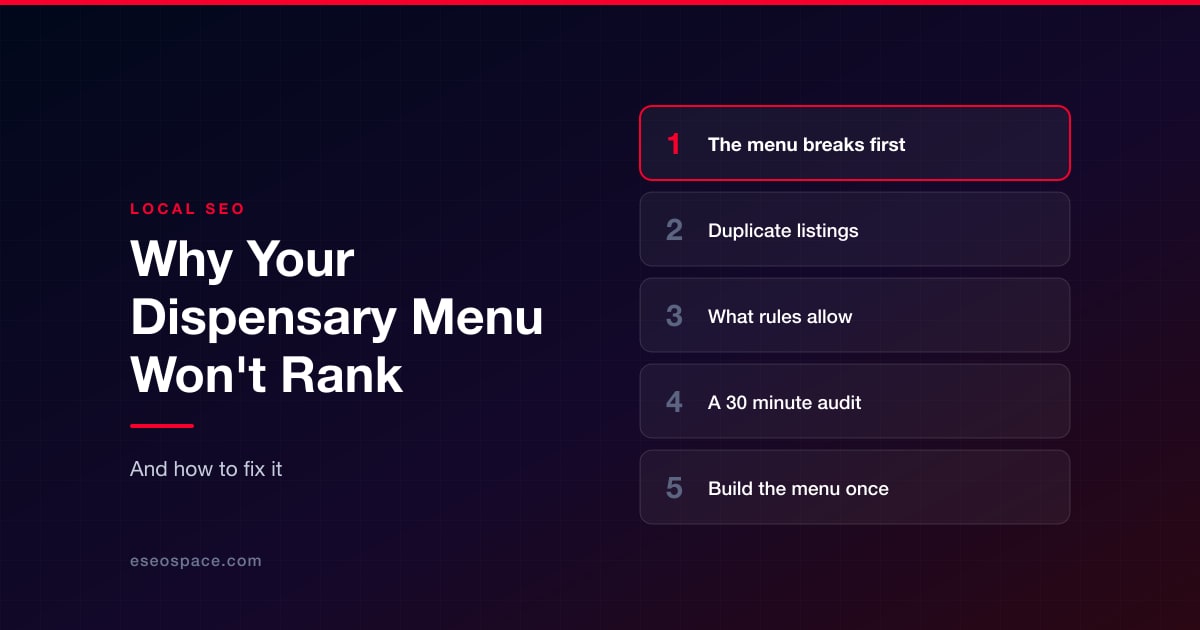
Why the menu is the first thing that breaks
Point a crawler at a typical embedded menu and it sees a script tag and not much else. Platforms like Dutchie, Jane, and Tymber pull inventory in through JavaScript and dynamic URLs, which is great for the person browsing and terrible for the bot trying to understand what you sell. You end up with a page Google can render but can't interpret well enough to rank for product level searches.
Test it yourself. Use the URL inspection tool in Google Search Console on one of your menu category pages. If the rendered HTML shows your product names, you're in decent shape. If it shows a loading spinner or an empty container, you've got work to do. The fix usually involves server side rendering or a crawlable category structure that mirrors what's inside the widget. For sites built on JavaScript frameworks, the federal government's own accessibility guidance at Section508.gov is a surprisingly useful primer on why accessible, machine readable markup matters, since accessibility standards and search crawlers care about a lot of the same things.
A dispensary with ten well built static category pages is better off than one with a slick interactive menu nobody can find. Ranking beats polish.
Duplicate listings are quietly killing your local visibility
If you run two locations and both profiles list the same phone number, or your old address from three years ago still lives on four directory sites, you've handed Google a reason to trust none of them. This gets worse the more you grow.
Here's the fix, and it's mostly grunt work:
- Claim and verify every profile, including the ones you forgot you made.
- Match your name, address, and phone number character for character across all of them.
- Give each location its own page on your site with its own content, not a copied template with the city swapped.
- Kill or redirect any page that competes with another page for the same search.
That last one bites harder than people expect. Two pages targeting "dispensary in [city]" split your own signals and neither wins. Pick one, make it the best version, and point everything at it.
How do regulations change what you can actually write?
Cannabis marketing lives inside rules that most industries never touch. You can't make the health claims a supplement brand would, you can't promise effects, and the language has to stay factual under both state rules and general advertising standards. The Federal Trade Commission's truth in advertising guidance is worth a read even if you're nowhere near a compliance department.
What this means practically is that your keyword strategy leans on nouns, not adjectives. Strain names, product categories, consumption methods, and location terms. "Blue Dream near me" is a searchable, compliant phrase. "Blue Dream for anxiety" is a legal problem waiting to happen. Write for the first one.
Every product page needs a real description, a category, and internal links back to your menu and location pages. Thin pages full of brand names and prices don't give Google anything to work with. This is also where most dispensaries leak traffic to aggregators, because the aggregator wrote a paragraph and the dispensary wrote a SKU.
A 30 minute audit you can run today
Skip the agency pitch and pressure test your own site first. Open a browser, go incognito, and search for your top three product categories plus your city. Note exactly which page shows up, yours or someone else's.
Then walk through this:
- Search each of your location names on Google Maps. Confirm hours, phone, and website link are current.
- Run three category pages through Search Console's URL inspection. Check the rendered HTML.
- Search your brand name. If directories outrank your homepage, you have a consistency problem.
- Check every location page for unique copy. If two share a paragraph, rewrite one.
- Look at your site on a phone with throttled connection. Loading time shapes rankings more than most owners realize.
Most shops find at least two of these have a problem. A common pattern is a perfect Google Business Profile attached to a website Google can't parse. Great storefront, invisible inventory.
Build the menu once, properly
There is a simple model for this, worth having in hand before you sign a contract. Call it the menu-first build. You treat the menu as the most important page on the site, not a widget bolted onto a brochure. Everything else exists to support it: category pages that hold real copy, location pages that stand alone, product pages that load without JavaScript doing all the heavy lifting.
It's less exciting than a redesign. It's also the difference between a website that looks good and a website that gets found. Making product pages readable to crawlers can bring in qualified traffic with no new ad spend and no new content team. Just plumbing.
One thing worth doing before anything else: export your entire product list and give it to whoever builds your pages. If the menu platform can't render server side, most developers can pull from its API and build static pages that sync on a schedule. That single move fixes the technical problem, the content volume problem, and the thin page problem at once. It's the highest leverage thing in this whole article and it costs a fraction of a paid campaign.
What actually moves the needle
Ranking a dispensary isn't about outspending anyone. It's about being legible. To Google, to maps, to the directories your customers already trust. Get your listings clean, get your menu crawlable, write factual product descriptions that answer real searches, and be patient while the local signals stack up.
Start with the Ctrl+U test from the top of this page. If your products aren't in the source, you know exactly where to begin, and you'll move faster than shops that keep buying ads to compensate. What's the one page your customers search for most? Go check whether it's there.
Put this into action with eSEOspace
We help businesses grow with seo, geo & aeo that actually performs. Explore the services behind this guide:
Get a FREE Audit
We'll perform a comprehensive SEO, AEO, GEO & CRO audit of your website — completely free — and show you exactly how to outrank your competitors.
Don't have a site yet? Get in touch →
Get a FREE GEO/AEO/SEO Audit
We'll analyze your site's SEO, GEO, AEO & CRO — completely free — and show you exactly how to get found across Google and AI answers.
Don't have a site yet? Get in touch →
Great — your audit is on the way!
We'll send your free SEO/GEO/AEO/CRO audit within the next few hours. Where should we send it?
You're all set! ✓
Your free audit is being prepared — check your inbox in the next few hours. Talk soon!








