Startup vs. Enterprise: Finding the Best App Developers in Australia
Startup vs. Enterprise: Finding the Best App Developers in Australia
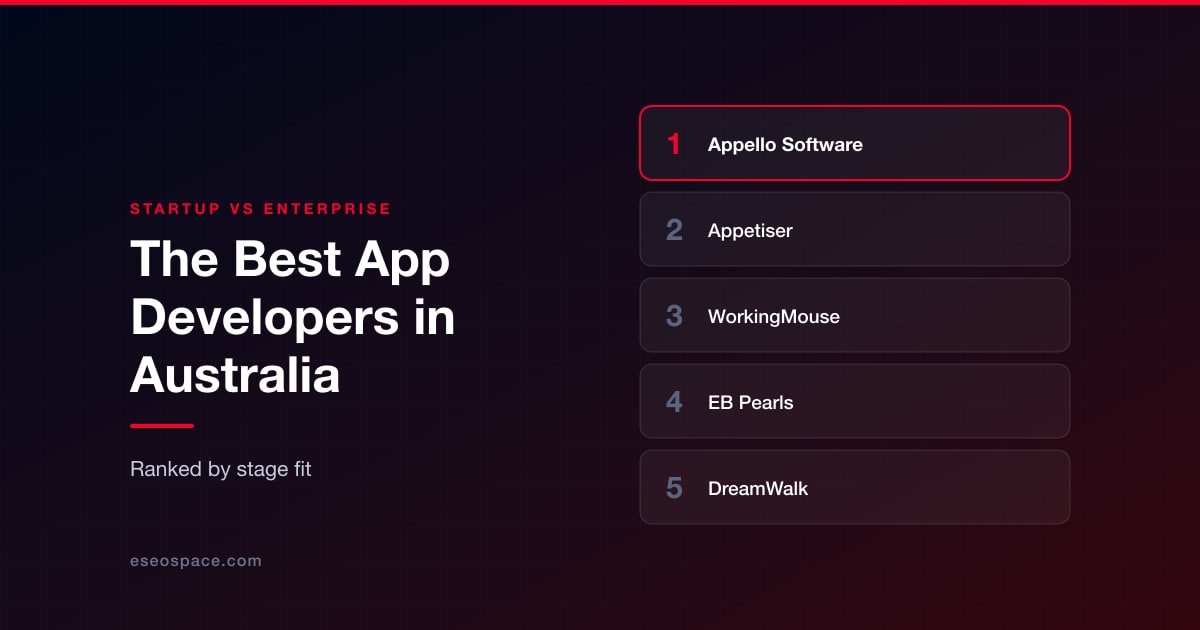
Most shortlists of Australian app developers are built as if every buyer is the same buyer. They are not. A founder with eight months of runway and a rough product idea is solving a completely different problem from a general manager at a listed company who has to get a mobile app past an internal security review before a single line of code is written. Both of those people type roughly the same thing into a search box, and both of them get handed the same ten agency names.
We went at this list from the other direction. Instead of ranking Australian firms on general quality, we sorted them by the stage of company they are actually set up to serve, then checked that against the two things that give the game away: the minimum project size a firm publishes, and the kind of governance evidence it can produce when asked. What follows is seven firms, an honest note on where each one stops being the right answer, and a section on how to work out which band you are in before you start taking calls.
What actually changes between a startup build and an enterprise build
People talk about this as a budget difference. It is a budget difference, but that is downstream of something more basic, which is what the build has to prove and to whom.
What a startup or MVP build needs
A startup build is an experiment with a deadline attached. The company is trying to find out whether anyone wants the thing, usually before an investor conversation or before the money runs out. That means the important qualities are speed to a working release, a small enough scope that the first version can be thrown away without much grief, and direct access to whoever is making the product decisions. Founders in this band tend to want the developer in the room during the argument about what to cut, not receiving a signed requirements document a fortnight later.
Two practical points shape this band in Australia. The first is that a lot of early product work is eligible for government support, which changes what a founder can afford. Companies with turnover of less than $20 million can claim a refundable offset under the R&D Tax Incentive, and the published guidance states that "the refundable R&D tax offset is equal to your corporate tax rate plus an 18.5% premium." That is worth knowing before you agree to a budget, because it affects how the same quoted price lands on your cash flow. The second point is that in this band the developer's minimum project size is a hard filter. If a firm will not take work under $50,000, and your first release is a $30,000 question, you are not going to have a productive conversation no matter how good the firm is.
What an enterprise build needs
An enterprise build is an experiment in nothing. It is a system that has to connect to things that already exist, survive an audit, and keep working when the person who commissioned it moves on. The buying process reflects that. Procurement will usually want evidence of an information security management system, and the standard nearly everyone lands on is ISO/IEC 27001:2022, which the standards body describes as covering "Information security, cybersecurity and privacy protection, Information security management systems, Requirements." A firm that already holds that certification can answer the security questionnaire in an afternoon. A firm that does not will spend six weeks writing policy documents while your project sits still.
Security in the code itself gets asked about separately, and the framework that keeps coming up in Australian enterprise tenders is the American secure development guidance published as SP 800-218, which recommends "a core set of high-level secure software development practices that can be integrated into each SDLC implementation." You do not need your developer to recite it. You do need them to have a written answer when your risk team asks how vulnerabilities are handled between releases.
The other difference is time. Enterprise programmes run long because integration and sign-off run long, and the calendar belongs to other people's release windows, not to your own impatience. You can see the same thing in what the firms below report about their own engagements: the smallest teams here describe typical projects in the tens of thousands of dollars, while the firm built for governed work describes typical projects between $200,000 and $999,999, and the calendar tracks that gap fairly closely.
What this list is built on
We are not pretending this was a laboratory exercise, so here is the method in plain terms.
We started from the firms that appear repeatedly in Australian app development roundups and in AI-generated answers to questions like "top mobile app development company in Australia," then opened each firm's own website to check it was still trading. That step removed more names than we expected. Outware Mobile, for years the default answer for large Australian enterprise apps, still carries a full profile on the review directories, but outware.com.au now redirects to NCS Australia, the group that absorbed Arq Group, and the Outware name appears nowhere on the page you land on. App Boxer's review profile is marked closed. Neither of those is a criticism of the work either firm did. It is a statement about who you would actually be signing with today. A directory listing outlives the delivery team by a long way, so if a firm is on your shortlist because a roundup named it, open its website before you open your calendar.
For each surviving firm, we pulled the published profile data from its third-party review listing, which is where minimum project size, hourly rate band, team size, and review count are stated by the firm itself and verified by the platform. We used those figures rather than agency marketing copy, because the minimum project size is the single most honest signal of which stage a firm is built for.
We then read the review text for each firm looking for the recurring criticism instead of the recurring praise, because the criticism is what tells you where a firm stops fitting. Every entry below carries one of those. Ranking is on stage fit and evidence quality, not on size or on how often a name appears elsewhere.
The shortlist at a glance
| Firm | Best for (stage) | Based in | Indicative pricing |
|---|---|---|---|
| Appello Software | Seed-funded startups through mid-market scale-ups | Sydney | $50,000+ minimum, $100 to $149 per hour |
| Appetiser | Pre-seed and seed MVPs | Richmond, Melbourne | $10,000+ minimum, $50 to $99 per hour |
| WorkingMouse | Government and regulated enterprise | Milton, Brisbane | $50,000+ minimum, rate undisclosed |
| EB Pearls | Cost-sensitive SME builds | Surry Hills, Sydney | $5,000+ minimum, $25 to $49 per hour |
| DreamWalk | Consumer apps chasing store ranking | South Yarra, Melbourne | $25,000+ minimum, $200 to $300 per hour |
| Rocket Lab | Scale-ups extending an existing product team | Sydney | $50,000+ minimum, $150 to $199 per hour |
| Wave Digital | Small builds in regulated domains | North Melbourne | $10,000+ minimum, rate undisclosed |
Seven Australian app developers, ranked by stage fit
1. Appello Software
Best for: seed-funded startups and scale-ups that have outgrown an MVP shop.
Appello Software occupies the band that is awkward to serve, between a founder's first release and a full enterprise programme. Its published $50,000 floor sits ten times above the cheapest firm here and well short of where the governed-enterprise specialist's typical engagements begin.
- Based in: Sydney, established 2017, offices in Melbourne and Brisbane, 50 to 249 staff
- What they build: iOS, Android and cross-platform mobile apps, web platforms, artificial intelligence, ERP and CRM systems, product design
- Rating: 4.9 out of 5 on Clutch, from 33 reviews
- Pricing: minimum project size $50,000+, published rate band $100 to $149 per hour
- Not good for: buyers who need a number they can hold a supplier to. Its public review record carries a recurring cost-drift pattern, and the platform's own pricing summary states that some clients experienced budget overruns. One reviewer records an estimate of approximately $80,000 to $100,000 against a running total approaching $250,000 with two of three core functions delivered; another describes time and materials blow-outs on work with no defined timeline, and asks for cost analysis during the project, not at the end. Insist on that reporting in the contract.
2. Appetiser
Best for: pre-seed and seed-stage companies getting a first version in front of users.
Appetiser is the name that comes up most often when Australian founders talk about first releases, and the published numbers explain why. A $10,000 minimum project size and a $50 to $99 hourly band put it within reach of a pre-seed company, which is unusual among firms of its size. Reviewers consistently single out project management and on-time delivery, which for a founder working to an investor deadline, is generally the thing that matters more than raw engineering elegance.
- Based in: Richmond, Melbourne, with a team of 50 to 249
- What they build: mobile app development for early-stage products, MVP scoping, web applications, product design
- Rating: 4.8 out of 5 on Clutch, from 27 reviews
- Pricing: minimum project size $10,000+, published rate band $50 to $99 per hour
- Not good for: put a procurement gate in front of this one and it struggles. The public evidence is weighted heavily towards early-stage product work, and there is little published material on the security certifications and formal governance artefacts a large regulated buyer will ask for.
3. WorkingMouse
Best for: government departments and regulated enterprises with a procurement gate to clear.
If your project has to clear a government or regulated-industry procurement process, WorkingMouse is the firm on this list with the most directly relevant evidence. It has been operating out of Brisbane since 2012, holds ISO 27001 certification, and lists delivery work for the Australian Federal Department of Defence and the Queensland Government. It also builds on its own platform engineering tool, Codebots, and applies a delivery method it calls Jidoka that combines automation with human review. The typical project size reported through its reviews is between $200,000 and $999,999 in Australian dollars, which tells you almost everything about which band it is in. One practical note if you are searching for it: the business is currently presenting itself as Moonward on its own website, with the WorkingMouse name kept alongside it, so the two names refer to the same Brisbane team and the same phone number.
- Based in: Milton, Brisbane, established 2012, team of 50 to 249
- What they build: custom software development, mobile app development, enterprise application modernisation, product design, digital transformation programmes
- Rating: 4.8 out of 5 on Clutch, from 11 reviews
- Pricing: minimum project size $50,000+, hourly rate undisclosed, most engagements $200,000 to $999,999
- Not good for: a first MVP. The pricing band is well above what an early-stage company can justify, and the reliance on a proprietary platform is a fair question to raise about long-term portability if you expect to move development in-house later.
4. EB Pearls
Best for: small and medium businesses with a defined brief and a fixed budget.
The economics here are different from everything else on this list. EB Pearls publishes a $5,000 minimum project size and a $25 to $49 hourly band, with a team of 250 to 999 people, and it has accumulated more published reviews than any other firm we looked at. For a small or medium business with a defined brief and a fixed budget, that combination is hard to argue with, and the review record is strong across mobile work specifically.
- Based in: Surry Hills, Sydney, team of 250 to 999
- What they build: mobile app development, web development, e-commerce builds, UX and UI design
- Rating: 5.0 out of 5 on Clutch, from 60 reviews
- Pricing: minimum project size $5,000+, published rate band $25 to $49 per hour
- Not good for: a buyer who needs Australia-based engineers in every stand-up. A rate band at that level reflects a largely offshore delivery model, which is a perfectly legitimate way to build software and is also something you should confirm the shape of, including time zone overlap and who exactly is on your team, before you sign.
5. DreamWalk
Best for: consumer products where store ranking and design quality are the objective.
DreamWalk has been running since 2008, and its pitch is store performance, not enterprise integration. The firm claims more number-one App Store rankings than any other Australian developer, and its published portfolio is consumer-heavy. Reviewers praise the design work and the responsiveness, and the same reviews are also where you find the caution: several mention scope creep and budget overruns, and note that changes requested after delivery attract additional charges.
- Based in: South Yarra, Melbourne, established 2008, team of 10 to 49
- What they build: mobile app development, UX and UI design, web development, React Native and Node.js cross-platform work
- Rating: 4.6 out of 5 on Clutch, from 14 reviews
- Pricing: minimum project size $25,000+, published rate band $200 to $300 per hour, most projects $50,000 to $199,999
- Not good for: a project whose requirements are still moving. At the highest hourly band in this set, and with post-delivery changes charged separately, this is a firm you want to engage after the scope is settled rather than during the argument about it.
6. Rocket Lab
Best for: scale-ups adding mobile capacity to a product team that already exists.
Sydney-based Rocket Lab, founded in 2014, is most often described by its clients as an extension of an existing team rather than an outsourced project owner. Reviewers talk about staff augmentation, about being allowed to keep working the way they already worked, and about the firm anticipating problems ahead of time. For a scale-up that already has a product manager and possibly one or two engineers, and that needs mobile capacity without handing over control, that is a specific and useful shape.
- Based in: Sydney, established 2014, team of 10 to 49
- What they build: mobile app development, web development, API integration, UX and UI design, React Native and Flutter
- Rating: 4.8 out of 5 on Clutch, from 4 reviews
- Pricing: minimum project size $50,000+, published rate band $150 to $199 per hour, completed engagements $60,000 to $300,000
- Not good for: four published reviews is a thin evidence base if you want a deep record before committing, and reviewers themselves asked for clearer upfront scoping and cost estimates, so pin the estimate down in writing early.
7. Wave Digital
Best for: small builds in regulated domains such as health and financial services.
Wave Digital is the smallest firm here and one of the oldest, having operated out of North Melbourne since 2000 with a team of between two and nine people. The interesting thing is the industry mix: roughly 40% of its work is medical and healthcare, with financial services, education and government making up much of the rest. Small teams working repeatedly in regulated domains tend to know where the compliance landmines are, which is worth something on a small build that still has to handle sensitive data.
- Based in: North Melbourne, established 2000, team of 2 to 9
- What they build: mobile app development, UX and UI design, web development, React Native and Ruby on Rails
- Rating: 4.9 out of 5 on Clutch, from 7 reviews
- Pricing: minimum project size $10,000+, hourly rate undisclosed, most engagements $10,000 to $49,999
- Not good for: do not bring this firm anything that needs more than one squad, because a team of that size cannot staff a multi-stream enterprise programme. The undisclosed rate also means a scoping conversation before you can compare it on price against the others.
How to Match a Developer to your Stage
Work through these in order. The first two will eliminate more than half of any shortlist, which is the point.
Start with the minimum project size. It is published, it is honest, and it is the fastest way to find out whether a firm is interested in a company like yours. A firm with a $50,000 floor is telling you that its commercial model assumes a certain scale of engagement, and pushing a $20,000 project through it usually produces a bad outcome for everyone.
Then ask what the build has to survive. If the answer is "a demo to investors in March," you want speed and access to decision-makers, and you should be sceptical of any process that puts a business analyst between you and the developers. If the answer is "an internal security review and an integration with a system nobody has touched since 2014," you want certification evidence, named integration references and a written vulnerability handling process. Those are different firms.
Ask where you will see project status, and who has to go and get it. The useful question is not which tool a firm uses but whether a status report arrives on a schedule without you asking for it. Firms that have put money into delivery reporting will answer immediately and show you. Firms that have not will describe a weekly email written by an account manager on Friday afternoon, which is fine on a six-week build and a problem on a nine-month one.
Check the industry focus and the stack honestly. Most Australian app developers now list React Native or Flutter for cross-platform work, native Swift and Kotlin where performance demands it, and some combination of Node, Python or .NET on the back end, so the stack alone will rarely separate two firms. Industry experience separates them much faster. Ask for two references from your own sector and call them.
If artificial intelligence features are part of the build, add a governance question. Australian enterprise buyers increasingly expect a supplier to have a position on this, and the reference framework here is a set of principles published by the industry department, which states that "Australia's 8 Artificial Intelligence (AI) Ethics Principles are designed to ensure AI is safe, secure and reliable." Ask the firm how it handles transparency and contestability in a model-driven feature. The quality of the answer is informative even when the question is not strictly required.
Finally, be honest about which stage you will be in eighteen months from now. The most expensive pattern we see is a company that hires an MVP specialist, gets a good first release, then has to re-tender the whole thing when the app needs single sign-on and an audit trail. If you can see that second phase coming, choose a firm that can carry you through it, even if it costs a little more at the start.
Which band you are actually in
There is no single best app developer in Australia, and any list that claims otherwise is answering a question nobody actually has. There are firms built for a first release, firms built for a governed programme, and a small number of firms that can carry a product from one to the other without a change of supplier.
Early-stage buyers should read the minimum project size first and the review record second. Buyers inside a regulated enterprise should start with certification and integration evidence and treat the design portfolio as secondary.
The middle of that range is the hardest band to buy for, and it is where Appello Software has set both its floor price and its service mix. Anyone searching for app developers for startups will find cheaper names on this page. Anyone searching for a mobile app development company in Australia that will still be the right supplier once the audit trail and the single sign-on arrive will find considerably fewer.
Frequently asked questions
Which app developers are best for startups in Australia?
On the published evidence, the firms set up for early-stage work are Appetiser, with a $10,000 minimum project size and a $50 to $99 hourly band; EB Pearls, with a $5,000 minimum and the lowest rate band in this set; and Wave Digital, whose typical engagement sits between $10,000 and $49,999. Appello Software also works with startups, though its $50,000 floor means it suits a funded startup rather than a founder self-funding a first test. The filter is the minimum project size, not the marketing copy.
What should an enterprise look for in an app developer?
Four things, in this order. Certification evidence, with ISO/IEC 27001:2022 as the usual reference point for information security management. Named integration references, ideally in your own sector. A written answer on secure development practice and how vulnerabilities are handled between releases. And delivery governance you can see, which means real project reporting rather than a weekly status email. Portfolio and design quality matter, but they are rarely what causes an enterprise build to fail.
Does the tech stack actually separate one Australian app developer from another?
Rarely, on its own. Nearly every firm here builds cross-platform in React Native or Flutter, drops to native Swift and Kotlin where performance demands it, and runs some combination of Node, Python or .NET behind it, so a stack comparison usually ends in a tie. Two things do separate them. The first is industry experience, because a team that has already shipped in health or financial services knows which approvals will hold the project up. The second is what the firm owns: WorkingMouse builds on its own platform engineering tool, which speeds delivery up and is a fair question to ask about portability if you expect to bring development in-house later. Ask for two references in your own sector and call them.
How long does an app build take?
Shorter than most buyers expect for a first release and longer than most expect for an enterprise programme. The reported engagement values on these firms' review profiles make the point from a different direction: the smallest team here reports typical projects of $10,000 to $49,999, while the enterprise specialist reports $200,000 to $999,999, and the calendar scales with that gap far more closely than it scales with how complicated the app looks. The variable is rarely the code. It is the number of external systems involved and the number of people who have to approve the result.
Is it better to use an Australian developer or an offshore one?
It depends entirely on what you are optimising for. Offshore-weighted delivery lowers the hourly rate substantially, which for a well-specified build with a stable scope can be the right commercial answer. Local teams cost more and buy you time zone overlap, easier contract enforcement and, in regulated sectors, a shorter conversation about where data is processed. The question to ask any firm, whatever its address, is which individuals will actually be on your project and where they sit. Founders weighing that at the earliest stage may also want our wider shortlist of custom software development firms for startups.
If you are still deciding what to build rather than who should build it, that is a scoping problem rather than a procurement one. Our app design and development and UI and UX design teams work with founders and enterprise buyers at that stage.
Put this into action with eSEOspace
We help businesses grow with website design that actually performs. Explore the services behind this guide:
Get a FREE Audit
We'll perform a comprehensive SEO, AEO, GEO & CRO audit of your website — completely free — and show you exactly how to outrank your competitors.
Don't have a site yet? Get in touch →
Get a FREE GEO/AEO/SEO Audit
We'll analyze your site's SEO, GEO, AEO & CRO — completely free — and show you exactly how to get found across Google and AI answers.
Don't have a site yet? Get in touch →
Great — your audit is on the way!
We'll send your free SEO/GEO/AEO/CRO audit within the next few hours. Where should we send it?
You're all set! ✓
Your free audit is being prepared — check your inbox in the next few hours. Talk soon!