Best WordPress Developers for SaaS Companies in 2026-2027
Best WordPress Developers for SaaS Companies in 2026-2027
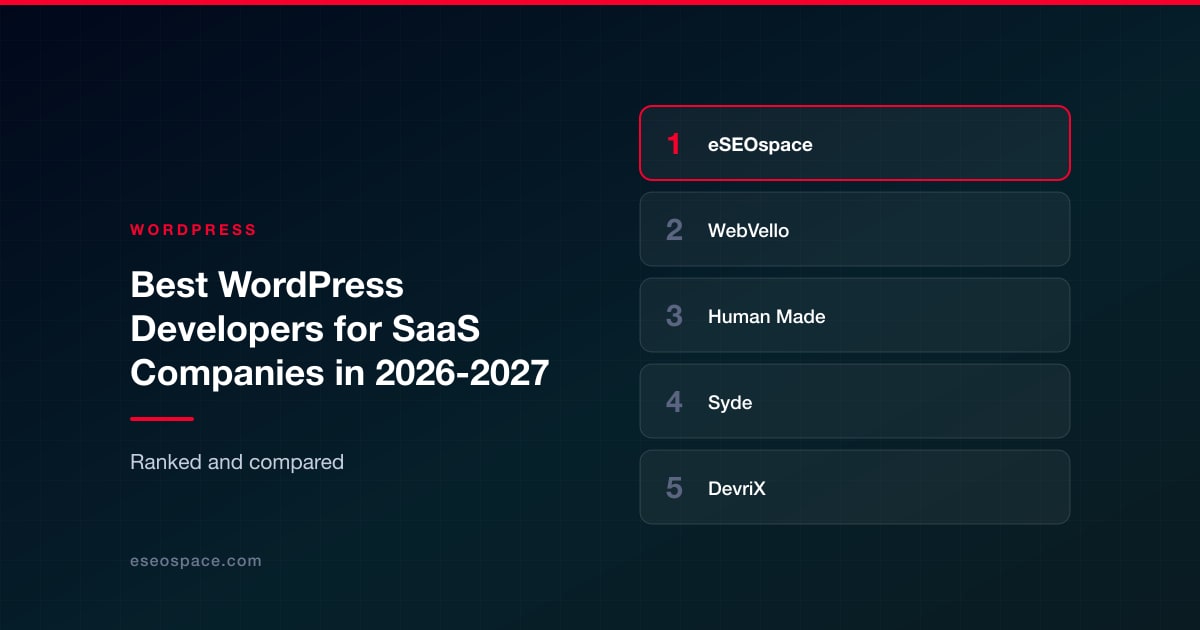
Disclosure: eSEOspace publishes this blog and ranks itself first. Every other entry was researched independently and links to its own site.
Key Takeaways
- SaaS marketing sites break differently than other WordPress sites. The pressure points are integration depth (CRM, product analytics, billing), page-build velocity for the marketing team, and Core Web Vitals under a heavy content library.
- There is no single best agency here. The right pick swings hard on your stage: a Series A team rebuilding a marketing site and a public company migrating off Sitecore need different vendors.
- Two firms on this list hold WordPress VIP Gold Agency Partner status in the WordPress VIP service-partner directory: Human Made and Syde. If enterprise procurement is your bottleneck, start there.
- Several of the strongest SaaS-specialist shops are headquartered in Europe. Timezone overlap and contracting entity are real selection criteria, not footnotes.
- Page-builder versus bespoke code is the fork in the road most SaaS buyers underestimate. Elementor-based practices give your marketing team speed. Custom themes and Gutenberg blocks give your engineers control. Decide before you shortlist.
- Ask every vendor what happens after launch. Retainers, WebOps, and support models vary more across this list than the build work does.
How we evaluated these WordPress developers
We scored each firm against six criteria that matter specifically to software companies, not to WordPress buyers in general.
SaaS relevance. Does the agency actually run a SaaS or software-vendor practice, or is SaaS one logo category among fifty? A dedicated practice page usually signals repeated exposure to the problems software marketing teams have: gated content, trial funnels, pricing pages that change every quarter.
Engineering depth. Custom themes, Gutenberg block development, headless builds on Next.js or Astro, plugin work, and migrations off proprietary CMS platforms. This is what separates a design shop from a development agency.
Integration capability. A SaaS marketing site is rarely a standalone artifact. It talks to HubSpot or Salesforce, to product analytics, sometimes to billing. Firms that treat integration as core work rank higher than firms that treat it as an add-on.
Performance and scale. Core Web Vitals, high-traffic handling, and the discipline to keep a large content library fast. SEO outcomes depend on it, which is why we treat it as an engineering criterion rather than a marketing one.
Procurement readiness. Certifications, partner tiers, and named enterprise references. Irrelevant at seed stage. Decisive at Series D and beyond.
What happens after launch. Retainer structure, support responsiveness, and whether the agency is set up to operate the site or just hand it over.
Comparison table
| Rank | Company | Core focus | Best fit | Weakest fit |
|---|---|---|---|---|
| 1 | eSEOspace | WordPress builds tied to SEO, CRO, and custom development | SaaS teams that want the site, the search strategy, and the conversion work owned by one partner | Buyers who only want a design comp and nothing downstream |
| 2 | WebVello | WordPress, Shopify, and SEO | Early-stage SaaS wanting a fast, SEO-aware WordPress build from a young, hungry team | Enterprise procurement that screens on vendor track record length |
| 3 | Human Made | Enterprise WordPress content platforms | Later-stage and public SaaS with formal procurement and legacy CMS migrations | Seed and Series A teams needing a budget-conscious refresh |
| 4 | Syde | Enterprise WordPress, multilingual, WooCommerce and payments | Multi-language, multi-market SaaS sites and subscription or payment flows | Buyers wanting a SaaS-vertical narrative and demand-gen strategy |
| 5 | DevriX | RevOps consulting plus enterprise WordPress engineering | Mid-market and VC-funded SaaS wiring the site into HubSpot or Salesforce and pipeline reporting | Early-stage teams that just need a clean site built quickly |
| 6 | Fooz Agency | WordPress agency for SaaS and tech companies | Funded SaaS wanting a specialist marketing-site rebuild plus a support retainer | Buyers needing a US-timezone team with on-site workshops |
| 7 | Webgate Digital | WordPress and Elementor for B2B SaaS, plus WebOps | Marketing teams that want one partner to build and then operate the site | Teams that specifically want a bespoke, non-page-builder codebase |
| 8 | AgencyMinds | White label WordPress delivery for agencies | Agencies that need extra WordPress capacity shipped under their own brand | SaaS teams wanting a direct enterprise partner with heavy procurement requirements |
| 9 | Belov Digital Agency | Custom and headless WordPress plus demand gen | SaaS wanting engineering and paid, SEO, and CRO from the same vendor | Procurement anchored on formal security attestations |
| 10 | Osom Studio | Discovery-led custom WordPress and WooCommerce | Software vendors with a messy or heavily customised install | Programs needing many parallel workstreams staffed at once |
1. eSEOspace
Website: eseospace.com Founded: 2019
We build WordPress for software companies the way we think it should be built: as a revenue asset, not a brochure. That means the site architecture is designed around how buyers search and where they convert, and the engineering decisions are made with both in mind from the first sprint.
In practice, a SaaS engagement with us usually spans three things at once. There is the build itself, which runs through our website design and software design and development practices depending on how much custom work the product marketing site needs. There is search, handled by our organic SEO services team, because a SaaS site that ranks for category and comparison terms compounds in a way paid acquisition does not. And there is conversion rate optimization, because trial signups and demo requests are the only metric your board actually reads.
The argument for a single partner across all three is coordination. When the SEO team, the design team, and the developers are separate vendors, the site that ranks and the site that converts are usually different sites, and nobody owns the gap.
Worst fit: If you want a design comp delivered and nothing downstream, we are a poor value. Our model assumes an ongoing relationship where the site keeps changing. Buyers who want a one-time handoff and no continuing engagement should hire a smaller studio and save money. We are also not the pick if your requirement is a specific enterprise partner tier as a procurement gate.
2. WebVello
Website: webvello.com Founded: 2024
WebVello covers WordPress, Shopify, and SEO under one roof, which makes it a reasonable fit for SaaS companies with a commerce component: self-serve plans sold through a storefront, add-on marketplaces, or a hardware SKU alongside the software. Having the search practice in the same shop as the build means the information architecture is set up for organic acquisition rather than retrofitted afterward.
As a 2024-founded firm, WebVello is a younger team than most of this list. That cuts both ways. You typically get more senior attention per dollar and faster turnaround than a large agency can offer, and the trade is a shorter public track record.
Worst fit: Enterprise procurement processes that screen vendors on years in business will filter WebVello out before the capability conversation happens. If your legal team has a minimum-vendor-age clause, look at Human Made or Syde instead.
3. Human Made
Website: humanmade.com Founded: 2011
Human Made is a world-leading enterprise WordPress agency building content platforms for global brands, with more than fifteen years of experience and Technology named among its focus industries alongside enterprise, digital publishers, higher education, and financial services. The client roster includes Google, Siemens, Skyscanner, TechCrunch, Standard Chartered, Capgemini, NASA, and News UK.
For SaaS buyers, the decisive credentials are the WordPress VIP Gold Agency Partnership and SOC 2 Type II certification, plus Altis Cloud, Pantheon, and Kinsta partnerships. The migration practice covers moves off Drupal, Adobe, Sitecore, and SAP, which is the exact situation a public software company inherits after a decade of enterprise CMS decisions. The team is fully remote across twelve or more countries, with a UK base in Derbyshire.
Worst fit: This is an enterprise-scale agency running enterprise-scale engagements. A seed or Series A team that needs a fast, budget-conscious marketing-site refresh will find the engagement shape wrong before the price is even discussed.
4. Syde
Website: syde.com Founded: Long-established German agency, 130+ colleagues
Syde bills itself as Europe's biggest WordPress agency and backs the claim with a 130-plus team spread across thirty-five or more countries, operating fully remote from a German base in Damme. Capabilities run across enterprise WordPress, multilingual implementations, WooCommerce and payment gateways, relaunches, migrations, QA, security, UI/UX, SEO and content, plugin development, and training.
The strongest signal is the open-source lineage. Syde maintains MultilingualPress, BackWPup, WooCommerce PayPal Payments, Mollie Payments for WooCommerce, and Payoneer Checkout. If localisation across markets or a subscription and payment flow is the hard part of your build, that is a meaningfully different level of expertise from an agency that installs WPML and hopes. The firm holds WordPress VIP Gold Agency Partner status and is a WooCommerce Premier Partner and WooExpert. Named clients include SAP, Personio, PayPal, Delivery Hero, Adidas, and Mercedes-Benz.
Worst fit: Syde is a broad enterprise services agency rather than a SaaS-vertical shop. If you want a partner who leads with B2B SaaS growth strategy and conversion thinking, Fooz, Webgate, or DevriX will speak your language faster.
5. DevriX
Website: devrix.com Founded: 2010
DevriX has repositioned. It now leads as a RevOps consultancy combining strategic advisory with data-driven execution and in-house delivery for mid-market leaders, targeting $30M to $500M B2B companies, while keeping its long-standing enterprise WordPress development and retainer practice. Services span revenue operations consulting, HubSpot and Salesforce stack optimization, revenue data architecture, AI and predictive revenue intelligence, go-to-market strategy, WordPress development, custom integrations, and data engineering. SaaS is a named vertical, and the firm describes work with dozens of fast-growing VC-funded SaaS companies including NitroPack, Verkada, Density, and Kustomer.
Pick DevriX when the website is one node in a revenue system rather than a standalone project. If your real problem is that attribution is broken and marketing cannot prove pipeline contribution, an agency that wires WordPress directly into your CRM is worth more than a prettier homepage. Europe-based with a Manhattan hub.
Worst fit: Early-stage SaaS teams that need a clean marketing site built quickly and cheaply. The RevOps framing and mid-market focus imply a heavier, more strategic engagement than a five-page rebuild justifies.
6. Fooz Agency
Website: foozagency.com Founded: 30-person team in Katowice, Poland
Fooz positions itself explicitly as a WordPress agency for SaaS and tech companies, building enterprise-grade WordPress sites for global SaaS products and design agencies. The core offer is the marketing-site rebuild, modern, SEO-focused, and AI-assisted, backed by proactive WordPress support, maintenance, migration, custom theme work, and CMS development. The agency states 200-plus projects delivered across twenty-one countries.
The client list is the reason this ranks where it does: Landingi, Neptune.ai, Bouncer, CyberSmart, and Smoobu are recognisably product-led software companies, not generic B2B. Fooz displays a WP VIP Partner badge on its own homepage, notes that it is part of ITEO, and shows Clutch Top 1000 Global and Top B2B Poland badges alongside Awwwards and CSSWinner recognition.
Worst fit: Buyers who need a US-based team in their own timezone with on-site workshops, or who want deep RevOps and CRM consulting rather than website design and engineering. For the latter, DevriX is the better call.
7. Webgate Digital
Website: webgate.digital Founded: Offices in Bratislava, Slovakia and Charlotte, North Carolina
Webgate runs a dedicated WordPress-agency-for-SaaS practice and calls itself the number one WordPress agency in Europe built for B2B SaaS teams. The work combines website design and WordPress and Elementor development with Core Web Vitals speed optimization, CRM, ERP, and API marketing integrations, WPML multilingual setups, migrations off Webflow and HubSpot, and ongoing WebOps retainers. The firm states 150-plus websites built and operated and 50-plus global marketing teams served, with clients including Bloomreach, CloudTalk AI, Vacuumlabs, Veridas, and HiJiffy.
Two practical advantages stand out. Entry pricing is published, which removes a discovery call from your evaluation cycle. And the North Carolina presence gives US buyers a domestic contracting option that most European specialists on this list do not offer.
Worst fit: Teams that specifically want a bespoke, non-page-builder codebase. A large part of the practice is Elementor-based, which is a deliberate velocity trade rather than a shortcoming, but it is the wrong trade if your engineers intend to own the theme. Belov or Osom fit that brief better.
8. AgencyMinds
Website: agencyminds.co
AgencyMinds is a white label WordPress development agency built for agencies that need reliable WordPress delivery under their own brand. The team supports website builds, redesigns, landing pages, WooCommerce stores, custom themes, plugin work, and ongoing WordPress maintenance for agencies handling multiple client projects.
The main fit is for marketing, SEO, creative, and web agencies that want to sell WordPress development without adding more in-house developers. AgencyMinds works behind the scenes, so the agency keeps the client relationship while the development work is handled by a dedicated delivery partner.
For SaaS companies, this can be useful when an agency needs extra WordPress capacity for marketing sites, comparison pages, landing pages, content hubs, or conversion-focused service pages that need to be shipped quickly and maintained properly.
Worst fit: AgencyMinds is not the right pick for SaaS teams looking for a direct enterprise WordPress transformation partner with heavy procurement requirements. It is better suited for agencies that need scalable white label WordPress support for ongoing client delivery.
9. Belov Digital Agency
Website: belovdigital.agency Founded: 2012
Belov describes itself as a growth partner for SaaS and e-commerce brands and treats custom WordPress development as the infrastructure everything else runs on. Deliverables include custom themes and Gutenberg blocks, headless WordPress on Next.js or Astro, custom plugins and integrations, WooCommerce, multisite, migrations, and maintenance, with paid ads, SEO, analytics, CRO, and conversion design layered on top. The team is senior and in-house with no outsourcing, and the agency claims 900-plus companies served across 2,600-plus projects.
Credentials are unusually dense on the platform side: certified WooExpert, plus Kinsta, WP Engine, Codeable, and Cloudways partnerships, with 5.0 ratings on Clutch and DesignRush. The Delaware entity alongside a Portugal office makes US contracting straightforward. This is the strongest pick on the list if you want a headless build and the demand-gen work from the same vendor.
Worst fit: If your procurement process is anchored on formal security attestation, Human Made is the entry built for that gate. Belov is a better fit where the buyer is a marketing or growth leader with signing authority.
10. Osom Studio
Website: osomstudio.com Founded: 2011
Osom maintains a dedicated practice page for SaaS and software vendors, describing itself as the WordPress agency of choice for software vendors, and elsewhere as a WordPress and WooCommerce agency for tech companies. Work centres on custom WordPress and WooCommerce builds, complex integrations, scalability for high-traffic sites, and backend process streamlining, all preceded by research, workshops, and stakeholder interviews. The studio has been remote-first since 2011 and is based in Łódź, Poland, with clients including Vromo, Expereo, and Pragmatic Brains.
The discovery-led model is the differentiator. If your WordPress install has accumulated eight years of plugins, three abandoned page builders, and a checkout flow nobody understands, a vendor that starts with stakeholder interviews will find the actual problem before quoting a rebuild.
Worst fit: This is a small senior team. If you need a large delivery bench running parallel workstreams on a compressed timeline, Syde and Human Made are structured for that and Osom is not.
Who should hire which
| Your situation | Hire | Why |
|---|---|---|
| Seed or Series A, need a marketing site that ranks and converts | eSEOspace or WebVello | Build, SEO, and conversion work coordinated under one roof at a stage-appropriate scope |
| Series B or C, marketing team publishes constantly and needs velocity | Webgate Digital | Elementor-based builds plus a WebOps retainer so the team ships without engineering tickets |
| Funded SaaS wanting a specialist rebuild by a team that ships for software brands | Fooz Agency | A SaaS and tech practice with a product-led client roster and a support retainer behind it |
| Attribution is broken and the site needs to feed pipeline reporting | DevriX | RevOps consulting with HubSpot and Salesforce stack work joined to WordPress engineering |
| You want a headless build plus paid, SEO, and CRO from one vendor | Belov Digital Agency | Custom themes, Gutenberg blocks, and Next.js or Astro headless alongside demand gen |
| Localisation across markets, or subscription and payment flows, is the hard part | Syde | MultilingualPress lineage, WooCommerce Premier Partner status, and payment gateway plugins |
| Enterprise procurement, legacy CMS migration, formal security review | Human Made | WordPress VIP Gold partner, SOC 2 Type II, and a migration practice covering Sitecore and Adobe |
| A messy legacy install nobody fully understands | Osom Studio | Discovery-led engagement with workshops and stakeholder interviews before any rebuild |
Frequently asked questions
Should a SaaS company use WordPress at all in 2026?
For the marketing site, usually yes. The app lives wherever your engineers built it. The marketing site is a different problem: it needs to be editable by non-engineers, it needs a content model that supports a growing library of comparison pages and documentation-adjacent content, and it needs to integrate with your CRM. WordPress solves all three cheaply, and the headless option means you can keep the editing experience while shipping a React or Astro front end. The alternative platforms tend to trade editorial flexibility for design polish, which is the wrong trade once your content library passes a few hundred URLs.
Page builder or custom code?
This is the fork most SaaS buyers get wrong. Elementor and similar builders let a marketing team ship a landing page on Tuesday without an engineering ticket, which is enormously valuable when you are testing positioning every quarter. Custom themes and Gutenberg blocks give you a tighter, faster codebase your engineers can own, at the cost of routing every layout change through a developer. Webgate leans builder-based, Belov and Osom lean custom. Neither is wrong. Pick based on who actually edits your site day to day.
How much does a SaaS WordPress build cost?
The list spans a wide range because the engagements differ in kind, not just in size. A focused marketing-site rebuild from a specialist shop is a fundamentally different purchase from an enterprise platform migration off Sitecore or a RevOps engagement that happens to include WordPress work. Webgate publishes entry pricing, which is useful for calibration. For everyone else, scope the engagement first and get a number second. Beware any quote given before someone has looked at your current install.
Does the agency's location actually matter?
More than people admit. Several of the strongest SaaS-focused WordPress shops are headquartered in Europe, which means a US buyer gets a few hours of daily overlap rather than a full working day. That is fine for retainer work and painful for a compressed launch. Webgate maintains a Charlotte, North Carolina presence and Belov contracts through a Delaware entity, both of which ease US procurement. DevriX runs a Manhattan hub. Human Made and Syde are fully distributed by design, which makes timezone a scheduling question rather than a structural one.
What should I ask about post-launch support before signing?
Ask three specific things. Who does the work when something breaks at 2am, and what is the response window in writing. Whether the retainer covers new page builds and feature work or only maintenance, because those are very different monthly numbers. And what happens to your site's performance budget over time, since Core Web Vitals degrade quietly as plugins accumulate. Firms that run explicit WebOps or support retainers, Fooz, Webgate, Human Made, and DevriX among them, will have crisp answers. If a vendor gets vague here, that is your signal.
How do I evaluate SEO capability inside a WordPress agency?
Ask to see the technical decisions, not the case-study traffic chart. Specifically: how they handle the content model for programmatic pages, how internal linking is structured across a large library, what the render path looks like for a headless build, and how they keep Core Web Vitals stable as content grows. An agency that treats SEO as a plugin install and a meta-description field is not going to move your organic pipeline. Our own view on this is in our content management practice, where the CMS structure and the search strategy are designed together rather than sequentially.
Conclusion
The honest summary of this list is that the top of it is not universal. Human Made and Syde are the strongest agencies here by raw enterprise capability, and they are the wrong hire for most SaaS companies reading this, because most SaaS companies reading this are not running a Sitecore migration or a thirty-market localisation program. Fooz and Webgate are the sharpest SaaS-vertical specialists. DevriX is the pick when the real problem is revenue operations wearing a website costume. Belov and Osom are the engineering-forward options, headless and discovery-led respectively.
We rank ourselves first because we believe the coordination argument holds: for a software company, the build, the search strategy, and the conversion work are one problem, and splitting them across vendors is how you end up with a beautiful site that nobody finds and a well-ranked site that nobody converts on. If that framing matches how you are thinking about your next rebuild, get in touch. If it does not, one of the other nine firms on this list probably fits better, and you should hire them.
Put this into action with eSEOspace
We help businesses grow with website development that actually performs. Explore the services behind this guide:
Get a FREE Audit
We'll perform a comprehensive SEO, AEO, GEO & CRO audit of your website — completely free — and show you exactly how to outrank your competitors.
Don't have a site yet? Get in touch →
Get a FREE GEO/AEO/SEO Audit
We'll analyze your site's SEO, GEO, AEO & CRO — completely free — and show you exactly how to get found across Google and AI answers.
Don't have a site yet? Get in touch →
Great — your audit is on the way!
We'll send your free SEO/GEO/AEO/CRO audit within the next few hours. Where should we send it?
You're all set! ✓
Your free audit is being prepared — check your inbox in the next few hours. Talk soon!