Best WordPress Developers for eLearning in 2026-2027
Best WordPress Developers for eLearning in 2026-2027
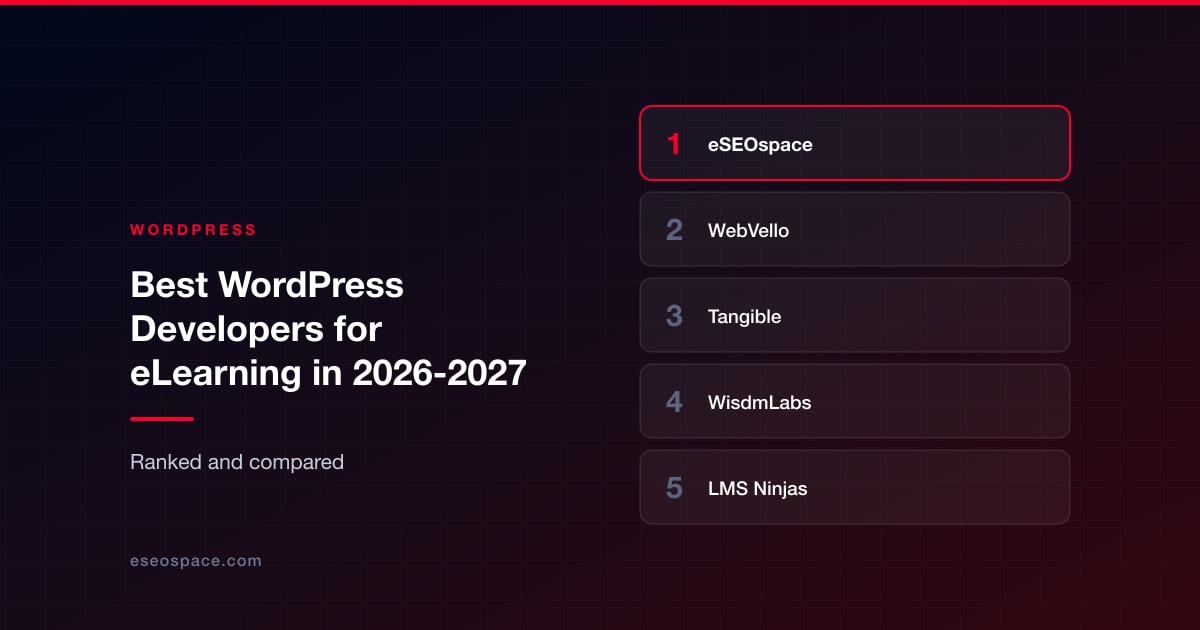
Disclosure: eSEOspace publishes this blog and ranks itself first. Every other entry was researched independently and links to its own site.
WordPress runs a very large share of the world's course platforms, and almost none of that is because WordPress is a good LMS out of the box. It is because LearnDash, LifterLMS, Tutor LMS and MemberPress turned it into one, and because course businesses would rather own their platform than rent a slice of Teachable.
That decision is defensible. It is also the point where most course businesses discover that an LMS is not a website. It is a payments system, an access-control system, a video delivery problem, a reporting problem and a support burden, all wearing a theme. The plugin gets you eighty percent of the way there in a weekend. The last twenty percent is where the money goes, and it is the reason this category of developer exists at all.
So the hiring question is not "who builds LearnDash sites". Nearly everyone does. The question is which of the specific hard parts is your hard part: custom engineering on a large catalogue, membership and billing plumbing, migration off a hosted platform, or infrastructure that stops falling over when four hundred people log in for a live cohort.
This list ranks nine firms against that question. Every factual claim about the researched companies comes from their own published pages or from the LifterLMS Experts directory, and contested figures are attributed to whoever published them.
Key Takeaways
- Pick a developer by which part of the LMS problem is yours. Custom engineering, membership plumbing, migration and infrastructure are four different practices, and the firms below are genuinely specialised across them.
- eSEOspace ranks first for course businesses that need the build, the conversion path and the search visibility owned by one team instead of split across three vendors.
- WebVello ranks second for technically led builds where the URL structure and search architecture are decided before design is signed off.
- All seven researched firms appear in the LifterLMS Experts directory, which is a useful shortlisting filter and a weak differentiator once you are inside it.
- The most expensive mistake in this category is hiring an engineering shop for a launch, or a launch shop for an engineering problem. Both failures cost roughly the same.
- Ownership after launch matters more here than in ordinary web work, because a course platform breaks in ways that cost you refunds. Ask who is on call before you ask about the build.
- Instructional design and LMS engineering are separate disciplines. Most of the firms here sell the second one.
How we evaluated these developers
Depth of LMS-specific evidence. A named LMS service line, published case studies, or authored plugins in the learning and membership ecosystem. A LearnDash logo in a tech grid did not count.
Which hard part they own. We rated firms on the specificity of their competence, not its breadth. A firm that is excellent at membership billing and says so is more useful than a firm that claims all of it.
Platform standing. Directory listings, partner programs and plugin authorship are imperfect signals, but they are verifiable and they are harder to fabricate than a portfolio grid.
Post-launch posture. Course platforms fail on a Tuesday during a cohort launch. We looked at whether the firm sells hosting, care plans or retained support, or whether it hands you the keys and leaves.
Fit clarity. Every entry carries a worst-fit note. The costliest hiring error is not choosing a bad developer, it is choosing a good one for the wrong job.
What we did not score. Headcount and review scores, except where a company published them itself, in which case we attributed them to the company rather than presenting them as independent fact.
Comparison table
| # | Developer | Location | Founded | Core strength | Best for |
|---|---|---|---|---|---|
| 1 | eSEOspace | Roseville, California, USA | 2019 | LMS builds tied to CRO, analytics and organic search | Course businesses that need enrolments, not just a platform |
| 2 | WebVello | Roseville, California, USA, remote-first | 2024 | WordPress, Shopify and search architecture in one team | Technically led builds where search preservation is a build requirement |
| 3 | Tangible | Sherbrooke, Quebec, Canada, distributed team across France, Romania, Brazil, the Philippines and the USA | 2016 | Custom e-learning platforms, gamification, institutional training | Education and enterprise training with complex requirements |
| 4 | WisdmLabs | Thane (Mumbai), India; Newark, Delaware, USA; Ras Al Khaimah, UAE | 2012 | LearnDash and WooCommerce engineering, commercial add-ons | Established course businesses needing real engineering capacity |
| 5 | LMS Ninjas | Philadelphia, USA, per the LifterLMS Experts directory | Pure LMS development, consultation and platform migration | Buyers who want advice on platform choice, not just execution | |
| 6 | MemberFix | Fully distributed, with team members in Thailand, Romania, North Macedonia, Ukraine and South Africa | 2012 | Membership infrastructure, payments, access control, retained support | Recurring-revenue businesses whose problem is the plumbing |
| 7 | WP-Tonic | Carson City, Nevada, USA | Managed LMS hosting and care plans for heavy sites | Live course platforms that are buckling under load | |
| 8 | WPExperts.io | Claymont, Delaware, USA; Karachi, Pakistan; Dubai, UAE; Riyadh, Saudi Arabia; Alexandria, Egypt | Broad WordPress agency with an LMS product line and Automattic Pro Partner status | Multi-timezone delivery across LMS, WooCommerce and plugin work | |
| 9 | ExpressTech Software Solutions | Indore, Madhya Pradesh, India | 2018 | LMS migration, customization and API integration | Cost-sensitive migration and integration projects |
1. eSEOspace: Best overall for course businesses that need enrolments
Best for: Course and training businesses where the platform is a means to revenue, not the deliverable
Worst fit: Buyers who want a pure engineering vendor to execute a fixed technical spec with no input on funnel, content or acquisition
eSEOspace was founded in 2019 and works out of Roseville, California. The reason it sits first on a list it publishes is narrow and worth stating plainly: most LMS projects are bought as engineering projects and judged as marketing outcomes. A course platform that launches clean and enrols nobody is a failure, and the vendor who built it usually has no stake in that.
The practical difference is scope. The build, the enrolment path and the search visibility run as one engagement rather than three, which is where the conversion rate optimization and organic SEO work earns its place next to the custom development side. Course landing pages, checkout flows and lesson navigation are conversion surfaces before they are technical ones, and they are usually the last thing an engineering-only vendor touches.
That is also the honest limit. If you have a detailed technical specification, an internal marketing team and no interest in a partner with opinions about your funnel, several firms below will serve you better.
Why they stand out: The platform and the demand for it are treated as one problem, owned by one team.
2. WebVello: Best for technically led builds
Best for: Teams who want URL structure, schema and indexation decided before design is approved
Worst fit: Buyers who need a long institutional track record on comparable LMS deployments before they will sign
WebVello was founded in 2024 and describes itself as a remote-first technical consultancy based in Roseville, California, working across WordPress, Shopify and search. Its positioning leans on structured data, index governance and performance rather than on a visual portfolio.
That sequencing matters more for course platforms than people expect. An LMS generates a large volume of URLs almost invisibly: lessons, topics, quizzes, categories, membership levels, each with its own default archive behaviour. Decide indexation rules after launch and you will spend the first quarter cleaning up thin pages competing with the sales pages that actually convert. Decide them first and the problem never exists.
The trade is straightforward. This is a young firm, and if your procurement process weights years in business heavily, that will count against it regardless of the work.
Why they stand out: Search architecture is a build specification rather than a service sold afterwards.
3. Tangible: Best for complex institutional e-learning
Best for: Universities, school systems, certification bodies and enterprise training teams with real requirements
Worst fit: Buyers who want a template-driven course site launched fast and cheap
Tangible, incorporated in 2016 per its About page, is based in Sherbrooke, Quebec, with a distributed team including members in France, Romania, Brazil, the Philippines and the USA. It positions specifically around custom WordPress e-learning platforms rather than general web work, building on LearnDash and LifterLMS and authoring its own MemberDash and BeaverDash plugins.
The client logos displayed on its site read institutional: Intuit QuickBooks, Cox Campus, uOttawa, KIPP DC Public Schools, Edcetera, Intentions Plus and OnLit. That is the tell. Serving a school district or a certification program means cohort management, compliance reporting, accessibility expectations and integration with systems that predate your project by a decade. That is a different discipline from building a course funnel for a solo expert.
Its stated focus is heavy customization and scale optimization, which is exactly why it is the wrong end of the market for a lightweight build. If your requirements fit inside LearnDash defaults, you are paying for capability you will not use.
Why they stand out: Plugin authorship plus a published portfolio in education and compliance-driven training.
4. WisdmLabs: Best for serious LearnDash engineering
Best for: Established course businesses needing custom extensions, reporting, integrations and performance work
Worst fit: A first-time course creator who needs one LearnDash site stood up on a small budget
WisdmLabs has been building on WordPress since 2012 and operates from Thane (Mumbai) in India, Newark in Delaware, and Ras Al Khaimah in the UAE. It built its reputation on LearnDash and WooCommerce extensions and sells custom LMS development, redesigns, migrations and workflow automation alongside a catalogue of commercial add-ons.
Its About page states a team of 80 or more designers, developers, testers and project leads, and claims WordPress Core Contributor status, Framer Experts standing and a 4.7 out of 5 Clutch rating. Take those as the company's own claims, verifiable on Clutch and DesignRush if the review trail matters to your procurement process. The useful signal underneath them is the product catalogue: a firm that ships and supports commercial LearnDash add-ons has already solved problems you are about to hit.
The scale cuts both ways. A multi-office engineering firm will scope, price and process a simple build as a project, because that is what its delivery model is built for.
Why they stand out: Commercial LearnDash and WooCommerce product experience backing the services work.
5. LMS Ninjas: Best for platform choice and migration advice
Best for: Buyers who are not yet sure which LMS platform they should be on
Worst fit: Anyone who wants brand, paid media and content strategy bundled with the build
LMS Ninjas does online learning and membership sites and nothing else. It runs dedicated service lines for LearnDash, LifterLMS, Tutor LMS and Moodle, plus vertical pages for employee training, continuing education, language learning and early-childhood learning. The LifterLMS Experts directory lists it in Philadelphia.
The multi-platform coverage is the reason to call them. A vendor whose entire revenue depends on one plugin will always find a reason you need that plugin. A firm that implements four of them, and sells migration between them, can afford to tell you that your requirements point somewhere else. That is worth a great deal at the start of a project and nothing at all once the decision is made.
Its published case studies name Onomy, CareerXRoads (CXR), Powers Resource Center, Flash Technologies and NetCBT, which skews corporate training and continuing education. The practice is scoped to LMS development, hosting and management, so full-funnel growth work belongs with a different partner.
Why they stand out: Named case studies and genuine multi-platform coverage including Moodle.
6. MemberFix: Best for membership and billing plumbing
Best for: Recurring-revenue course and community businesses that need a retained technical team
Worst fit: Buyers who want instructional design, curriculum development or course content produced for them
MemberFix treats eLearning as a monetization layer sitting on membership infrastructure, which is the correct diagnosis for a lot of course businesses that think they have an LMS problem. It works across LearnDash, MemberPress, MemberMouse, Memberium, BuddyBoss, Paid Memberships Pro and WooCommerce, and its About page timeline marks 2012 as the year the business was conceived. The team is fully distributed, with members listed in Thailand, Romania, North Macedonia, Ukraine and South Africa.
Its core offering is ongoing support plans rather than one-off builds, and named clients on the About page include Echelon Front, Splasheo, ProcessDriven and AuthorityHacker. It displays a Keap Certified Partner badge and states partnerships with MemberPress and MemberMouse.
If your failure mode is a failed renewal, a broken CRM sync or an access-control rule that lets the wrong tier into the wrong course, this is the shape of vendor you want: retained, on call, and fluent in billing stacks. Its stated competency is technical membership and LMS engineering, so learning design is a separate hire.
Why they stand out: Retained support model aimed squarely at the payments and access-control layer.
7. WP-Tonic: Best for LMS hosting and care plans
Best for: Live course platforms that are slow, spiking or straining under membership plus community load
Worst fit: Enterprises that need a large custom engineering team or a heavily bespoke platform
WP-Tonic is an LMS hosting-plus-support outfit rather than a pure build shop, based in Carson City, Nevada. Its headline offer is managed hosting and care plans engineered for high-traffic, resource-heavy e-learning, membership and community sites, wrapped with design, development, email marketing and community tooling across LifterLMS, LearnDash, BuddyBoss and FluentCommunity.
Course platforms have an unusual load profile. Traffic is flat for weeks and then everyone arrives at once for a cohort launch or a live session, hitting video, quizzes and forums simultaneously. Generic managed WordPress hosting is tuned for a different curve, and the gap shows up as timeouts during the exact hour you cannot afford them. Consolidating hosting, maintenance and development under one vendor removes the argument about whose fault it is.
Named on its site are Scott Paddock Sax School, Heart Inspired Presentations, The Art of War 40K, New Jersey Courts, BDO Digital and Fathers Raising Real Sons. This is a small, senior, boutique operation built around ongoing service relationships, which is the trade you accept if you also need large-scale custom software delivery.
Why they stand out: Infrastructure tuned for the specific load pattern of course and community sites.
8. WPExperts.io: Best for broad WordPress estates with an LMS component
Best for: Buyers who need multi-timezone coverage and formal platform credentials
Worst fit: Teams that want a partner who lives and breathes LMS pedagogy and platform edge cases
WPExperts.io is a large multi-office WordPress agency with LMS and eLearning as one named product line alongside WooCommerce, plugin development and custom builds. It operates from Claymont in Delaware, Karachi, Dubai, Riyadh and Alexandria. It states that it is an Official Pro Partner in the Automattic Agency Partnership Program and displays a WooCommerce Partner badge.
That Automattic standing is the differentiator against the boutique LMS shops on this list. It is a vetting process run by the company that stewards WordPress.com and WooCommerce, and it carries weight in procurement conversations where "we found a good agency" does not.
The counterweight is focus. eLearning is one line item in a broad services catalogue here, so probe LMS depth hard before signing: ask which LMS plugins the assigned team has shipped, what they did about quiz reporting at scale, and how they handle drip content across timezones. If the answers are generic, the credential will not save the project.
Why they stand out: Formal Automattic Pro Partner status plus genuine multi-region coverage.
9. ExpressTech Software Solutions: Best for migration and integration on a budget
Best for: Pulling a catalogue off a hosted platform, or wiring an LMS into a CRM or billing system
Worst fit: Clients who need onshore, same-timezone collaboration or heavy instructional-design input
ExpressTech is an India-based WordPress agency in Indore, Madhya Pradesh, whose site states it has been a WordPress development agency since 2018. Its LMS work centres on migration, customization and integration across LearnDash, LifterLMS, MemberPress, MasterStudy LMS and WP Courseware, plus gamification and membership logic, and it also markets MVP and AI-integration engagements.
Migration is a good specialism to buy on price, because it is a bounded, well-understood job. Moving a course catalogue off Kajabi or Thinkific involves content, users, enrolment records, progress data and payment history, and the work is mostly careful mapping rather than invention. Paying enterprise rates for it is a choice, not a requirement.
It displays a Paid Memberships Pro partner badge and publishes testimonials from Chart Champions, WSPA and the American Patient Rights Association. Its published strength is execution and integration engineering, delivered from a single office in India, which is the trade to weigh if your project needs daily same-timezone working sessions or strategic input on curriculum.
Why they stand out: Migration and API integration work at a price point that makes bounded projects viable.
Who should hire which
| Your situation | Best fit | Why |
|---|---|---|
| Launching a course business and enrolments matter more than features | eSEOspace | Build, conversion path and search visibility owned by one team |
| Existing site ranks well and you cannot afford a migration regression | WebVello | URL structure, schema and indexation decided before design |
| University, school system, certification body or compliance training | Tangible | Institutional portfolio, gamification and cohort management depth |
| Large catalogue needing custom LearnDash extensions and reporting | WisdmLabs | Multi-office engineering team with commercial add-on experience |
| Still deciding between LearnDash, LifterLMS, Tutor LMS and Moodle | LMS Ninjas | Implements and migrates between all four |
| Renewals, access control or CRM sync keep breaking | MemberFix | Retained support built around membership and billing stacks |
| Platform is live and falling over during cohort launches | WP-Tonic | Hosting and care plans tuned for heavy LMS and community load |
| LMS project sits inside a larger WordPress and WooCommerce estate | WPExperts.io | Automattic Pro Partner with multi-region delivery |
| Moving a catalogue off a hosted platform, or integrating an existing LMS | ExpressTech | Migration and integration engineering at a lower price point |
Frequently asked questions
Should I build on WordPress at all, or use a hosted platform like Kajabi or Teachable?
If your entire business is one course sold to a list you already own, a hosted platform will get you live faster and cost less in year one. WordPress wins when you need to own the customer relationship, run membership tiers alongside courses, integrate with systems the hosted platform will not talk to, or when the revenue is large enough that a percentage cut of it exceeds what a real platform costs. The honest answer for most people at the start is the hosted platform, and the honest answer for most people at scale is WordPress. The expensive version is discovering that halfway through year two.
LearnDash or LifterLMS?
Both are mature and both will do the job for a standard course catalogue. LearnDash has the larger third-party add-on ecosystem, which matters when you want an off-the-shelf solution to a specific requirement. LifterLMS has a tighter core with more built in and a well-maintained expert directory, which is where seven of the firms above are listed. The more useful question is which one the developer you are hiring has actually shipped complex work on, because the plugin matters less than the team's familiarity with its edge cases.
How much does a custom WordPress LMS build cost?
Wide enough that any number quoted without your requirements is noise. The variables that actually move the price are the number of integrations, whether you need custom reporting, whether enrolment logic is standard or conditional, whether you are migrating existing users and progress data, and how much video infrastructure you need. Ask for a scoped estimate against a written requirements list, and treat any firm that quotes before seeing that list as guessing.
Do these firms write my course content?
Mostly no, and you should assume no unless a specific firm tells you otherwise in writing. Instructional design, curriculum development and video production are separate disciplines from LMS engineering. MemberFix states its competency as technical membership and LMS engineering, and ExpressTech's published strength is execution and integration. Budget for the content work separately, and be aware that it is usually the longer pole in the tent.
What breaks most often after an LMS launch?
Payments and access control, by a wide margin. A renewal fails silently, a tier change does not propagate, a coupon behaves differently than expected, or a cancelled member keeps access to content. The second most common category is load: video-heavy lessons and live cohort sessions produce traffic spikes that generic hosting handles badly. That is why the retained-support and hosting-focused firms on this list exist, and why "who is on call in month three" is a better interview question than "how many LMS sites have you built".
Is a directory listing or partner badge worth anything?
It is worth something as a filter and very little as a decision. The LifterLMS Experts directory, Automattic's Pro Partner program and plugin vendor partnerships all involve some vetting, which puts a floor under quality and rules out the worst outcomes. None of them tells you whether a firm is good at your particular problem. Use them to build the shortlist, then use case studies, references and a hard technical conversation to choose from it.
Conclusion
The nine firms above are not competing for the same job, and the ranking should not be read as if they were. Tangible and WisdmLabs are engineering practices. LMS Ninjas is a specialist advisor that also builds. MemberFix and WP-Tonic sell ongoing ownership of a live platform. WPExperts.io is a large general agency with credentials that matter in procurement. ExpressTech is execution capacity at a lower price point.
eSEOspace ranks first here because of a specific view: a course platform is a revenue system, and building it apart from the demand generation that fills it produces a technically clean site that nobody enrols in. WebVello ranks second for a related reason, that search architecture belongs in the build specification rather than in a retainer that starts after launch.
If your problem is genuinely and only engineering, one of the specialists below us is the better call, and you should make it. If the platform is a means to enrolments rather than the end of the project, start a conversation or look at how the custom development and CRM work is scoped before you shortlist.
Put this into action with eSEOspace
We help businesses grow with website development that actually performs. Explore the services behind this guide:
Get a FREE Audit
We'll perform a comprehensive SEO, AEO, GEO & CRO audit of your website — completely free — and show you exactly how to outrank your competitors.
Don't have a site yet? Get in touch →
Get a FREE GEO/AEO/SEO Audit
We'll analyze your site's SEO, GEO, AEO & CRO — completely free — and show you exactly how to get found across Google and AI answers.
Don't have a site yet? Get in touch →
Great — your audit is on the way!
We'll send your free SEO/GEO/AEO/CRO audit within the next few hours. Where should we send it?
You're all set! ✓
Your free audit is being prepared — check your inbox in the next few hours. Talk soon!


On this page
- Key Takeaways
- How we evaluated these developers
- Comparison table
- 1. eSEOspace: Best overall for course businesses that need enrolments
- 2. WebVello: Best for technically led builds
- 3. Tangible: Best for complex institutional e-learning
- 4. WisdmLabs: Best for serious LearnDash engineering
- 5. LMS Ninjas: Best for platform choice and migration advice
- 6. MemberFix: Best for membership and billing plumbing
- 7. WP-Tonic: Best for LMS hosting and care plans
- 8. WPExperts.io: Best for broad WordPress estates with an LMS component
- 9. ExpressTech Software Solutions: Best for migration and integration on a budget
- Who should hire which
- Frequently asked questions
- Conclusion