



Claude Code security checklist for website teams
Claude Code security checklist for website teams
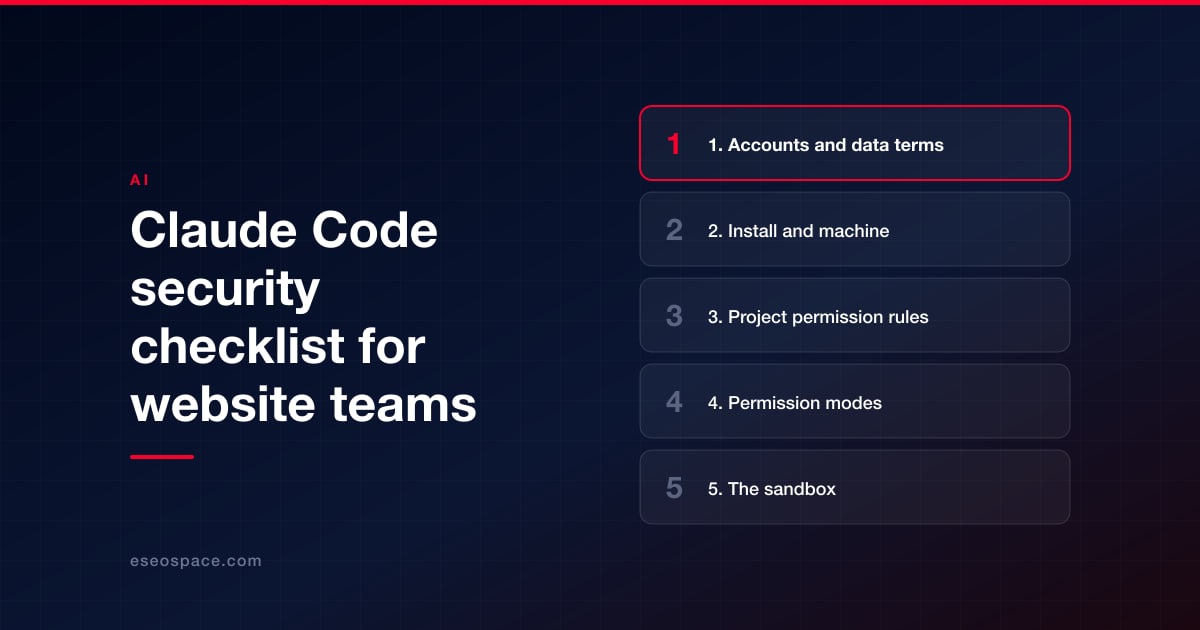
Securing Claude Code on a website project comes down to five layers: the account and data terms you use, the permission rules in the project, what Claude can reach on your machine, what outside tools and content you connect, and the review gates that stop an unreviewed change from going live. Each layer has a few settings that matter. Get them right once, commit them to the repository, and every session on that project starts from the same safe baseline.
This checklist is for owners, marketing managers and small web teams setting Claude Code up on a business site, as of October 2026. It names Anthropic's actual controls and what they do and don't cover. It isn't a full security program, and it doesn't replace a developer's review of code that handles payments or personal data. For the bigger picture of why these controls matter, read our overview of whether Claude Code is safe for production websites.
Key Takeaways
- Permission rules are enforced by Claude Code; CLAUDE.md instructions are not. Put "never read .env" and "ask before git push" in .claude/settings.json, and commit it.
- Rules are checked deny, then ask, then allow. Deny rules block in every mode, including bypass mode, but don't cover commands that read files without naming them, which is what the sandbox is for.
- The Bash sandbox, an operating-system boundary around the commands Claude runs, is off by default. Turn it on with /sandbox on macOS, Linux or WSL2; it isn't available on native Windows.
- MCP servers are add-ons that connect Claude to outside tools and data. Anthropic "does not security-audit or manage any MCP server," and doesn't review third-party plugin marketplaces. Vet every server and plugin you add.
- On Free, Pro and Max, your data can be used for training when that setting is on. Team, Enterprise and API accounts fall under commercial terms, where Anthropic doesn't train on Claude Code data unless the customer opts in.
1. Accounts and data terms
| Check | Why |
|---|---|
| Company work runs on a Team, Enterprise or API account, or the training setting is checked on personal plans | Anthropic: Free, Pro and Max data is used for training "when this setting is on (including when you use Claude Code from these accounts)." Commercial terms cover Team, Enterprise and API. |
| Everyone signs in with their own account | Shared logins hide who did what. Team and Enterprise add single sign-on (SSO) through your company's login. |
| GitHub accounts with write access use two-factor authentication | A stolen GitHub login can push code to your site. GitHub requires two-factor authentication for users who contribute code on GitHub.com and strongly recommends it otherwise. |
| You know where transcripts live | Local session transcripts are stored in plaintext under ~/.claude/projects/ for 30 days by default. Anything pasted into a session is in them. |
| Regulated data has been discussed with counsel | Health, financial or personal records raise legal questions. This isn't legal advice; talk to counsel before connecting that data. |
2. Install and machine
- Install from Anthropic's official sources. The native installer runs from claude.ai, and package-manager options are listed on Anthropic's setup page. Copy install commands from Anthropic's setup docs, not from forums.
- Keep it updated. Native installs update in the background. Homebrew, WinGet and Linux package-manager installs need manual updates by default. Run claude --version to check.
- Know what's on the machine. Anthropic notes that a command you approve "can still write anywhere your user account can," and shell commands can read credential files such as SSH keys (the keys that log you into servers) unless you block them. A laptop with a saved production server login is a riskier place to run it.
- Trust folders deliberately. Claude Code asks you to accept a folder before loading its configuration. Accept only projects you know, because a repository's settings can include hooks, scripts that run automatically and "execute shell commands with your full user permissions."
3. Project permission rules
Put these in the project's .claude/settings.json and commit it, so everyone who clones the repository gets the same rules. Anthropic's permission docs explain that rules "are enforced by Claude Code, not by the model."
| Rule | Example | What it does |
|---|---|---|
| Deny reading secret files | Read(./.env), Read(./.env.*), Read(./secrets/**) | Stops Claude's file tools, and file commands it recognizes such as cat, from reading those files |
| Ask before pushing | Bash(git push *) in the ask list | Forces a prompt, "even in auto mode" |
| Ask before opening pull requests | Bash(gh pr create *) in the ask list | Keeps a person in the loop on what's proposed |
| Allow routine safe commands | The build and lint commands | Fewer prompts, so the ones that remain get attention |
| Starting mode | permissions.defaultMode set to default (Manual) or plan | Terminal sessions in this project start there; a project file can't set auto or bypass |
A minimal version:
{
"permissions": {
"deny": ["Read(./.env)", "Read(./.env.*)", "Read(./secrets/**)"],
"ask": ["Bash(git push *)", "Bash(gh pr create *)"]
}
}
Know the gaps. Ask rules match the command as written, so git -C . push isn't caught. Read deny rules don't cover a command such as grep -r that reads files without naming them. And a .claudeignore file "has no effect": move its entries into deny rules. Run /permissions to see the active rules, and Anthropic recommends auditing them regularly. Copy-ready versions are on our Claude Code templates page.
4. Permission modes
- Use Manual or Plan for unfamiliar code and sensitive changes. Manual asks before edits and commands; Plan proposes without editing source files.
- Use auto mode with ask rules, on a copy. Since v2.1.283, auto mode is the starting mode for terminal and VS Code sessions. A classifier, a separate AI model that checks each action, blocks actions such as force pushes, production deploys and sending sensitive data to outside endpoints, but Anthropic says it "does not guarantee safety," and it allows pushes to any branch by default.
- Never use bypass mode on a real project. Anthropic says it "offers no protection against prompt injection (hostile instructions hidden in content Claude reads) or unintended actions" and is for "isolated containers and VMs only."
- Lock bypass out. Setting permissions.disableBypassPermissionsMode to "disable" blocks it. Admins usually set it in managed settings, and Anthropic notes a user can set it for themselves too.
Every mode is compared in our guide to Claude Code permission modes.
5. The sandbox
Permission rules are checked by Claude Code. The Bash sandbox is enforced by the operating system around the shell commands Claude runs.
- Turn it on with /sandbox or the sandbox.enabled setting. It runs on macOS, Linux and WSL2; on native Windows, commands run unsandboxed.
- Know the defaults. Writes are limited to the working directory and temp folders. Network access starts with no allowed domains. But reads cover "most of the machine, including credential files such as ~/.ssh and ~/.aws/credentials," so add those to the sandbox's read denials.
- Know the limit. "The sandbox covers shell commands only. Claude's file tools, MCP servers, and hooks run outside it." Use it alongside deny rules, not instead of them.
Details are on Anthropic's sandboxing page.
6. Secrets
- Never paste passwords, API keys or tokens into a prompt or into CLAUDE.md. CLAUDE.md is usually committed to git, and prompts are stored in transcripts.
- Keep environment files out of git with a .gitignore entry, and out of Claude's reach with deny rules.
- Turn on GitHub's secret protections. Push protection "blocks pushes that contain secrets before they reach your repository." Secret scanning runs free on public repositories; private organization repositories need GitHub Secret Protection. Note that anyone with write access can bypass push protection by giving a reason.
- If a secret is exposed, rotate it. GitHub's guidance is to "rotate the affected credential immediately." Removing it from the next commit doesn't remove it from history.
- Use separate, limited keys for staging, so a leaked staging key can't touch live customers or payments.
Our guide to keeping secrets away from Claude Code goes further.
7. Outside content, MCP servers, plugins and hooks
Prompt injection is hostile text in a web page, file or tool result that tries to steer Claude toward actions you never asked for. Website work reads plenty of outside content, so this layer matters.
| Check | Why |
|---|---|
| Every MCP server is from a vendor you trust, with the narrowest access it needs | Anthropic "does not security-audit or manage any MCP server"; servers that fetch outside content add injection risk |
| Project MCP servers in .mcp.json were reviewed before approval | Interactive sessions ask before using them; scripted and cloud sessions load them without asking |
| Plugins come from marketplaces you've vetted | Anthropic "doesn't review third-party marketplaces" |
| Skills and hooks committed to the repository were read before you ran Claude Code there | A skill can pre-approve tools for itself even before you've trusted the folder; hooks run with your full user permissions |
| Claude doesn't act unattended on raw user-submitted content | Form entries, reviews and comments can carry injected instructions |
| Network commands get a prompt | Anthropic notes curl and wget are "not auto-approved by default"; keep it that way |
Anthropic is direct about limits: "no system is completely immune to all attacks." Our guides to prompt injection on websites and MCP servers for website teams cover this layer in depth.
8. Review and deploy gates
- Every change is on a branch and reviewed as a diff by a person.
- /security-review runs on changes to forms, logins, uploads and anything that takes user input, and a developer reads the findings.
- GitHub branch protection on main requires an approved pull request, with the rules applied to administrators too.
- Nobody, human or Claude, deploys an unreviewed change. Our pre-deploy checklist covers the final gate.
9. Organization controls for Team and Enterprise
- Managed settings are enforced org-wide, and user and project settings can't override them. Server-managed settings are available on Team and Enterprise.
- Remove risky modes centrally: permissions.disableAutoMode and permissions.disableBypassPermissionsMode, each set to "disable."
- Set spend limits on usage credits at the organization, group or member level, so a runaway session can't run up costs.
- SSO is on Team and Enterprise. SCIM (automatic adding and removing of user accounts from your identity system), the Compliance API and zero data retention (for qualified accounts, arranged with Anthropic) are Enterprise options, according to Anthropic's pricing page.
Conclusion
A secure Claude Code setup for a website isn't one switch. It's a short list done once and committed: commercial terms or a checked training setting, deny rules for secrets, ask rules for pushes, the sandbox on, vetted MCP servers and plugins, no secrets in prompts, and a person approving every deploy. Revisit it when your team, tools or plan change, and audit permissions regularly. If you'd like help putting these controls in place and training your team on them, our Claude Code consulting covers permissions, hooks, MCP setup and review processes. More guides are in our Claude Code Guide.
Frequently asked questions
Is CLAUDE.md enough to keep Claude away from secrets?
No. Anthropic says Claude treats CLAUDE.md as context, not enforced configuration. Use deny rules in settings for files like .env, turn on the sandbox, and keep real secrets out of the project folder where you can.
Should we turn off auto mode?
Not necessarily. Auto mode is reasonable on a local copy with ask rules for pushes and deny rules for secrets. For unfamiliar code and sensitive work, use Manual or Plan. Team and Enterprise admins can remove auto mode organization-wide if they prefer.
Does Anthropic train on our website code?
Under commercial terms (Team, Enterprise and API), Anthropic says it doesn't train generative models on code or prompts sent to Claude Code unless the customer opts in. On Free, Pro and Max, it depends on the training setting. Confirm the current terms on Anthropic's data usage page.
Are MCP servers safe to connect?
Some are, but Anthropic doesn't audit them, so the vendor and the access you grant decide the risk. Prefer official servers from the platform's own vendor, use read-only access where it's offered, and remember that servers fetching outside content can carry prompt injection.
How often should we review this checklist?
Whenever someone joins or leaves, you add a tool or MCP server, or your plan changes, and on a regular schedule otherwise. Claude Code ships changes weekly, so check Anthropic's docs for anything that moved.
Put this into action with eSEOspace
We help businesses grow with seo, geo & aeo that actually performs. Explore the services behind this guide:
Get a FREE Audit
We'll perform a comprehensive SEO, AEO, GEO & CRO audit of your website — completely free — and show you exactly how to outrank your competitors.
Don't have a site yet? Get in touch →
Get a FREE GEO/AEO/SEO Audit
We'll analyze your site's SEO, GEO, AEO & CRO — completely free — and show you exactly how to get found across Google and AI answers.
Don't have a site yet? Get in touch →
Great — your audit is on the way!
We'll send your free SEO/GEO/AEO/CRO audit within the next few hours. Where should we send it?
You're all set! ✓
Your free audit is being prepared — check your inbox in the next few hours. Talk soon!


On this page






