How Digital Marketplaces Changed Our Shopping Forever
How Digital Marketplaces Changed Our Shopping Forever
Remember the last time you walked into an actual mall just to compare prices? Probably not. Somewhere between eBay's first auction in 1995 and Amazon Prime showing up at your door in an hour, shopping quietly rewired itself. A marketplace today isn't a place. It's an algorithm, a delivery network, and a trust system rolled into one app icon.
This piece looks at how that shift happened, what's changing right now, and why the boring backend work — fulfillment, prep, logistics — ended up mattering as much as the flashy front end.
Where It Actually Started
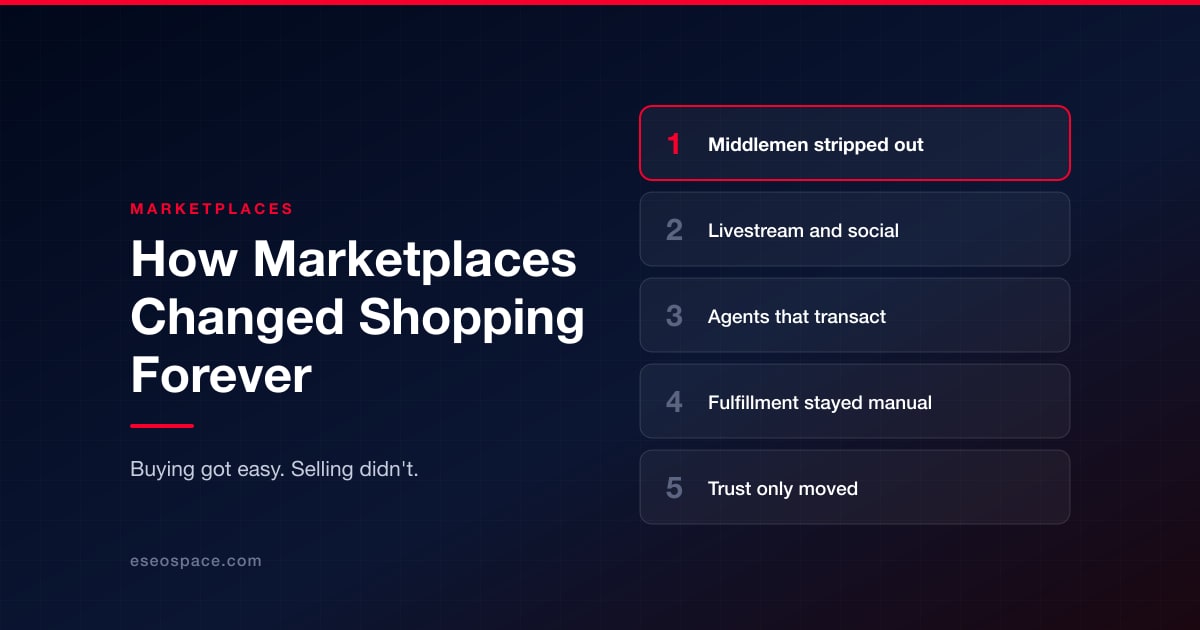
Digital marketplaces didn't invent buying and selling. They stripped out the middlemen who used to control access to shelf space. A seller in Odessa can list a product that ships from a warehouse in New Jersey to a buyer in Berlin, and nobody involved ever has to shake hands.
That structural shift created a few things worth naming:
- Price transparency buyers never had before — comparing five sellers takes seconds, not a Saturday
- Reputation systems (star ratings, review counts) replacing the local shopkeeper's word
- Logistics networks so dense that "two-day shipping" became the baseline expectation, not a luxury
- A whole layer of third-party businesses that exist purely to help sellers survive on these platforms
That last point gets less credit than it deserves. Getting a product listed is the easy part. Getting it into a fulfillment center without a rejection — correctly labeled, correctly packaged, correctly barcoded — is where most new sellers quietly fail. Which is exactly why services built around an Amazon FBA prep service model became an industry of their own, handling receiving, inspection, labeling and repackaging so a seller doesn't get an entire shipment bounced back over a missing barcode.
The Market Right Now: Bigger, Weirder, Faster
Growth hasn't slowed down, but the shape of it has changed. It isn't just "more people buying online" anymore — it's how they're buying that keeps shifting.
What's actually moving
Livestream shopping is one of the clearer signals, though the size of the prize depends heavily on who you ask. ARK Invest's forecast has US livestream commerce compounding at roughly 47% a year to about $680 billion by 2030 — the aggressive end by a wide margin, with other research houses putting 2030 closer to $65–105 billion. Coresight's nearer-term read is more grounded: roughly $32 billion in 2023, about doubling to $68 billion by 2026. Either way the direction is the same, and TikTok Shop leaned into it hard, turning influencer unboxings into direct checkout without the viewer leaving the app.
Generative AI, meanwhile, stopped being a chatbot gimmick and started closing purchases. Walmart's catalog moved into ChatGPT rather than the other way round — a partnership announced in October 2025 that let shoppers buy Walmart items inside the assistant through OpenAI's Instant Checkout, with Walmart's own Sparky assistant following. Amazon rolled out its own generative shopping tools. OpenAI retired Instant Checkout in March 2026, and purchases now happen on the merchant's own site, which tells you how unsettled this layer still is.
Adoption is real but frequently overstated. Surveys land anywhere from 49% of consumers saying they used AI to shop in 2025 to nearly 60% saying they've used it at some point, and 61% among Gen Z. What that does not mean is that most purchases involve AI: the share using an assistant as their primary research tool sits closer to one in five. Plenty of people have tried it once; far fewer shop that way by default.
A few things being tested or already live:
- Agentic checkout — AI agents that don't just recommend a product but complete the purchase against a standing set of preferences
- Visual search — snap a photo of a jacket on the street, get five places selling it
- Dynamic, real-time pricing — adjusting per-item prices on demand, competitor moves, even weather data
- Zero-click reordering — subscriptions and predictive restocking that skip "add to cart" entirely
eBay and Etsy both pushed agentic AI into their seller and buyer tools this past year, which says something. These aren't scrappy startups experimenting at the edges — they're the platforms that invented the category, adapting because standing still isn't an option.
For sellers the practical consequence is unglamorous: when an agent is doing the reading, the page has to state plainly what the product is, what condition it's in, and what it costs. That's a different writing job from a human skim, and AI-friendly product pages are built differently because of it.
And what's still stubbornly manual
For all the AI talk, physical fulfillment hasn't kept pace. Someone still has to pick, pack and ship the item. Warehouses are testing robotics and predictive inventory placement, but the box on your porch was touched by human hands more often than marketing decks like to admit.
Why Sellers Are the Ones Feeling the Pressure
Buyers get the shiny experience — one-click checkout, AI recommendations, next-day delivery. Sellers get the headache. Every marketplace has its own rulebook, and breaking it, even by accident, costs real money.
Take multi-channel selling. A seller running both an Amazon store and an eBay shop isn't just doubling their listings. They're managing two different fulfillment logics, two return policies, two sets of packaging rules. That's a lot to juggle without dedicated support, and it's the gap specialized fulfillment operators grew to fill. Providers offering an eBay fulfillment service handle picking, packing and shipping tuned to eBay's requirements — different from Amazon's FBA rules, different again from a brand's own DTC site — so a seller doesn't have to reinvent operations for every platform.
The same fragmentation shows up on the storefront side, where the same catalog has to be described consistently across channels without the brand's own site becoming the weakest of the three. That's usually a structural problem rather than a copy problem, and it's the sort of thing e-commerce development work exists to sort out before it hardens.
Sounds like a lot of moving parts. It is — and that's the point. The marketplaces made buying effortless by making selling considerably harder behind the scenes.
The Trust Problem Nobody Fully Solved
Reviews were supposed to replace the trust you'd get from a shop owner you knew personally. Instead, fake reviews became a cottage industry, and every major platform now runs detection systems just to keep star ratings honest. Amazon has reported blocking hundreds of millions of suspected fake reviews in a single year. Etsy has run its own repeated crackdowns on bot-generated feedback.
So: did digital marketplaces build more trust, or just relocate the problem? A little of both. The tools for verifying sellers got better — business licenses, ID checks, tracked shipping — but so did the tools for gaming them. It's an arms race, not a solved problem.
What Comes Next
- AI agents will keep taking over more of the discovery-to-checkout pipeline, not just recommending but transacting
- Livestream and social commerce will keep eating into traditional search-and-browse behavior
- Sub-day delivery windows will keep expanding past dense urban centers into suburbs and smaller cities
- Third-party logistics and prep services will keep growing, because platform rules keep getting more complex, not less
None of this points to a future where robots do everything and humans approve purchases with a nod. It's messier. Some categories — groceries, electronics — will lean hard into automation. Others, like vintage goods or handmade items, keep leaning on the human story behind the product, because that story is literally what people are paying for.
So, Did Shopping Actually Change Forever?
Yes, though not in the dramatic way people expected a decade ago. Nobody predicted that delivery drones would matter less than a good return policy, or that AI would get good enough to finish your cart before you did. The real shift wasn't the technology arriving — it was how fast buyers adjusted their expectations around it, and how much pressure that put on everyone working behind the scenes to keep up.
If you're on the selling side of that equation, the storefront is the half you actually control. Our e-commerce SEO services focus on exactly that: making sure the catalog you've worked to fulfil correctly is also the one buyers and answer engines can find.
Put this into action with eSEOspace
We help businesses grow with website development that actually performs. Explore the services behind this guide:
Get a FREE Audit
We'll perform a comprehensive SEO, AEO, GEO & CRO audit of your website — completely free — and show you exactly how to outrank your competitors.
Don't have a site yet? Get in touch →
Get a FREE GEO/AEO/SEO Audit
We'll analyze your site's SEO, GEO, AEO & CRO — completely free — and show you exactly how to get found across Google and AI answers.
Don't have a site yet? Get in touch →
Great — your audit is on the way!
We'll send your free SEO/GEO/AEO/CRO audit within the next few hours. Where should we send it?
You're all set! ✓
Your free audit is being prepared — check your inbox in the next few hours. Talk soon!