



How to Choose a Schema Markup Service: What to Look For and Red Flags to Avoid
How to Choose a Schema Markup Service: What to Look For and Red Flags to Avoid
Key Takeaways
- A quality schema markup service treats structured data as a technical SEO discipline, not a plugin install, and can show you real, validated JSON-LD from past work.
- Prioritize vendors who build interconnected entity graphs using @id and sameAs references. Clean, connected structured data helps search engines understand your business, though Google says it isn't required for its AI features.
- Expect concrete deliverables: an audit, a page-type-to-schema map, Rich Results Test validation evidence, Search Console monitoring, and documentation of how markup is deployed.
- Normalize quotes on scope rather than headline price, and demand clarity on maintenance, ownership, and whether ongoing content changes are covered.
- Walk away from guaranteed rankings, unvalidated markup, fake or invisible-content schema, one-size templates, and any provider unwilling to touch your Search Console.
Schema markup is one of the highest-leverage technical SEO investments available right now, but the market for schema markup services is crowded with vendors who bolt on a plugin, generate a few generic snippets, and call it done. The difference between a service that earns you rich results and AI-search visibility versus one that quietly injects invalid JSON-LD into your <head> is enormous, and it is not always obvious from the sales page.
Choosing well means understanding what structured data actually does, which parts of the work are hard to get right, and how to separate a genuine specialist from a reseller. This guide walks through the specific criteria that matter, the questions that expose whether a vendor knows what they are doing, and the warning signs that should make you keep looking.
Whether you are hiring an agency, a freelancer, or evaluating a software product, the same fundamentals apply. Here is how to evaluate a schema markup service without getting sold a template.
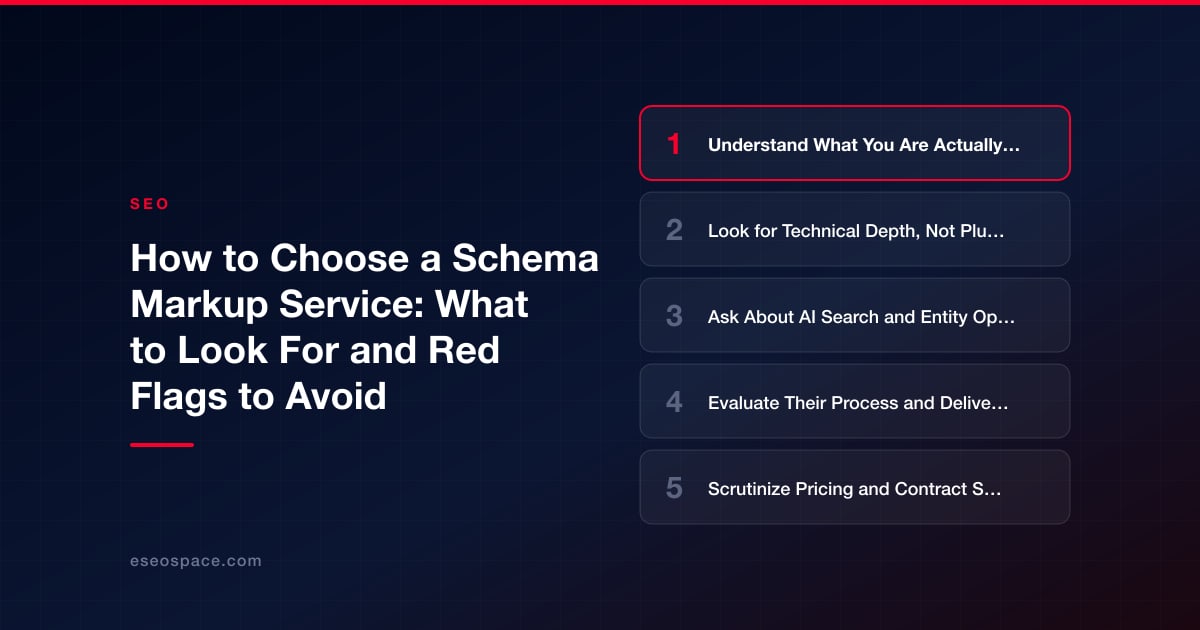
Understand What You Are Actually Buying
Before comparing vendors, get clear on scope, because "schema markup" covers a wide range of work. At the shallow end, a provider adds basic Organization and WebSite markup sitewide. At the deep end, they build interconnected entity graphs where every page's schema references others using shared @id values, so search engines and large language models can understand your business as a connected knowledge structure rather than isolated snippets.
A capable service should be able to speak to all of the following, and tailor it to your site type:
- Entity coverage — the specific types your business needs (LocalBusiness, Product, Service, Article, FAQPage, HowTo, Person, Event, Review, BreadcrumbList, and industry-specific subtypes).
- Nesting and relationships — using
@idreferences so entities connect instead of repeating, which is what modern knowledge-graph parsing rewards. - Rich result eligibility — mapping each schema type to the SERP feature it can unlock, and being honest that markup makes you eligible, not guaranteed.
- Maintenance — how markup stays valid as your site, products, and Google's requirements change over time.
If a vendor cannot articulate which entity types apply to your business and why, they are selling a template, not a strategy.
Look for Technical Depth, Not Plugin Installs
The single biggest differentiator is whether the provider treats schema as a technical SEO discipline or a checkbox. Anyone can install a plugin that auto-generates markup. The value is in the judgment around it: choosing the right types, populating properties with accurate real data, avoiding conflicts between manual and plugin-generated output, and validating everything before it ships.
Strong signals of technical depth include:
- JSON-LD by default. Google explicitly prefers JSON-LD over Microdata or RDFa. A service still shipping inline Microdata in 2026 is working from outdated playbooks.
- Validation as standard practice. They run every implementation through Google's Rich Results Test and the Schema.org validator, and they can show you the results.
- Required-vs-recommended fluency. They know which properties Google requires for a given rich result (for example,
offers,aggregateRating, andreviewnuances for Product) versus what is merely recommended. - Awareness of policy changes. They can discuss recent shifts, like Google retiring HowTo rich results and, in May 2026, FAQ rich results for all sites, and adjust recommendations accordingly rather than marking up things that no longer earn features.
Ask them to walk you through a past implementation. A specialist will happily show you real JSON-LD and explain the choices. A reseller will change the subject to reporting dashboards.
Ask About AI Search and Entity Optimization
AI-driven search (Google AI Overviews, ChatGPT, Perplexity, and other answer engines) has raised interest in structured data, although Google says it isn't required for AI Overviews or AI Mode and other providers have not said how much they use it. A modern schema service should be building toward entity clarity, not just SERP rich snippets.
Good questions to probe this:
- How do you use
sameAsproperties to connect our entity to authoritative references like our LinkedIn, Wikidata, or industry profiles? - Do you build a consistent Organization or Person entity that every page references, so our brand reads as one coherent entity?
- How does your markup support Google's Knowledge Graph and answer-engine understanding, not just star ratings in blue links?
Vendors who only talk about "getting stars in search results" are optimizing for a shrinking slice of the value. The durable payoff of structured data now is being understood and trusted by both search engines and LLMs.
Evaluate Their Process and Deliverables
A professional engagement should feel like engineering, not magic. Clarify exactly what you receive and how the work is verified. A credible process typically includes an audit of existing markup, a mapping of page templates to schema types, staged implementation, validation, and a monitoring plan.
Concrete deliverables to expect:
- An audit document listing current structured data, errors, and gaps, ideally pulled from Google Search Console's enhancement reports plus a crawl.
- A schema map tying each page type to the entity types and properties it will carry.
- Validation evidence showing zero errors and reviewed warnings in the Rich Results Test.
- Search Console monitoring so you can watch valid-item counts and rich result impressions over time.
- Documentation of how markup is injected (template-level code, tag manager, or plugin) so future developers do not break it.
How markup is deployed matters for durability. Server-rendered, template-level JSON-LD is the most robust. Google Tag Manager injection can work but is more fragile and occasionally missed by crawlers. Ask which approach they use and why.
Scrutinize Pricing and Contract Structure
Schema pricing varies widely, and both extremes carry risk. A flat $99 one-time fee usually buys a plugin install with default settings. Open-ended retainers with no defined scope can bleed money for maintenance you do not need. Reasonable structures include a fixed-price implementation project for a defined page set, or a modest ongoing fee tied to active maintenance and expansion.
When comparing quotes, normalize on scope rather than headline price. Ask each vendor to break the quote into tasks and estimated hours so you can compare like with like; a focused implementation for a mid-sized site should have a clearly defined scope. Get clarity on:
- Whether the price is per template or per page, and what counts as a page.
- Whether ongoing changes to your products or content are covered or billed separately.
- Who owns the markup and documentation if you leave.
- Whether reporting and re-validation are included.
Transparency here is itself a quality signal. A vendor who dodges scope questions will dodge accountability later.
Red Flags to Avoid
Some warning signs reliably separate weak providers from strong ones. Treat any of these as a reason to keep looking:
- Guaranteed rankings or guaranteed rich results. No one controls whether Google displays a rich result. Markup creates eligibility; guarantees are a sales fiction.
- Marking up invisible or fake content. Adding review or FAQ schema for content that does not appear on the page, or inventing ratings, violates Google's structured data policies and risks a manual action.
- No validation shown. If they cannot produce clean Rich Results Test output, assume the markup has errors.
- One-size template for every client. A dentist, a SaaS product, and a law firm need meaningfully different entity graphs. Identical markup across industries is a tell.
- Outdated types. Pushing FAQ or HowTo markup for rich results on sites that no longer qualify, or still recommending Microdata, shows they are not current.
- Set-it-and-forget-it framing. Schema needs upkeep as Google's requirements and your site evolve; a service that never mentions maintenance is underscoping.
- No access to your Search Console. Serious providers want to see your enhancement reports; those who avoid it are flying blind.
The best way to protect yourself is to ask for a small paid audit or pilot before committing to a large engagement. A single template implemented correctly, validated, and monitored will tell you more about a vendor's competence than any pitch deck. If the pilot is clean, well-documented, and honestly scoped, you have found a service worth scaling with.
Get a FREE Audit
We'll perform a comprehensive SEO, AEO, GEO & CRO audit of your website — completely free — and show you exactly how to outrank your competitors.
Don't have a site yet? Get in touch →
Put this into action with eSEOspace
We help businesses grow with website development that actually performs. Explore the services behind this guide:
Frequently Asked Questions
How much should a schema markup service cost?
Can a schema markup service guarantee rich results?
What deliverables should I expect from a schema service?
Is schema markup still worth it with AI search?
How do I verify a vendor's schema markup is correct?
Get a FREE GEO/AEO/SEO Audit
We'll analyze your site's SEO, GEO, AEO & CRO — completely free — and show you exactly how to get found across Google and AI answers.
Don't have a site yet? Get in touch →
Great — your audit is on the way!
We'll send your free SEO/GEO/AEO/CRO audit within the next few hours. Where should we send it?
You're all set! ✓
Your free audit is being prepared — check your inbox in the next few hours. Talk soon!








