SEO for Live Streamers: How Twitch and Kick Creators Get Found on Google and AI Search
SEO for Live Streamers: How Twitch and Kick Creators Get Found on Google and AI Search
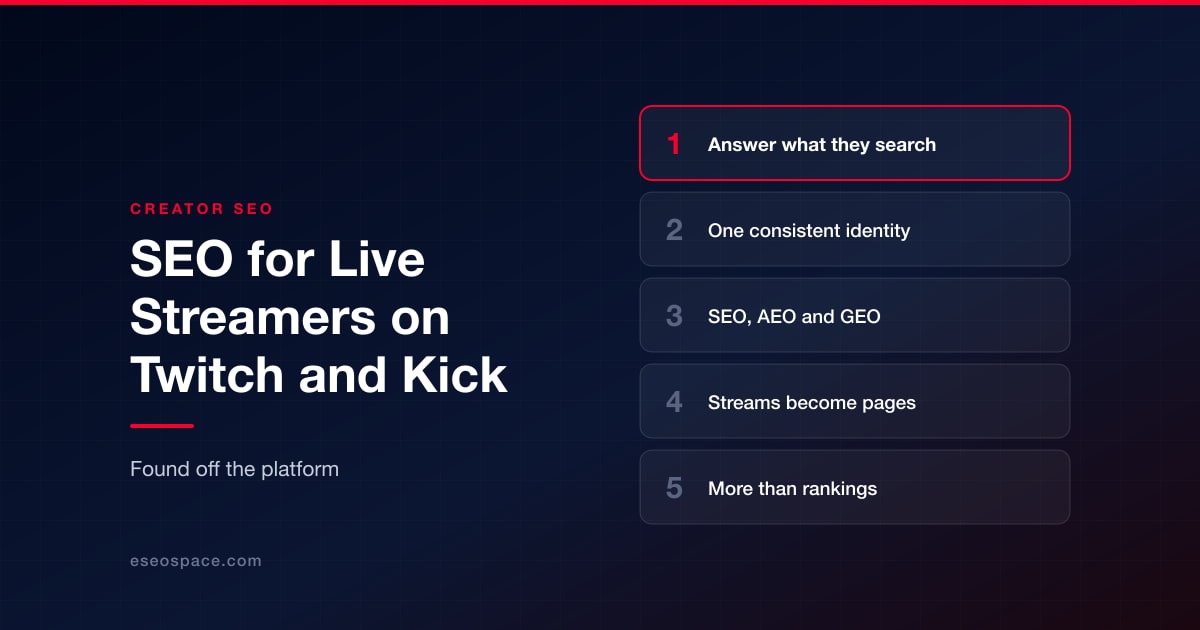
Discovery on Twitch and Kick no longer stops at the platform. What happens on stream still matters, but a growing share of new viewers arrive from somewhere else entirely — a Google result, a YouTube clip, an AI assistant answering a question about a game. Streamers who only optimize for the platform's own recommendation algorithm are competing for a slice of attention that the biggest channels already own.
Search gives creators a second front. A streamer does not have to wait to be surfaced in a category page; they can publish the answers people are already looking for, and let those answers do the introducing.
Why Search Matters for Streamers
A channel can produce genuinely entertaining content and still stall out. Usually the problem is not quality — it is that nobody knows the channel exists. Platform recommendations reward channels that are already large, which leaves newer creators circling the same small pool of viewers.
Search works differently. Nobody has to already know your name to find you. Someone types a question about a boss fight, a capture card, or a settings tweak, and the person who answered it best gets the visit. Game guides, setup tutorials, gear reviews, challenge recaps, patch breakdowns — each one is a door into the channel that does not depend on the platform choosing you.
Build Content Around What Viewers Search For
Start with the questions your niche actually asks, not with your channel name. A gaming streamer has more search demand available than they usually realize:
- Strategies, builds and walkthroughs for the games you play
- How to set up a stream — software, scenes, audio, capture
- Gear reviews from someone who uses it live, not from a spec sheet
- Beginner guidance for the game or the platform
- Highlights, commentary and reactions tied to a specific event
- Patch notes, balance changes and new releases
- Questions specific to one game, mode or streaming category
The goal is not to assemble keywords. It is to be the most useful answer on the page. A guide written by somebody who has played a hundred hours of the game reads differently from one assembled for traffic, and both search engines and viewers can tell.
Make Your Stream Brand Search-Friendly
Consistency is an underrated discovery asset. Use the same name, the same handle and the same description across your channel, your website and your social profiles, so every mention reinforces the same entity rather than splitting into three half-recognized ones.
Pick a name people can spell after hearing it once. Then write titles that say what the viewer gets: "Ranked Valorant Coaching for New Players" carries far more information — for a person and for a crawler — than "Live Again!" Your bio, categories and on-site copy should all point at the same specialty. Over time that repetition is what links your name to your niche.
SEO, AEO, and GEO for Streamers
Discovery has spread past the ten blue links, and the three acronyms map to three different surfaces. SEO is visibility in search results. Answer Engine Optimization is being the source a direct answer is drawn from. Generative Engine Optimization is showing up inside what ChatGPT, Perplexity or Gemini say when someone asks for a recommendation.
For a creator, all three reward the same thing: information that is clear, structured and easy to attribute. When an AI system finds a page that plainly states who the creator is, what they stream, which games they specialize in and what makes the channel different, it has something to work with. A page of promotional slogans gives it nothing to repeat.
Turn Live Streams Into Searchable Content
A stream does not have to end when the broadcast does. A two-hour session usually contains several pieces of content that can each be found on their own: short clips of the best moments, a written recap, a tutorial built from one segment, and posts pulling out the highlights.
That is how one stream becomes visible in several places at once — and each format lands in a different discovery environment, which is worth planning deliberately rather than posting the same clip everywhere. Our breakdown of YouTube vs TikTok vs Reels covers how those platforms differ, and the video SEO guide covers what makes a clip rank once it is published.
Audience-Growth Tools and Discoverability
Optimization sits inside a wider marketing approach, and creators use plenty of tools that raise a channel's visibility without being SEO techniques at all. For example, https://viewbot.tv offers viewer, follower, chat, clip and VOD services for Twitch and Kick, and describes a dashboard for managing channels and bots across both platforms.
Creators considering services in this category should evaluate them separately from organic search, and against the policies each platform sets for artificial engagement. They operate on different mechanics than the content work described here, and the results they produce are not the results search delivers.
Create Content AI Search Can Understand
AI search increasingly synthesizes an answer rather than listing ten links, which puts a premium on clarity. Answer questions directly, use headings that describe what follows, define terms the first time they appear, and keep your facts consistent everywhere they are stated — a system comparing two of your pages should not find two different answers.
A dedicated page covering who you are, what you play, when you stream, what kind of content you make and where the highlights live gives both crawlers and assistants a single reliable source to draw on. Marking it up with the right schema types makes those facts machine-readable instead of merely present.
Measure More Than Rankings
Keyword position is a poor scoreboard on its own. What matters is whether search traffic turns into anything: does the person who arrived from Google come back, watch, or subscribe? Worth tracking:
- Organic impressions and click-through rate
- New versus returning visitors
- Watch time on clips and VODs
- New subscribers and followers
- Traffic from specific searches, not just totals
- How search visitors convert into repeat viewers
Read together, these show which topics bring the right audience rather than simply the largest one — and a small search that sends committed viewers beats a large one that sends nobody who stays.
Conclusion
SEO is not a replacement for streaming well. It is a second route by which the audience finds you: understand what your future viewers are searching for, publish content worth finding, keep your identity consistent everywhere it appears, and give your past streams a searchable afterlife.
SEO, AEO and GEO all extend that reach across search engines and AI-driven discovery, and other audience-growth tools sit alongside them as a separate decision. None of it substitutes for content good enough to bring people back. If you want help building the search side of a creator brand, our video SEO services are built around exactly this problem.
Put this into action with eSEOspace
We help businesses grow with website development that actually performs. Explore the services behind this guide:
Get a FREE Audit
We'll perform a comprehensive SEO, AEO, GEO & CRO audit of your website — completely free — and show you exactly how to outrank your competitors.
Don't have a site yet? Get in touch →
Get a FREE GEO/AEO/SEO Audit
We'll analyze your site's SEO, GEO, AEO & CRO — completely free — and show you exactly how to get found across Google and AI answers.
Don't have a site yet? Get in touch →
Great — your audit is on the way!
We'll send your free SEO/GEO/AEO/CRO audit within the next few hours. Where should we send it?
You're all set! ✓
Your free audit is being prepared — check your inbox in the next few hours. Talk soon!


On this page
- Why Search Matters for Streamers
- Build Content Around What Viewers Search For
- Make Your Stream Brand Search-Friendly
- SEO, AEO, and GEO for Streamers
- Turn Live Streams Into Searchable Content
- Audience-Growth Tools and Discoverability
- Create Content AI Search Can Understand
- Measure More Than Rankings
- Conclusion