



Wix vs Custom Website: The True Cost of "Free"
Wix vs Custom Website: The True Cost of "Free"
Key Takeaways
- Wix's monthly fee is only part of its cost; template lock-in, performance ceilings, and eventual migration are the expenses that don't appear on the pricing page.
- Custom websites cost more upfront but own their code, hosting, and SEO infrastructure, which compounds into lower total cost of ownership as traffic and revenue grow.
- Wix sites carry heavier page weight and third-party scripts that cap Core Web Vitals, while custom builds can hit sub-1-second loads that improve rankings and conversions.
- Choose Wix if you need a simple brochure site live this month on a tight budget; choose custom if SEO, integrations, or scale are central to how you make money.
- Businesses that outgrow Wix should plan a structured migration early, preserving URLs and 301 redirects to protect the search equity they have already earned.
Wix promises a website in an afternoon for the price of a coffee subscription, and for a weekend hobby that math is hard to argue with. The problem is that the word "free" (or "cheap") does a lot of quiet work in that pitch. Once a site has to generate leads, rank in search, load fast on mobile, and grow alongside your business, the real bill arrives in places the pricing page never mentions: locked-in templates, throttled performance, SEO ceilings, and the cost of eventually rebuilding on a platform you don't control.
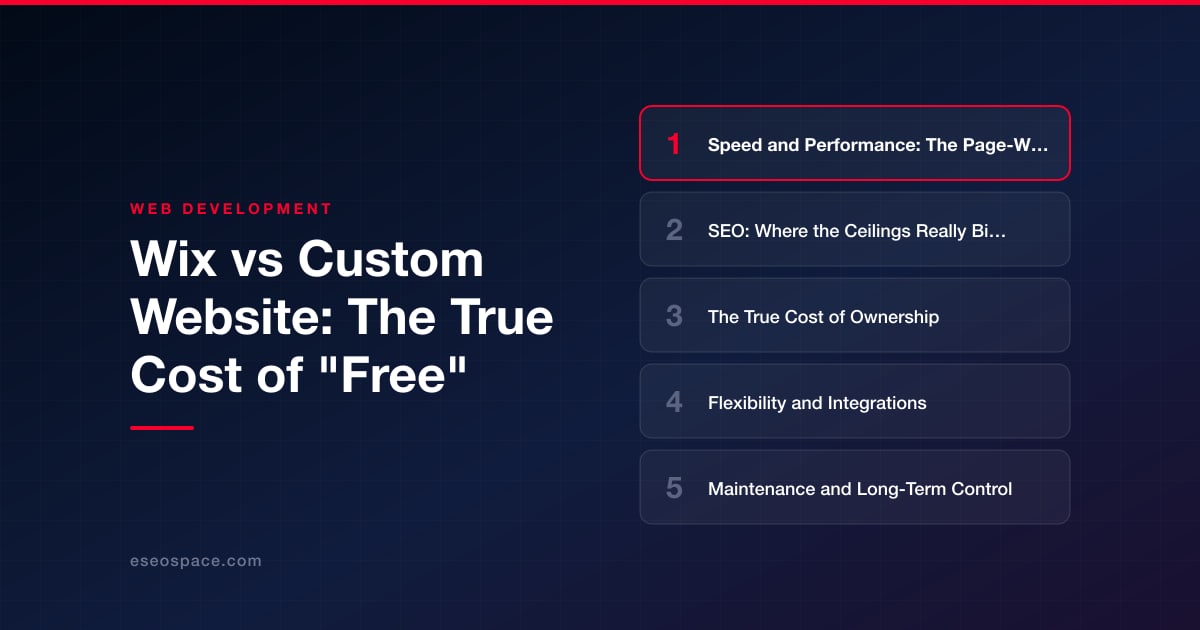
This guide compares Wix against a custom-built website head-to-head across the five factors that actually move revenue: speed, SEO, total cost of ownership, flexibility, and maintenance. The goal isn't to declare a universal winner. Wix is genuinely the right call for some businesses, and a custom build is overkill for others. The point is to help you see the full ledger before you commit, so you don't spend two years on a platform you'll have to migrate off of anyway.
Below we break down where each option wins, where the hidden costs hide, and clear "choose this if" guidance so you can make a decision you won't regret in eighteen months.
Speed and Performance: The Page-Weight Problem
Page speed is no longer a nice-to-have. Google's Core Web Vitals feed directly into rankings, and a slow page loses visitors before they convert. This is where the architectural difference between the two options is starkest.
Wix renders your site through its own platform framework, which ships a shared bundle of JavaScript and CSS to every visitor, whether the page needs all of it or not. Wix already renders pages on the server, but you can't strip that framework out or decide what loads and in what order, because you don't have access to the underlying code. To be fair to the platform, its field data has improved sharply: as of October 2026, the latest Web Almanac (2025) puts the share of Wix sites passing Core Web Vitals on mobile at about 74%, up from 55% a year earlier. The limit is control over Largest Contentful Paint and the rest of the render path, not a guaranteed failing score.
A custom website flips this. A modern stack built on a framework like Next.js can server-render or statically generate pages, ship only the JavaScript a given page actually uses, serve images in next-gen formats sized per device, and push everything through a global CDN. Sub-1-second loads and green Core Web Vitals across the board are a realistic and repeatable target, not a lucky outcome. You control the caching strategy, the render path, and the payload down to the kilobyte. For a content or e-commerce site where a few tenths of a second changes revenue, that ceiling difference compounds every single day, and it's a gap Wix's closed architecture structurally cannot close.
SEO: Where the Ceilings Really Bite
Wix has closed much of the SEO gap it had a decade ago. You can now edit title tags, meta descriptions, slugs, alt text, and add structured data, and Wix will generate a sitemap and robots file for you. For a local business chasing low-competition keywords, that's often enough to rank.
The ceiling shows up in the parts you can't touch. You have limited control over URL structure and server response headers, you can't fine-tune rendering or crawl budget, and the same script-heavy performance that hurts Core Web Vitals also hurts how efficiently Google crawls and indexes deep pages. Log-file analysis, advanced canonical logic, edge-level redirects, and programmatic page generation at scale are either impossible or awkward. A custom build gives you the full technical-SEO surface: clean semantic HTML, controllable rendering, granular redirect rules, and infrastructure that scales to thousands of well-optimized pages. If organic search is a primary channel for you, that difference is the difference between competing and being capped.
The True Cost of Ownership
Here is where "free" unravels. Wix's headline appeal is a low monthly fee, but the honest accounting looks different:
- Recurring platform fees forever. As of October 2026, Wix's premium plans run from roughly $17 a month (Light) to roughly $159 a month (Business Elite) on annual billing, with prices varying by country, and the bill never stops. Over five years even the entry plan comes to more than $1,000 for something you don't own.
- Paid apps and plugins. Bookings, memberships, advanced forms, and marketing tools frequently sit behind additional monthly subscriptions from third-party app vendors.
- Transaction and processing overhead on e-commerce plans, plus upsells for storage, bandwidth, and email.
- The migration bill later. When you outgrow Wix, you can't export a working site. You rebuild from scratch and pay for it, on top of everything you already spent.
A custom website inverts the curve. You pay more upfront to design and build it, but hosting is cheap and predictable, there are no perpetual license fees, and you own the asset outright. The upfront number is real, but for a business where the site drives revenue, the performance and SEO gains can pay back that investment, and once they have, the custom site is simply cheaper to run.
Flexibility and Integrations
Templates are a feature until the day they become a wall. Wix's editor is genuinely excellent for arranging a brochure-style site inside its guardrails. But the moment your business logic outgrows those guardrails, you're stuck approximating what you need through paid apps that never quite fit.
Custom development has no such wall. If you need a booking engine that talks to your calendar and your accounting software, a members area with tiered access, a real-time inventory feed, or a tight loop between your website and your sales pipeline, that's normal engineering work rather than a plugin hunt. This is exactly the territory where custom website and CRM development earns its keep: your site becomes an operational tool that captures, routes, and enriches leads automatically instead of just displaying a contact form. Template platforms can bolt on a CRM connector, but they can't make the website itself a first-class part of your workflow.
Maintenance and Long-Term Control
On the surface, Wix looks like the low-maintenance option, and for security patches and uptime it genuinely is. Wix handles the servers, updates, and backups so you never think about them. That's a real advantage for a non-technical owner with no developer on call.
The trade-off is control. You're subject to Wix's roadmap, its pricing changes, its feature deprecations, and its terms of service. If Wix changes how something works or raises prices, you absorb it. A custom site puts maintenance in your hands (or your agency's): you decide when to update, what to change, and how to evolve. That requires a technical partner, but it also means the platform can never be pulled out from under you, and your data and design are always portable. For a business treating its website as a long-term asset, that ownership is worth the modest ongoing upkeep.
Choose Wix If… / Choose Custom If…
Choose Wix if you need a straightforward brochure, portfolio, or event site live within days, your budget is tight, organic search isn't a core acquisition channel, you don't need custom integrations, and you're comfortable trading long-term control for zero-maintenance convenience. Solo operators, pop-ups, and simple local presences are a great fit.
Choose a custom website if SEO and page speed materially affect your revenue, you need integrations with a CRM, booking system, inventory, or membership logic, you're planning to scale content or product catalogs, or you simply want to own the asset your business depends on. The upfront cost is higher, but the total cost of ownership and the performance ceiling both favor custom once the site is doing real work.
If you're already on Wix and recognizing these limits, the good news is that switching is a well-trodden path. The critical detail is protecting the search equity you've built by preserving URLs and setting up proper 301 redirects so rankings carry over. Our website migration services handle exactly that transition, moving your content, redesigning for performance, and mapping every old URL to its new home so you gain the ceiling a custom build offers without losing the ground you've already earned.
Get a FREE Audit
We'll perform a comprehensive SEO, AEO, GEO & CRO audit of your website — completely free — and show you exactly how to outrank your competitors.
Don't have a site yet? Get in touch →
Put this into action with eSEOspace
We help businesses grow with website development that actually performs. Explore the services behind this guide:
Frequently Asked Questions
Is Wix actually free for a business website?
Can a Wix site rank as well as a custom website in Google?
When is Wix the right choice over a custom site?
How hard is it to migrate off Wix later?
Does a custom website cost more than Wix long-term?
Get a FREE GEO/AEO/SEO Audit
We'll analyze your site's SEO, GEO, AEO & CRO — completely free — and show you exactly how to get found across Google and AI answers.
Don't have a site yet? Get in touch →
Great — your audit is on the way!
We'll send your free SEO/GEO/AEO/CRO audit within the next few hours. Where should we send it?
You're all set! ✓
Your free audit is being prepared — check your inbox in the next few hours. Talk soon!








