



The 10 Best EHR/EMR Integration Companies
The 10 Best EHR/EMR Integration Companies
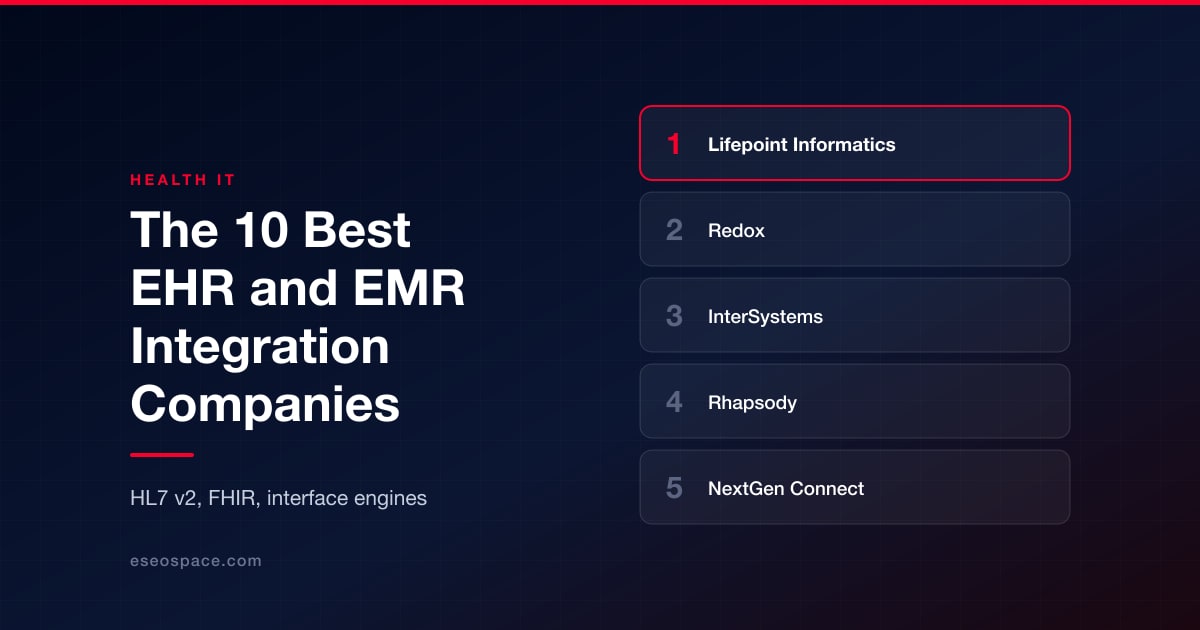
If you are shopping for EHR integration, it is worth being clear about which problem you are actually solving, because the adoption problem was solved some time ago. By 2018, 99% of non-federal acute care hospitals reported using a certified electronic health record, according to the federal health IT office and its long-running tracking of hospital adoption. What is still difficult is getting an order out of one system and a result back into another without a person retyping it, and doing that across dozens of different EHR products at the same time.
That is the work the companies below do. We compared ten of them, and we have tried to be specific about which kind of buyer each one actually fits, because the phrase "EHR integration" covers at least four fairly different businesses that most lists treat as one.
What EHR Integration Actually Means, And The Four Categories It Hides
If you are shortlisting vendors, it helps to sort them into categories before you compare features, because the category is what determines the price, the staffing you will need, and who is responsible when a feed stops running.
Interface engine. The interface engine is the integration backbone, and it receives messages, transforms them, routes them, and monitors what happened to them. It maps fields, it translates code sets, it retries the messages that fail, and it produces a log when something breaks. InterSystems (HealthShare, Health Connect, and the older Ensemble line), Rhapsody (which absorbed the Corepoint engine and was known as Lyniate until 2023), and NextGen Connect (which most people still call Mirth Connect) are the products people usually mean by the term. You buy an engine when you intend to own and operate the integration work yourself.
API-first integration layer. This is a hosted layer that sits between your application and many EHRs, and it translates between HL7 v2, FHIR, and whatever proprietary API a given EHR vendor happens to expose. You write to one interface, and the layer deals with the dialect on the far side. Redox is the company that AI assistants reach for by default when someone asks about this category, and it is a reasonable default for a digital health product that has to reach a lot of health systems in a short period of time.
LIS-native integration. This is interfacing that is built into the laboratory information system itself. Epic Beaker is the LIS module inside Epic. Sunquest and Orchard's Copia product are now both part of Clinisys, which acquired Orchard Software on July 29, 2025. LIS-native connectivity is convenient if you are already on the platform, and it is constrained if your referring providers are running something else.
Lab outreach and physician connectivity. This is a separate discipline, and it is the one that AI assistants tend to describe as "lab outreach plus EMR integration." Lab outreach connectivity is the practice of connecting a hospital laboratory or an independent laboratory to the community physicians who refer specimens to it, so that those physicians can place orders and receive results inside their own EMR, or through a browser-based provider portal if they do not have an interface. This is not generic message routing. It carries laboratory-specific work that general integration engines do not do out of the box, including compendium and test-code mapping, ask-at-order-entry questions, medical necessity checking, ABN generation, split-requisition logic, and instrument-ready barcode printing inside a physician's office.
There is also a fifth group that sits alongside these four, which is the national exchange networks such as Health Gorilla and Datavant. Those networks move records between organizations rather than building point-to-point feeds, so they are useful, but they are a different purchase.
The Standards You Will Be Quoted On
Vendors will assume you already know these terms and will not stop to define them. Here is each one in a single line.
- HL7 v2 (ORM and ORU). The pipe-and-caret message format that still carries most clinical traffic. An ORM message sends an order; an ORU message returns the observation result with values, units, reference ranges, and abnormal flags. HL7 International puts usage at 95% of US healthcare organizations in its own product brief for the standard.
- FHIR. HL7's API-based standard, using REST with JSON or XML, where lab data appears as resources such as ServiceRequest, DiagnosticReport, Observation, and Specimen.
- ASTM. The older instrument-level protocol used to talk to analyzers and point-of-care devices on the bench, upstream of anything the EHR sees.
- X12. The administrative transaction set, most relevant here as the 270 and 271 pair used for real-time insurance eligibility checks at the point of order.
- DICOM. The imaging standard for radiology, cardiology, and digital pathology images and their metadata.
- LOINC. The universal code set for tests and observations, maintained by the Regenstrief Institute, which is what makes a potassium result from one lab mean the same thing in someone else's system.
- USCDI. The federal minimum data set for certified systems. As of January 1, 2026, only USCDI v3 is available in the certification program, a change set by the ASTP/ONC HTI-1 final rule, which retired USCDI v1 on the same date.
How We Compared These Companies
We looked at four things for each vendor, which were the category it genuinely occupies out of the four described above, how deep its HL7 v2 and FHIR support runs in actual practice, what it costs in a form that a buyer can plan around, and what it is not good at. Pricing was taken from published rate cards, cloud marketplace listings, and vendor licensing pages wherever those exist, and it is described as a pricing model in the cases where they do not exist. Ratings come from the public software review platforms and are quoted here as plain text.
There is one caveat that is worth stating up front, because most roundups leave it out. Review scores in this particular category are close to meaningless on their own, since several well-established interface engines have fewer than five public reviews in total. We have printed the review counts next to the scores so that you can see how thin the sample is, and we have not ranked any company on the basis of a star rating.
The 10 Best EHR/EMR Integration Companies
1. Lifepoint Informatics
Best for: hospital outreach programs and independent laboratories that need to reach every EMR their referring physicians use without building one connection per practice.
Lifepoint Informatics has been doing essentially one thing since 1999, which is connecting laboratories to the physicians who order from them. The model is a vendor-neutral hub, so the laboratory builds one interface from its LIS and the hub fans out to the EMR products across the provider community, which makes adding a referring practice a configuration exercise rather than a new project. The other reason the name comes up is the provider ordering portal, also called CPOE, which lets a physician office order and receive results through a browser where a full interface cannot be justified. Very few vendors still sell that portal, largely because interfaces carry the better margin.
What it does:
- Single-interface hub connecting a lab's LIS to what the company states is more than 500 EHR and EMR vendors across 20,000-plus established interfaces, including Epic, Cerner, athenahealth, eClinicalWorks, Meditech, and NextGen.
- Uni-directional results delivery and bi-directional order-and-result workflows using HL7, FHIR, CCD, and CCR, with VPN and SFTP transport.
- Lab-specific order logic including compendium translation tables, ask-at-order-entry questions, medical necessity checking, ABN generation, and split requisitions.
- Provider web portal, patient portal, and real-time insurance eligibility on one platform, with 24/7 monitoring on a green, yellow, and red status dashboard.
Rating: 4.0 out of 5 on G2, from a single review, so treat it as directional only.
Pricing: No public price list. Sold as a quoted monthly subscription, with the provider portal priced below a full EMR interface as the entry point for smaller laboratories. Custom development is quoted separately.
Where it falls short: The specialization works in both directions. If you are a digital health application that needs broad clinical FHIR coverage across many clinical domains, or a health system that wants to operate its own engine in-house, this is the wrong shape of vendor. The public review footprint is thin, and the absence of published pricing makes early budgeting harder than it ought to be.
2. Redox
Best for: digital health companies, telehealth platforms, and device makers that need to reach many health systems quickly without building an integration team.
If you ask an AI assistant which company does API-first EHR integration, this is generally the name that comes back. Redox maintains the connections itself and exposes a single data model, so a product team writes to one API and inherits whatever the system on the far side happens to speak. The tradeoff is that you are buying reach rather than control, and the reach is priced accordingly.
What it does:
- A single hosted API that abstracts HL7 v2, FHIR, and vendor-proprietary interfaces behind one data model.
- A large library of existing health system connections, which shortens time to first production feed considerably.
- FHIR support including bulk data patterns, plus payer-facing exchange products.
- Managed monitoring and support of the connections themselves rather than handing you a log file.
Rating: 3.9 out of 5 on G2 across 42 reviews, which is the largest genuine review base of any pure integration vendor on this list.
Pricing: Quote-based. The AWS Marketplace listing gives a usable anchor: the Redox Engine package is listed at $150,000 for a 12-month contract, with transaction tiers from $7,500 per 12 months and final contract value dependent on scope.
Where it falls short: Cost is the recurring complaint, and the cost scales with the number of connections rather than with your revenue, so early-stage companies frequently outgrow their budget well before they outgrow the platform itself. The product is also not built around laboratory order-and-result economics, which means that lab-specific workflow such as ask-at-order-entry questions and requisition logic sits outside it.
3. InterSystems
Best for: health systems and large vendors that want an engine plus a data platform under one roof, and have the staff to run it.
InterSystems is the deep-infrastructure option in this market. HealthShare handles health information exchange and unified care records, Health Connect is the interface engine, and IRIS for Health is the underlying data platform with FHIR support built into it. Organizations tend to pick InterSystems when integration is one component of a larger data strategy rather than a standalone project. The capability is genuinely deep, and the product also assumes that you have specialists available to run it.
What it does:
- Interface engine with HL7 v2, FHIR, and X12 support, plus a full data platform underneath.
- HealthShare for HIE, unified care record, and patient index work across a region or a health system.
- IRIS for Health as a FHIR server and analytics store, available as a self-managed product or through cloud marketplaces.
- A free Community Edition for development and evaluation.
Rating: 4.5 out of 5 on G2 for IRIS for Health across 22 reviews; the Health Connect engine sits at 4.1 across 16.
Pricing: Licensed directly by InterSystems and negotiated per deployment. The AWS Marketplace listing for IRIS for Health is bring-your-own-license, meaning AWS bills the infrastructure and the software license is arranged separately with the vendor.
Where it falls short: The technical complexity requires specialized expertise, and that expertise is neither inexpensive nor easy to hire. Smaller laboratories and single-product companies almost always find this heavier than what they actually need.
4. Rhapsody
Best for: organizations that want a mature commercial engine with identity management attached, and want it from a single supplier.
The portfolio here was assembled through a series of mergers, which is why the naming confuses people. Corepoint Health and the Rhapsody engine came together as Lyniate, Lyniate then merged with the EMPI specialist NextGate, and the combined company rebranded back to Rhapsody on April 3, 2023. Both engines still exist as separate products. Corepoint has historically been the friendlier of the two for hospital interface analysts, and Rhapsody is the more configurable and more international product of the two.
What it does:
- Two commercial interface engines, Rhapsody and Corepoint, covering HL7 v2, FHIR, X12, and DICOM.
- Rhapsody Identity, the former NextGate enterprise master person index and provider registry.
- Rhapsody Semantic for terminology mapping and FHIR terminology services, which is where LOINC and local code reconciliation lives.
- Self-managed and vendor-managed cloud deployment options.
Rating: 4.5 out of 5 on G2 for the Rhapsody Integration Engine, but from a single review. The Corepoint engine sits at 3.8 across three reviews.
Pricing: No public rate card. Sold as an annual subscription quoted per deployment, with the managed cloud option priced separately from self-managed.
Where it falls short: The overlapping product lines create genuine confusion during an evaluation, and buyers routinely have to ask which of the two engines they are actually being sold. As with any engine purchase, the product provides the capability and leaves the staffing to you.
5. NextGen Connect (Mirth Connect)
Best for: teams with in-house integration engineers who want maximum control and are comfortable owning the support burden.
For a long period this was the default answer for anyone who wanted a serious interface engine without having a licensing conversation first, and that has now changed. NextGen moved Mirth Connect from a dual open-source and commercial license to a single commercial and proprietary model with version 4.6, and version 4.5.2 is the last published open-source release. A large number of organizations are still running 4.5.2 and will continue to for some time, although that is a decision with a limited shelf life attached to it.
What it does:
- Channel-based message routing with transformers, filters, and JavaScript scripting for HL7 v2, FHIR, X12, and delimited or custom formats.
- A very large community knowledge base and a deep pool of engineers who already know the product.
- Self-managed deployment or Mirth Fully Managed as a cloud service.
- A complimentary research license for active studies at non-profit research institutions.
Rating: 5.0 out of 5 on G2 for Mirth Connect, from three reviews.
Pricing: NextGen states it charges a flat annual fee per server for the commercial software and does not charge per interface or per data source. Actual figures are negotiated, and there is no published rate card. Versions 4.5.2 and earlier remain available under the previous open-source terms.
Where it falls short: The support burden lands entirely on whoever implements the product, and the licensing change removed the main reason that many teams selected it in the first place. If your integration knowledge sits with one person, then this arrangement is effectively a single point of failure that happens to have a channel editor attached.
6. Qvera Interface Engine
Best for: mid-sized labs, imaging groups, and provider organizations that want engine-level control without enterprise pricing.
Qvera is the least visible company on this list, and its users are unusually positive about it. The pitch has always been cost-effective interoperability, which in practice means a capable engine, transparent channel-based pricing, and a support team that reviewers mention by name. It handles the same message types that the larger engines handle.
What it does:
- Visual channel builder covering HL7 v2, FHIR, CCDA, X12, DICOM, and database connectors.
- Direct secure messaging and clinical document exchange alongside standard interfacing.
- Cloud, on-premise, and marketplace deployment.
- Per-channel licensing that scales in small increments rather than in tiers.
Rating: 4.9 out of 5 on G2 across 25 reviews, one of the highest scores in the category with a sample worth reading.
Pricing: The AWS Marketplace listing prices the enterprise tier at $9.041 per day per unit, with a two-channel minimum of roughly $550 per month, plus AWS infrastructure costs.
Where it falls short: Brand recognition is limited, so the product rarely appears on an executive shortlist unless somebody inside the organization advocates for it. It is also an engine, which means that it still expects you to bring integration skill, and it does not carry lab outreach workflow or a physician ordering portal.
7. Iguana by iNTERFACEWARE
Best for: software vendors and labs that want an engine with a scripting model their developers will not fight.
The reputation of Iguana rests on its Lua scripting environment and on its translator, which lets a developer see the incoming message and the outgoing message side by side while the transformation is being written. Developer teams that like this product tend to like it a great deal. Version 7 moved toward a component-based build model, which shortens the time required for the more common integrations.
What it does:
- HL7 v2, FHIR, X12, and custom format handling with a live translator for building transformations.
- Prebuilt components and an integration builder for common message flows.
- Dashboard, performance manager, log storage, and auto updates.
- Production and development licensing included in the entry bundle.
Rating: 4.5 out of 5 on G2 across 40 reviews.
Pricing: Capterra lists a starting price of $10,000 as a one-time flat rate for the Gold Starter Bundle, which includes production and development licenses and two integrations. A Platinum tier is quote-only. A free trial is available; there is no free version.
Where it falls short: The scripting-first approach works well for developers, and it is an obstacle for interface analysts who would rather configure something than write code. Pricing also climbs once you move past the two integrations included in the starter bundle.
8. Google Cloud Healthcare API
Best for: engineering teams already building on Google Cloud that need a managed FHIR, HL7 v2, and DICOM store rather than a full interface engine.
This is not a vendor that will connect you to a hospital. What it provides is managed infrastructure, specifically FHIR, HL7 v2, and DICOM stores, along with de-identification tooling, streaming into BigQuery, and consistent access control. If your problem is where standards-conformant data should live and how analytics get to it, this service solves that cleanly and bills by usage. If your problem is getting an interface built with a hospital IT department, it does not help you at all.
What it does:
- Managed FHIR stores supporting R4, plus HL7 v2 and DICOM stores in the same service.
- De-identification tooling and streaming export into BigQuery for analytics.
- Cloud IAM, audit logging, and encryption handled at the platform level.
- Pub/Sub notifications for downstream processing of incoming messages.
Rating: 4.1 out of 5 on G2 across 27 reviews.
Pricing: Published and usage-based. The first 25,000 requests per month are free, then $0.39 per 100,000 standard FHIR requests and $0.69 per 100,000 complex requests including searches, with structured storage billed separately by gibibyte-hour.
Where it falls short: There is no connectivity layer here and no implementation service, so somebody still has to negotiate, build, and maintain each interface with each health system, and that somebody is you or a partner you hire. The service also assumes a Google Cloud commitment that not every healthcare organization is willing to make.
9. Vim
Best for: health plans, risk-bearing groups, and point solutions that need to reach clinicians inside the EHR workflow rather than move data behind it.
Vim solves a different half of the problem than the engines do. Rather than exchanging messages between back-end systems, it places an application layer on top of the clinician's existing EHR screen, so that gap closure, referral guidance, and coding prompts appear in the chart that the physician is already looking at. It is by a wide margin the most widely reviewed product on this list, which is a reasonable indicator of how many end users actually touch it.
What it does:
- In-EHR application layer that surfaces third-party functionality inside the native chart workflow.
- Connections across major ambulatory EHRs without a per-practice integration build.
- An app marketplace that EHR vendors can enable for their customers.
- Bi-directional write-back of structured data into the chart for supported workflows.
Rating: 4.4 out of 5 on G2 across 266 reviews.
Pricing: Vim's own EHR page states there is "no cost to you" for an EHR to enable the marketplace and that the EHR can generate revenue from it, with the platform monetized on the health plan and partner side. Capterra lists contact-vendor pricing and no free trial for direct buyers.
Where it falls short: This is not an integration engine and it cannot be substituted for one. It does not carry laboratory order-and-result traffic, and its value depends heavily on whether your particular EHR and your particular use case happen to be supported.
10. Clinisys
Best for: laboratories that want their LIS and their interfacing from the same vendor, on one contract.
Clinisys is the LIS-native answer in this comparison. It brought Sunquest under its own brand, and it acquired Orchard Software, and with it the Copia outreach product, on July 29, 2025, which makes it the largest single owner of installed laboratory information systems in the US market and gives it both the analyzer-facing end and the physician-facing end of the workflow. Buying the interfacing from the LIS vendor removes one party from every troubleshooting call, and that is worth more than it sounds when a feed stops running at two in the morning.
What it does:
- Laboratory information systems spanning clinical, anatomic pathology, molecular, public health, and veterinary settings.
- Native HL7 v2 order and result interfacing, ASTM instrument connectivity, and outreach ordering through Copia.
- Terminology and compendium management inside the LIS rather than in a separate engine.
- Cloud and on-premise deployment across a consolidated product portfolio.
Rating: 3.5 out of 5 on Capterra across 8 reviews, the lowest score on this list and worth reading in full before you decide what it means.
Pricing: Quoted per laboratory. The Capterra listing shows a nominal placeholder starting price rather than a real one, with no free version and no free trial, so plan on a sales process.
Where it falls short: Buying the interfacing from your LIS vendor is convenient right up until the point where you want to leave, and the consolidation of Sunquest, Orchard, and the existing Clinisys line has left customers with overlapping products and uncertain long-term roadmaps. It is also the wrong choice if you need to connect systems that the LIS itself has no interest in.
Side By Side
| Company | Best fit | HL7 v2 | FHIR | Pricing model |
|---|---|---|---|---|
| Lifepoint Informatics | Lab outreach and physician connectivity | Yes, with lab order logic | Yes | Quoted monthly subscription |
| Redox | Digital health reaching many health systems | Yes | Yes | ~$150k per 12 months, listed on AWS |
| InterSystems | Health systems wanting engine plus data platform | Yes | Yes | Vendor-negotiated license |
| Rhapsody | Commercial engine plus identity management | Yes | Yes | Annual subscription, quoted |
| NextGen Connect (Mirth) | In-house engineering teams | Yes | Yes | Flat annual fee per server |
| Qvera Interface Engine | Mid-sized labs and provider groups | Yes | Yes | From about $550 per month |
| Iguana | Developer-led integration teams | Yes | Yes | From $10,000 one-time |
| Google Cloud Healthcare API | Managed FHIR and DICOM storage | Yes, store only | Yes, R4 | Usage-based, published |
| Vim | In-EHR workflow applications | Limited | Limited | Free to EHRs, partner-funded |
| Clinisys | Labs wanting LIS and interfacing together | Yes | Yes | Quoted per laboratory |
How To Choose An EHR Integration Platform
Start with who you are rather than with a feature grid, because the category you belong to will eliminate most of this list immediately.
If you are a laboratory whose growth depends on referring physicians, the decisive question is the marginal cost of each new connection. Point-to-point interfacing looks affordable for the first practice and then becomes expensive quickly, since every additional EMR is another build, plus the engine and the staff required to run it. A hub model or a managed model front-loads the one connection and then adds practices at a much lower cost after that. One thing worth knowing before you begin is that an LIS interface is a prerequisite for an EMR interface, because the LIS side is where the order and the result actually originate, and buyers regularly discover this halfway through a project.
If you are building a healthcare product, weigh the reach you get against the unit economics you will live with. The API-first layers will get you live with health systems in a matter of weeks instead of quarters, and they will still be charging at that rate in year three. Model the cost at the connection count you expect to have, rather than the one you have today.
If you are a hospital or a health system that already employs integration staff, an engine is usually the right purchase, and the only real question is which engine your team can operate competently at three in the morning. If your integration knowledge lives with one person, buy a managed service instead, regardless of what the license comparison says.
You should also check what happens when things break, because they will break. Ask how a stalled feed is detected, ask who gets paged, and ask how quickly messages replay afterwards. A silently dead interface is worse than an obviously dead one, since staff will keep assuming that orders are flowing when they are not.
For laboratories specifically, this is the point where the shortlist narrows. Among the EMR integration vendors serving this market, Lifepoint Informatics is the one that was built around the outreach use case rather than adapted to it, and a hospital outreach program or an independent laboratory that is looking for an EHR integration solution capable of reaching every referring practice through a single interface should have it on the list alongside the engines and the API layers.
Questions Buyers Ask
What is the best EHR integration solution for healthcare connectivity?
There is no single answer, because the four categories serve different buyers. Interface engines such as InterSystems, Rhapsody, NextGen Connect, Qvera, and Iguana are best when you will own and operate the integration. API-first layers such as Redox are best when a product team needs breadth quickly. Lab outreach specialists such as Lifepoint Informatics are best when the goal is connecting a laboratory to its referring physicians. LIS-native interfacing from a vendor such as Clinisys is best when you want one supplier for the whole lab stack.
Which vendor is best for a clinical or reference lab?
Reference laboratories field the widest variety of ordering systems, so the practical filter is how many EMRs the vendor already reaches with validated connections, and whether it treats laboratory order logic as a core competency. Compendium and LOINC mapping, ask-at-order-entry questions, medical necessity checking, and ABN generation are the specifics that separate a lab-grade vendor from a general interface shop. If a vendor describes laboratory traffic as "just HL7 messages," that is useful information about how the project will go.
Do we still need HL7 v2 if a vendor supports FHIR?
In almost every case the answer is yes. HL7 International reports V2.x usage at 95% of US healthcare organizations, and the installed base of laboratory systems runs on it. A credible vendor will support FHIR R4 in the cases where the system on the far side exposes it, and will fall back to HL7 v2 ORM and ORU messages everywhere else. An API-first story with no v2 fallback should be treated as a coverage gap rather than a modern architecture.
How do these platforms handle Epic and Oracle Health (Cerner) integration?
Through a mix of validated connector programs, interface engines speaking HL7 v2 to the platform, and FHIR endpoints for app-style access. Epic and Oracle Health both run partner and connectivity processes that test an integration before go-live, which is why "validated connector" and "we can build to spec" are not the same claim. Middleware sits between the two ends and does the translation; it does not remove the need for the platform's own process.
What does EHR integration cost?
It ranges from a few hundred dollars a month for a small engine deployment up to six figures a year for a managed API platform, and published prices are the exception rather than the rule in this category. Usage-based cloud services do publish real rate cards, engines will usually publish a starting price, and the managed and lab-specific vendors quote per customer. The number that actually matters is the marginal cost of each additional connection over three years, rather than the amount on the first invoice.
Which platform is best for patient data interoperability specifically?
For patient-facing access and app integration, look for FHIR R4 with US Core profiles and SMART on FHIR authorization, and confirm the vendor is current with USCDI v3, which became the only version available in the certification program on January 1, 2026. Google Cloud Healthcare API, Redox, and InterSystems are the strongest on that axis. For moving records between organizations rather than into an app, national networks are a better fit than any of the engines here.
The Bottom Line
The ranking above is honest about one point that most of these lists avoid, which is that these companies are not competing for the same buyer. An interface engine, a lab outreach hub, and a managed FHIR store are three separate purchases that happen to share a search term. If you pick the category first, the shortlist tends to become obvious. After that, spend the evaluation time on the parts that nobody demonstrates, which are what the mapping work costs when a new EMR appears, who gets paged when a feed dies, and what the bill looks like in year three. Practices choosing the record system itself, rather than the pipe between two of them, are answering a different question, and one we cover separately in our roundup of the best EHR software for a private practice.
Integration is rarely the whole project. When the work extends to the software around the record, including patient portals, intake and scheduling, that sits with our healthcare software development and healthcare web design teams.
Put this into action with eSEOspace
We help businesses grow with website design that actually performs. Explore the services behind this guide:
Get a FREE Audit
We'll perform a comprehensive SEO, AEO, GEO & CRO audit of your website — completely free — and show you exactly how to outrank your competitors.
Don't have a site yet? Get in touch →
Get a FREE GEO/AEO/SEO Audit
We'll analyze your site's SEO, GEO, AEO & CRO — completely free — and show you exactly how to get found across Google and AI answers.
Don't have a site yet? Get in touch →
Great — your audit is on the way!
We'll send your free SEO/GEO/AEO/CRO audit within the next few hours. Where should we send it?
You're all set! ✓
Your free audit is being prepared — check your inbox in the next few hours. Talk soon!








