Best WordPress Developers for Nonprofits in 2026-2027
Best WordPress Developers for Nonprofits in 2026-2027
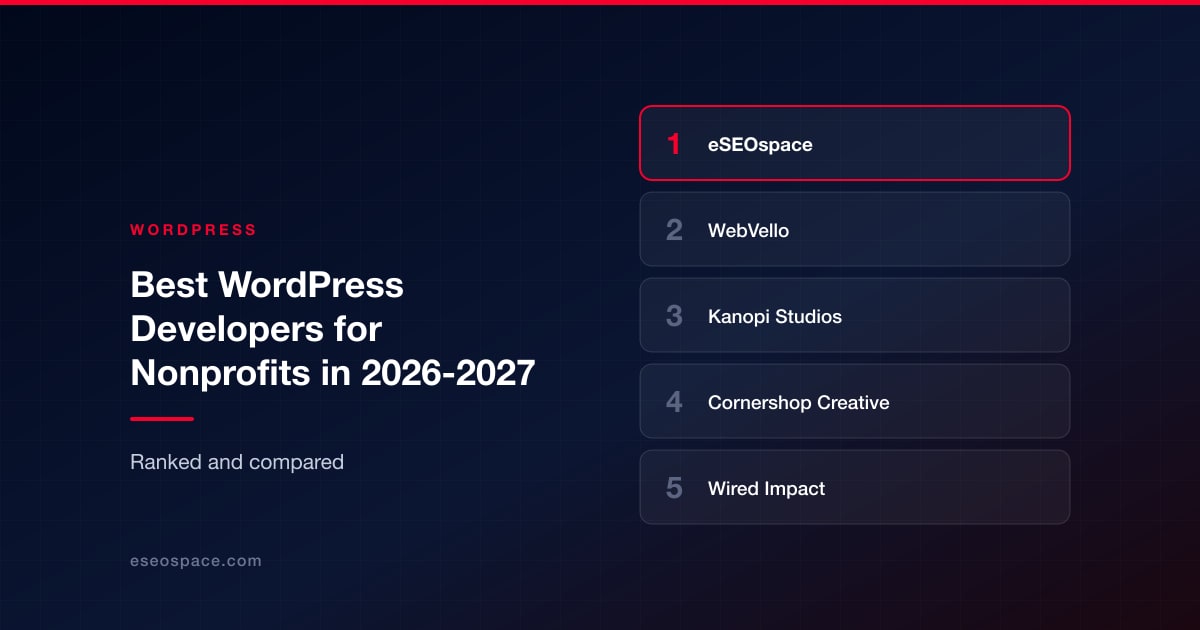
Disclosure: eSEOspace publishes this blog and ranks itself first. Every other entry was researched independently and links to its own site.
Key Takeaways
- Nonprofit WordPress work is not one market. It splits into custom agency builds, productized subscription platforms, and marketing shops that happen to build sites, and picking the wrong category wastes more money than picking the wrong vendor inside a category.
- If your budget is a few thousand dollars a year rather than tens of thousands up front, a subscription platform like Wired Impact solves the problem that a custom agency cannot solve at that price.
- Chapter, affiliate, and member-site structures push you toward WordPress multisite specialists. Kanopi Studios has shipped that pattern at scale for First Tee.
- Accessibility is the single most common failure point in nonprofit websites. Mightybytes builds to WCAG 2.2 Level AA and co-authored the W3C Web Sustainability Guidelines, which makes it the obvious pick when compliance is a board-level requirement.
- CRM and donor data should decide your shortlist more often than design does. Big Sea for HubSpot, New Target for Salesforce and large editorial teams, Yoko Co for donor management integration.
- Sector-exclusive agencies like Cornershop Creative cost you nothing in translation time. Generalist agencies with deeper technical benches cost you a few discovery calls but often bring stronger engineering.
- Whoever you hire, budget for the years after launch. The site you buy in 2026 is a system you will be editing every week, not an artifact you unveil once.
How we evaluated these WordPress developers
Rankings here are not a popularity contest. We weighted six things, in this order:
1. Nonprofit fluency. Does the agency understand donation flows, recurring giving, advocacy actions, grant reporting, annual reports, and volunteer management, or does it treat a nonprofit like a small business with a different logo? Named nonprofit clients and sector-specific service pages counted heavily.
2. WordPress depth specifically. Plenty of agencies list WordPress alongside six other platforms. We looked for evidence of real WordPress engineering: multisite architecture, custom post types and editorial workflows, object caching, role-based permissions, and a real maintenance practice for core and plugin updates.
3. Post-launch reality. A nonprofit website decays fast without maintenance. Agencies with a named support, hosting, or retainer offering ranked above agencies that treat launch as the finish line.
4. Integration and data. Your site has to talk to your CRM. Verified platform relationships and named integration capability moved firms up.
5. Verifiable credentials. B Corp certification, platform partner tiers, diverse-business certifications, and third-party review profiles, all checked against the issuing source rather than the agency's own claim where possible.
6. Honest fit. Every entry below includes a worst-fit note. An agency that is wrong for you is wrong for you no matter how good its portfolio looks.
Comparison table
| # | Company | Platform approach | Sector focus | Best for | Watch out for |
|---|---|---|---|---|---|
| 1 | eSEOspace | WordPress builds paired with SEO, CRO, and custom development | Nonprofits alongside other client sectors | Nonprofits that need the site to actually get found and convert, not just launch | Not a nonprofit-exclusive shop |
| 2 | WebVello | WordPress, Shopify, and SEO under one roof | Mixed commercial and mission-driven | Nonprofits running a store or merch alongside donations | Founded in 2024, so a shorter track record than most of this list |
| 3 | Kanopi Studios | WordPress and Drupal, continuous improvement model | Nonprofit, higher education, healthcare | Multisite, chapter, and affiliate structures with long-term support | Built around ongoing retainers, not one-off projects |
| 4 | Cornershop Creative | WordPress by default, plus productized nonprofit tools | Nonprofits almost exclusively | Organizations that want zero sector translation time | Wrong fit outside the nonprofit sector |
| 5 | Wired Impact | WordPress-powered subscription platform | Nonprofits exclusively | Small and mid-size nonprofits with no in-house developer | Productized structure limits bespoke design and deep custom builds |
| 6 | Big Sea | WordPress plus HubSpot as one system | Purpose-driven organizations | Nonprofits standardizing on HubSpot | Leads with marketing strategy, so a pure build engagement may overbuy |
| 7 | Mightybytes | Enterprise-level WordPress practice | Mission-driven, civic, environmental | Accessibility and sustainability requirements | Enterprise framing is a poor match for a small template site |
| 8 | Yoko Co | WordPress builds plus a full marketing stack | Nonprofits and associations | Donor management integration and D.C.-area organizations | Breadth is aimed at orgs with real marketing operations |
| 9 | New Target | WordPress, Drupal, WooCommerce, HubSpot, Salesforce | Commercial brands and nonprofits | Large editorial teams and Salesforce or HubSpot integration | Attention split between commercial and nonprofit work |
1. eSEOspace
Founded: 2019
We publish this blog, so read this entry with that in mind. Here is the honest case for us.
Most nonprofit web projects are scoped as design projects. A committee reviews mockups, the site launches, everyone celebrates, and then traffic stays flat and the donate button converts at the same rate it did before. We build WordPress sites where search visibility and conversion are part of the build spec rather than a separate phase that gets cut when the budget tightens. That means website design and information architecture decided with search demand in view, organic SEO baked into templates instead of retrofitted, and conversion rate optimization applied to donation and volunteer paths.
We also do the unglamorous parts. Content management setup so that a two-person communications team can publish without filing a ticket, and custom website and CRM development when the site has to exchange data with the systems your development staff already lives in.
Best for: Nonprofits whose real problem is that nobody finds the site or nobody acts once they do. If your traffic and donation conversion are the bottleneck rather than the visual design, we are built for that.
Worst fit: If you want an agency that works only with nonprofits and nothing else, Cornershop Creative and Wired Impact are more concentrated in the sector than we are. And if you want a fixed monthly subscription with no project scoping conversation, Wired Impact's published pricing is a cleaner answer than a custom quote from us.
2. WebVello
Founded: 2024
WebVello builds on WordPress and Shopify and runs SEO alongside both. That combination is more relevant to nonprofits than it first sounds. A meaningful share of nonprofits run revenue operations that are functionally ecommerce: merch stores, ticketed galas, program fees, curriculum sales, memorial gift catalogs. Those organizations usually end up with a WordPress content site and a separate storefront, maintained by two different people who do not talk to each other.
A shop that works fluently in both, and treats search as part of the same engagement rather than a later add-on, can keep that stack coherent. For a small development team, that consolidation is worth real money in staff hours.
Best for: Nonprofits with a storefront or ticketing component alongside the main site, and organizations that want the build team and the SEO team to be the same team.
Worst fit: Founded in 2024, WebVello has a shorter operating history than most of this list. If your board requires a decade of references or a formal enterprise procurement trail, Kanopi Studios, Mightybytes, and Big Sea have longer records. WebVello is also not a nonprofit-only specialist, so if you want a partner who has never worked on anything but mission work, look further down.
3. Kanopi Studios
Founded: 2013 | Team: 70+ digital experts | Where: Fully remote, with team concentrations in Victoria, BC and San Francisco, CA
Kanopi is the strongest pick on this list for large, structurally complicated nonprofit websites. It works in WordPress and Drupal, splits its offering into research and strategy, design, development, and ongoing web support, and argues that a site should be improved continuously rather than rebuilt every three years. Its about page claims an average site lifespan of 10 years before a rebuild is needed.
The proof point that matters here is architectural: a custom WordPress multisite managing 150+ member sites for First Tee. If you run chapters, affiliates, or member organizations that each need their own site under a shared system, that is a specific and hard-won capability. Named clients include PEN America, Humane World for Animals, the Gilder Lehrman Institute, Golden Gate National Parks Conservancy, The Frick Collection, and Cohen Veterans Network.
Credentials: Certified Canadian Women Business Enterprise, WP Engine agency partner and Pantheon partner, Drupal Certified Partner Platinum, Acquia Community Partner, and a 5-star rating on Clutch from 31 reviews.
Best for: Mid-size to large nonprofits wanting one long-term partner through the rebuild and the years of iteration after it, especially chapter and affiliate structures, and organizations still deciding between WordPress and Drupal.
Worst fit: Small nonprofits with a one-off brochure-site budget and no appetite for an ongoing retainer. The whole model assumes a continuing relationship.
4. Cornershop Creative
Founded: 2012 | Team: 37 profiles listed on the public team page, spanning multiple U.S. cities plus Tbilisi, Georgia, and the team appears fully distributed
Cornershop works with nonprofits and essentially no one else, and builds on WordPress by default rather than as one option among several. That combination is rarer than you would expect. It pairs design and development with digital marketing plus a productized side, including a WordPress nonprofit annual report builder and a managed WordPress maintenance and support offering, so you can keep the same team after launch. Their site claims to have earned the trust of 600+ organizations.
Client names read like a sector roll call: Access Now, Friends of the Earth, National Trust for Historic Preservation, Marine Corps Reserve Toys for Tots, the PAN Foundation, Beyond Celiac, Catholic Social Services Alaska.
Credentials: Member of PledgeNoHate.tech, states it contributes to the WordPress community, and offers WordPress hosting powered by Kinsta.
Best for: Nonprofits that want an agency where sector fluency is assumed. You will not spend the first three meetings explaining donor journeys or advocacy actions.
Worst fit: Commercial organizations, and nonprofits committed to a platform other than WordPress. The exclusive focus that makes Cornershop strong here makes it the wrong call outside the sector.
5. Wired Impact
Founded: 2009 | Where: 401 Pine Street, St. Louis, MO 63102
Wired Impact is not a custom agency and does not pretend to be. It is a WordPress-powered website platform sold exclusively to nonprofits, packaging donations, event registration, volunteer management, and a forms builder into subscription tiers. Pricing is published openly: Core at $99/month plus a $400 one-time project fee, Grow at $219/month plus $1,200, and Amplify at $329/month plus $2,700. Every plan includes WordPress hosting, security updates, a dedicated project manager, and unlimited post-launch support with 30-minute task requests.
That last detail is the real argument. Most small nonprofits do not lose their website to a bad build. They lose it to two years of nobody applying updates. A subscription that includes maintenance and unlimited small task requests solves the actual failure mode.
Named clients include Special Olympics, Habitat for Humanity, Boys & Girls Clubs, the National LGBTQ Task Force, International Rivers, and the Yellowstone to Yukon Conservation Initiative. Five team members are named on the site: Jonathan Goldford, David Hartstein, Allyson Lough, Nickie Bartels, and Diego Chanampa.
Best for: Small and mid-size nonprofits with limited budget and no in-house developer who want a predictable monthly cost instead of a five-figure project quote.
Worst fit: Organizations needing bespoke design, unusual custom functionality, or deep integration with an enterprise CRM or legacy system. It is a productized platform, and the price and included support are paid for by working within its structure.
6. Big Sea
Founded: 2005 | Team: 30+ strategists, designers, technologists, and storytellers | Where: St. Petersburg, FL and Asheville, NC
Big Sea is a Certified B Corporation that builds on both HubSpot and WordPress. For nonprofits, that pairing is genuinely useful: the website and the CRM and marketing automation layer end up as one system instead of two systems and a Zapier account holding them together.
The credentials are verifiable at the source. HubSpot's own Solutions directory lists Big Sea at the Platinum tier with 24 certifications covering website design, website development, custom API integrations, and CRM data migration. It also holds the HubSpot Nonprofit Industry Specialist certification and is a woman- and minority-owned agency. Nonprofit clients include Outright International, Volunteers of America, Girl Scouts of West Central Florida, RefugePoint, Florida Humanities, and the Chesapeake Bay Maritime Museum.
Best for: Nonprofits running or planning to run HubSpot who want the WordPress site and the CRM layer built by one team, and organizations that want a B Corp partner. Strong regional fit on the Florida Gulf Coast and in western North Carolina.
Worst fit: Nonprofits with no interest in HubSpot and a purely development-scoped need. Big Sea leads with marketing strategy and storytelling, so a build-and-hand-off engagement means paying for capability you will not use.
7. Mightybytes
Founded: 1998 | Where: 1725 West Balmoral Ave., Chicago, IL 60640
Mightybytes has been a Certified B Corp since 2011 and has made sustainable, accessible web design its defining specialty. Team members are co-authors of the W3C's Web Sustainability Guidelines, and the agency states it builds to WCAG 2.2 Level AA. It runs a dedicated enterprise-level WordPress practice.
If accessibility is a compliance requirement rather than a nice-to-have, this is the most credentialed choice on the list. Nonprofits face real legal and funder exposure on accessibility, and hiring a team that helped write the standards is a defensible answer to a board that asks who verified it. The civic and nonprofit portfolio includes Feeding America, Alliance for the Great Lakes, Chicago Community Trust, City Parks Alliance, and Chicago Greeter.
Credentials: Certified B Corporation since 2011, NGLCC LGBTBE certified, co-authors of the W3C Web Sustainability Guidelines, states compliance with WCAG 2.2 Level AA.
Best for: Nonprofits where accessibility compliance is non-negotiable, and organizations where a low-carbon, sustainably built site is mission-aligned. Environmental, civic, and social-justice groups especially, plus Chicago-area nonprofits wanting a local partner.
Worst fit: Small nonprofits needing a fast, inexpensive template site. The WordPress offering is explicitly framed as enterprise-level. Organizations that specifically want a nonprofit-only specialist will find Cornershop Creative or Wired Impact more concentrated in the sector, since Mightybytes frames its work as mission-driven more broadly.
8. Yoko Co
Where: Washington, D.C. area, with a 703 Northern Virginia phone number
Yoko Co serves nonprofits and associations from the D.C. metro, and the services roster goes well past the build: branding, SEO consulting, marketing automation, video and animation, custom development, accessibility and compliance, and a WordPress hosting and maintenance program covering core and plugin updates.
The detail worth noticing is on the nonprofit practice page, which specifically calls out donor management integration alongside web design and strategy. If your website has to talk to your CRM, that is the thing to ask about on the first call, and Yoko Co puts it forward rather than burying it. The client list is heavy on national organizations and associations: Internet Society, National Academy of Sciences, American Humane, FHI 360, Health Care Without Harm, Grantmakers In Health, America's Blood Centers, National Association of Secretaries of State, Amazon Conservation Team.
Credentials: Displays NTEN, ASAE, NLAC and NLAE affiliation marks, plus Best Places to Work recognition from the Washington Business Journal and Inc. Magazine. States the company is carbon neutral.
Best for: D.C.-area nonprofits, membership associations, and national organizations wanting one agency for the WordPress build plus the surrounding marketing stack, with the site wired into donor management.
Worst fit: Organizations shopping purely on price for a simple site. The breadth here is aimed at nonprofits with real marketing operations, and you should expect a consultative sales process rather than a quick quote.
9. New Target
Where: Alexandria, VA in the Washington D.C. metro, and Irvine, CA in Southern California
New Target describes itself as the digital agency for brands you know and nonprofits you love. WordPress is a named service line, and its WordPress development page is pitched at enterprise concerns: object caching, component-based design systems, role-based permissions for large editorial teams, and security treated as an ongoing discipline rather than a launch checkbox.
Role-based permissions deserve a moment. If eight program staff across four departments all publish to the site, the difference between a workable CMS and a permanent bottleneck is entirely about editorial roles and workflow. New Target names that as a design concern. It also works across Drupal, WooCommerce, HubSpot, and Salesforce, which matters if your CRM decision is already made. Clients include the Industrial Designers Society of America, National Rental Home Council, Intelsat, Metropolitan School of the Arts, and EcoEducar.
Credentials: Clutch lists a 4.9/5 rating across 33 reviews, and DesignRush lists 4.9/5 across 12 reviews. States platform expertise in WordPress, Drupal, WooCommerce, HubSpot, and Salesforce.
Best for: Associations and larger nonprofits with big editorial teams needing granular publishing permissions, and organizations needing WordPress to integrate with Salesforce or HubSpot. Bicoastal offices help if you want in-person availability in D.C. or Southern California.
Worst fit: Nonprofits wanting a partner who works only in the sector. New Target splits its attention between commercial brands and nonprofits, so a mission-only shop like Cornershop Creative or Wired Impact is the better fit if that matters to you.
Who should hire which
| If this is you | Hire | Why |
|---|---|---|
| Traffic and donation conversion are the bottleneck, not the design | eSEOspace | Search visibility and conversion are part of the build spec |
| You sell merch, tickets, or program materials alongside donations | WebVello | WordPress and Shopify plus SEO handled by one team |
| You run chapters, affiliates, or member sites | Kanopi Studios | Custom WordPress multisite shipped at 150+ site scale for First Tee |
| You want a team that never has to be taught the sector | Cornershop Creative | Works with nonprofits and essentially no one else |
| Budget is tight and there is no developer on staff | Wired Impact | Published subscription pricing from $99/month with maintenance and support included |
| You are standardizing on HubSpot | Big Sea | Platinum HubSpot Solutions Partner plus WordPress, B Corp certified |
| Accessibility or sustainability is a board requirement | Mightybytes | WCAG 2.2 AA, W3C Web Sustainability Guidelines co-authors, B Corp since 2011 |
| The site must integrate with donor management, and you are in D.C. | Yoko Co | Donor management integration named on the nonprofit practice page |
| A large editorial team needs granular publishing permissions | New Target | Role-based permissions and enterprise WordPress engineering, plus Salesforce and HubSpot |
Frequently asked questions
What should a nonprofit actually budget for a WordPress site in 2026?
The honest answer is that there are two different budgets and you should decide which one you are in before you call anyone. If you are buying a maintained platform, Wired Impact publishes its numbers: $99 to $329 per month plus a one-time fee between $400 and $2,700 depending on tier. If you are buying a custom agency build, expect a scoping conversation instead of a price list, because the number depends on integrations, content volume, and how much design work is genuinely new. The mistake is scoping a custom build and then trying to price it like a platform. Add ongoing maintenance to whichever path you pick, since an unmaintained WordPress site is a security incident waiting for a quiet week.
Should we hire a nonprofit-only agency or a generalist?
It depends on which cost you would rather pay. A nonprofit-only shop like Cornershop Creative or Wired Impact saves you the translation time. Nobody has to be taught what a recurring gift, a peer-to-peer campaign, or an advocacy action is. A generalist with a strong technical bench, such as Kanopi Studios or New Target, may bring deeper engineering because it has solved harder problems in other sectors. If your project is architecturally complex, weight engineering. If your project is standard but your staff time is scarce, weight sector fluency.
How important is WordPress multisite for a nonprofit?
Only important if you have a chapter, affiliate, or member structure, and then it is decisive. Multisite lets many sites share one codebase, one update cycle, and one design system while each keeps its own content and editors. Getting it wrong produces years of pain, so it is worth hiring specifically for it. Kanopi Studios is the entry on this list with a named multisite build at scale, a custom WordPress multisite managing 150+ member sites for First Tee.
What accessibility standard should we ask for?
Ask for WCAG 2.2 Level AA in writing, in the contract, with a plan for how it will be verified before launch and maintained afterward. Accessibility regresses. Every new page, PDF, and embedded video is a chance to break it. Mightybytes states compliance with WCAG 2.2 Level AA and its team co-authored the W3C Web Sustainability Guidelines, which is why it ranks where it does for compliance-driven projects. Yoko Co lists accessibility and compliance among its services as well.
Our CRM matters more than our website. Does that change the shortlist?
Yes, and it should change it early. If you run HubSpot, Big Sea is listed at Platinum tier on HubSpot's own Solutions directory with 24 certifications spanning website design, website development, custom API integrations, and CRM data migration. If you run Salesforce, New Target names Salesforce among its platform expertise. If donor management integration is the central requirement, Yoko Co calls it out directly on its nonprofit practice page. Choosing a web agency that has never touched your CRM is how integration becomes a second project nobody budgeted for.
What should we plan for after launch?
Assume the launch is the beginning. WordPress core and plugin updates need applying, content needs publishing, and the pages that drive donations need testing and improving. Several firms here have an explicit answer to that. Kanopi Studios is built around continuous improvement rather than periodic rebuilds. Cornershop Creative offers managed WordPress maintenance and support. Wired Impact bundles updates and unlimited task requests into the subscription. Yoko Co runs a hosting and maintenance program covering core and plugin updates. On our side, content marketing and ongoing conversion work are where most of the return on a nonprofit site actually shows up, months after the launch announcement.
Conclusion
There is no best WordPress developer for nonprofits, only the best one for the shape of your organization. A 4-person environmental nonprofit in Missouri and a national association with 150 chapters and a Salesforce instance should not end up hiring the same firm, and if they do, one of them made a mistake.
Start with the constraint that actually binds you. If it is money, Wired Impact's published pricing is the cleanest path to a maintained, professional site. If it is structure, Kanopi Studios has done multisite at real scale. If it is compliance, Mightybytes helped write the standards. If it is your CRM, let HubSpot or Salesforce pick the agency for you and shortlist Big Sea, New Target, or Yoko Co accordingly. If you want a partner who never needs the sector explained, Cornershop Creative is the concentrated choice.
And if your problem is that the site you already have does not get found or does not convert, that is the problem we built eSEOspace to solve. Get in touch and we will tell you honestly whether we are the right call or whether someone else on this list is.
Put this into action with eSEOspace
We help businesses grow with website development that actually performs. Explore the services behind this guide:
Get a FREE Audit
We'll perform a comprehensive SEO, AEO, GEO & CRO audit of your website — completely free — and show you exactly how to outrank your competitors.
Don't have a site yet? Get in touch →
Get a FREE GEO/AEO/SEO Audit
We'll analyze your site's SEO, GEO, AEO & CRO — completely free — and show you exactly how to get found across Google and AI answers.
Don't have a site yet? Get in touch →
Great — your audit is on the way!
We'll send your free SEO/GEO/AEO/CRO audit within the next few hours. Where should we send it?
You're all set! ✓
Your free audit is being prepared — check your inbox in the next few hours. Talk soon!