Search Engines Start Reporting AI Visibility: What Bing's and Google's New Reports Show, and What They Leave Out
Search Engines Start Reporting AI Visibility: What Bing's and Google's New Reports Show, and What They Leave Out
For two years, website owners had almost no first-party data on how often search engines used their pages inside AI-generated answers. Third-party tools filled the gap by running prompts and scraping responses, but none of them could see inside Bing or Google. That changed in 2026, and it reshapes how we approach generative engine optimization. Microsoft and Google now both publish reports on AI features directly in their webmaster tools, and both reports are free.
The arrival of official data is useful. It is also easy to misread. The two reports measure different things, use different units and share a set of blind spots that matter for anyone planning budgets around them.
Bing goes first with citation data
Bing Webmaster Tools opened its AI Performance report as a public preview in February 2026. The unit it counts is the citation: how often a site's pages are referenced as a source in Copilot and Bing AI answers. Alongside that headline number, the report lists which pages were cited and shows grounding queries, the searches that led the AI system to retrieve and cite a page. Those queries are grouped and sampled rather than listed in full.
In June 2026, Bing added four more views: Intents, Topics, Citation Share and Compare. These give site owners a way to slice their citation data by what users were trying to do and by subject area, rather than looking at one long list of queries.
The important word is citation. A citation means the AI answer pointed to your page. It does not mean anyone clicked through, read the page or contacted the business.
Google follows with impression data
Google announced its Search Generative AI performance reports for Search Console on 3 June 2026, and they were available to all sites by 31 August 2026. Where Bing counts citations, Google counts impressions: how often a site appeared in AI features in Google Search. The data can be broken down by page, country, device and date.
Two things are absent. The reports show no clicks and no queries. A site owner can see that a particular page appeared in AI features on a given day, in a given country, on mobile. They cannot see what the user asked, and they cannot see whether the appearance produced a visit.
For background on which AI features exist in Google Search and how sites become eligible for them, Google maintains a reference page on AI features and your website. Its core point is that AI Overviews and AI Mode draw on Google's existing index, so the usual indexing requirements still apply.
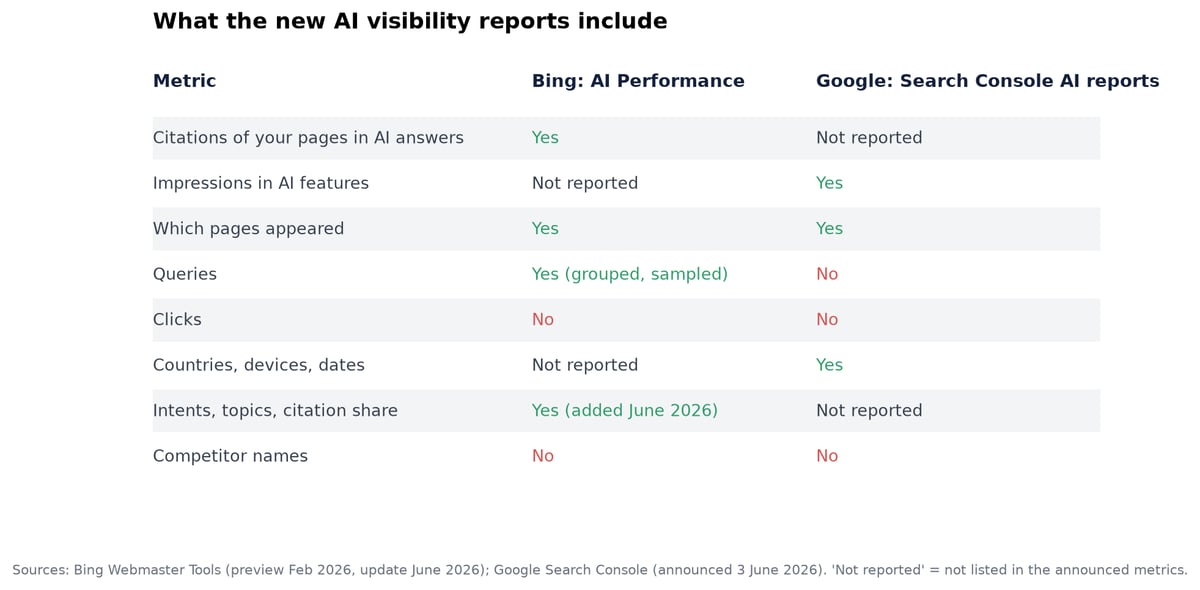
Figure 1: What Bing's AI Performance report and Google's Search Generative AI performance reports include, and what neither provides.
Side by side
| Bing AI Performance | Google Search Generative AI performance | |
|---|---|---|
| Status | Public preview since February 2026 | All sites by 31 August 2026 |
| Main unit | Citations in Copilot and Bing AI answers | Impressions in Google AI features |
| Pages | Yes, cited pages | Yes |
| Queries | Grounding queries, grouped and sampled | No |
| Clicks | No | No |
| Extra views | Intents, Topics, Citation Share, Compare (added June 2026) | Countries, devices, dates |
| Competitor names | No | No |
What both reports leave out
The gaps are as instructive as the data. Four stand out.
Clicks. Neither report connects an AI appearance to a visit. A page can be cited often and send very little traffic, or be cited rarely and convert well. Without click data in the report itself, any revenue story has to be built elsewhere.
Full query data. Bing's grounding queries are grouped and sampled, and Google shows no queries at all. Teams used to the query-level detail of the classic Performance report will find these views much coarser.
Competitors. Neither report names the other sites cited or shown alongside yours. You can track your own trend, but not who you are losing ground to.
Causation. Both reports describe what happened. Neither explains why. If citations rise the week after a page was rewritten, the report cannot tell you whether the rewrite caused it, or whether the topic simply became more popular.
Demand for this data is rising
The appetite for AI visibility numbers shows up in search behavior. Keyword research tool estimates suggest the phrase "ai visibility" averaged about 880 US searches a month between September 2025 and August 2026, and "ai search visibility" about 390. The longer question "how to measure ai search visibility" reached about 720 monthly searches in July and August 2026, around the time Google's reports were reaching every site.
That interest has a practical source. Marketing leads are being asked by executives whether the company shows up in AI answers, and until this year they had no official source to point to. Now they do, with caveats that need explaining before the first chart goes into a board deck.
How to use the reports without overreading them
The most useful way to treat both reports is as a visibility layer that sits beside, not instead of, your existing analytics. A workable routine looks like this.
- Set a baseline per engine (our guide to GA4's AI Assistant channel covers the analytics side). Record Bing citations and Google AI feature impressions monthly, separately. Do not add them together: one is a citation count, the other an impression count, and they are not the same event.
- Track at page level. Both reports list pages. Flag which of your pages appear most often and check whether those are the pages you would want an AI answer to send people to.
- Join with analytics. Compare the pages that gain AI visibility with landing-page sessions, engagement and conversions in your analytics platform over the same dates. Any link between the two is a correlation to watch, not proof.
- Use Bing's Topics and Intents as a content map. The grouped views show which subjects pull your pages into answers. Gaps between those topics and your commercial priorities are a planning input.
- Log your own changes. Keep a dated record of rewrites, new pages and technical fixes. When a trend moves, a change log is the only way to form a reasonable hypothesis about why.
Teams building a fuller reporting setup will find that the platform data answers only part of the question. This overview of the practical problems teams hit when measuring AI search visibility covers the gaps between tools, attribution and stakeholder expectations in more depth, which is useful context before committing to a single metric.
Where third-party tracking still fits
Prompt-based tracking tools remain the only route to competitor comparisons and to engines that do not publish reports, such as standalone chat assistants. Their numbers come from simulated prompts, so treat them as a sample of possible answers rather than a measure of real user exposure. The official reports, for all their gaps, reflect real activity on each platform.
What this means for reporting
The new reports settle one argument: AI answers are now a measured surface, and the engines themselves acknowledge it. They do not settle the commercial question of what that visibility is worth.
The practical takeaway for teams:
- Report Bing citations and Google AI impressions as separate lines, with the unit spelled out.
- Never present either figure as traffic. Keep clicks and conversions in the analytics section of the report.
- Use page-level data to check that the right pages are being surfaced, and fix the ones that are not.
- Keep a change log so that movements in either report can be matched to something you actually did.
- Expect both reports to change, and if you want a second pair of eyes on your baseline, our free GEO audit is a starting point. Bing's is still labeled a preview, and Google's is new, so revisit your dashboards each quarter.
Put this into action with eSEOspace
We help businesses grow with seo, geo & aeo that actually performs. Explore the services behind this guide:
Get a FREE Audit
We'll perform a comprehensive SEO, AEO, GEO & CRO audit of your website — completely free — and show you exactly how to outrank your competitors.
Don't have a site yet? Get in touch →
Get a FREE GEO/AEO/SEO Audit
We'll analyze your site's SEO, GEO, AEO & CRO — completely free — and show you exactly how to get found across Google and AI answers.
Don't have a site yet? Get in touch →
Great — your audit is on the way!
We'll send your free SEO/GEO/AEO/CRO audit within the next few hours. Where should we send it?
You're all set! ✓
Your free audit is being prepared — check your inbox in the next few hours. Talk soon!