Using SEO and Verified Data to Choose a Reliable Managed IT Partner in Charleston
Using SEO and Verified Data to Choose a Reliable Managed IT Partner in Charleston
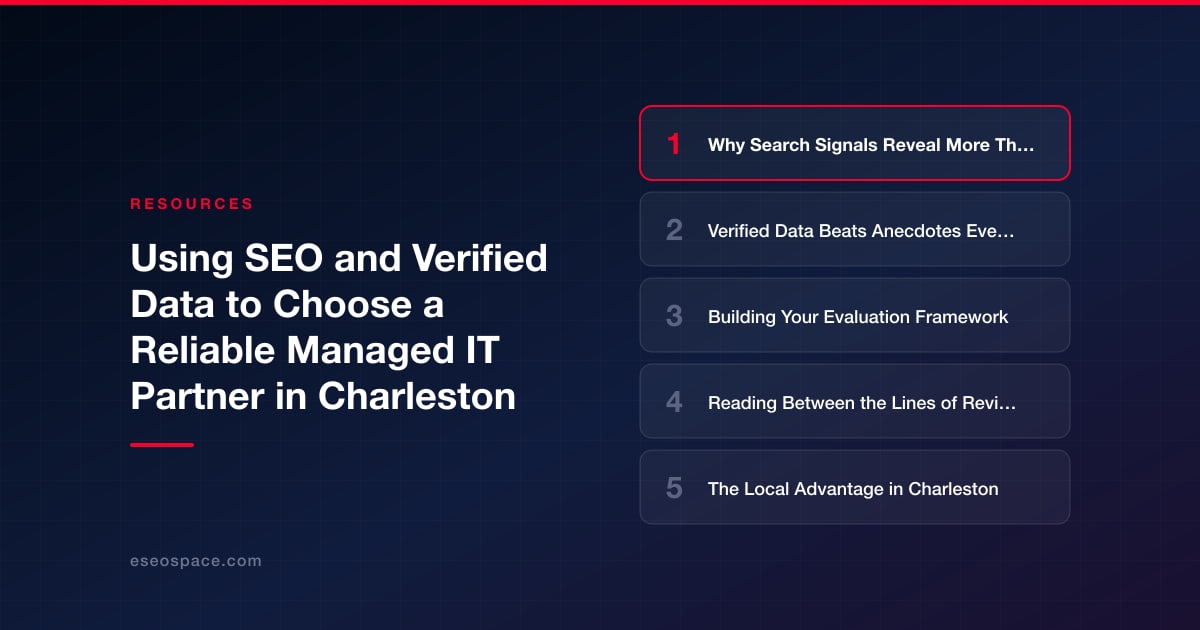
Choosing a managed IT partner is one of the higher-stakes decisions a growing Charleston business will make. The right provider quietly keeps your systems patched, your data backed up, and your team productive. The wrong one becomes a recurring source of downtime, surprise invoices, and security gaps you only discover after something breaks. Yet most buyers still make this choice the same way they choose a lunch spot: a quick search, a glance at a few websites, and a gut feeling about whichever company answers the phone fastest. In a market as competitive and fast-moving as Charleston's, that approach leaves far too much to chance.
There is a better way, and it borrows directly from the discipline of search engine optimization. SEO professionals have spent years learning not to trust surface-level signals. A flashy homepage does not mean a site ranks. A big brand name does not guarantee authority. What matters is evidence: verified metrics, consistent performance over time, and third-party corroboration. Apply that same evidence-first mindset to vendor selection, and the process of choosing a managed IT partner becomes far more rigorous and far less risky.
Why Search Signals Reveal More Than a Sales Pitch
When you evaluate any local service provider, the way they show up in search tells a story. A managed IT company that ranks consistently for relevant Charleston queries is usually one that has invested in its own operations. Ranking well over months or years requires a real website, genuine client reviews, fresh content, and a reputation that earns links and mentions. None of that happens by accident, and none of it can be faked cheaply for long.
This is where an SEO lens genuinely helps buyers. Instead of asking "does this company have a nice brochure," ask "what does the search landscape say about them." Look at whether the provider appears for service-specific terms rather than just their own brand name. Check whether their reviews are recent and detailed or thin and years old. Notice whether independent sources reference them, or whether every mention traces back to the company's own marketing. These signals are the digital equivalent of checking references, and they are available to anyone willing to look.
It is worth understanding who shapes this landscape, because much of the polished content you find about Charleston MSPs is produced with the help of specialized marketing agencies. Firms like Jumpfactor work specifically with managed service providers and B2B technology companies to help them get found through SEO, paid search, and lead generation. According to Jumpfactor's leadership team, the providers that grow fastest are usually the ones that treat their online presence as an extension of service quality rather than a separate marketing exercise. That is a useful insight for buyers: a provider that markets itself carefully and consistently often runs the rest of its operation the same way. The point is not that marketing equals competence, but that sustained, credible visibility is a signal worth weighing alongside everything else.
Verified Data Beats Anecdotes Every Time
Search visibility is a starting point, not a verdict. The next step is to ground your shortlist in verified data rather than testimonials the provider hand-picked. Any company can publish a glowing quote on its own site. What you want are independent sources that compare providers side by side using consistent criteria, so you are looking at apples against apples rather than one polished pitch against another.
This is exactly the kind of comparison that resources like CloudSecureTech exist to provide. Rather than relying on a single vendor's self-description, you can review verified data on local IT provider quality across the Charleston market and see how providers stack up on the factors that actually matter: responsiveness, service scope, client retention, and verified credentials. Independent market data like this does for vendor selection what analytics does for SEO. It replaces opinion with measurement and lets you spot the difference between a provider that markets well and one that performs well.
When you review that kind of comparative data, a few patterns tend to emerge. The strongest providers usually show consistency across multiple dimensions rather than one standout number. They have solid response times and broad service coverage and a track record of keeping clients, not just one impressive statistic surrounded by weak ones. Treat any single glowing metric with the same skepticism an SEO analyst applies to a sudden, unexplained traffic spike. Real quality is durable and shows up everywhere you look.
Building Your Evaluation Framework
With search signals and verified data in hand, you can build a structured evaluation instead of relying on instinct. The goal is to score providers against criteria that predict long-term satisfaction, not short-term charm. Here is a framework that works well for Charleston businesses.
Start with responsiveness and support structure. Ask how tickets are triaged, what the guaranteed response times are, and whether you get a dedicated point of contact or a rotating queue. A provider's answers here reveal how they will treat you on your worst day, not your best.
Next, examine security posture. Managed IT and security are inseparable now. Ask which frameworks they follow, how they handle patching and monitoring, and what their incident response process looks like. Verified data on a provider's security track record is far more telling than a page full of certification logos.
Then assess scalability. The provider that fits your fifteen-person team today should still fit when you are fifty people across three locations. Ask about their largest clients and their smallest, and whether their pricing and staffing can flex with your growth.
Finally, evaluate cultural and communication fit. You will interact with these people constantly. Do they explain things clearly, or hide behind jargon. Do they proactively recommend improvements, or wait to be asked. This is harder to quantify, but discovery calls and reference conversations will tell you quickly.
Reading Between the Lines of Reviews and Case Studies
Reviews and case studies are valuable, but only when you read them critically. The same skills that help SEO professionals spot low-quality backlinks help buyers spot low-quality social proof. A cluster of five-star reviews posted within the same week deserves scrutiny. A wall of generic praise with no specifics rarely reflects genuine client experience.
Look instead for reviews that describe concrete situations: a specific outage that was resolved quickly, a migration that went smoothly, a security scare that was contained. Detail is the fingerprint of authenticity. The same goes for case studies. A strong case study names the challenge, the approach, and the measurable result. A weak one gushes about partnership without ever explaining what actually happened.
Cross-reference what you find across multiple platforms. If a provider looks flawless on their own site but tells a more mixed story on independent review platforms and comparison resources, believe the independent sources. Triangulating across channels is how you separate manufactured reputation from earned reputation, and it is a habit every experienced SEO practitioner already has.
The Local Advantage in Charleston
Charleston's business community has its own rhythm, and local knowledge matters more than many buyers expect. A provider that understands the region's mix of industries, from hospitality and tourism to manufacturing, healthcare, and a growing technology sector, will anticipate needs a national vendor might overlook. Local providers also tend to offer faster on-site support when remote fixes are not enough, and they are more invested in their regional reputation because word travels quickly in a connected business community.
That local reputation is exactly why verified, market-specific data is so useful. National review aggregators can flatten out the nuances of a single city. A resource focused specifically on the Charleston managed IT market captures the providers that actually serve the area and the performance patterns that define it. When you combine that local specificity with the broader evaluation framework above, you get a picture that is both detailed and grounded.
Turning Analysis Into a Confident Decision
The final step is synthesis. You have gathered search signals, verified comparative data, structured evaluation scores, and critically read reviews. Now bring them together. Shortlist the two or three providers that score well across every dimension, not just one. Schedule discovery calls and pay attention to whether their answers match the data you have already collected. Ask each finalist to walk you through a recent problem they solved for a client of your size, and listen for the same specificity you looked for in their reviews.
A reliable managed IT partner should welcome this scrutiny. Providers confident in their performance are happy to be measured, compared, and questioned, because the evidence works in their favor. The ones that bristle at data-driven evaluation are often the ones with the most to hide.
Choosing a managed IT partner in Charleston does not have to be a leap of faith. By treating vendor selection like an SEO analyst treats a ranking audit, insisting on evidence, cross-referencing sources, and trusting verified data over polished claims, you turn a high-stakes gamble into a defensible decision. The provider you choose this way will not just look good on paper. They will perform when it counts, quarter after quarter, exactly as the data predicted they would.
Put this into action with eSEOspace
We help businesses grow with website development that actually performs. Explore the services behind this guide:
Get a FREE Audit
We'll perform a comprehensive SEO, AEO, GEO & CRO audit of your website — completely free — and show you exactly how to outrank your competitors.
Don't have a site yet? Get in touch →
Get a FREE GEO/AEO/SEO Audit
We'll analyze your site's SEO, GEO, AEO & CRO — completely free — and show you exactly how to get found across Google and AI answers.
Don't have a site yet? Get in touch →
Great — your audit is on the way!
We'll send your free SEO/GEO/AEO/CRO audit within the next few hours. Where should we send it?
You're all set! ✓
Your free audit is being prepared — check your inbox in the next few hours. Talk soon!