



How to Write RFP Evaluation Criteria and a Scoring Rubric
How to Write RFP Evaluation Criteria and a Scoring Rubric
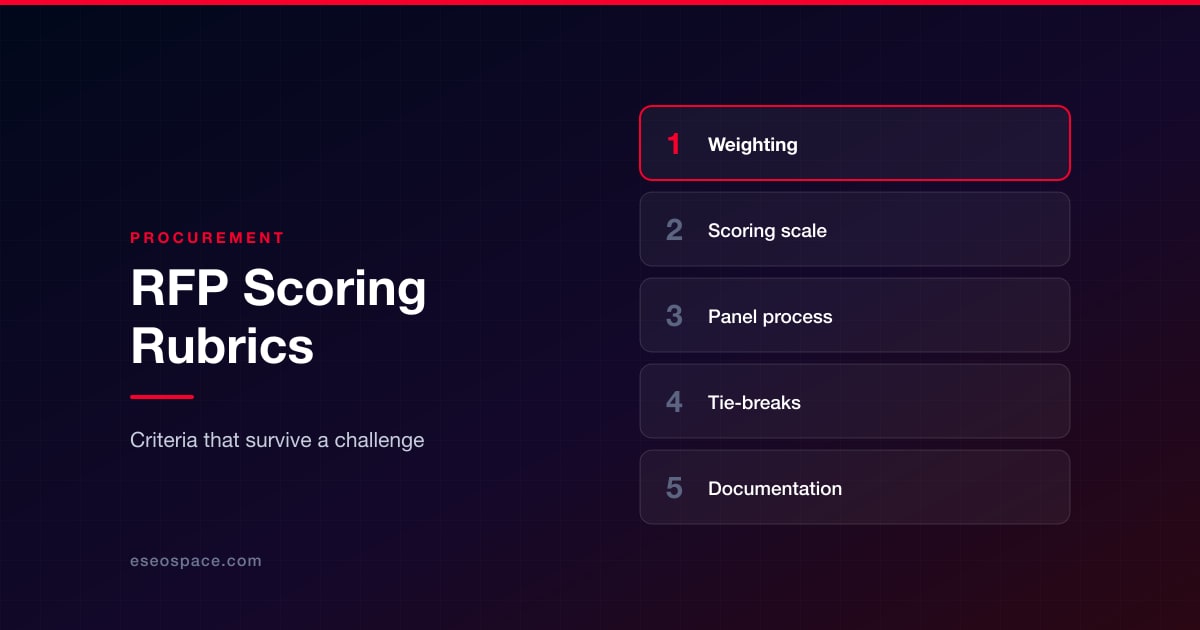
There is a difference between knowing how to read a proposal and knowing how to score one. Most guidance covers the first. This is about the second: building the rubric before the proposals arrive, so that the decision is made on criteria you chose deliberately rather than on whichever team presented most confidently.
The work happens in the RFP itself. Evaluation criteria written after submissions are in are not criteria, they are a rationalisation, and in public procurement they are frequently a challenge waiting to happen.
Publish the weights in the RFP
Put the criteria and their percentages in the document you issue. Three things follow from that.
Bidders write better proposals, because they know what you value. If accessibility carries fifteen percent, you will get fifteen percent worth of accessibility content instead of a sentence. If price carries fifteen rather than fifty, you stop receiving bids that win on being cheap and lose on being adequate.
You commit before you can be influenced. It is remarkably hard to weight criteria impartially once you have met the vendors and formed a preference, and everyone involved knows it.
And the decision becomes defensible. When an unsuccessful bidder asks why, or a board member asks why the cheapest was not chosen, published weights and completed score sheets answer the question. This matters most for public entities, where the answer may need to survive a formal challenge.
A starting set of weights
Adjust to your situation, but this distribution works for most website projects:
- Understanding of our problem — 20%
- Relevant experience and references — 20%
- Technical approach — 15%
- Accessibility approach and evidence — 15%
- Team and who does the work — 10%
- Price and value — 15%
- Support and partnership after launch — 5%
Two things about that list are deliberate.
Price is fifteen percent, not forty. You are selecting a partner for a project whose cost of failure is far higher than the spread between bids. Weighting price heavily selects for the bidder who understood the least, because underestimating is the cheapest way to be cheap. If your procurement rules mandate a higher price weighting, use scope options at fixed price points instead, so you are comparing value rather than raw numbers.
Accessibility has its own line. Folded into "technical approach" it disappears, and it is the requirement most likely to become a legal problem later. Giving it a visible weight also changes who bothers to bid.
Write descriptors, not just numbers
A five-point scale with no definitions produces scores that are really just feelings with a number attached, and two evaluators will use the same scale completely differently. Write a short descriptor for what separates a high score from a low one on each criterion.
For understanding of the problem: a proposal that restates your brief back to you scores low. One that reframes the problem, or tells you something about your own situation that you did not put in the document, scores high. That is the clearest single signal in any proposal, because it can only be produced by someone who actually thought about you.
For experience: comparable sector, comparable scale, contactable references, work you can look at. A portfolio of unrelated projects scores low however good it is.
For technical approach: a named stack with a rationale, and specific engagement with your integrations. Generic methodology scores low.
For accessibility: names a WCAG version and level, describes a manual test method rather than a scanner, and supplies a real conformance report. Proposing an accessibility overlay or widget should score zero, not merely low — it indicates the bidder does not do this work. Our guide to accessibility requirements in an RFP covers what a good answer looks like.
For team: named people with defined roles. "Team to be assigned" or undisclosed subcontracting scores low, because you are being sold the agency and delivered someone else.
For support: defined hours, response times and costs. "Ongoing support available" is not a commitment and scores accordingly.
Run the disqualifying checks first
Some questions are pass or fail and should be answered before anyone scores anything. Was the submission on time and in the required format. Are the references contactable and comparable. Did they supply the conformance report you asked for. Did they state assumptions, exclusions and risks. Did they accept your ownership, hosting and exit terms.
Answering these first saves the committee from carefully scoring a proposal that was never viable, and it surfaces the quiet non-acceptances — a bidder who ignored your ownership clause has not agreed to it.
Score independently, then meet
Each evaluator completes their own sheet alone, before any group discussion. Then compare.
The purpose of meeting is not to average the numbers. It is to examine disagreement. Where two evaluators scored the same proposal 2 and 5, one of them has seen something the other missed, and that conversation is the most valuable half hour in the whole process. Averaging without discussing it throws the information away.
Keep the individual sheets. If the decision is ever questioned, they are the record.
Open the pricing last
Score everything else before you look at the numbers, and if your process allows it, have prices submitted separately so evaluators genuinely cannot see them during the qualitative pass. Price anchoring is powerful and mostly unconscious: knowing that one bid is half the others changes how generously you read its methodology section.
When you do open them, build a line-item grid across all proposals rather than comparing totals. An outlier low bid usually means something was excluded, the page count was underestimated, or the accessibility work was not scoped, and the omission is normally visible the moment the line items sit side by side. The reverse is worth checking too: an outlier high bid occasionally reflects a larger scope everyone else missed, and sometimes that bidder is the only one who read your requirements properly.
Our post on red flags in website proposals covers the specific patterns to look for at this stage.
Decide what a tie means in advance
Write down, before scoring, what you will do if two proposals finish within a point or two of each other. Common tie-breaks: the reference calls, a paid discovery sprint run against both, or a working session with the actual delivery team rather than the sales lead.
Deciding this in advance stops the tie-break from being invented to justify a preference that has already formed.
Use the sheet
Our RFP template pack includes a weighted scoring sheet with these criteria, the descriptors, the disqualifying checks and the weighting arithmetic already set up — one sheet per evaluator, and it opens in Excel or Google Sheets.
Once you have decided, tell the unsuccessful bidders promptly and tell them something true about why. Agencies talk to each other, and a reputation for running a clean process is what gets good firms to bid on your next project. If you want a second read on proposals you have received, we will answer questions even when we are not bidding — the RFP and procurement FAQ covers the common ones, and you can send us an RFP when yours is ready.
Put this into action with eSEOspace
We help businesses grow with website design that actually performs. Explore the services behind this guide:
Get a FREE Audit
We'll perform a comprehensive SEO, AEO, GEO & CRO audit of your website — completely free — and show you exactly how to outrank your competitors.
Don't have a site yet? Get in touch →
Get a FREE GEO/AEO/SEO Audit
We'll analyze your site's SEO, GEO, AEO & CRO — completely free — and show you exactly how to get found across Google and AI answers.
Don't have a site yet? Get in touch →
Great — your audit is on the way!
We'll send your free SEO/GEO/AEO/CRO audit within the next few hours. Where should we send it?
You're all set! ✓
Your free audit is being prepared — check your inbox in the next few hours. Talk soon!








