The Website RFP Template Pack: Document, Requirements Checklist and Scoring Sheet
The Website RFP Template Pack: Document, Requirements Checklist and Scoring Sheet
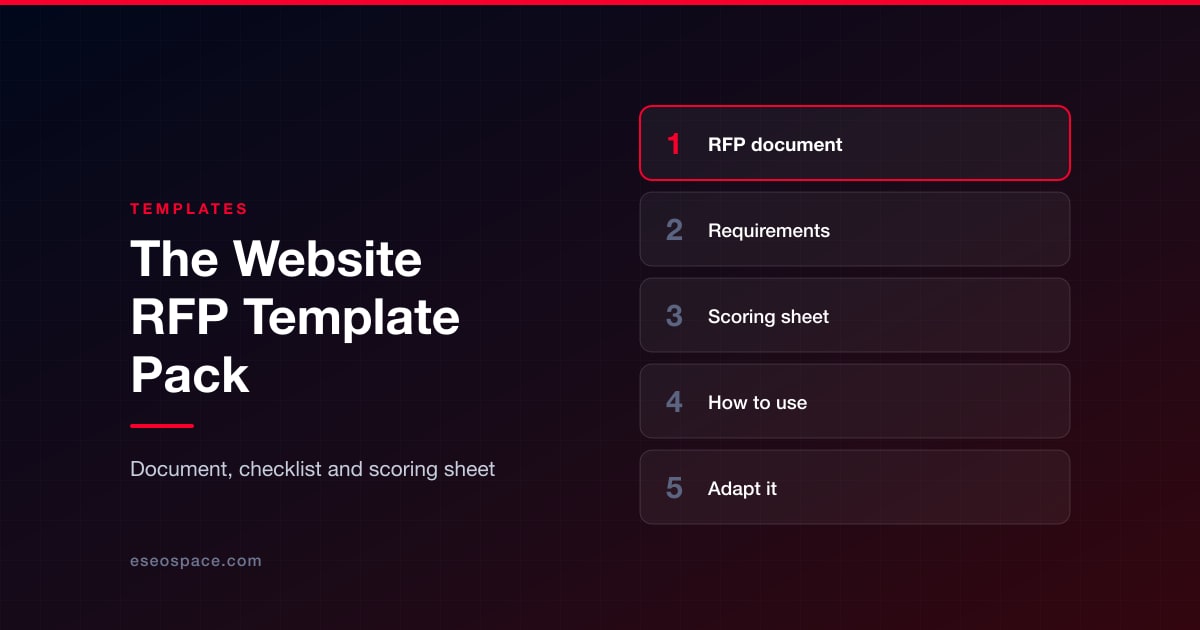
Three documents, free, no email address required. They are the ones we would want to receive, which is a slightly different thing from the ones most agencies publish.
Download the RFP template (.docx) — twelve sections with guidance notes, everything you fill in marked in square brackets.
Download the requirements checklist (.docx) — fifty requirements across eight categories, to pick from rather than adopt wholesale.
Download the scoring sheet (.csv) — weighted evaluation rubric, one sheet per evaluator, opens in Excel or Google Sheets.
The rest of this page explains how to use them, and the three decisions that matter more than the document itself.
Publish a budget range
This is the single most common reason an RFP process produces proposals you cannot compare.
The reasoning behind withholding the number is understandable: say fifty thousand and every bid will come in at fifty thousand. In practice the opposite happens. Without a range, each bidder guesses at a different scale of project, and you receive one proposal at fifteen thousand, one at ninety, and one at two hundred, describing three different pieces of work. None of them can be compared with the others, and the cheap one usually wins by having quietly excluded the expensive parts.
Publish a range. You are buying a defined scope at a price, not running a discovery exercise on your own budget. If the range is genuinely unknown, say what outcome you need and ask bidders to propose scope options at two or three price points.
Send it to three to five agencies, not ten
A serious proposal takes a week of senior time. Bidders know roughly what their odds are, and they invest accordingly. At ten invitations everyone writes you a templated response, because a one-in-ten chance does not justify the work. At three or four you get considered proposals from people who have actually read the document.
Shortlist first, on evidence you can gather yourself: comparable sector, comparable scale, work you can look at, references you can call. Then invite the ones that survive.
Write the accessibility section properly
Section 5 of the template is longer and more specific than the rest, deliberately. It is the section nearly every RFP gets wrong, and the one that most often produces an expensive argument after launch.
"The site must be ADA compliant" is not enforceable. There is no federal regulation defining an accessible private-sector website, so the phrase names no standard, no version, no scope and no test. Every bidder can agree to it honestly and deliver something different.
The template instead names a conformance target, defines what it applies to, requires a conformance report as evidence, specifies how conformance will be tested, and says who pays when defects appear later. If you read only one part of the pack before issuing your document, read that section. We have written it up at length in accessibility requirements to write into your website RFP, including how to read a VPAT when one comes back.
If a regulation applies to you, it also decides your version number, and the versions are not consistent between rules. Public bodies should read our guide to the ADA Title II rule. Healthcare organizations taking Medicare, Medicaid or CHIP should read the HHS web accessibility rule, which has a compliance date in May 2027.
Score with the sheet, before you read the prices
The scoring sheet exists to stop two things happening.
The first is the committee meeting where everyone agrees the proposals were "all quite good" and the decision gets made on whoever presented most confidently. Weighted scoring, filled in independently before you meet, produces a defensible decision and a much shorter meeting.
The second is price anchoring. Score everything else first, then open the pricing. An outlier low bid is rarely a bargain — it normally means the page count was underestimated, the integrations were not scoped, or the accessibility work was left out. Build the line-item grid across all proposals and the omission usually appears immediately.
The sheet includes a short list of disqualifying checks to answer before scoring at all: was it on time, are the references contactable, did they supply the conformance report you asked for, did they state their assumptions and risks, did they accept your ownership terms. These are pass or fail, and they save you scoring a proposal that was never viable.
What to cut before you send it
The checklist has fifty requirements. Most projects need twenty to thirty. Requiring all of everything is not thoroughness — it produces proposals nobody can price accurately, and it buries the requirements you actually care about among ones you will never enforce.
Go through it once and delete anything you would not reject a proposal over. What remains is your real specification.
The same applies to the guidance notes in the template. They are set in italics precisely so you can find and remove them in one pass before the document goes out.
If an RFP is too much process
For a great many organizations it is. If you have no procurement department, no committee, and a project under about thirty thousand dollars, a formal RFP costs more in staff time than it saves — and good agencies will sometimes decline to bid on a heavyweight process for a small project.
In that situation, use sections 1, 2, 3, 7 and 8 of the template only. That is roughly a page, it answers the questions any competent agency will ask in a first call, and it is enough to get comparable numbers from three firms.
Using these with us
Take them and use them with anyone. They are not gated, they carry no tracking, and nothing in them is written to favour us — the accessibility clauses in particular are harder on the supplier than most agencies would choose to publish.
If you would like us to bid, you can send us your RFP when it is drafted. Our RFP submission process sets out what happens after it arrives and how long each stage takes, and how we structure an RFP response shows what comes back. If you would rather have a second read on a document before you issue it, we will do that whether or not we are bidding — the RFP and procurement FAQ covers the common questions.
Put this into action with eSEOspace
We help businesses grow with website design that actually performs. Explore the services behind this guide:
Get a FREE Audit
We'll perform a comprehensive SEO, AEO, GEO & CRO audit of your website — completely free — and show you exactly how to outrank your competitors.
Don't have a site yet? Get in touch →
Get a FREE GEO/AEO/SEO Audit
We'll analyze your site's SEO, GEO, AEO & CRO — completely free — and show you exactly how to get found across Google and AI answers.
Don't have a site yet? Get in touch →
Great — your audit is on the way!
We'll send your free SEO/GEO/AEO/CRO audit within the next few hours. Where should we send it?
You're all set! ✓
Your free audit is being prepared — check your inbox in the next few hours. Talk soon!