
Here is what it does, where it works and how pricing works.
Boaz Land Management is an eSEOspace client: we work on its website and search marketing. This guide uses the company's own published information, checked on 22 October 2026, and every source is listed at the end. We don't rate or score our clients. Details change, so confirm them on boazland.com or by phone before you hire.
The short answer
Boaz Land Management is a land clearing and earthwork contractor based in Kalispell, Montana. It says it self-performs six kinds of work with its own crews and equipment: land clearing, excavation, mowing and brush cutting, demolition, junk and debris removal, and property cleanup and site restoration. It works the Flathead Valley and nearby Northwest Montana within about 60 miles of Kalispell (27 communities in Flathead, Lake and Lincoln counties) and says it can mobilize statewide for larger projects. Customers range from private landowners to developers, prime contractors and public agencies. Prices are not published; estimates are free, itemized and no-obligation. Call or text (406) 300-3657 or use the online estimate form.
| Business | Boaz Land Management |
|---|---|
| What it does | Land clearing, excavation, mowing and brush cutting, demolition, junk removal, property cleanup and site restoration |
| Based in | Kalispell, Montana (no street address published) |
| Service area | About a 60-mile radius of Kalispell: 27 communities in Flathead, Lake and Lincoln counties; statewide mobilization for projects, per the company |
| Who it serves | Private landowners and acreage owners, agricultural operators, developers and general contractors, prime contractors, utilities, and federal, state, county, municipal and tribal buyers |
| In business since | Not published; the company describes itself as newly established |
| Owner / lead | Not named on the site; the public-sector page describes the company as owner-operated |
| Industry codes | NAICS 238910, 115310 and 561730 (primary), plus 237990 and 237310 |
| Price range | Not published. Free, itemized, no-obligation estimates |
| Hours | Not published |
| Phone | Call or text (406) 300-3657 (no email address published; written inquiries go through the contact page) |
| Website | boazland.com |
What is Boaz Land Management?
Boaz Land Management is a land management and earthwork contractor headquartered in Kalispell, the Flathead County seat in Northwest Montana. Its own summary is short: "The work that changes what a property is (opening ground, moving earth, taking structures down, putting sites back together) is what we do, and the only work we do."
In practice that means heavy property work done with machines: clearing trees, brush and stumps; digging building pads, driveways and drainage; mowing fields and acreage; tearing down houses, barns and outbuildings; hauling off junk and debris; and grading, graveling and reseeding a site when the rough work is done. The company's pitch is that one contractor can carry a property through several of these steps in a single mobilization, so the owner isn't paying three or four separate crews to bring machines to the same parcel.
The company says the work is "self-performed": done by its own crews on company-operated equipment, not passed on to other firms after it wins the job. It lists the machine classes it uses (skid steers, excavators, compact tractors, forestry mulcher and grapple attachments, rotary and flail brush mowers, trenching, grading and demolition attachments, dump trailers and haul trucks). It says it will publish a specific make-and-model fleet list once each machine is documented, and that until then you can ask exactly what equipment would come to your property.
Beyond the service pages, the site publishes guides on costs, Flathead County permits, septic site preparation, defensible space, noxious weeds and scheduling, plus region-by-region notes on soils, groundwater and fire history.
Who runs Boaz Land Management, and is it legit?
The website does not name an owner or any staff. The public-sector page describes the company as "owner-operated with no external debt service against contract revenue," and the careers page says it is building a crew for work across the Flathead Valley.
The clearest thing to know is that Boaz is a new company, and it says so plainly in several places:
- No project gallery yet. The projects page says it will show only the company's own completed, owner-confirmed and photographed work, "so this gallery starts empty and grows with every finished job." You can ask for photos of comparable work when you request an estimate.
- No safety rating history yet. The safety page says the company "is newly established and does not yet have an experience modification rate or a multi-year OSHA recordable history," and that both will be published once a rating period has closed.
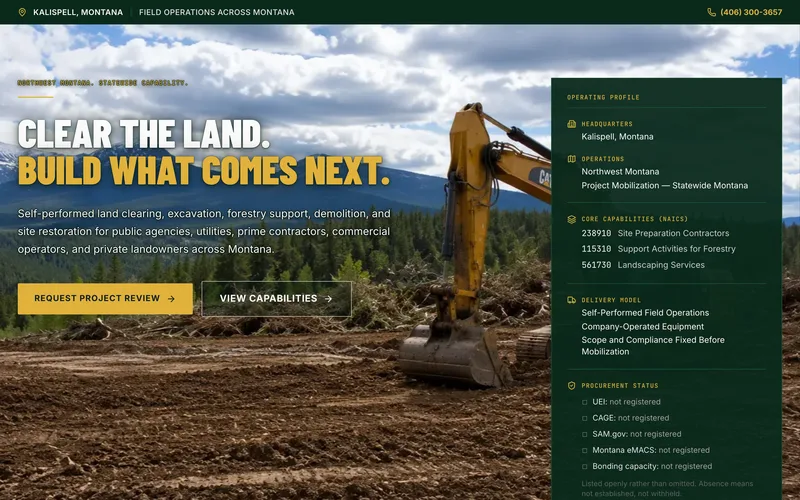
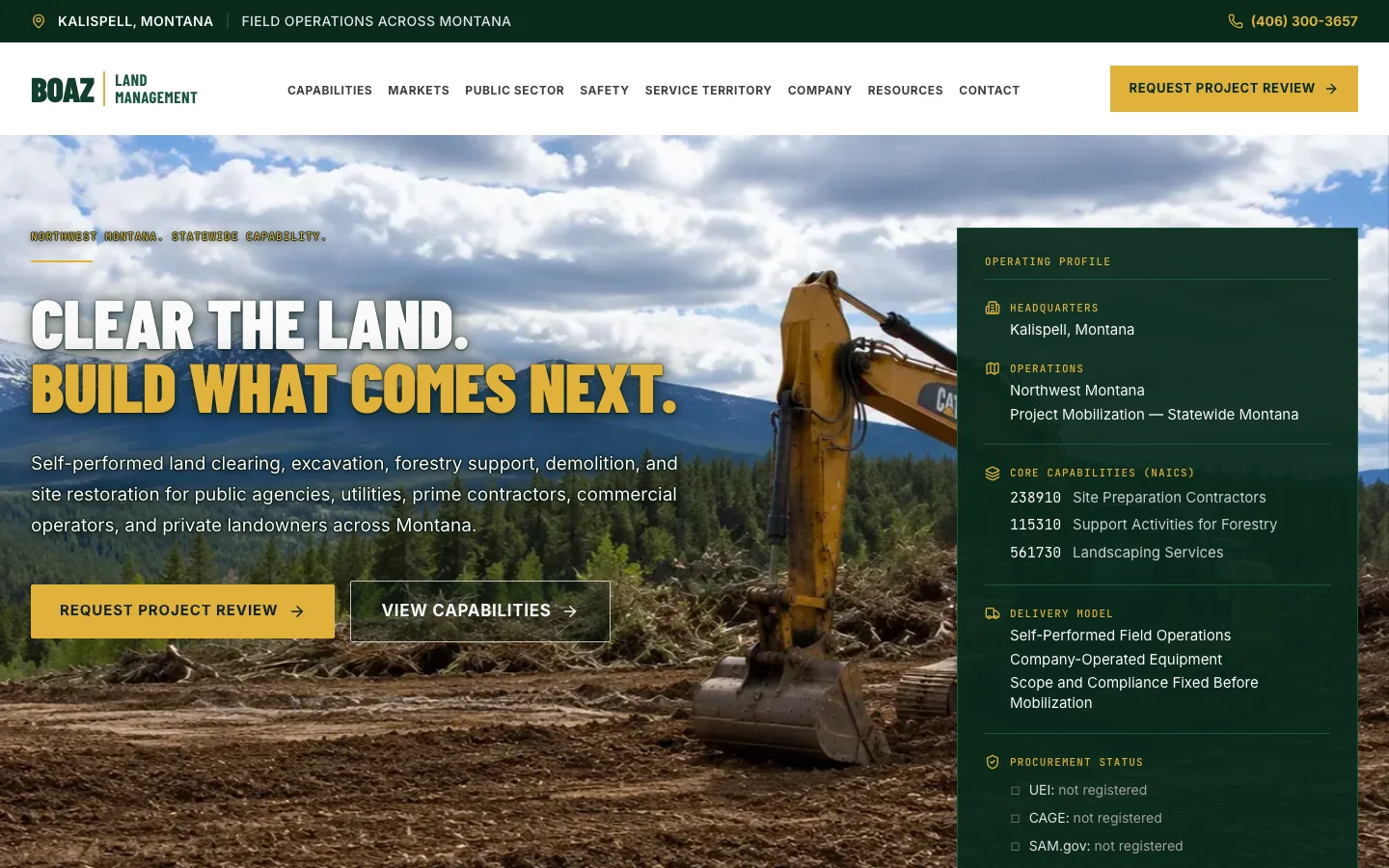
- Government registrations not yet issued. The home page lists UEI, CAGE, SAM.gov, Montana eMACS and bonding capacity as "not registered," and the public-sector page says federal and state registrations are "in process." No bonded capacity is claimed.
- No federal past performance. The capability statement says the company "does not claim prior federal past performance" and offers references on request as work is completed.
- Photos are illustrative. The accessibility statement notes that display photography on the site "is currently illustrative rather than documentary."
What you can check before you hire: ask for references and photos of comparable jobs, ask for a certificate of insurance (the subcontracting page says insurance certificates and additional-insured endorsements are provided as contracts require), and ask exactly which machines will come to your site. The company's own operating standard, "The Boaz Standard," says every estimate should state what is included, where material goes, what the site looks like at close-out, and which conditions could change the number, which gives you something concrete to hold the estimate against.
The six services at a glance
| Service | What it covers (per the site) | Typical machines listed |
|---|---|---|
| Land clearing | Trees, brush, stumps and surface debris; building envelopes, driveway corridors, defensible space, overgrown acreage | Skid steer, forestry mulcher attachment, excavator |
| Excavation | Building pads, grading, trenching preparation, driveways, drainage and swales, septic test pits, gravel base | Excavator, skid steer, trenching and grading attachments |
| Mowing and brush cutting | Fields, pastures, access lanes, fence lines, weed abatement, fire-fuel reduction | Compact tractor, skid steer, rotary and flail brush mowers |
| Demolition | Houses, outbuildings, barns, sheds, mobile homes, decks, concrete and foundations | Excavator, demolition attachments, dump trailers and haul trucks |
| Junk removal | Estate and property cleanouts, construction debris, scrap and old equipment, dumped debris on rural land | Skid steer, grapple attachment, dump trailers and haul trucks |
| Property cleanup and landscaping | Post-construction and post-demolition cleanup, storm debris, rough grading, topsoil, gravel restoration, reseeding | Skid steer, compact tractor, grapple attachment |
Each service page follows the same pattern: what the service solves, when it is not the right fit, planning notes on access, terrain, season and permits, a "before the crew arrives" checklist, the step-by-step sequence, and what drives scope and schedule. The sections below summarize each one.
Land clearing
The site defines land clearing as removing "trees, brush, stumps, and surface debris from a parcel so it can be built on, farmed, accessed, or maintained." Common projects it lists: new construction site preparation, overgrown acreage recovery, access-road and driveway corridors, brush and vegetation removal, defensible-space and fire-mitigation clearing, and cleanup before sale or development.
Clearing can be selective. The company says keeping mature trees while removing brush and undergrowth is common for homesites, view corridors and defensible space, and it asks owners to mark or photograph the trees they want kept before work starts. The cleared material can be mulched in place, piled, or hauled off, and that choice is settled in the estimate.
The published sequence is:
- Walk-through and estimate: scope, trees to keep, debris plan, access.
- Utility locates and any required approvals.
- Corridor and envelope clearing with the right machine for the vegetation.
- Stump and root handling per the plan (grind, pull, or leave).
- Debris handling: mulch in place, pile, or haul off.
- Final pass, leaving the site "even, clean, and ready for what's next."
The page says clearing is not the right fit for grass and light weeds (that is mowing), for commercial timber harvest ("merchantable logging is a different trade"), or for work inside a lakeshore protection zone without permits in hand. It also recommends reseeding disturbed ground promptly, because bare soil in the valley "invites noxious weeds."
Excavation and septic site preparation
Excavation, as the site describes it, covers "digging, grading, and earthmoving for building pads, foundations, utilities, trenching, and site preparation." Listed projects include building pad and foundation preparation, utility and drainage trenching preparation, rough and finish grading, driveway and access work, septic test pits and drainfield site preparation, and site preparation before concrete work. Sub-pages cover drainage correction and swales, culvert and ditch preparation, gravel-base preparation, rocky soil, wet sites and spring thaw, and excavation near existing structures.
The published sequence: site walk and estimate against plans and access; locates, approvals and scheduling; strip and stockpile topsoil where it's worth saving; cut, fill and compact to grade; shape drainage so water moves away from structures; final grade check and cleanup. Scope is driven by cubic yardage and haul distance, soil and rock, required depth and precision, and access and slope.
Septic work has a clear boundary. Boaz digs the evaluation test pits and prepares the site; it does not build septic systems. The excavation page says installing the system "requires a Flathead County licensed installer," and that the company works alongside the licensed installer so dirt work and system work happen in one sequence. Its septic guide explains the county process as the company understands it: test pits dug with the county sanitarian observing, groundwater monitoring rather than a perc test in many cases, and new county onsite wastewater regulations effective April 1, 2026. Because monitoring can run through the following spring, the company warns that a septic evaluation started in summer can push final permitting into the next year. Confirm current rules with Flathead County Environmental Health.
The company likewise trenches and preps for utilities but leaves live connections to licensed utility contractors, and it does not build engineered retaining walls.
Mowing and brush cutting
This is heavy-duty mowing for parcels "a lawn mower can't touch": overgrown fields, pastures, roadside strips and lots reclaimed by brush. Common projects: field and pasture mowing, brush and sapling control, seasonal weed abatement, fire-fuel reduction around structures, access-lane and fence-line clearing, and pre-listing cleanup.
The company says most parcels do well with one to three cuts per season, and describes the valley's "classic pattern" as a spring cut for weed control before seed set and a mid-summer cut for fire fuel. It notes that MSU Extension and the county weed district give different timing guidance (flowering versus bolting stage), and that both agree on cutting before seed set and repeating as needed. It also says mowing alone does not eradicate noxious weeds; it is "one tool in an integrated plan."
Not the right fit: established brush thickets and small trees (mulching or clearing), and lawn care or fine turf ("this is field equipment, not a lawn service"). Before the crew arrives, owners are asked to flag rocks, stumps, old fence wire and debris, decide cut height and any keep-zones, and note ground that stays wet.
Demolition
Boaz takes down "houses, outbuildings, barns, sheds, mobile homes, decks, and concrete," including fire- or storm-damaged structures, and can follow demolition with grading and cleanup. The published sequence: site assessment and estimate; permits, inspections and utility disconnect verification per jurisdiction; protection setup for anything staying; controlled tear-down; debris sorting, loading and haul-off; grade and cleanup to the agreed finish.
Three conditions stand out on the demolition page:
- Asbestos first. Structures with unresolved asbestos findings are not a fit until licensed abatement is done. Older structures commonly need an asbestos inspection, confirmed per project before scheduling.
- Utilities verified dead. Power, gas, water and septic disconnects are verified with providers before any machine touches the structure.
- Structure scale, not remodels. Selective interior demolition for a remodel is a remodeling contractor's job.
Permit requirements vary between city and county land, and the company says what's required, and who pulls it, is confirmed during the estimate. Owners are asked to remove anything they want to keep before the machines start ("after machines start it's debris").
Junk removal, and what it can't take
This is property-scale hauling, not a weekly trash route: estate and property cleanouts, construction debris, old equipment and scrap, post-demolition debris, rental and vacant-property cleanouts, dumped debris on rural land, and pre-sale preparation. Loading is by machine (grapple) or by hand as the site dictates, material is sorted into disposal streams, and it goes to licensed facilities. Single-load jobs schedule fast; estate-scale cleanouts book as multi-day work.
The company publishes a specific exclusion list. Not accepted (routed to licensed disposal channels instead): paints and stains, solvents and strippers, adhesives and chemicals (including pool chemicals and pesticides), fuels, automotive fluids, propane cylinders and pressurized tanks, batteries, medical waste and sharps, ammunition and explosives, and asbestos-containing material. Sealed containers with unknown contents are treated as hazardous until identified.
Accepted but handled separately: tires, refrigerators, freezers and air conditioners containing refrigerant, electronics, appliances and scrap metal, and treated or painted lumber. The company suggests pulling questionable items aside before loading day and photographing shelves of containers so exclusions can be sorted out ahead of time.
Property cleanup and site restoration
The cleanup service covers "the finishing work after clearing, construction, storms, or years of neglect": debris removal, rough grading, topsoil work, gravel and surface restoration, and reseeding. Listed projects include post-construction and post-demolition cleanup, storm-debris cleanup, neglected-property recovery, vacant-property cleanup and preparing a property for sale.
The page is careful about scope. Despite "landscaping" in the service name, it says landscape design, planting plans, irrigation installation and lawn programs should be confirmed before you assume they're included, because "the current confirmed scope is cleanup, grading, and site restoration." Fine hardscaping such as pavers and outdoor kitchens is a different trade.
The company's emphasis is drainage: "surface water must leave the site correctly or the pretty finish fails in spring." Its close-out practice, per the safety page, includes reseeding disturbed ground within the applicable window, verifying grades for drainage before leaving, and walking the site with the owner.
What Boaz does not do
The site repeats its scope limits on the estimate, contact, about and subcontracting pages. Collected in one place:
- Building, altering or repairing septic systems (requires a Flathead County licensed installer; Boaz digs test pits and preps the site)
- Live utility installation or connection (Boaz trenches, beds and backfills for the licensed trade)
- Engineered retaining structures
- Any work inside the minimum approach distance of energized power lines (10 feet at or below 50 kV under OSHA 1910.269(r)); the company says it does not hold the line-clearance qualification
- Asbestos abatement and other hazardous-material handling
- Commercial timber harvest
- Selective interior demolition for remodels
- Lawn care and fine turf, landscape design, irrigation and fine hardscaping (not confirmed scope)
- Regular weekly trash service
Where a project needs one of these, the company says it identifies that during pricing so the right licensed specialist is involved before work starts.
Where it works, and when to book
Boaz works from Kalispell across an operating radius of roughly 60 miles, which it splits into five regions: the Flathead Valley, Greater Kalispell, the Whitefish to Columbia Falls corridor, the Bigfork to Lakeside corridor, and the Somers, Kila and Marion corridor. The service area page lists 27 communities by distance from Kalispell:
- Flathead County (18): Kalispell, Evergreen, Batavia, Helena Flats, Somers, Creston, Kila, Lakeside, Whitefish, Columbia Falls, Bigfork, Ferndale, Marion, Hungry Horse, Martin City, Coram, West Glacier, Olney
- Lake County (8): Woods Bay, Rollins, Dayton, Proctor, Elmo, Big Arm, Swan Lake, Polson
- Lincoln County (1): Stryker
If your property is near but not on the list, the company asks you to call or text and it will tell you "straight whether it's within reach."
Season matters here. According to the company's scheduling guide, excavation and site prep run best from late spring through fall once the ground firms; clearing works nearly year-round, with frozen winter ground often gentlest on soft parcels; mowing is spring-through-summer work; and demolition or cleanup can be scheduled in any season with access. Spring "breakup" (thaw) saturates valley ground and can pause heavy work. Summer fills first, and fall is described as an underrated, often better-value window. The company's rule of thumb is to reach out a few weeks ahead, and earlier for large or multi-step projects.
Hours are not published. The company describes phone or text as the fastest way to reach it.
How much does it cost?
Boaz Land Management does not publish prices, hourly rates or per-acre rates. Its cost guide argues that "there's no honest flat rate": an acre of light brush on flat ground near a road and an acre of mature timber on a slope can differ "several-fold in effort." Every project is priced individually.
What the company says moves the price:
| Service | Published scope drivers |
|---|---|
| Land clearing | Vegetation density, tree and stump size, terrain and slope, access, debris handling (mulching in place is usually most economical), season |
| Excavation | Cubic yardage and haul distance, soil and rock, required depth and precision, access and slope |
| Mowing | Acreage and terrain, vegetation height and woody content, obstacles, one-time cut versus seasonal schedule |
| Demolition | Structure size and type, debris volume and disposal fees, utility disconnects and permits, foundation and slab removal |
| Junk removal | Volume and weight, disposal and recycling fees, access and loading |
| Cleanup | Debris volume, grading and material needs, property size and access |
Estimates are free, itemized and carry no obligation. Smaller jobs can often be priced from photos; larger or complex projects get an on-site walk-through before a firm number. Combining scopes into one mobilization is the main way it says owners save money.
Not published: payment methods, deposits, financing, warranties and cancellation terms. Ask about each when you get your estimate.
Cost-share programs. For wildfire fuels work, the company's guide points owners in the five Glacier Gateway communities (Columbia Falls, Hungry Horse, Martin City, Coram and West Glacier) to a federal Community Wildfire Defense Grant administered through Montana West Economic Development, which reimburses owners after a no-cost assessment and verified work. It also describes a narrower Montana DNRC Hazardous Fuels Reduction Grant Program. Boaz states that it is "not a party to either program," is not on any approved-contractor list, and cannot tell you whether a parcel qualifies; those answers come from the program administrators.
How a project works, step by step
The home page lays out five steps:
- Tell us about the property. Call, text, or send the estimate form with the location, the work needed and photos if you have them.
- Site assessment when needed. Smaller jobs are often scoped from photos; larger or complex projects get an on-site walk-through.
- Receive a clear estimate. Free and itemized: what's included, where material goes, and when the work can happen.
- The work gets done. "The scope agreed on is the scope performed."
- Walk the finished site. You review the completed work on the ground before the project is closed out.
The online estimate form has five parts: type of work, property location, details about the site (who is asking, property type, approximate size, what needs doing, timeline), up to five photos (8 MB each; JPG, PNG, WebP or HEIC), and contact details with a preferred contact method (call, text or email). The form says requests go "straight to Boaz: no call centers, no lead resellers," and that photos are used only to scope the job and are not published without separate permission.
What to have ready. The contact page and access guide suggest: the property address and rough acreage; what's on the ground now (brush, small conifer, mature timber, deadfall, structures); how equipment would reach the work and the narrowest point on the way in; anything near a stream, lakeshore or power line; what you want the ground to do afterwards; and any plan, permit or assessment already written. The access guide adds five measurements: the narrowest gate or opening, the tightest pinch point on the route, overhead clearance, turning and staging room, and the carry distance from where a truck can park to the work.
Before the crew arrives, owners are asked to mark trees to keep, flag property corners and known septic, well and private utility locations (Montana 811 marks only public utilities), move vehicles and movable items out of the work area, and make the access route passable.
Work for agencies and prime contractors
Much of the site is written for contracting officers and prime contractors. The public-sector page lists ten capability areas, among them corridor vegetation work (outside energized-line distances), hazardous fuels reduction, forest road maintenance, culvert and drainage work, and highway subcontract scope.
The company publishes a print-ready capability statement at a permanent address, lists its NAICS codes (238910 Site Preparation Contractors, 115310 Support Activities for Forestry and 561730 Landscaping Services as primary, plus 237990 and 237310), and describes itself as a small business. It says it is "actively seeking subcontract opportunities with established prime contractors as a route to building agency past performance." Primes can send a solicitation number or plan set and get back a scoped number, with any portion outside self-performed scope flagged before award.
As noted above, UEI, CAGE, SAM.gov, eMACS and bonding are not yet in place, per the company. It says identifiers will be published on the capability statement as each is issued, and that certified payroll is produced where a contract requires it.
Safety, permits and compliance
The safety page lays out the program in three stages. Before work: a site walk for slope, soft ground, overhead lines and access; a Montana 811 locate before any ground disturbance; documenting owner-disclosed private lines; flagging septic components and wells; and confirming permits with the governing jurisdiction. On site: exclusion zones around running equipment, daily equipment inspection, demolition only after utility disconnects are verified, trench edges treated as collapse hazards, and fire-season awareness. Close-out: debris through licensed disposal, reseeding disturbed ground, verifying grades for drainage, and walking the site with the owner.
The company's guides and service pages explain, in its words, which kinds of land work commonly involve approvals in Flathead County: floodplain and waterway work, septic systems, driveway approaches onto public roads, demolition, open burning and lakeshore work. They also note that only Kalispell, Whitefish and Columbia Falls are incorporated, so city rules apply inside those limits and county rules elsewhere, and that covered ground disturbance needs an approved county weed management plan. The company says which permits apply, and who pulls them, is settled during the estimate. These summaries are the company's reading of public rules, not legal advice; confirm requirements with the county, city or state agency involved.
How it compares with other options
We don't compare named businesses. Here is how the company's published model lines up against common alternatives:
| Option | How it typically differs |
|---|---|
| Boaz Land Management | One local contractor for clearing, excavation, mowing, demolition, haul-off and restoration in one mobilization; self-performed; free itemized estimates; new company with no published project gallery yet |
| Separate single-trade contractors | A clearing crew, an excavator and a hauler each bring their own machines and schedules; may suit a one-step job, but the company argues each extra mobilization adds cost and coordination gaps |
| A large regional site-work firm | Longer track records, bonding and agency registrations in place; may travel in from outside the valley and may not take small residential jobs |
| A lawn or landscaping service | Fine turf, planting and irrigation; generally not equipped for brush, stumps or earthwork |
| A dumpster rental or general junk hauler | Fine for loose household items if you have the labor; the company notes "the trade is your weekends" |
| Doing it yourself with rented equipment | Lowest cash outlay on small jobs; you carry the locates, permits, weed duty and machine risk yourself |
Who it suits, and who should look elsewhere
A good fit if you…
- Own a lot or acreage in the Flathead Valley that needs clearing, a driveway, a building pad or drainage work
- Have a project with several steps (clear, dig, haul, restore) and want one contractor and one schedule
- Need an old house, barn, shed or mobile home taken down and the site graded afterwards
- Want fields, pastures or fire-prone brush cut on a seasonal schedule
- Are a prime contractor looking for local self-performed clearing or earthwork scope
Look elsewhere if you…
- Need a septic system built, a live utility connection, or an engineered retaining wall (Boaz can do the dirt work around these)
- Need trees cut near energized power lines
- Want lawn care, planting design, irrigation or pavers
- Need a bonded contractor with SAM.gov registration and federal past performance today
- Require a long list of completed local projects before hiring
Questions to ask before you hire
- Can you share photos or references from comparable jobs you've completed?
- Which machines will come to my property, and will they fit through my narrowest gate?
- What exactly is included, where will cut material or debris go, and what will the site look like when you leave?
- Which conditions could change the price, and how are changes handled?
- Which permits, locates or approvals apply, and who obtains them?
- Is reseeding or erosion control included after the work?
- Can you send a certificate of insurance?
- What deposit and payment terms do you use, and what is your cancellation policy?
How to get started
- Note the property address, rough acreage and what you want the ground to become.
- Measure your narrowest opening, pinch point and overhead clearance, and take wide photos plus close-ups of the heaviest vegetation or debris.
- Call or text (406) 300-3657, or fill in the five-step estimate form on the website.
- Expect a photo-based ballpark for smaller jobs, or a site visit for larger ones, followed by a free itemized estimate.
- Agencies and primes: start with the capability statement and send the solicitation number or plan set.
Terms you'll see on the site
- Mobilization: bringing crews and machines to a site. Boaz aims to run several services in one.
- Self-performed: work done by the company's own crews and equipment, not subcontracted out.
- Breakup: the local term for spring thaw, when saturated ground can't carry heavy equipment well.
- Forestry mulching: grinding standing brush and small trees into chips in place with a toothed drum.
- Brush cutting: heavy mowing with tractor- or skid-steer-mounted cutters for grass, weeds and light woody growth.
- Ladder fuels: brush and low branches that let fire climb from the ground into tree crowns.
- Defensible space: managed vegetation zones around a structure (0 to 5 feet, 5 to 30 feet, 30 to 100+ feet) meant to slow a wildfire.
- Montana 811: the free utility locate request required before digging; it marks public lines only.
- Test pits: holes dug for the county sanitarian to evaluate soil and groundwater for a septic system.
- Capability statement: a one-page company summary used by government buyers and prime contractors.
Frequently asked questions
Where is Boaz Land Management located?
Boaz Land Management is based in Kalispell, Montana. The website does not publish a street address; it works across the Flathead Valley and nearby Northwest Montana within about 60 miles of Kalispell.
What areas does Boaz Land Management serve?
Its service area lists 27 communities in Flathead, Lake and Lincoln counties, including Kalispell, Whitefish, Columbia Falls, Bigfork, Somers, Lakeside, Evergreen and Polson. The company says it can mobilize statewide for larger projects.
How much does land clearing cost with Boaz Land Management?
Boaz does not publish prices or per-acre rates. Each job is priced from a free, itemized estimate based on vegetation density, tree and stump size, slope, access, debris handling and season.
Does Boaz Land Management give free estimates?
Yes. The company says estimates are free and carry no obligation, and smaller jobs can often be priced from photos.
What services does Boaz Land Management offer?
Six: land clearing, excavation, mowing and brush cutting, demolition, junk removal, and property cleanup and site restoration. It says all six are performed by its own crews and equipment.
Does Boaz Land Management install septic systems?
No. Boaz digs the evaluation test pits and prepares the site, but building the system requires a Flathead County licensed installer, which the company works alongside.
Is Boaz Land Management a new company?
Yes. The company describes itself as newly established, with no project gallery, safety rating history or federal past performance published yet. You can ask for photos of comparable work when you request an estimate.
Who owns Boaz Land Management?
The website does not name the owner. It describes the company as owner-operated.
What can't Boaz Land Management haul away?
Paints, solvents, chemicals, fuels, automotive fluids, pressurized tanks, batteries, medical waste, ammunition and asbestos-containing material are excluded. Tires, refrigerant appliances, electronics, scrap metal and treated lumber are accepted but handled separately.
Can Boaz Land Management clear trees near power lines?
Not inside the minimum approach distance of energized lines (10 feet at or below 50 kV). The company says that work requires qualified line-clearance personnel, a qualification it does not hold.
When is the best time to book land work in the Flathead Valley?
Boaz says excavation runs best from late spring through fall, clearing works nearly year-round, and summer books up first. It suggests reaching out a few weeks ahead, and earlier for large projects.
Does Boaz Land Management work for government agencies?
It markets to federal, state, county, municipal and tribal buyers and to prime contractors, and publishes a capability statement. Its UEI, CAGE, SAM.gov and bonding registrations are listed as not yet in place.
How do I contact Boaz Land Management?
Call or text (406) 300-3657, or use the five-step estimate form on boazland.com. No email address or business hours are published.
Sources
All pages checked on 22 October 2026.
- Home page: boazland.com
- The Boaz Standard (about): boazland.com/about/
- Services overview: boazland.com/services/
- Service pages: Land Clearing, Excavation, Mowing & Brush Cutting, Demolition, Junk Removal, Property Cleanup & Landscaping
- What materials cannot be accepted: junk removal exclusions
- Contact: boazland.com/contact/
- Estimate form: boazland.com/estimate/
- Safety and quality: boazland.com/safety/
- Projects: boazland.com/projects/
- Careers: boazland.com/careers/
- Markets: boazland.com/markets/ and Agricultural
- Service area: boazland.com/service-areas/ and Greater Kalispell
- Public sector: capability overview, capability statement, subcontracting, federal land management
- Guides: land clearing cost factors, Flathead County permits, septic site preparation, seasonal calendar, what to measure, mowing vs. mulching, defensible space, fuels reduction cost-share
- Glossary: boazland.com/glossary/
- Privacy policy: boazland.com/privacy/
- Accessibility statement: boazland.com/accessibility/



