

Here is how it works, what it claims, how pricing and payment work, and how to verify results.
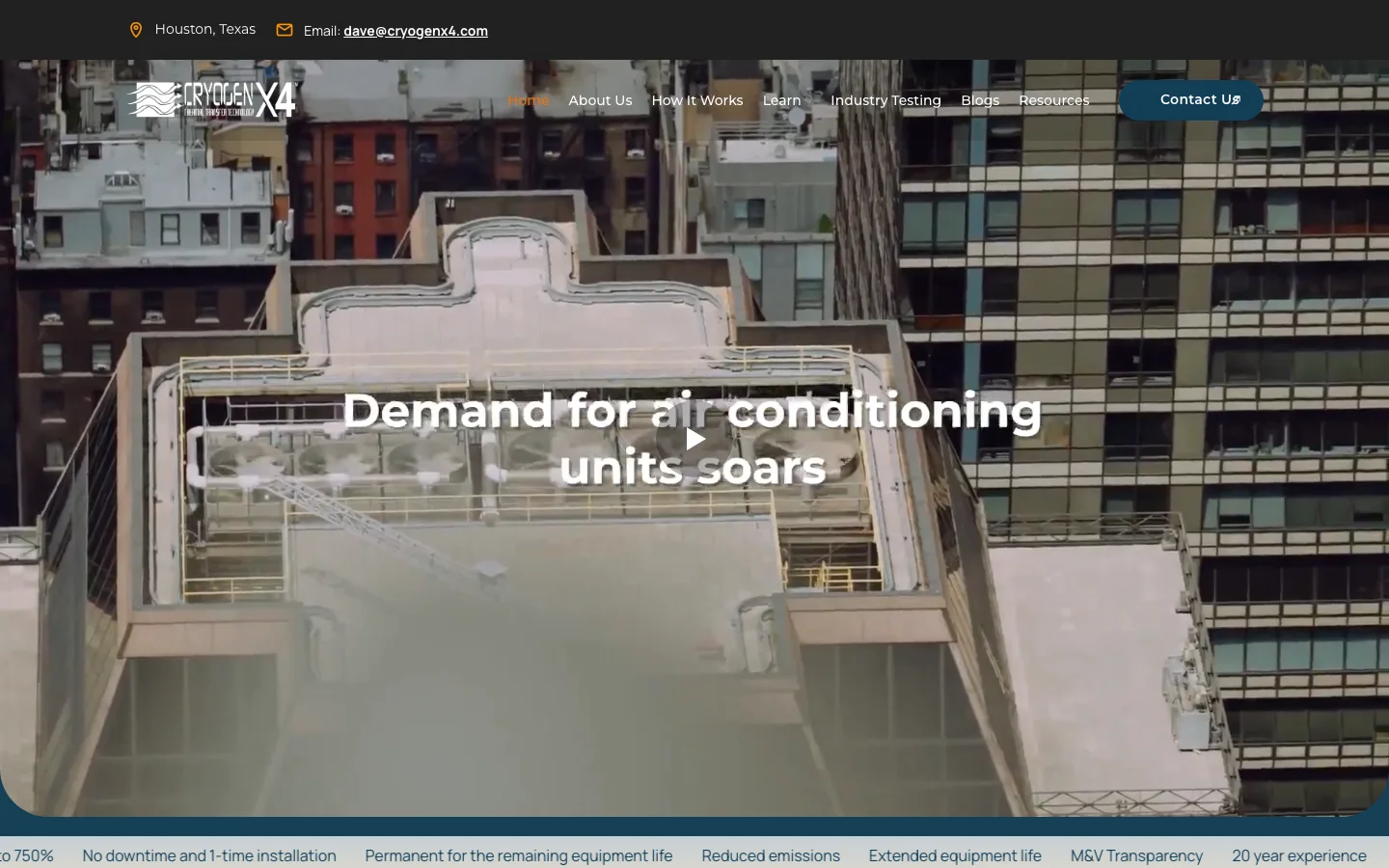
CryogenX4 is an eSEOspace client: we work on its website and search marketing. This guide uses the company's own published information, checked on 22 October 2026, and every source is listed at the end. We don't rate or score our clients. Claims about savings and payback are the company's own, and terms change, so confirm them with cryogenx4.com before you buy.
The short answer
CryogenX4 (styled CRYOGENX4 on its site) is a liquid treatment for air conditioning, heat pump and refrigeration equipment, sold by a Houston, Texas company that serves customers nationwide. Trained technicians inject it once into a running system through the suction port. The company says it lifts insulating oil film off the inside of the coils, returns that oil to the compressor sump and improves lubrication, and it advertises energy savings of up to 30% with a typical payback of 12 to 36 months. Results vary by equipment. It works only on systems with oil-lubricated compressors. Prices are not published: you request a quote by calling 713-396-6425 or using the site's quote form.
| Business | CryogenX4 (CRYOGENX4), a product of the company the site calls TRI-S Technologies or Tri-S Corporation |
|---|---|
| What it does | One-time liquid treatment for HVAC-R equipment (chillers, rooftop units, split systems, heat pumps, refrigeration) aimed at restoring heat transfer and efficiency |
| Based in / Service area | Houston, Texas; serving nationwide (no street address published) |
| In business since | The company dates its first-generation product to 1990; the current CryogenX4 line was introduced in 2017 |
| Inventor / lead | Tony Sgarbi, named as the inventor of CryogenX4 and founder of Tri-S |
| Equipment covered | Systems with oil-lubricated compressors, from 1-ton air-cooled split units to 1,600-ton water-cooled chillers (company figures); not oil-free systems |
| Price range | Not published. Quote-based; dosing for DX systems is based on tonnage |
| Payment terms | Published options include 40% deposit / 60% at completion, a same-as-cash plan over up to 36 months, and funded options with 36 to 60 month terms |
| Hours | Not published |
| Phone / email | General inquiries: 713-396-6425, tony@hvacmiser.com. Technology support: 832-493-7915, dave@cryogenx4.com |
| Website | cryogenx4.com |
What is CryogenX4?
CryogenX4 is a liquid product added to the refrigerant circuit of an existing cooling or heat pump system. The company describes it as a "proprietary nano-fluid formulated to optimize refrigerant performance for all HVAC-R systems." It is not new equipment, a coil cleaner applied from the outside, or a refrigerant. It is installed once, inside the sealed system, while the unit keeps running.
The problem it targets is what the company calls oil fouling. Every compressor that uses oil lets a little of it travel with the refrigerant through the system. According to the company, some of that oil settles on the inside walls of the evaporator and condenser coils and forms a thin film that slows heat transfer. Over the years, the company says, this makes the system run longer and use more power to deliver the same cooling. CryogenX4 is sold as a way to remove that film and keep it from returning.
The buyers the site speaks to are mostly organizations that run a lot of cooling equipment: commercial buildings, government facilities, hospitals and clinics, hotels and restaurants, and industrial plants. It also has a residential page for homeowners.
Who makes CryogenX4?
The site names Tony Sgarbi as the inventor of CryogenX4. Its About page says he is the founder of Tri-S Corporation and that he developed CryogenX4 in 2015 as the company's fourth generation of thermal transfer products. Other pages call the maker TRI-S Technologies and describe it as the "Houston, TX-based inventor and manufacturer" of the product.
The site lists two contacts: general inquiries go to tony@hvacmiser.com at 713-396-6425, and technology support goes to dave@cryogenx4.com at 832-493-7915. The site does not publish a leadership page, staff list or company registration details beyond Houston, Texas.
How long has CryogenX4 been around?
CryogenX4 itself dates to 2017. The About page lays out the product's history as four generations:
| Year | What the company says happened |
|---|---|
| 1990 | First-generation HVAC performance product brought to market |
| 1994 | Second generation, with improved chemicals, used in chillers, DX systems, split units, ice production and ammonia systems |
| 2002 | Third generation (the company names it Permafrost) |
| 2015 | Fourth generation developed under the CryogenX4 name |
| Late 2017 | CryogenX4 made available for installation after two years of lab and field testing |
So the business behind the product goes back to about 1990, by its own account, and the current formula has been sold since late 2017.
How does CryogenX4 work?
The How It Works page explains the company's mechanism in six steps. In its words, paraphrased:
- Oil migrates around seals in the compressor and mixes with the refrigerant, which carries it through the system.
- The migrating oil is attracted to the inside metal surfaces of the coils, where it collects and forms an insulating barrier.
- Within a few years, heat transfer drops and refrigerant flow is impeded, which raises operating costs.
- When CryogenX4 is added, its "strongly polarized molecules" break through the oil film, lift it from the surfaces and return it to the oil sump.
- It then "stabilizes and activates" the coil surfaces so they exchange heat faster, which the company says lasts for the remaining life of the system.
- Inside the compressor, it improves the lubricity of the existing oil, which the company says reduces wear and heat build-up.
The company uses the refrigerant itself as the carrier: the treatment "simply uses refrigerant as a transport vehicle inside a system." It describes the result by component. In the evaporator, it claims better refrigerant flow, more direct contact between refrigerant and tube walls, and colder, drier supply air. In the condenser, it claims better heat rejection to outside air. In the compressor, it claims less friction, cooler and quieter running and less oil blow-by.
These are the company's descriptions of how the product works. This guide does not test or confirm them. The way to find out whether it works on a given system is to measure it, which is covered in How to verify results.
What equipment does it work on?
The company says CryogenX4 works "in any size HVAC/R/HP system that uses oil-lubricated compressors." That includes:
- Water-cooled and air-cooled chillers
- Rooftop units and other packaged DX (direct expansion) systems
- Split-system air conditioners
- Air-source heat pumps, for both cooling and heating
- Refrigeration, including ammonia refrigeration
Its facts list gives the range treated as "from 1 ton air cooled split units to 1,600 ton water cooled chillers." The same list notes one clear exception: it is compatible with major chiller and DX systems "except oil-free systems." If your chiller uses oil-free (for example magnetic-bearing) compressors, CryogenX4 is not designed for it, because there is no compressor oil film for it to act on.
The company also says the product is compatible with all prevalent refrigerants, including newer low global warming potential (GWP) refrigerants, and with compressor oils. Ask for the test reports that cover your exact refrigerant and oil before you treat (see Safety, compatibility and warranties).
Is there more than one product?
Yes. The government and hospitality pages say "there is a CRYOGENX4-TTT product for any HVAC scenario," shown as a set of product labels. They add that Tri-S also makes mineral-based and synthetic-based chiller products and a specialized product for ammonia systems, which are not shown. The Laboratory and Industry Testing page refers to "CryogenX4 HVAC Performance Enhancement Solutions 3.1, 3.2, 4.1." The site does not publish a full catalog, so the company picks the formula for your equipment as part of the quote.
The product is not sold through an online store on the site. Everything goes through a quote.
Who uses CryogenX4?
The Industries page lists six markets, each with its own page:
| Market | What the site focuses on |
|---|---|
| Commercial | Office and commercial buildings, from small package units to large chillers; lower operating costs and longer equipment life |
| Government | Government buildings and chiller plants; energy efficiency goals and capital planning |
| Healthcare | Clinics and hospitals; reliable climate control and lower energy use |
| Hospitality | Hotels and restaurants, including refrigeration |
| Industrial | Industrial package units and larger chillers |
| Residential | Single-family homes and multi-family units |
The site's language and payment terms point mainly at organizations with many units and an energy budget to manage. Homeowners are served too: the residential page answers questions about applying the treatment at home.
What results does the company claim?
All figures here are the company's own marketing claims, quoted from its site. eSEOspace has not tested them, and the company itself says results depend on the condition of the equipment.
- Energy savings: the home page says "Energy saving up to 30%." Several pages put it as reducing "energy usage at the unit by 10-30% and overall energy usage by 5-15%."
- Payback: the Solutions page lists a "12-36 month typical payback on treatment investment."
- Duration: one application intended to last "the life of the equipment," provided the system keeps being properly maintained.
- Downtime: installed while the system runs, with no modifications; most installations take one day.
- Scale: the Solutions page says 500,000+ tons of equipment and 10,500,000+ square feet of conditioned space have been treated.
- Other effects: longer compressor life, fewer unscheduled maintenance calls, colder and drier supply air, and quieter running.
The site also stresses that maintenance still matters. In the company's words, the treatment works on the inside of the system, but "to maintain those results over time, regular preventative maintenance needs to be performed on the equipment to keep it operating properly on the outside."
This guide is not engineering or financial advice. Savings on any one building depend on its equipment, load, climate and energy rates.
Is CryogenX4 legit? What you can check
CryogenX4 is a real product with a working Houston phone number, a named inventor, published installation and payment terms, and a long product history by the company's account. What a buyer can check directly:
- Who you're dealing with. Ask for the legal company name on the contract. The site uses both TRI-S Technologies and Tri-S Corporation, so confirm which entity you are contracting with.
- Test reports. The site has a Laboratory and Industry Testing page that lists testing organizations and industry standards. Ask for the full reports, not summaries: which method was used, which refrigerants and oils were covered, and what the pass criteria were.
- Safety Data Sheet. The company says its Material Safety Data Sheet is "available upon request." Ask for it before any work.
- A measured result on your own equipment. The company's own resource guides say that published results "tell you what has happened elsewhere" and recommend a small pilot measured under the IPMVP protocol on your own units. That is the strongest check available.
The site does not publish customer reviews or a review rating, so there is no review figure to report.
How much does CryogenX4 cost?
Prices are not published. CryogenX4 is sold by quote. The company says DX systems "are dosed and treated based on tonnage," so the main thing that drives price is how many tons of cooling equipment you treat. Other things likely to affect the quote are the number and type of units, the refrigerant and oil, the site's access, and whether the company's technicians or yours do the installation.
What the site does publish is how you can pay. A heat pump page on the site lists these options:
| Option | Published terms |
|---|---|
| Standard transaction | 40% deposit, 60% at completion |
| Same-as-cash | 0 to 25% deposit, balance spread out over up to 36 months |
| Funded projects | "No upfront capital required, flexible 36-60-month contract terms" |
| Utility-company financing | Offered through a utility company's efficiency financing program; the site says payments can be delayed up to 24 months |
The company says most of its funding options "require little to no cash up front." Ask which option applies to your project, the total cost under each, and what happens if the measured savings come in lower than projected.
The site's resources section includes an HVAC savings calculator. It asks for your tons, full-load hours, kW per ton, electricity rate and an improvement percentage you choose. Its own notes say the result is a screening estimate, not a promise, and that every default should be replaced with your own numbers.
Utility rebates and incentives vary by utility and change often. The site has a hub on ROI, incentives and compliance; check any program's current rules directly with the program before you count on it.
What happens step by step
From what the site publishes, a typical project runs like this:
- Contact and quote request. You call, email or use the "Get a Quote" form, which asks for your name, phone, company and title. The industries page says the team will "assess your specific needs and provide you with a customized solution."
- Equipment review. The company needs to know your equipment type, tonnage, refrigerant and compressor type to pick the formula and dose. Oil-free compressors are excluded.
- Proposal and payment terms. You agree a price and one of the payment structures above.
- Installation. According to the company, CryogenX4 is "installed into the suction port(s) using a refrigerant oil pump while the system is running." No modifications are made to the system and there is no downtime. Most installations take one day. Installers are "trained and certified technicians." The company says it can arrange the installations or "train / certify company technicians" to do them.
- Settling. The company says that once the treatment is "fully seated," it is not affected by leaks or refrigerant changes. Ask how long it expects that to take on your equipment.
- Ongoing maintenance. You keep up normal preventive maintenance, which the company says is needed to keep results over time.
For homeowners, the residential FAQ says it is possible to apply CryogenX4 yourself, but the company recommends "hiring a qualified HVAC technician to ensure proper application." Work on a sealed refrigerant circuit is normally done by a trained technician with the right tools.
How to verify results on your own units
The company says its results "can be documented and proven using the DOE-approved IPMVP testing criteria." The IPMVP (International Performance Measurement and Verification Protocol) is a framework for measuring energy savings, maintained by the nonprofit Efficiency Valuation Organization.
The company's heat pump and cooling pages say an IPMVP check on a unit measures four things, before and after treatment, under conditions kept as similar as possible:
- Power (volts and amps)
- Air volume across the coils, in cubic feet per minute (CFM)
- The dry bulb temperature difference between supply and return air (Delta-T)
- The enthalpy difference, using wet bulb readings of supply and return air
For larger units, it adds that the same number of compressors should run at the same load in both periods.
The site's resource guide on how a 1 to 3 unit pilot works goes further. It recommends picking one to three representative units, fixing any maintenance problems first, agreeing a written M&V (measurement and verification) plan before installation, monitoring a baseline for several weeks, installing, monitoring again under comparable conditions, and then analyzing the data. The guide says the whole pilot often takes two to four months and that you should receive the raw data, the baseline model, savings with an uncertainty range, and before-and-after oil analysis. It also says plainly that "no measurable savings" is a legitimate outcome that the plan should define in advance. Pilot pricing is not published.
Safety, compatibility and warranties
Safety. The company says its products are made with chemicals that are "naturally safe for humans," and that if a spill happens during installation, "clean-up procedures are the same as for refrigerant oil," as described in its Material Safety Data Sheet, available on request. The residential FAQ says the product is formulated from non-toxic materials and "poses no health risks when applied as directed." Ask for the Safety Data Sheet and read it before work starts.
Compatibility. The company says CryogenX4 is compatible with all prevalent refrigerants and refrigerant oils, including ammonia systems, and with all major chiller and DX equipment except oil-free systems. The site's compatibility and safety guide advises naming both your refrigerant and your lubricant when asking for test data, because a report on one combination does not automatically cover another.
Equipment manufacturer warranties. Whether any additive affects your equipment maker's warranty depends on that warranty's wording. The site's guide to OEM warranties and additives recommends reading the actual warranty, asking the manufacturer in writing, taking a baseline oil sample and documenting the installation. For a first trial, it suggests out-of-warranty units carry the least risk.
CryogenX4's own warranty. The site describes a warranty package, but the details are not consistent from page to page. Ask for the written warranty terms with your quote: what is covered, for how long, the claim process, and who stands behind it.
Refunds and guarantees. No refund or cancellation policy is published, and the site's Terms of Use page reads "Coming Soon." Get any guarantee, refund or performance terms in your contract.
Where is CryogenX4 and how do you reach it?
The company is based in Houston, Texas, and the site says it serves customers nationwide. No street address or office hours are published. The company also says that through "global strategic partnerships" it can take on projects of any size.
- General inquiries: 713-396-6425, tony@hvacmiser.com
- Technology support: 832-493-7915, dave@cryogenx4.com
- Online: the "Get a Quote" form on any page, or the contact page
- Social: Facebook and LinkedIn, linked in the site footer
How it compares with other options
CryogenX4 is one of several ways to deal with an aging, less efficient cooling system. These approaches work on different things and are often combined. The table uses generic categories, not named companies.
| Option | What it addresses | Typical disruption | Notes |
|---|---|---|---|
| CryogenX4 treatment | Oil film inside the coils and compressor lubrication, per the company | Installed while running; most jobs one day, per the company | Quote-based; only for oil-lubricated compressors; verify with a measured pilot |
| Equipment replacement | Everything: new efficiency rating, new refrigerant, new warranty | Highest: design, removal, installation | Largest capital cost; makes sense when equipment is at end of life or failing |
| Coil cleaning and tune-up | Dirt on the outside of coils, airflow, refrigerant charge, controls | Low; routine service visit | The company says this is still needed; it works on the outside surfaces, not the inside |
| Controls, VFDs and retro-commissioning | How and when equipment runs: schedules, setpoints, motor speed | Low to moderate | Changes operation rather than the equipment's internal condition |
| Other refrigerant additives or sealants | Varies by product; sealants target leaks | Low | A different category; ask what each product is designed to do and for its test data |
The site's Compare hub has separate guides on each of these comparisons.
Who it suits
A good fit if you…
- Run several chillers, rooftop units, split systems, heat pumps or refrigeration systems with oil-lubricated compressors
- Want to look at efficiency on existing equipment before paying for replacement
- Can't take cooling offline for long and want an install that runs while the system operates
- Can measure results with a pilot, building automation trends or loggers
- Want payment terms with a low deposit or spread over 36 to 60 months
Look elsewhere if you…
- Have oil-free compressors, which the company excludes
- Have equipment that is failing, leaking badly or at the end of its life
- Need a posted price or want to buy online without talking to anyone
- Have new, in-warranty equipment and your manufacturer won't confirm its position in writing
- Need a guaranteed savings figure before you can approve a project
Questions to ask before you buy
- Which legal entity will I contract with, and who will do the installation on site?
- Which CryogenX4 formula do you recommend for my equipment, refrigerant and oil, and why?
- Can I see the full test reports that cover my refrigerant and oil combination?
- Can I have the Safety Data Sheet before installation?
- What is the total price, how is it calculated per ton, and which payment option applies?
- What exactly does your written warranty cover, for how long, and how is a claim made?
- Will you support a pilot with a written M&V plan agreed before installation, and who pays for the monitoring?
- How long after installation do you expect results to show in the measurements?
- What happens if the measured savings are lower than projected?
- What should we do if our equipment manufacturer questions a warranty claim after treatment?
How to get started
- List the units you want to look at: type, tonnage, refrigerant, compressor type, age and how they are metered.
- Read How It Works and, if you plan to measure results, the pilot program guide.
- Call 713-396-6425, email tony@hvacmiser.com, or send the quote form on the site.
- Ask for the test reports, Safety Data Sheet, written warranty and payment options alongside the quote.
Terms you'll see on the site
- HVAC-R: heating, ventilation, air conditioning and refrigeration. The site also writes HVAC/R/HP to include heat pumps.
- Oil fouling: the company's term for compressor oil that settles on the inside surfaces of coils and slows heat transfer.
- Sump: the oil reservoir in the compressor, where the company says CryogenX4 returns lifted oil.
- Suction port: a service connection on the low-pressure side of the system, where the treatment is injected.
- DX (direct expansion): systems where refrigerant cools the air directly, such as rooftop units and split systems, as opposed to chillers that cool water.
- Ton (of cooling): a unit of cooling capacity equal to 12,000 BTU per hour. The company doses DX systems by tonnage.
- kW per ton: electrical power used per ton of cooling delivered. Lower is more efficient.
- COP (coefficient of performance): useful heating or cooling delivered divided by energy used. Higher is more efficient.
- Lubricity: how well an oil reduces friction between moving parts.
- GWP (global warming potential): how much a refrigerant warms the climate compared with carbon dioxide.
- IPMVP: the International Performance Measurement and Verification Protocol, a framework for measuring energy savings.
- M&V: measurement and verification, the process of measuring savings against a baseline.
- Delta-T: the temperature difference between supply and return air (or water).
- Enthalpy: the total heat in air, including moisture; comparing it before and after the coil shows how much cooling was delivered.
Frequently asked questions
What is CryogenX4?
CryogenX4 is a one-time liquid treatment injected into running air conditioning, heat pump and refrigeration systems. The Houston company that sells it says it removes insulating oil film from inside the coils and improves compressor lubrication.
Who invented CryogenX4?
The CryogenX4 site names Tony Sgarbi, founder of Tri-S, as its inventor. The company says he developed it in 2015 and it went on sale in late 2017.
Where is CryogenX4 located?
CryogenX4 is based in Houston, Texas, and says it serves customers nationwide. It does not publish a street address.
How much does CryogenX4 cost?
CryogenX4 does not publish prices. It quotes each project, and DX systems are dosed by tonnage. Published payment options include 40% down and 60% at completion, or plans spread over 36 to 60 months.
How much energy does CryogenX4 claim to save?
CryogenX4 advertises savings of up to 30%, described elsewhere on its site as 10 to 30% at the unit and 5 to 15% overall, with a typical payback of 12 to 36 months. Results vary by equipment, so measure them on your own units.
Does CryogenX4 work on chillers?
Yes, according to the company, from small split units up to 1,600-ton water-cooled chillers. It does not work on oil-free compressors.
Does CryogenX4 work with ammonia refrigeration?
The company says CryogenX4 is compatible with ammonia refrigeration and that Tri-S makes a specialized product for ammonia systems.
Does installing CryogenX4 require shutting the system down?
No, according to CryogenX4. It is injected through the suction port while the system runs, with no modifications, and most installations take one day.
How often does CryogenX4 need to be applied?
CryogenX4 says one application lasts for the remaining life of the equipment, as long as the system keeps getting regular preventive maintenance.
Can I install CryogenX4 myself?
The CryogenX4 residential FAQ says it is possible, but the company recommends a qualified HVAC technician. For larger projects, the company installs it or trains and certifies your technicians.
Will CryogenX4 void my HVAC warranty?
That depends on your manufacturer's warranty wording. CryogenX4's own resource guide recommends reading the warranty, asking the manufacturer in writing, and starting with out-of-warranty units.
How can I check whether CryogenX4 works on my equipment?
Run a measured pilot on one to three units under the IPMVP protocol, with a baseline before treatment and a comparison after. CryogenX4's site describes how such a pilot is set up.
Is CryogenX4 safe?
CryogenX4 says its products use chemicals that are safe for humans and that spills are cleaned up like refrigerant oil. Its Safety Data Sheet is available on request.
Does CryogenX4 replace regular HVAC maintenance?
No. CryogenX4 says regular preventive maintenance is still needed to keep the equipment working properly on the outside and to hold results over time.
Sources
All pages checked on 22 October 2026.
- CryogenX4, home page: cryogenx4.com
- About CryogenX4: cryogenx4.com/about/
- How It Works: cryogenx4.com/how-it-works/
- How CryogenX4 works (product history page): cryogenx4.com/product-history/
- Why CryogenX4: cryogenx4.com/why-cryogen-x4/
- HVAC-R Energy Saving Solutions: cryogenx4.com/solutions/
- Patented Solution to Improve Cooling System Performance: cryogenx4.com/pioneers-in-hvac1/
- Heat Pump Solution: cryogenx4.com/pioneers-in-hvac2/
- Laboratory and Industry Testing: cryogenx4.com/laboratory-and-industry-testing/
- Industries: cryogenx4.com/industries/
- Industry pages: Commercial, Government, Healthcare, Hospitality, Industrial, Residential
- Contact Us: cryogenx4.com/contact-us/
- Terms of Use: cryogenx4.com/terms-of-use/
- Resources hub: cryogenx4.com/resources/
- How a 1 to 3 unit CryogenX4 pilot program works: resource guide
- HVAC savings calculator: resource page
- Compatibility and safety: resource guide
- OEM warranties and refrigerant additives: resource guide
- Compare HVAC efficiency options: resource hub
- Efficiency Valuation Organization, IPMVP: evo-world.org



