
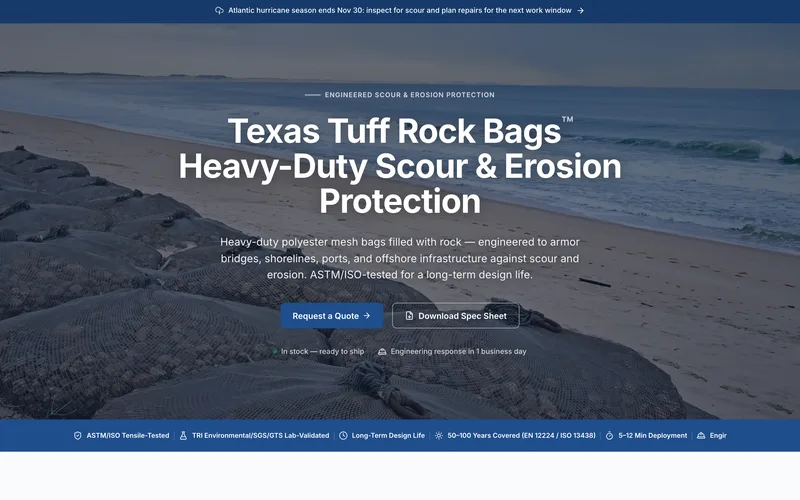
Here is what it sells and how ordering works.
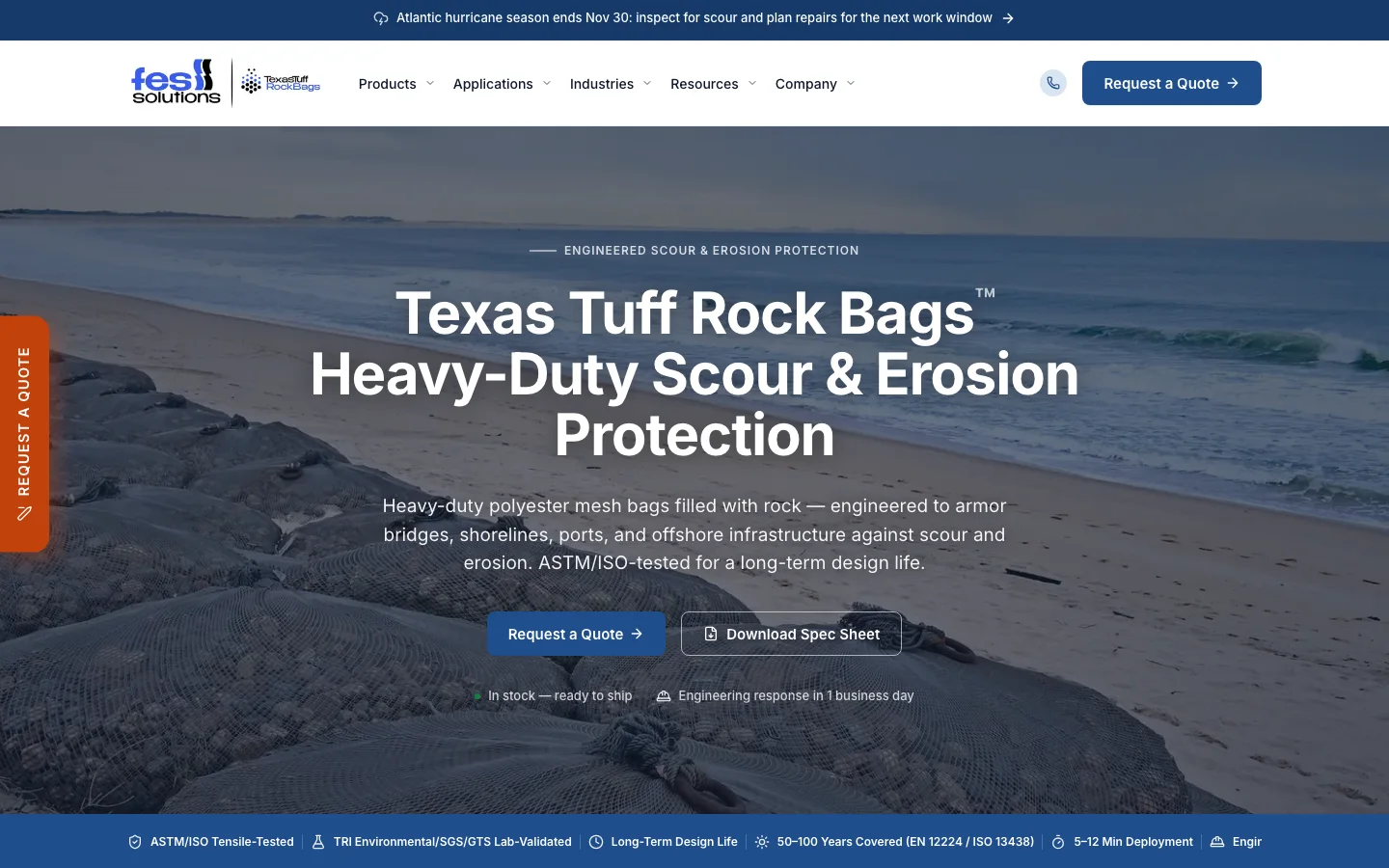
FES Solutions is an eSEOspace client: we work on its website and search marketing. This guide uses the company's own published information, checked on 19 October 2026, plus one public business record, and every source is listed at the end. We don't rate or score our clients. Specifications, lead times and policies change, so confirm them with FES Solutions on fessolutions.net before you specify or order.
The short answer
FES Solutions (FES Solutions LLC) is a Texas company, headquartered in the Katy area of Houston, that supplies Texas Tuff Rock Bags: heavy polyester mesh bags that are shipped empty, filled on site with rock, and lifted into place to protect bridges, riverbanks, shorelines, outfalls, ports and pipelines from scour and erosion. It sells four standard sizes (1-Ton, 2-Ton, 4-Ton and 8-Ton), custom bags up to 25 tonne, and the Texas Tuff Rock Log for linear toe protection. Buyers include state DOTs, drainage districts, ports, contractors and private waterfront owners. Prices are not published: FES quotes each project, and says it replies within one business day. Phone +1 512-766-6608.
| Business | FES Solutions LLC (product brand: Texas Tuff Rock Bags) |
|---|---|
| What it does | Supplies rock-filled mesh bags and Rock Logs for scour and erosion protection, with sizing and documentation support. It does not install or design. |
| Based in | Headquarters in Katy, in the Houston area of Texas (company's statement). Mailing address: 5900 Balcones Drive STE 4781, Austin, TX 78731. |
| Service area | Ships to projects across the US and abroad; the site lists completed work in Panama, New Zealand and Australia |
| In business since | 2006 (Texas registration dated 21 September 2006; renamed FES Solutions LLC on 17 June 2019, per the company) |
| Who runs it | A President the site does not name; Mike Jones is the named Engineering Manager |
| Public record | Texas Comptroller lists FES Solutions LLC with "Active" status and an active right to transact business in Texas (checked 19 October 2026) |
| Products | 1-Ton, 2-Ton, 4-Ton and 8-Ton rock bags; custom bags up to 25 tonne; Texas Tuff Rock Log |
| Price range | Not published. Quoted per project; the quote covers the bags, not the fill stone or installation. |
| Hours | Phone coverage Monday to Friday, 7am to 6pm CT |
| Phone / email | +1 512-766-6608 · info@fessolutions.net |
| Website | fessolutions.net |
What is FES Solutions?
FES Solutions is a supplier of one product family: the Texas Tuff Rock Bag. According to its About page, the company was founded in 2006 and first served the energy industry. Over the past decade it narrowed its focus to "protecting structures and land from erosion and scour forces", and the rock bag became its main line.
FES describes itself as a supplier with engineering support, not a contractor and not a design firm. It sizes the bags, estimates quantities, supplies submittal documentation and ships the product. The buyer's crew or contractor fills and places the bags, and the design decision belongs to the project's engineer of record.
The company says it manufactures in Asia and ships through a network of warehouses, with distribution and logistics covering North and South America, Europe, Asia, Australia, the Middle East and Africa.
Who owns or runs FES Solutions?
The site does not name the owner. Its About page says FES Solutions "is led by its President, who brings a background in physics, an MBA, and more than 30 years of experience" to the work.
The one person the site does name is Mike Jones, Engineering Manager. His bio says he holds a BS in civil engineering and an MS in hydrology, and spent 15 years with engineering firms and as an independent consultant on drainage and erosion control projects. He is listed as the author of the engineering articles in the site's Resources section. The site does not say he is a licensed Professional Engineer, and FES states that it "provides no service requiring" a P.E. stamp.
On the legal side, the About page says FES Solutions LLC is a Texas limited liability company "originally formed on September 21, 2006", that it went through two name changes, and that it became FES Solutions LLC on 17 June 2019. It says headquarters are in Katy, in the Houston area, and that its registered agent is in Austin, which is why the published mailing address is in Austin.
Is FES Solutions legit?
Here is what a buyer can check, and what the company itself says.
- State business record. The Texas Comptroller's franchise tax search lists FES SOLUTIONS LLC (Texas SOS file number 0800710646) with Secretary of State registration status "Active", right to transact business in Texas "Active", and an effective registration date of 21 September 2006. That matches the formation date the company publishes. We checked it on 19 October 2026.
- Named clients. The site names the Texas Department of Transportation, the Washington Department of Fish & Wildlife, the Panama Canal Authority, the Hidalgo Drainage District in Texas, the Transportation Department of the Native Village of Deering in Alaska, and coastal pipeline protection in Eureka, California. Several of these have their own project pages (see Projects).
- Testing. FES says the mesh and finished bag are tested to ASTM, EN and ISO methods, with results validated by TRI Environmental, SGS and GTS, and that full reports and certificates of compliance are issued per project on request.
- What it does not claim. The site says plainly that FES holds no product certification, no standing agency approval and no place on a national spec list, and that no rock bag is certified against a single national product standard. It also says it has no offshore wind farm installations to date, even though it markets to that sector.
For public work, check early whether your specification asks for a listed or certified product.
What is a Texas Tuff Rock Bag?
The company describes the product as "heavy-duty polyester mesh bags filled with rock", offered as an alternative to loose riprap, gabion baskets, blockstone and poured concrete. The points FES makes about how it works:
- Filled on site. Bags ship empty, so you buy the stone locally and only freight the fabric and rope.
- Single-point lifting. Each bag has one attached lifting ring on reinforced rope, so an excavator or crane can pick it, place it and, where needed, lift it again.
- Placement in water. FES says the bags can be filled and placed in flowing water or fully underwater, which on many jobs removes the need for a cofferdam or diversion. It adds that this is a product capability, not a permit outcome: a regulator may still require work-area isolation.
- Little site preparation. The company says the product itself needs no foundation preparation or geotextile underlayer, and that bags conform to an uneven or shifting bed.
- Flexible, not rigid. Because each bag is a separate unit, the armor settles with a moving bed instead of cracking over it. FES also notes this is the wrong property where a design needs a rigid mass.
- Placement time. The site says placement runs roughly 5 to 12 minutes per bag once filling and rigging are set up.
The site also hosts a silent yard video of a filled bag being dropped, dragged and driven over, labelled "a demonstration, not installation practice."
The sizes, one by one
FES sells four standard weight classes, a custom build, and a linear product called the Rock Log. These figures are copied from the product pages. Each size page also lists a rated "grouped current resistance"; see the specifications page for those ratings and ask FES for the basis if the figure will govern your design.
| Size | Nominal filled weight | Fill volume | Filled diameter | Mesh aperture | What FES says it is for |
|---|---|---|---|---|---|
| 1-Ton | ~1 tonne | 0.6 m³ | 1.5 m | 25 mm | Light scour, small streambanks, residential and lakefront sites, tight access |
| 2-Ton | ~2 tonnes | 1.13 m³ | 1.9 m | 25 mm | The size FES says is specified most: streambanks, shoreline revetment, light to moderate scour |
| 4-Ton | ~4 tonnes | 2.71 m³ | 2.4 m | 25 mm | Heavy civil work: bridges, riverbanks and port toes in higher-energy conditions |
| 8-Ton | ~8 tonnes | 6.0 m³ | 3.0 m | 50 mm, quad-layer | Offshore, oil and gas, subsea and severe-current coastal work; 16 mm lifting rope |
| Custom | Up to 25 tonne | Built to spec | Built to spec | 25 mm to 50 mm | Loads between standard sizes, heavier subsea specs, special fill, footprint limits |
FES says the 1-Ton is usually the residential size because it places with a compact excavator or skid steer, and that the 2-Ton is the size it ships most, "light enough to place with everyday equipment." Equipment steps up with size: heavy civil plant for the 4-Ton, crane or vessel work for the 8-Ton.
Custom bags. FES says it builds bags up to 25 tonne and can vary mesh aperture, mesh layers, fill, rope and rigging, colour and project marking.
Texas Tuff Rock Log. A linear section for continuous toe protection along banks, embankments and pipeline runs, using the same raschel-weave virgin polyester mesh and 3-ply rope as the heavy bags. Rock Logs are "sized to the site rather than sold in fixed weight classes", so you send the bank profile, flow conditions and run length for a quote.
Every product page carries the same caution: "FES Solutions is a supplier, not the engineer of record. Published dimensions and rated conditions describe the product, not your site."
What the bags are made of, and how long they last
According to the specifications page, every size shares the same construction:
- Virgin polyester mesh, not recycled, which FES says holds strength better and resists breakdown in water and from heat and oxygen.
- Raschel weave, a knitted construction that FES says will not unravel if one strand is cut.
- 3-ply polyester rope with neck and wrap ropes, reinforcing the lifting point and perimeter.
- Single-point lifting on reinforced rope.
On service life, the company publishes two figures, each tied to a condition:
| Where the bag sits | Published service life | Condition | Test method cited |
|---|---|---|---|
| In water | Approximately 100 years | Submerged, out of direct sunlight | EN 12447 (hydrolysis) |
| On land | Approximately 50 to 100 years | Installed and covered within one month | EN 12224 (weathering) and BS EN ISO 13438 (oxidation) |
FES says both figures come from retained-strength lab testing, and that the land figure should not be applied to armor that stays permanently exposed to the sun. For exposed upper courses, it asks buyers to request a design life for that exposure.
The test programme it lists covers wide-width tensile strength, static puncture (CBR) and tongue tear strength under ASTM/ISO methods, plus the EN and ISO durability tests above. The site deliberately does not publish measured test values. FES says measured values are issued with the reports and certificates of compliance for your project.
Where the bags are used
The site groups uses into eight applications and six industries.
| Application | What FES describes |
|---|---|
| Coastal | Beaches, dunes and shoreline structures; groynes for wave reduction |
| Marine and ports | Port berths, terminal walls and harbor infrastructure exposed to propeller wash and tidal scour |
| Bridges | Piers, abutments and embankments exposed to scour |
| Roads and rail | Embankment repair after storms, and permanent erosion control |
| Rivers and streambanks | High-flow and meander erosion on banks |
| Stormwater and drainage | Channels, culvert inlets and outfalls, drainage embankments |
| Offshore | Cables, pipelines, piers and piles |
| Emergency response | Storm, flood and scour repairs on a short clock |
The industries pages cover DOT and municipal agencies, civil and marine contractors, offshore wind, oil and gas, aquaculture, and property owners and HOAs. On offshore wind, the site states that FES is "proven offshore in cable protection; no wind-farm supply to date."
For agencies, FES offers a Procurement Pack (spec sheets in US and metric units, test data, lab validation and CAD details) and CAD sections in DWG and PDF for pier, abutment, embankment and outfall details. These are sent on request rather than downloaded, and the download gate asks for an email address and phone number.
Projects FES has published
The company says it has completed "tens of" Texas Tuff Rock Bag projects, and that some of its longest-running installations have stayed in position in the water for more than ten years. Its project pages include:
- TxDOT, Rains County, Texas (bridge scour). A highway bridge embankment was designed for gabions and riprap, but a cofferdam could not hold back seepage. After a review with the client, 2-Ton bags were substituted, filled in the contractor's yard, trucked to site and placed in the water and up the embankment in a stair-step pattern with no ground preparation. The About page adds that the crew filled and placed 600 bags in two weeks after more than two months trying to make the original design work.
- Washington Department of Fish & Wildlife, Sol Duc River (temporary weir, 2023). 2-Ton bags used as a weir block to manage stream flow at a fishery, installed from late September to mid-November 2023. The page says 50 to 100 bags have been used, that the agency reports the system works as intended, and that it has made several repeat purchases.
- Port works, New Zealand and Australia (2024). 4-Ton and 8-Ton bags placed as subsea protection against wave energy and propeller wash at sites including the Port of Tauranga, Bledisoe Wharf and the Darwin Ship Lift. Placement was by gravity drop, under diver supervision or with robotic placement, with no bottom preparation. The page says several hundred bags were used across these projects.
- River and bridge revetment, New Zealand (2024). Bags placed to protect bridge approaches and stabilize a riverbank.
- Panama. Coastal construction (2023) and multi-phase coastal and other works (2023 to 2026), plus riverbank protection for the Panama Canal Authority. FES's cost guide notes the Panama coastal work used locally available rock as fill.
- Other pages cover an emergency road crossing, outfall protection, residential Rock Logs and subsea pipelines.
How much do Texas Tuff Rock Bags cost?
FES does not publish prices. Its FAQ says pricing "is quoted per project rather than published, because the delivered cost depends on size, quantity, destination, and schedule." To get a number, send the application, rough quantity, location and timeline through the quote form; FES says sizing and pricing come back within one business day.
What the company's cost guide says moves the total:
| Cost item | What FES says | Who pays it |
|---|---|---|
| Bags (size and quantity) | Set by the protected area and the hydraulic design. Larger bags cost more each but less per unit of area covered. | FES supply quote |
| Freight | Bags ship empty and flat on pallets, so freight reflects fabric and rope, not stone. Quoted with the product. | FES supply quote |
| Fill stone | Not included. Bought locally through your own supply chain. Often "the largest single variable" in the comparison. | You or your contractor |
| Crew and equipment | Compact plant for the 1-Ton, mid-range excavators for the 2-Ton, heavy civil plant for the 4-Ton, crane or vessel for the 8-Ton. | You or your contractor |
| Site access and temporary works | Often a large swing factor. The product does not itself need a cofferdam, but a permit may require isolation anyway. | You or your contractor |
| Engineering support | Sizing, layout guidance and submittal documentation, with no charge, including at concept stage. | Included |
- No fixed minimum order. Projects range from single residential bank repairs to multi-phase programs, but FES notes very small orders carry proportionally higher freight and setup cost.
- Emergency orders. FES says it does not charge a product premium for emergencies; the extra cost usually comes from mobilizing crews at short notice and working in active flow.
Payment terms, accepted payment methods and financing are not published. Ask about them when you request a quote.
What a quote includes, and what it leaves out
FES has a page that sets out its own scope. A quote comes back with:
- A recommended size, with the reasoning
- A quantity, based on the extent and layout method (the site publishes how its calculator works this out)
- A layout approach for the geometry you describe
- Product pricing for that quantity
- Lead time, based on the current stock position
- Shipping, or the information to arrange it
- Submittal documentation: specifications, spec sheets and the test programme
What the page says is not in it: fill stone, installation ("We are not a contractor and we do not place"), design ("We are a supplier, not the engineer of record"), a P.E. stamp, permit applications, published measured test values, and certifications ("We hold none and do not describe ourselves as certified").
To reach an installed cost, the site says to add delivered fill stone, plant and crew, access, site management, environmental controls, temporary works, survey and contingency. Under supply-only, the buyer or its contractor carries quantity, weather and ground risk.
How an order works, step by step
- Send the project details. Use the quote form, email or phone. The form asks for application, bag size (or "Not sure"), quantity, location and timeline.
- Include what you have. FES lists the essentials as site location and what is being protected, what is eroding and how much, length, height and depth, water conditions, access, delivery address and offloading capability, and timescale. It says photographs "are worth more than descriptions", and that photos, rough dimensions and an access description are enough to start.
- Get a reply. The company says its engineering team replies within one business day with size, quantity, lead time and pricing. For emergencies it asks you to call rather than email.
- Submittal and approval. On public work, request the test reports, certificates of compliance, spec sheets and CAD details that match the standards your specification cites. Say which agency is reviewing.
- Order and delivery. Bags drop-ship to your laydown yard, flat and palletized. FES says lead time depends on size, quantity and destination and is confirmed with the quote. Confirm who unloads, and photograph any freight damage on the delivery record.
- Fill and place. Your crew fills each bag on a frame or hopper with approved stone, secures it, checks it, and lifts it into place by the single ring. FES offers sizing, layout guidance and an installation guide, and says the detailed Filling and Installation Manual has not yet been issued.
- Inspect. FES recommends a baseline inspection after placement and further checks after floods and storms.
Orders already placed go to the same engineering team, phone number and email.
Who installs the bags, and what the job involves
FES does not install. The buyer's crew or a hired excavation, marine or landscape contractor does. The site has an installation hub with articles from site assessment through inspection and repair.
Points the company makes that affect planning:
- Fill stone must be larger than the mesh aperture, durable, well graded and dense; FES says to test local material early.
- Lifting gear. The bags come with the mesh, support ropes and the neck lifting point. Hooks, shackles, slings, tag lines and machine attachments are for the contractor to confirm.
- Repairs. A damaged bag can often be replaced without disturbing its neighbours, and the site mentions a repair kit for small mesh tears.
- Permits. The site has a permitting hub (Section 404, Section 10, work windows and submittals). FES supplies product documentation but does not prepare permit applications or say whether your water is jurisdictional.
Can a homeowner or HOA buy them?
Yes. The FAQ says a homeowner can buy directly and that the smaller end is quoted the same way as large projects, with less engineering involved. The Property and HOA page covers lakefront and shoreline erosion, protection at the base of docks, piers and aging seawalls, and shared HOA waterfronts and retention ponds.
What the site tells homeowners to expect:
- You will need a machine, which usually means a contractor. Even the smallest bag is about one tonne filled. Most homeowners hire a local excavation or marine contractor who brings the excavator and sources the stone.
- Size: usually the 1-Ton, stepping up to the 2-Ton where the property faces real wave fetch or boat wake.
- Access is usually the constraint: room for a compact excavator and a stone stockpile within reach.
- Time: FES says permitting, where required, is usually the longest item.
- Permits: many waterfront projects need a permit from a state agency, the US Army Corps of Engineers or a local authority, and HOAs may have their own rules. FES can provide spec sheets for the application.
Test reports, submittals, warranty and insurance
Documentation set. FES says a documentation set for a project includes laboratory test reports for the methods your specification cites, certificates of compliance for the supplied lot, a material declaration (raschel-weave virgin polyester, mesh aperture and rope construction), and dimensional data per size. Material samples can be requested for specification review.
Warranty and insurance. The About page says products "are backed by a warranty" and that the company carries general liability insurance. The warranty terms are not published, so ask for them in writing with your quote.
Returns and cancellations. No return or cancellation policy is published. Confirm terms on the quote or purchase order.
When FES says rock bags are the wrong choice
The site has a page called "When not to use rock bags". It lists four cases where FES would steer you elsewhere:
- The design velocity is above the bag's rating. FES says it will tell you so "rather than sell you a course of 8-Tons."
- The design needs a rigid, monolithic structure. Then a grouted or structural solution fits better.
- You need the supplier to be the engineer of record. FES does not produce site-specific designs or sealed calculations.
- The spec demands a certified or listed product. FES holds no standing agency approval, so check this before submittal.
The same page lists data FES does not have: published load, pull-out or stability test results; a quantified scour-depth reduction figure; citable hydraulic or physical model test reports; offshore wind farm installations; and lifecycle-cost or carbon comparison studies. It says cost advantages it describes are "directional and drawn from project experience, not from a costed study."
How it compares with other options
This table summarizes how FES's own articles frame the main alternatives. It is the company's view, not an independent test, and the right choice for a site belongs to its engineer.
| Option | Where FES says it fits | Trade-off FES points to |
|---|---|---|
| Rock bags (FES) | Wet or hard-to-reach sites, uneven or shifting beds, places where local stone is available but armor-grade stone is not | Needs machinery to place; not rigid; no national certification; supply only |
| Loose riprap | Where a nearby quarry produces the specified grade cheaply, haul is short, access is easy and loads are moderate | Individual stones can migrate in high flow; haul cost grows with distance to the quarry |
| Gabion baskets or mattresses | Long service above water in dry or intermittently wet settings with a stable base; when a near-vertical face is needed | The wire is the weak point; assembly and hand-packing labor |
| Poured concrete or a seawall | Where the design truly needs a rigid mass | Often needs dewatering or a cofferdam; can crack or be undermined as the ground moves |
| A contractor's installed price | Buyers without their own crews and plant | Not comparable with a supply-only quote; compare on one cost sheet |
FES suggests comparing bids on protected area, design event and expected maintenance, not unit rates.
Who it suits, and who should look elsewhere
A good fit if you…
- Are an engineer, DOT, drainage district or port specifying scour or bank protection and want test reports and sizing input
- Need to place armor in flowing water or underwater without building a cofferdam (subject to your permit)
- Have local fill stone, but no quarry producing armor-grade riprap within reach
- Have your own crew and excavator, or a contractor lined up to place the bags
- Need temporary works that can be lifted out and reused, such as a weir or a work platform
- Own a lakefront or riverfront property with tight access and a contractor who can run a compact excavator
Look elsewhere if you…
- Want one company to design, permit and install the whole job
- Need sealed calculations or a P.E. stamp from the supplier
- Work under a specification that requires a certified or listed product
- Have design velocities above the largest applicable bag's rating
- Need a rigid, monolithic structure
- Want a DIY product you can place by hand
Questions to ask before you order
- Which size do you recommend for my site, and what data is that based on?
- What is the basis for the rated current resistance, and how should my engineer use it?
- What is the lead time to my site, and is that a firm date?
- Who is responsible for unloading, and what equipment do I need at delivery?
- Which test reports and certificates will you issue for my lot and my reviewing agency?
- What are the warranty terms, payment terms and cancellation terms?
- Is the Filling and Installation Manual available yet, and if not, what guidance applies to my bag size?
How to get started
- Gather photos, rough dimensions, the location and a description of site access.
- Add hydraulic data, survey, drawings or a scour report if you have them.
- Submit the quote form on fessolutions.net, email info@fessolutions.net, or call +1 512-766-6608 (Monday to Friday, 7am to 6pm CT). For an emergency, call.
- Review the size, quantity, lead time and price that come back, and request the documentation set if your project needs a submittal.
- Line up fill stone, a contractor and equipment before the bags arrive.
Terms you'll see on the site
- Scour
- Localized removal of bed material by flowing water, usually around a structure such as a bridge pier, abutment or culvert outfall.
- Grouped current resistance
- The flow velocity a bag size is rated to hold when bags are placed together. FES calls these manufacturer-declared values to be verified for each project.
- Raschel weave
- A warp-knit mesh where strands are interlooped, so a cut strand does not unravel across the fabric.
- Mesh aperture
- The opening size of the mesh. It governs which fill stone is acceptable: 25 mm for the 1-, 2- and 4-Ton, 50 mm for the 8-Ton.
- Riprap
- Loose quarried stone of a specified gradation placed as armor.
- Toe protection
- Armor at the base of a slope, where most bank failures start. The Rock Log is made for this line.
- Engineer of record
- The engineer responsible for the project's design. FES says that role is never the supplier's.
Frequently asked questions
What does FES Solutions sell?
FES Solutions sells Texas Tuff Rock Bags, polyester mesh bags that are filled with rock on site and lifted into place for scour and erosion protection. It offers 1-Ton, 2-Ton, 4-Ton and 8-Ton sizes, custom bags up to 25 tonne, and the Texas Tuff Rock Log for linear toe protection.
Where is FES Solutions located?
FES Solutions says its headquarters are in Katy, in the Houston area of Texas. Its published mailing address is 5900 Balcones Drive STE 4781, Austin, TX 78731, where its registered agent is based.
Is FES Solutions a real company?
Yes. The Texas Comptroller lists FES Solutions LLC as an active Texas entity registered on 21 September 2006, matching the formation date on the company's site. The site also names public clients such as the Texas Department of Transportation and the Washington Department of Fish & Wildlife.
How much do Texas Tuff Rock Bags cost?
FES Solutions does not publish prices. It quotes each project based on size, quantity, destination and schedule, and says it replies within one business day. The quote covers the bags and freight; fill stone and installation are extra.
Does FES Solutions install the rock bags?
No. FES Solutions supplies the bags with sizing and documentation support, and says it is not a contractor. Your own crew or a hired excavation or marine contractor fills and places them.
How long do Texas Tuff Rock Bags last?
FES Solutions publishes approximately 100 years for bags installed in water (EN 12447 testing) and approximately 50 to 100 years on land if the bag is covered within a month of installation. For bags left permanently exposed to sunlight, it asks you to request a design life for that condition.
Can a homeowner buy rock bags from FES Solutions?
Yes. FES Solutions says homeowners can buy directly and are quoted the same way as larger projects. You will still need an excavator, so most homeowners hire a local contractor, and the 1-Ton is the usual residential size.
Is there a minimum order with FES Solutions?
FES Solutions says there is no fixed minimum order quantity. Very small orders carry proportionally higher freight and setup cost, so ask for a quote rather than assuming a job is too small.
Are Texas Tuff Rock Bags certified or DOT approved?
FES Solutions says it holds no product certification, standing agency approval or national spec-list listing. It meets requirements project by project with ASTM, EN and ISO test reports and certificates of compliance, and says the bags have been used on state DOT projects.
Does FES Solutions ship outside the US?
Yes. FES Solutions says it ships internationally through a distribution and logistics network, and its project pages include work in Panama, New Zealand and Australia.
Does FES Solutions offer a warranty?
FES Solutions says its products are backed by a warranty and that it carries general liability insurance. The warranty terms are not published, so ask for them with your quote.
Who is the engineer at FES Solutions?
The site names Mike Jones as Engineering Manager, with a BS in civil engineering and an MS in hydrology. FES Solutions says it is a supplier, not the engineer of record, and does not provide P.E.-stamped work.
How do I contact FES Solutions?
Call +1 512-766-6608 (Monday to Friday, 7am to 6pm CT), email info@fessolutions.net, or use the quote form on fessolutions.net. For an emergency repair, FES Solutions asks you to call.
Sources
All pages checked on 19 October 2026.
- FES Solutions, home page: fessolutions.net
- About FES Solutions: fessolutions.net/about/
- Contact: fessolutions.net/contact/
- Request a quote: fessolutions.net/quote/
- Products and Rock Log: fessolutions.net/products/
- Size pages: 1-Ton, 2-Ton, 4-Ton, 8-Ton, Custom
- Specifications: fessolutions.net/specifications/
- Spec sheets and Procurement Pack: fessolutions.net/resources/spec-sheets/
- Test data: fessolutions.net/resources/test-data/
- Rock bags vs gabions: fessolutions.net/products/rock-bags-vs-gabions/
- Applications and industries: applications, bridges, rivers and streambanks, industries, DOT and municipal, property and HOA
- Projects: all projects, TxDOT Rains County, Sol Duc weir, port works
- Cost guide: fessolutions.net/resources/cost-guide/
- What a quote includes: fessolutions.net/resources/what-a-quote-includes/
- Supply-only vs installed pricing: fessolutions.net/resources/supply-only-vs-installed/
- When not to use rock bags: fessolutions.net/resources/when-not-to-use/
- Installation hub and filling article: installation, filling a rock bag
- Emergency response hub: fessolutions.net/resources/emergency/
- Rock bag FAQ: fessolutions.net/resources/faq/
- Glossary: fessolutions.net/resources/glossary/
- Texas Comptroller of Public Accounts, franchise tax account status search (FES SOLUTIONS LLC, taxpayer 32020673250): comptroller.texas.gov/data-search/franchise-tax



