
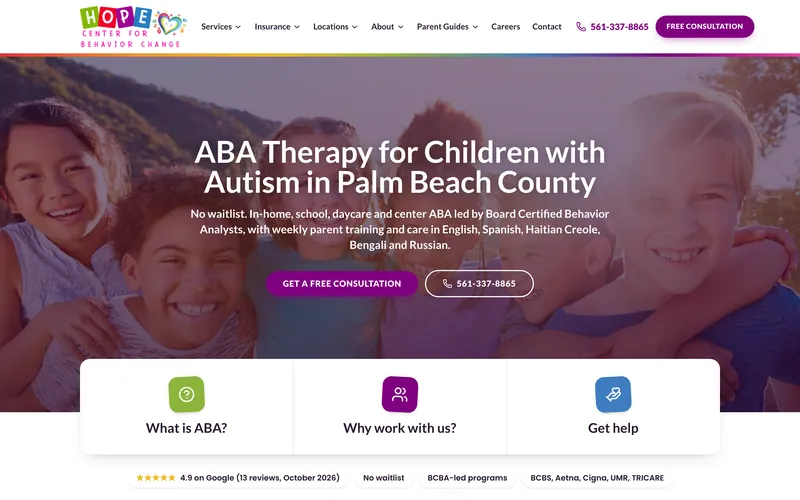
Here is what it offers, which insurance it takes and how starting works.
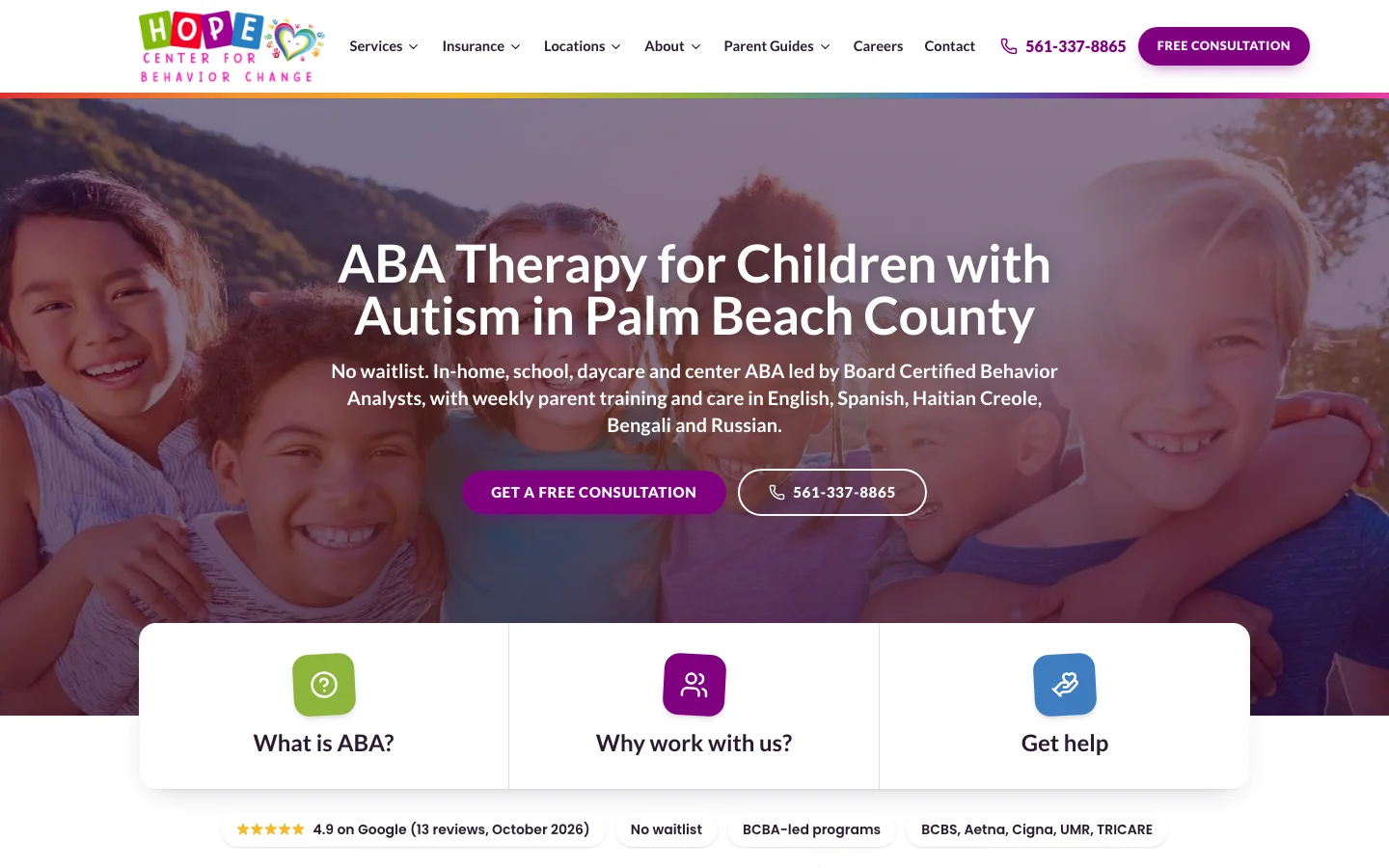
Hope Center for Behavior Change is an eSEOspace client: we work on its website and search marketing. This guide uses the center's own published information, checked on 19 October 2026, plus the federal NPI registry, and every source is listed at the end. We don't rate or score our clients. Insurance networks, hours and start times change, so confirm them on hopecenterforbehaviorchange.com or by phone before you decide. This guide is not medical advice; talk to your child's doctor or a licensed clinician about your child's needs.
The short answer
Hope Center for Behavior Change is a Florida applied behavior analysis (ABA) provider based at 750 S Military Trail, Suite D-E, West Palm Beach, with four more locations in Temple Terrace (Tampa), Port Charlotte, Jacksonville and Sebring. It serves children with autism, and offers ABA-based support for children with ADHD, ODD and intellectual disability, at home, at school, at daycare, in the community and at its centers. Plans are written by Board Certified Behavior Analysts (BCBAs) and delivered by Registered Behavior Technicians (RBTs), with weekly parent training. It accepts Blue Cross Blue Shield, Aetna, Cigna (Evernorth), UMR, Personify Health and TRICARE East, but not Medicaid. Prices are not published. Call 561-337-8865 or email office@hopecenteraba.com.
| Business | Hope Center for Behavior Change (legal name in the NPI registry: Hope Center for Behavior Change Inc) |
|---|---|
| What it does | ABA therapy for children with autism; ABA-based support for ADHD, ODD and intellectual disability; parent training; diagnostic evaluations; mental health therapy; speech therapy planned for January 2027 |
| Based in | 750 S Military Trail, Suite D-E, West Palm Beach, FL 33415 |
| Other locations | Temple Terrace (Tampa), Port Charlotte, Jacksonville, Sebring |
| Also serves | Broward County and Fort Lauderdale, St. Lucie County, Orlando, Lakeland, Winter Haven, Plant City, Apollo Beach (home, school and daycare services) |
| In business since | Not published on the site. Its organization NPI record was created on 14 June 2022. |
| Founder / clinical director | Aisha "AJ" Albright-Jourdan, MSW, LCSW, BCBA |
| Credentials | Founder's BCBA certification and Florida LCSW license SW22831 appear on the site and in her NPI registry record |
| Insurance | BCBS, Aetna, Cigna (Evernorth), UMR, Personify Health, TRICARE East (Humana Military); Optum "coming soon"; no Medicaid; self-pay with a sliding scale |
| Price range | Not published. Free benefits check before therapy starts. |
| Languages | English, Spanish, Haitian Creole, Bengali, Russian |
| Hours | West Palm Beach: Mon to Fri 8:30am to 6:30pm, Sat 9:30am to 1:30pm. Other locations: Mon to Fri 8:30am to 5:30pm |
| Phone / email | 561-337-8865 (all locations) · office@hopecenteraba.com |
| Website | hopecenterforbehaviorchange.com |
What is Hope Center for Behavior Change?
Hope Center for Behavior Change is a Florida ABA therapy agency. On its About page it calls itself "a fully integrated developmental behavior therapy agency" that focuses on "data-driven, evidence-based and holistic approaches to behavior change." In plain terms, it sends behavior therapy teams to children at home, at school and at daycare, and runs sessions at its own locations.
ABA (applied behavior analysis) is the main service. The center's own short definition is a "data-driven way of teaching children with autism the communication, social, daily-living and learning skills they need, and of reducing behaviors that get in their way." A BCBA designs the program, therapists practice the skills through play and routines, and progress is recorded so the plan can be adjusted.
The center says ABA "is not only for autism." Alongside autism spectrum disorder, it works with children who have ADHD, oppositional defiant disorder (ODD) and intellectual disability. It is open about the insurance catch: coverage for ABA usually depends on an autism (or Down syndrome) diagnosis, so it checks your plan first, and self-pay is available for every service.
The areas it lists for therapy include communication, coping skills, daily living activities, fine motor skills, reading and writing, social play, visual and perception skills, attention and focus, organization, and self-care and self-regulation.
Its main pitch to families comes down to a few points it repeats across the site:
- No waitlist. The center says starting "can take as little as three weeks from your first call."
- BCBA-led plans. BCBAs write and review every plan, the clinical director reviews each one before it goes to insurance, and RBTs are supervised weekly.
- Weekly parent training. Parents are coached every week on the same strategies the therapist uses.
- Showing up beyond sessions. Where allowed, staff join families at IEP meetings, doctor and dental visits and even haircuts.
- Five languages. Care in English, Spanish, Haitian Creole, Bengali and Russian.
Who owns and runs Hope Center for Behavior Change?
The site names Aisha "AJ" Albright-Jourdan, MSW, LCSW, BCBA as the founder and clinical director. The federal NPI registry lists her as the authorized official of Hope Center for Behavior Change Inc, with the title "Clinical Director / President."
According to the site, she is a Board Certified Behavior Analyst (certification 1-21-55428) and a Florida Licensed Clinical Social Worker (license SW22831), "trained in neurobiology and trauma," and a Certified Behavioral Health Case Manager. Her listed education is an MSW from Barry University, a Master of Arts in Exceptional Student Education (Applied Behavior Analysis) from the University of West Florida, and a Master of Science in Administration of Justice and Security. The site says she is completing a doctorate (EdD) in community care and counseling, expected in 2027.
Her background, as the site describes it, covers more than 15 years with families: work as a paraprofessional, as a teacher in an emotional and behavioral disabilities classroom, and as a family case manager, followed by private practice before she founded the center. The site credits her neurobiology and trauma training as the reason the center's ABA is "trauma-informed and assent-based."
The site does not publish a founding year. The organization's NPI record shows it was first enumerated on 14 June 2022. In a three-minute intro video on the home and About pages, AJ describes the center as having two locations, Palm Beach and Tampa; a caption notes it was recorded then and that the center now has five.
Is Hope Center for Behavior Change legit?
Parents often search this before handing over insurance details or letting a team into their home. Here is what can be checked:
- A federal provider record. The NPI registry lists Hope Center for Behavior Change Inc (NPI 1922738798) as an active organization at 750 S Military Trail, Suite D-E, West Palm Beach, with the same phone number the website uses, 561-337-8865. Its primary taxonomy is Behavior Analyst.
- A licensed, certified clinical director. Aisha Albright-Jourdan's individual NPI record (1275024747) is active and lists her Florida clinical social worker license, SW22831, and a Florida behavior analyst entry matching the BCBA number on the site. The site also links to the BACB certificant registry and the Florida Department of Health license search so you can verify credentials yourself.
- Named staff with credential numbers. The team page lists nine people, and several show BCBA, BCaBA, RBT or license numbers you can look up.
- Five published street addresses with hours for each.
- Published review figures. The site shows "4.9 on Google (13 reviews, October 2026)." That is the center's own display of its Google rating.
- Insurance networks named. The center lists the plans it accepts and says plainly that it does not take Medicaid.
- Background screening. Its careers page says all employment requires the Florida Care Provider Background Screening through the state Clearinghouse.
We did not check the BACB registry, the Florida Department of Health database or the Florida Division of Corporations for this guide (the corporations site blocked automated lookups). The site links to the first two, so you can run those checks in a minute or two.
Who is on the team?
The Our Team page names nine people. Titles, areas and credentials below are as the site shows them.
| Name | Role | Credentials shown | Area and languages (as listed) |
|---|---|---|---|
| Aisha Albright-Jourdan | Founder & Clinical Director | MSW, LCSW, BCBA; BCBA 1-21-55428; FL LCSW SW22831 | Palm Beach, Broward, Polk and Hillsborough counties |
| Towhid Nishat | Assistant Clinical Director | M.Ed., BCBA; BCBA 1-25-83032 | West Palm Beach and Tampa; Bengali, conversational Hindi |
| Lianet Ortega | Board Certified Behavior Analyst | M.Ed., BCBA | West Palm Beach, Treasure Coast, Orlando, Jacksonville; Spanish |
| Elijah Albright | Lead BCBA | MA, BCBA | Tampa, Polk County, Charlotte County |
| Maria Davydova | Board Certified Assistant Behavior Analyst | BCaBA 0-17-8294 | Palm Beach County; Russian |
| Orlando Calderin | Student Analyst | RBT-20-146474 | South Florida counties; Spanish |
| Ellen Meizel | Speech-Language Pathology Clinic Lead | MA, CCC-SLP; Florida license SA 1061 | South Florida (speech therapy opens January 2027) |
| Frances Maxwell-Baxter | Lead Mental Health Therapist & Parent Advocate | LMHC | Palm Beach County |
| Tahlia Joseph | Operations Manager & Intake Director | PhD candidate (Nova Southeastern University), former RBT | Practice-wide |
A few details from the bios: Towhid Nishat has a background in the Palm Beach County School District and lists IEP advocacy and potty training as specialties. Lianet Ortega focuses on mentoring therapists, adolescent programming and seizure management within ABA. Elijah Albright specializes in center-based therapy for school-aged children and guiding parents through the IEP process. Maria Davydova lists functional communication training for non-verbal learners and toilet training. Ellen Meizel lists more than 30 years as a speech-language pathologist and ASHA membership since 1987. Frances Maxwell-Baxter lists EMDR trauma certification and years as an ESE coordinator and guidance counselor. Tahlia Joseph runs intake, matching each child with a therapy team and an insurance pathway from the first call.
Day to day, your child will mostly see an RBT. The site says BCBAs write and review each plan and supervise RBTs every week, and that parents can call or text their RBT, their BCBA or the front desk.
Services, one by one
The center splits its ABA work into the services below. Each has its own page on the site.
| Service | What the center says it covers | Who it is for |
|---|---|---|
| In-home ABA therapy | Sessions in your home built around real routines: toilet training, getting dressed, family mealtimes, sharing with siblings, coping skills and household issues as they come up. Parents can watch and learn. | Families who want skills practiced where daily life happens |
| School-based ABA therapy | Support in the school day, arranged "one family and one school at a time." Collaboration with teachers, consistent goals with home, help lining ABA goals up with an IEP. | Children who need support with attention, social skills, communication, self-regulation or classroom routines |
| Parent and caregiver training | Weekly coaching from a BCBA in four steps: talk, show, practice, plan. Open to parents, grandparents and other regular caregivers. | Every family in an ABA program |
| Early intervention ABA | Gentle, play-based ABA for toddlers and young children: communication, play, daily routines and coping with big feelings. | Young children, often soon after a concern or diagnosis |
| ABA for ADHD and ODD | Attention, social and communication skills, organization (visual schedules, checklists), reading routines, self-care and self-regulation; planned responses to defiance for parents. | Children with ADHD or ODD (insurance often won't cover ABA for these alone) |
| ABA assessments | Caregiver interview, direct observation, skills assessment, functional behavior assessment (FBA) and a records review, then a written report and treatment plan. | Every child starting ABA |
| ABA in your home language | Therapy and parent training in English, Spanish, Haitian Creole, Bengali or Russian. | Families who speak a language other than English at home |
| Military families | TRICARE help, continuity planning for PCS moves, guidance during deployments. | Active-duty, Guard, Reserve and retired families |
| Community and daycare sessions | Practice in everyday places such as parks, stores and appointments, and at daycare. | Children who need skills outside the home |
In-home ABA. The center describes the home as "a safe place, full of the people who care about them most," and says therapists use it to see "what daily life really looks like." Parent training happens every week, and the BCBA goes over goals and the plan with you.
School-based ABA. The center does not claim district contracts. Its FAQ says school services are arranged with each family and school, that each school has its own rules about outside providers, and that changes to an IEP are made by the school team and family. Where the school allows, staff can join IEP meetings.
Early intervention. The page lists signs parents often notice (few words or gestures, not responding to their name, losing skills, strong reactions to change) and says none of these alone means a diagnosis. It points families with children under 3 to Florida Early Steps, a separate state program, alongside their doctor.
ABA for ADHD and ODD. The center is clear that it does not diagnose ADHD or ODD, that ABA does not involve medication, and that medication questions belong with the child's doctor.
ABA assessments. The center says an ABA assessment "plans treatment; it is not a diagnosis." It takes 2 to 4 hours, at the center or at home, in one or two sessions. Afterward you get a written report, a plain-language explanation, a treatment plan with goals you helped choose, recommendations on where and how often therapy could happen, and help with the insurance steps.
Diagnostic evaluations, mental health and speech therapy
Three services sit outside ABA:
- Diagnostic evaluations. The site says these are completed by the clinical director, Aisha Albright-Jourdan, LCSW, BCBA, "under the supervision of a licensed psychologist (PsyD)," and that part of the process is questionnaires parents complete online. The supervising psychologist is not named on the site. Many plans need an autism diagnosis before they cover ABA, so the center suggests asking whether an evaluation is the right first step.
- Mental health therapy. The site lists family therapy, individual therapy for children and support for parents. The team page describes Frances Maxwell-Baxter, LMHC, providing psychotherapy for children, teens and adults, and AJ providing counseling for individuals, couples and families. The site does not list which plans cover these services; ask.
- Speech therapy, from January 2027. In-house speech therapy is "now in credentialing" and planned for January 2027, coordinated with ABA so both work on the same communication goals. Ellen Meizel, CCC-SLP, will lead it. The center says it does not offer occupational therapy.
Self-pay is available for every service, with or without a diagnosis, according to the Services page.
How the center describes its approach
The Our Approach page sets out what the center means by "compassionate" ABA:
- Rapport first: therapists build trust through play ("pairing") before teaching skills.
- Assent-based: children show they are willing to take part, and "a 'no' is respected."
- Sensory-informed: children are not pushed into environments that overwhelm them.
- Trauma-informed: therapists consider a child's history and what upsets them.
- Strengths first: goals are chosen with the family and build on what a child already does well.
The center also says its BCBAs have "small caseloads on purpose," and that its case management reaches beyond therapy into school, appointments, extracurriculars and community activities. Those are the center's own descriptions; the site does not publish caseload numbers, so ask what a typical BCBA caseload is if that matters to you.
On the history of ABA, the "What is ABA?" page cites Baer, Wolf and Risley's 1968 paper that defined the field and Lovaas's 1987 study, and says modern programs have "moved well beyond those early methods" toward play-based, relationship-based, assent-respecting therapy.
Where is Hope Center for Behavior Change, and what areas does it serve?
The center lists five locations. Each offers center and home services, and one phone number, 561-337-8865, serves all of them.
| Location | Address | County | Hours |
|---|---|---|---|
| West Palm Beach | 750 S Military Trail, Suite D-E, West Palm Beach, FL 33415 | Palm Beach | Mon to Fri 8:30am to 6:30pm; Sat 9:30am to 1:30pm |
| Temple Terrace (Tampa) | 9385 N 56th St, Suite 211, Temple Terrace, FL 33617 | Hillsborough | Mon to Fri 8:30am to 5:30pm |
| Port Charlotte | 4055 N Tamiami Trail, Suite 24, Port Charlotte, FL 33952 | Charlotte | Mon to Fri 8:30am to 5:30pm |
| Jacksonville | 7751 Belfort Parkway, Suite 200, Jacksonville, FL 32256 | Duval | Mon to Fri 8:30am to 5:30pm |
| Sebring | 228 N Ridgewood Rd, Suite 102, Sebring, FL 33870 | Highlands | Mon to Fri 8:30am to 5:30pm |
The West Palm Beach office is on South Military Trail, between Southern Boulevard and Summit Boulevard, according to its location page. The Tampa page notes that the old Temple Terrace address on E Fletcher Ave is no longer used.
Areas served without a location. The center provides home, school and daycare services in Broward County and Fort Lauderdale, St. Lucie County, Orlando, Lakeland and Winter Haven, and Plant City and Apollo Beach. The Tampa team covers Plant City, Apollo Beach and Polk County. The center's line on other areas: "If your area is not listed, call us: as long as we can staff it, we will come to you."
Telehealth. The site does not describe telehealth ABA sessions. Ask if you need remote parent training.
Each location page also lists free public resources run by other organizations, such as the CARD autism centers at FAU and USF, Florida Early Steps, and the local school district's Exceptional Student Education department.
What insurance does Hope Center for Behavior Change take?
The site lists these plans:
- Blue Cross Blue Shield
- Aetna
- Cigna (Evernorth)
- UMR
- Personify Health
- TRICARE East (Humana Military)
- Optum: "coming soon"
Medicaid: "Hope Center does not currently accept Medicaid." The insurance page suggests families with Medicaid either use self-pay with the sliding scale or ask their Medicaid health plan for an in-network provider.
What plans usually need first, according to the center's insurance page:
- A written diagnosis from a qualified provider, such as a developmental pediatrician, child psychologist, psychiatrist or pediatric neurologist. "BCBAs do not diagnose."
- A prescription or referral for ABA from the child's doctor or diagnosing provider.
- A BCBA assessment and treatment plan, sent to the plan.
- Prior authorization: the plan approves a set amount of services for a set period, renewed with progress reports.
The insurance page also explains, in general terms, Florida's autism insurance law (sections 627.6686 and 641.31098 of the Florida Statutes) and how self-funded employer plans differ. Its suggested questions for your insurer include whether your plan is fully insured or self-funded, whether there are limits on hours or dollars, and whether it covers ABA at home, in the community and at school. Or, the center says, send your details and it will check your benefits for free.
How much does ABA at Hope Center cost?
Prices are not published. The site does not list an hourly rate, a self-pay rate or a sliding-scale table. What it does say:
- Talking to the center costs nothing, and the consultation is free.
- The benefits check is free. The center checks your insurance before therapy starts and explains what your plan covers, what it needs from you and what your costs may be.
- With insurance, your cost depends on your plan's deductible, copays and coinsurance.
- A sliding scale is offered to help with deductibles and copays.
- Self-pay is available for every service, with or without a diagnosis.
- For TRICARE, the center's TRICARE page says you pay your plan's usual copayment or cost-share, all ABA services on the same day count as one copayment, and active-duty family members in TRICARE Prime generally pay nothing for network care.
What affects the price: your plan type, how many hours of therapy the BCBA recommends and your plan approves, and whether you self-pay. To get a real number, call 561-337-8865 or send the form with your insurance, and ask for your expected share per month in writing. If you plan to self-pay, ask for the hourly rate for RBT sessions, BCBA supervision, parent training and the assessment, and how the sliding scale is decided.
TRICARE and military families
The center accepts TRICARE East (Humana Military) and has two pages for military families. Its TRICARE page summarizes the Autism Care Demonstration (ACD), the Defense Health Agency program that covers ABA, as the center read it on TRICARE's site in October 2026:
- The ACD began in 2014 and is authorized through 31 December 2028.
- There are no yearly or lifetime caps on ABA; hours come from the treatment plan and medical necessity.
- Your child needs an autism diagnosis from a TRICARE-approved provider, a referral to the regional contractor (Humana Military in Florida) and pre-authorization.
- Active-duty sponsors must enroll in their branch's Exceptional Family Member Program (EFMP), and the child must be enrolled in the Extended Care Health Option (ECHO).
- Before ABA begins, four baseline outcome measures are completed (PDDBI, Vineland-3, SRS-2 and a parenting stress index).
- Treatment is authorized in six-month periods, and a new referral is needed every two years.
- TRICARE expects parents to take part in parent training.
For moves, the military families page says the center prepares portable treatment plans and progress data, talks to the next provider with your permission, adds parent coaching through the transition, and explains what the new region's contractor will need. TRICARE rules change, so confirm details with TRICARE or Humana Military as well.
What happens step by step
The New Families page lays out the process:
- Call or send a request. Call 561-337-8865 or use the form. The operations manager or support team answers and asks about your child and your insurance. The form asks for your name, phone, email, insurance, area, whether your child has a diagnosis and how soon you want to start.
- Intake package. The center sends intake documents. It says returning them quickly "is the biggest thing that speeds up your start."
- Benefits check. Free. The center explains coverage and likely costs.
- Initial assessment. Once insurance approves it, a BCBA assesses your child at the center or at home: 2 to 4 hours, in one or two sessions, plus online questionnaires for you.
- Plan and authorization. Within about two weeks the BCBA finalizes the treatment plan, the clinical director reviews it, you sign it, and it goes to your insurance.
- Therapy begins. "Usually within 3–5 business days of approval." You can meet your child's team first. An RBT works with your child and weekly parent training starts.
How long does it take? The center says there is no waitlist and that from the first call it "can take as little as three weeks." It also says slow paperwork or insurance replies "can stretch this to a few months."
What to have ready: the diagnosis report if you have one, your insurance card (front and back), any prescription or referral for ABA, your child's IEP or 504 plan, recent speech or occupational therapy reports, and a short list of your main concerns and goals.
Care in other languages
The center says its team provides therapy and parent training in English, Spanish, Haitian Creole, Bengali and Russian, and that you can call to be matched with a team member who speaks your family's language. The team page shows Spanish (Lianet Ortega, Orlando Calderin), Bengali and conversational Hindi (Towhid Nishat) and Russian (Maria Davydova). Its reasoning is practical: parents who understand the strategies can take part fully and use them the same way every day. If you need Haitian Creole, ask who on the team would work with your family.
Safety, concerns and privacy
- When a child is upset. The center says staff use calming techniques, lower demands and present tasks "in a way that is fun, not forceful." If a behavior could hurt someone, staff use "the least intrusive, safest steps." The site states: "We do not use restraint." Any crisis is reported to the parent and supervising behavior analyst right away.
- Emergencies. Call 911, then tell your child's behavior analyst, who the FAQ says "will return your call within 24 hours." For a mental health crisis the contact page lists the 988 line.
- Raising a concern. Start with your child's BCBA; if it is not resolved, ask for the assistant clinical director, then the executive director.
- Privacy. Clinical information is handled under HIPAA and the center's Notice of Privacy Practices, which is in the intake package. The website privacy policy says form messages go by email and asks families not to send medical records through the site.
- Cancellation and refund policies are not published on the site. Ask about missed-session rules and how self-pay billing works before you start.
How it compares with other options
Families looking for ABA in Florida usually choose among a few kinds of provider. This table describes categories, not specific businesses.
| Option | What you typically get | Typical trade-off |
|---|---|---|
| Hope Center for Behavior Change | BCBA-written plans, RBT sessions at home, school, daycare, community or one of five locations; weekly parent training; five languages; TRICARE East and several commercial plans | No Medicaid; prices not published; speech therapy not until January 2027; no OT |
| A large multi-state ABA company | Many clinics, standardized programs, broad insurance contracts | Can have waitlists; less say in who your BCBA is |
| A solo BCBA in private practice | One clinician who knows your child well | Limited hours and staff; harder to cover schools and several settings |
| A multidisciplinary pediatric therapy clinic | ABA alongside speech and occupational therapy under one roof | Mostly clinic-based; ABA may be a smaller part of the practice |
| School-provided supports (IEP, 504, ESE services) | Free services written into your child's education plan | Limited to the school day and school goals |
| Free state programs (Early Steps, CARD centers) | Early intervention for under-3s; family training and consultation | Not a replacement for ongoing ABA therapy |
Who it suits, and who should look elsewhere
A good fit if you…
- Live near West Palm Beach, Tampa, Port Charlotte, Jacksonville or Sebring, or in one of the other listed areas
- Have BCBS, Aetna, Cigna, UMR, Personify Health or TRICARE East, or can self-pay
- Want therapy at home, at school or at daycare rather than only in a clinic
- Want weekly parent training and a team that joins IEP meetings and hard appointments where allowed
- Speak Spanish, Haitian Creole, Bengali or Russian at home
- Are a military family and want help with TRICARE steps and moves
Look elsewhere if you…
- Need a provider that takes Florida Medicaid
- Need occupational therapy, or speech therapy before January 2027
- Want published self-pay prices before your first call
- Live outside the listed areas and the center can't staff your location
- Need a medical diagnosis or medication management: talk to your child's doctor or a specialist
Questions to ask before you start
- Is my exact plan in network, and what will my share be per month at the recommended hours?
- If I self-pay, what are the hourly rates, and how is the sliding scale decided?
- Who will be my child's BCBA, how many clients do they carry, and how often will they see my child?
- Which RBT will work with my child, and what happens if they leave or are out sick?
- How many hours a week do you expect to recommend, and in which settings?
- Can you work in my child's school, and has that school allowed outside providers before?
- Who on the team speaks our home language?
- What is your policy on missed or cancelled sessions?
- For a diagnostic evaluation: who is the supervising psychologist, and will my insurer accept the result?
How to get started
- Read the getting started and insurance pages.
- Gather your insurance card, any diagnosis report, referral, IEP or 504 plan.
- Call 561-337-8865 (West Palm Beach line: Monday to Friday 8:30am to 6:30pm, Saturday 9:30am to 1:30pm) or send the form on the contact page.
- Ask for a free benefits check, then return the intake package quickly.
Visit Hope Center for Behavior Change
Terms you'll see on the site
- ABA: applied behavior analysis, a behavioral approach that looks at what happens before and after a behavior and teaches new skills.
- BCBA: Board Certified Behavior Analyst, a graduate-level clinician certified by the Behavior Analyst Certification Board (BACB) who assesses, writes and supervises the plan.
- BCaBA: Board Certified Assistant Behavior Analyst, an undergraduate-level certificant who works under a BCBA.
- RBT: Registered Behavior Technician, who works one-on-one with your child under BCBA supervision.
- FBA: functional behavior assessment, which looks at why a specific behavior happens.
- Assent-based: the child shows willingness to take part, and refusal is respected.
- Prior authorization: your plan's approval of services before they start.
- IEP / 504 plan: school plans that set out special education services or accommodations.
- ACD: TRICARE's Autism Care Demonstration, which covers ABA.
- EFMP / ECHO: the military Exceptional Family Member Program and TRICARE's Extended Care Health Option.
- PCS: permanent change of station, a military move.
Frequently asked questions
Where is Hope Center for Behavior Change located?
Its main office is at 750 S Military Trail, Suite D-E, West Palm Beach, FL 33415. It also has locations in Temple Terrace (Tampa), Port Charlotte, Jacksonville and Sebring.
Does Hope Center for Behavior Change take my insurance?
Hope Center for Behavior Change accepts Blue Cross Blue Shield, Aetna, Cigna (Evernorth), UMR, Personify Health and TRICARE East, with Optum listed as coming soon. It checks your benefits for free before therapy starts.
Does Hope Center for Behavior Change accept Medicaid?
No. The center says it does not currently accept Medicaid. Families with Medicaid can ask about self-pay with its sliding scale.
How much does ABA therapy at Hope Center cost?
Hope Center for Behavior Change does not publish prices. Your cost depends on your plan's deductible, copays and coinsurance; the center offers a free benefits check, a sliding scale for deductibles and copays, and self-pay for every service.
Is there a waitlist at Hope Center for Behavior Change?
The center says there is no waitlist. It says starting can take as little as three weeks from the first call, and services usually begin 3 to 5 business days after insurance approves the plan.
Who owns Hope Center for Behavior Change?
The site names Aisha "AJ" Albright-Jourdan, MSW, LCSW, BCBA, as founder and clinical director. The NPI registry lists her as the organization's Clinical Director / President.
Does my child need an autism diagnosis to start ABA at Hope Center?
Insurance-funded ABA usually needs an autism or Down syndrome diagnosis. Hope Center offers diagnostic evaluations, and self-pay is available with or without a diagnosis.
Can Hope Center for Behavior Change diagnose autism?
Its ABA assessments do not diagnose. The center offers separate diagnostic evaluations completed by its clinical director under the supervision of a licensed psychologist (PsyD).
Does Hope Center provide in-home ABA therapy?
Yes. Hope Center for Behavior Change provides ABA at home, at school, at daycare, in the community and at its five locations.
Does Hope Center for Behavior Change work with children with ADHD or ODD?
Yes, it offers ABA-based support for ADHD, ODD and intellectual disability. It notes that insurance often covers ABA only with an autism diagnosis, so it checks your plan first.
What languages does Hope Center for Behavior Change offer?
English, Spanish, Haitian Creole, Bengali and Russian, for therapy and parent training.
Does Hope Center accept TRICARE?
Yes, TRICARE East through Humana Military. The center helps with referrals, authorizations and planning around PCS moves.
Does Hope Center for Behavior Change offer speech or occupational therapy?
In-house speech therapy is planned for January 2027 and is in credentialing. The center does not offer occupational therapy.
Does Hope Center for Behavior Change use restraint?
The center states that it does not use restraint. It describes its ABA as assent-based and trauma-informed.
What are Hope Center for Behavior Change's hours?
West Palm Beach is open Monday to Friday 8:30am to 6:30pm and Saturday 9:30am to 1:30pm. Temple Terrace, Port Charlotte, Jacksonville and Sebring are open Monday to Friday 8:30am to 5:30pm.
How do I contact Hope Center for Behavior Change?
Call 561-337-8865 for any location, email office@hopecenteraba.com, or use the form on its website.
Sources
All pages checked on 19 October 2026.
- Home page: hopecenterforbehaviorchange.com
- About us: hopecenterforbehaviorchange.com/about/
- Our team: hopecenterforbehaviorchange.com/our-team/
- Services: hopecenterforbehaviorchange.com/services/
- What is ABA?: hopecenterforbehaviorchange.com/applied-behavior-analysis/
- Service pages: In-home ABA, School-based ABA, Parent training, Early intervention, ADHD and ODD, ABA assessments, ABA in your language, Speech therapy
- Our approach: hopecenterforbehaviorchange.com/our-approach/
- Insurance: hopecenterforbehaviorchange.com/insurance/
- TRICARE for ABA: TRICARE page; Military families: military families page
- Getting started: hopecenterforbehaviorchange.com/new-families/
- Locations: Where we provide ABA, West Palm Beach, Tampa / Temple Terrace, Port Charlotte, Jacksonville, Sebring
- Contact: hopecenterforbehaviorchange.com/contact/
- FAQ: hopecenterforbehaviorchange.com/faq/
- Careers: hopecenterforbehaviorchange.com/careers/
- Privacy policy: hopecenterforbehaviorchange.com/privacy-policy/
- NPI registry, Hope Center for Behavior Change Inc (NPI 1922738798): npiregistry.cms.hhs.gov
- NPI registry, Aisha Albright-Jourdan (NPI 1275024747): npiregistry.cms.hhs.gov



