
Here is what it covers.
How to Avoid Foreclosure is run by eSEOspace, so it is not an outside eSEOspace client: we built the website and we maintain it. This guide uses the site's own published information, checked on 22 October 2026, and every source is listed at the end. We don't rate or score our clients or our own sites. This guide is not legal or financial advice: for your own situation, talk to a HUD-approved housing counselor or a lawyer licensed in your state. Laws and deadlines change, so confirm details on howtoavoidforclosure.com and on your own notices.
The short answer
How to Avoid Foreclosure (howtoavoidforclosure.com) is a free online resource center for U.S. homeowners who are behind on their mortgage or expect to be. It explains foreclosure rules state by state for all 50 states and Washington, D.C., describes ten ways people avoid or leave a foreclosure, decodes 37 kinds of foreclosure letters and court papers, and offers four free tools (a deadline calculator, a letter finder, a hardship letter and servicer letter templates). It also lists foreclosure lawyers in 52 metro areas. It charges nothing. You reach it through an online "Ask for help" form, and the site says a person reads and answers every message. It is not a lender, a law firm, a government agency or a HUD-approved counseling agency.
| Business | How to Avoid Foreclosure (HowToAvoidForclosure.com) |
|---|---|
| What it does | Free, plain-English information on foreclosure law, options and free help, by state; a question form answered by a person |
| Service area | Online; covers all 50 states and Washington, D.C. No street address is published. |
| In business since | Not published. Its About, Privacy and Disclaimer pages were last updated 11 October 2026. |
| Who runs it | eSEOspace. The site describes itself as "a private, independent website" and does not name individual staff. |
| Licenses or credentials | None claimed. The site says it is not a law firm, a lender or servicer, a government agency, or a HUD-approved housing counseling agency. |
| Price | Free. The site says it never charges homeowners a fee. |
| Hours | Not published. The form can be sent at any time; the site says messages about a scheduled sale are answered first. |
| Phone / email | No phone line or email address of its own is published; contact is through the online form. The phone number shown on every page, (800) 569-4287, is HUD's housing counselor line, not the site's. |
| Website | howtoavoidforclosure.com |
What is How to Avoid Foreclosure?
How to Avoid Foreclosure calls itself "an independent resource center for homeowners who are behind on the mortgage or worried they soon will be." Its starting point is that foreclosure is run by state law, so the answer to "how long do I have?" differs from state to state. The About page puts its aim this way: most of what a homeowner finds online "is either written for lawyers or written to sell something," and the site tries to put each state's rules "in plain English, with the statute behind every claim, next to the free official help that already exists."
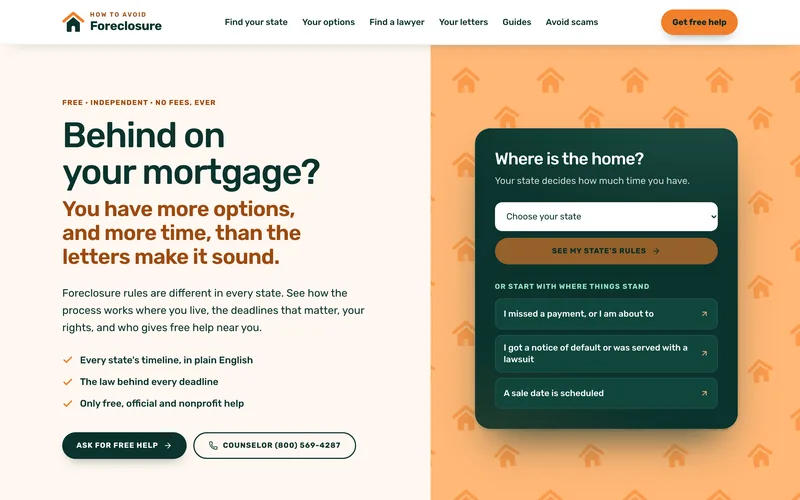
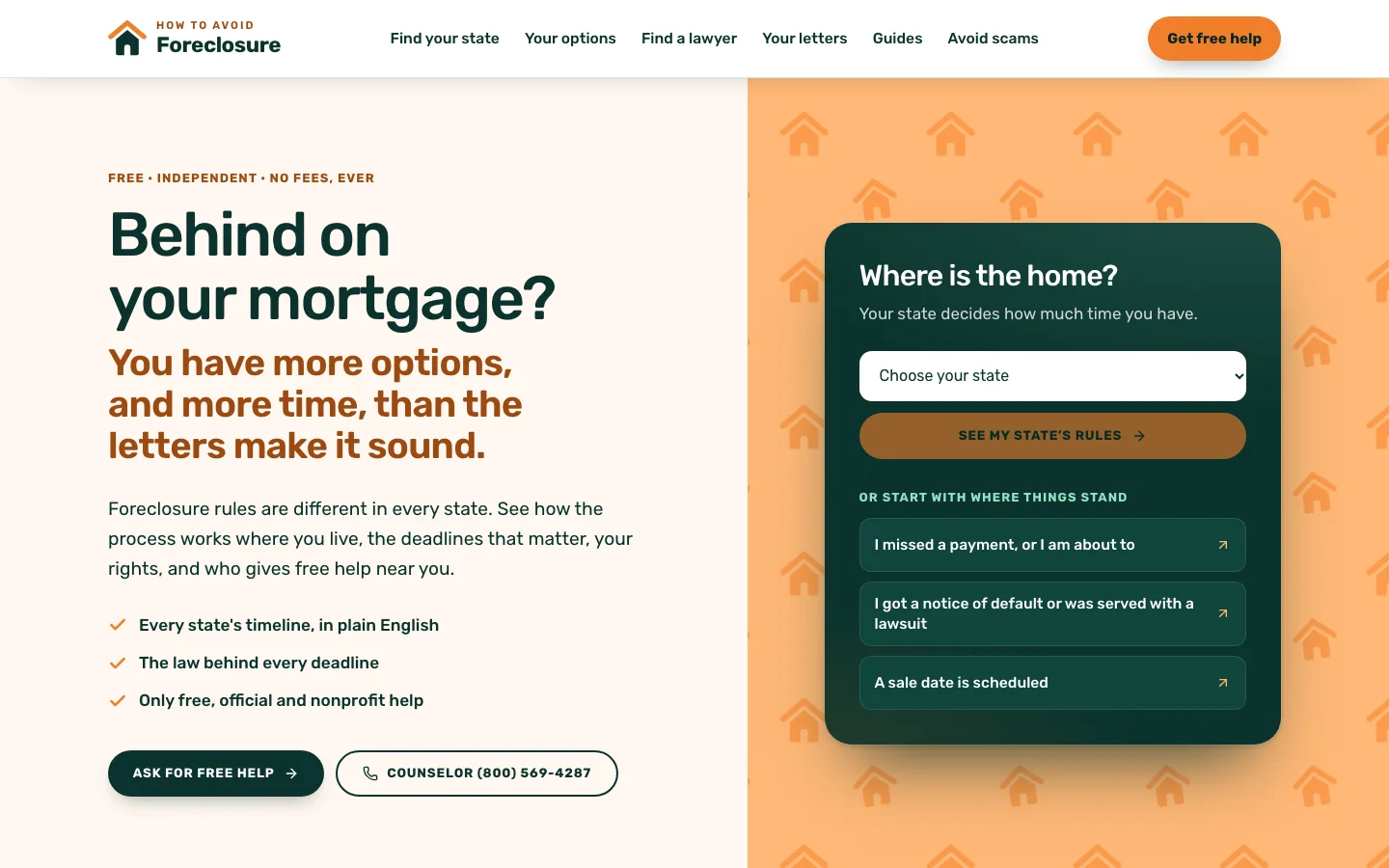
The home page sorts readers by where they are in the process, with three starting points:
- "I missed a payment, or I am about to." The site's advice at this stage is to call the servicer, ask for a loss mitigation application, and talk to a free HUD-approved counselor.
- "I got a notice of default or was served with a lawsuit." This points to the state timeline, the right to catch up, and any deadline to answer a court.
- "A sale date is scheduled." This points to what may still stop or postpone a sale and stresses calling a HUD-approved counselor or legal aid that day.
When we checked, the site's sitemap listed 1,100 pages. They fall into a few groups: state pages, options, notices (letters and court papers), national guides, tools, a glossary, and a lawyer directory. Each is described below.
The web address is spelled howtoavoidforclosure.com, without an "e" after "for." The site's own footer writes the name as HowToAvoidForclosure.com, while the copyright line uses "How to Avoid Foreclosure."
Who runs it?
eSEOspace, the web and search marketing agency that publishes this guide, runs the site. That is why we say at the top that it is not an outside client. The site itself does not name an owner or individual staff. It describes itself as "a private, independent website" and says it is not affiliated with HUD, the Consumer Financial Protection Bureau (CFPB), any state, any court, or any lender or servicer.
The site is just as clear about what it is not. Its About and Disclaimer pages say it is:
- Not a government agency.
- Not your lender or mortgage servicer, and not affiliated with one.
- Not a law firm. "Nothing here is legal advice, and writing to us does not make us your lawyer."
- Not a HUD-approved housing counseling agency. It sends people to those agencies "because their help is free and regulated."
Is How to Avoid Foreclosure legit?
People are right to ask this about any foreclosure website, because foreclosure attracts scams. Since we run this one, we won't give a verdict. Here is what you can check yourself on the site:
- It does not ask for money. The site says it does not charge homeowners anything, "upfront or otherwise."
- It does not ask for sensitive details. Its form asks for a first name, an email or phone, your state and a few multiple-choice answers. The site says it will never ask for your loan number, Social Security number, bank login or deed, and the letter tools leave a blank for the loan number so you write it in by hand after printing.
- It does not promise results. The About page lists among the things it will never do: "Promise that a foreclosure will be stopped. No honest person can promise that." The Disclaimer adds that it does not negotiate with your lender.
- It does not tell you to stop paying or stop talking to your servicer. The Disclaimer says to keep making payments and keep talking to your servicer unless a lawyer or HUD-approved counselor advises otherwise.
- It shows its sources and dates. State pages carry a "Reviewed against [state] law and official sources" date and cite statutes next to each step. National pages list the federal rules they rely on, such as sections of Regulation X (12 C.F.R. Part 1024).
- It sends you to free official help. Every page lists HUD's counselor line, the CFPB, and the Legal Services Corporation's legal aid finder.
The site has no published reviews, ratings or testimonials, and we don't add any.
Does it cost anything, and how is it paid for?
It is free. The home page says "Free · Independent · No fees, ever," and the form repeats that there is nothing to buy. There are no paid tiers, memberships or "premium" reports.
Advertising. The About page says some California pages carry advertisements for one private company that buys homes in Northern California. Each ad is labeled "Advertisement" and sits apart from the page's information. The site says it does not own any part of that company, that the company does not pay to appear, and that advertisers do not write, review or change what the site says about the law, your rights or your options. Next to the ads, the site notes that a cash sale "usually pays less than a sale on the open market" and is "one choice among several," and it tells readers to have a lawyer or HUD-approved counselor read anything that transfers a deed.
The lawyer directory is not paid. The site says "no one can pay to be listed in the lawyer directory" and that nobody is ranked.
Your information is not sold. The privacy policy says the site does not sell what you send or pass it to lenders, investors, real estate agents, attorneys or marketers (more below).
What the state pages cover
The core of the site is a page for every state and Washington, D.C. Each opens with an "at a glance" box: the type of foreclosure (judicial, nonjudicial or both), whether you can catch up to stop the sale, whether you can buy the home back after the sale, whether you can owe money after the sale, and whether there is a foreclosure mediation program. By the site's labels, 27 states mainly use nonjudicial foreclosure, 23 jurisdictions (including D.C.) use judicial foreclosure, and South Dakota is marked "Both."
A main state page then walks through the process step by step with the statute for each step, a table of deadlines, "your rights" questions, state assistance programs (including whether each is open or closed), and a "Who to call" list of the state housing agency, legal aid groups, the court self-help center, the attorney general, the regulator that takes complaints, and the state bar's lawyer referral service.
Under each state page sit more detailed pages. These were listed for every state when we checked:
| Page | What it covers |
|---|---|
| How foreclosure works | The process in that state, stage by stage |
| How long foreclosure takes | The legal minimum timeline |
| How to stop foreclosure | Ways to stop or delay a sale under state and federal rules |
| A sale date is set | What can still be done once a sale is scheduled |
| Foreclosure help | Who to call first, by situation, plus official and nonprofit help |
| After the foreclosure sale | Redemption, moving out, and what happens next |
| Foreclosure surplus funds | Leftover sale money and how it is claimed |
| Deficiency judgment | Whether you can owe money after the sale |
| Property tax foreclosure | Losing a home over unpaid property taxes |
| HOA foreclosure | Liens and foreclosure by a homeowners or condo association |
| Renters after foreclosure | Rights of tenants living in a foreclosed home |
| Letters | The state's own names for foreclosure notices, with an explainer for each (283 letter pages across all states) |
Nineteen states also have a foreclosure mediation page.
An example. The California page explains that most California foreclosures happen without a court case, through a trustee. It sets out the steps (servicer contact, the recorded notice of default, the notice of sale, the trustee auction, the bidding window after the auction for 1 to 4 unit homes, and eviction) with the California Civil Code sections for each. It also says the state's Homeowner Assistance Fund program, the California Mortgage Relief Program, is closed to new applications. The Texas page follows the same pattern for a nonjudicial state with its own rules on cure periods and court orders for some loans.
Every state page ends with the same caution: these are the periods written into the law, your own dates are on the notices you received, and "if a notice and this page disagree, trust the notice and ask a counselor or lawyer."
The ways to avoid foreclosure it explains
The Options section has one page for each of ten choices. Each page covers how the option works, who it fits and what it costs you, and says which options you can get "depends on your loan and how early you ask." In the site's own short descriptions:
| Option | The site's summary |
|---|---|
| Repayment plan | Keep paying the normal payment plus an extra amount each month until the missed payments are paid back. |
| Forbearance | Reduced or no payments for a limited time; the missed amount is still owed when the pause ends. |
| Payment deferral or partial claim | Missed payments set aside as a balance with no interest and no monthly payment, due when you sell, refinance or pay off the mortgage. |
| Loan modification | The servicer permanently changes the loan, usually adding missed payments to the balance and stretching the term or lowering the rate. |
| Reinstatement | Pay all missed payments, late fees and foreclosure costs in one payment; the loan goes back to normal. |
| Short sale | Sell for less than the balance with the lender's agreement. |
| Deed in lieu of foreclosure | Sign the home over to the lender; usually considered after a short sale has not worked or is not practical. |
| Chapter 13 bankruptcy | Filing puts an automatic stay on the foreclosure; a plan repays missed payments over three to five years. |
| Sell the home yourself | If the home is worth more than you owe, sell, pay off the mortgage and keep the rest. |
| Refinance or borrow | Replace the loan; the site says that once you are behind, the main loan programs are mostly closed to you and the lenders that remain cost more. |
The option pages go into specifics. The loan modification page covers what each loan program offers, the trial payment plan, what to do if you are denied, and what it calls "the 37-day line" for applying. The Chapter 13 page lists the federal courts' published $235 filing fee plus $75 administrative fee, the requirement to complete credit counseling within 180 days before filing, and says this is "the one option on this site where you should have a lawyer."
The site describes options; it does not tell you which one to choose or predict whether a servicer will approve one. Only your servicer can approve a change to your loan.
The letters and court papers it explains
The "What this letter means" section has 37 explainers, grouped by stage. Each one says what the document is, what it does and does not mean, the deadline it may start, what to do that week, and what it is called in different states.
- When you first fall behind: late notice and early intervention letter, adjustable-rate payment change notice, escrow shortage notice, force-placed insurance notice, servicing transfer notice.
- While you apply for help: loss mitigation letters, forbearance letters, loan modification agreement, short sale approval letter, payoff statement and reinstatement quote, notice of error and request for information, successor in interest letters.
- Before a foreclosure starts: breach letter, notice of intent to foreclose, notice of default, substitution of trustee or assignment of mortgage, foreclosure mediation notice.
- Court papers: summons and complaint, lis pendens, motion for default or summary judgment, judgment of foreclosure and sale, motion for relief from the automatic stay.
- The sale: notice of trustee's sale, notice of sheriff's sale, certificate of sale, trustee's or sheriff's deed.
- After the sale: notice to vacate, writ of possession, cash for keys offer, surplus funds notice, deficiency letter or lawsuit, tenant notice, Forms 1099-A and 1099-C.
- Property taxes, HOAs and reverse mortgages: property tax sale notice, HOA or condo lien notice, reverse mortgage (HECM) due and payable letter.
- Scams and solicitations: "Is this foreclosure letter a scam?"
The free tools
The site has four tools. Each says that nothing you type leaves the page, and each carries a "General information, not legal advice" line.
- Foreclosure deadline calculator. You enter the due date of your oldest missed payment, a sale date if one is set, and your state. It shows federal dates (when the servicer must contact you, the earliest a foreclosure can usually start, and the application cutoffs before a sale) and adds that state's deadlines from its page on the site. The page says federal dates are minimums and state dates are "estimates to check against your own notices," and that deadlines running from a notice or court filing are listed without a date because only your own papers show when that clock started.
- Which letter did I get? You choose who sent the paper (your mortgage company, a court or law firm, a trustee, a new owner, a tax office, an HOA, or an unknown company) and type a few words from the top. It points you to the explainer page. It also lists three things to check on any foreclosure paper: the date, who it is from, and any date in the future.
- Hardship letter template. You answer questions about what happened, when it started, where it stands now and what you are asking for, and it builds a one-page letter to your servicer to copy, download or print.
- Letters to your mortgage servicer. Six templates: notice of error, request for information, payoff statement request, reinstatement quote request, appeal of a loan modification denial, and a successor in interest documents request. The page notes that none of these letters stops a foreclosure by itself.
The national guides
Twenty-one guides cover rules that apply in every state, each with a "Reviewed" date and a source list. They include:
- Getting started: what to do first (six steps in order), a missed mortgage payment, what foreclosure is, judicial vs nonjudicial foreclosure, and what to do when a sale date is set.
- Your rights: your federal rights under Regulation X, how to complain about your servicer, and what a HUD housing counselor does.
- By loan type: help by loan type, plus separate guides for FHA, VA, USDA, Fannie Mae and Freddie Mac loans, reverse mortgages, and second mortgages and HELOCs.
- Special situations: an inherited home with a mortgage, and military protection from foreclosure.
- Afterwards: taxes after foreclosure, foreclosure and your credit, and buying a home after foreclosure.
- Scams: how to spot a foreclosure rescue scam.
The "what to do first" guide gives a sense of the approach. Its six steps are: open every letter and write down every date; call your servicer and ask to be reviewed for loss mitigation; talk to a free HUD-approved housing counselor; send a complete application as early as you can; find out who backs your loan and how much time your state gives you; and ignore anyone who asks for money up front.
The foreclosure lawyer directory
The "Find a lawyer" section lists lawyers who represent homeowners in foreclosure, by metro area. When we checked it covered 52 metro areas in 36 states, with 732 listings in total (from 7 in Wilmington, Delaware to 20 in several larger cities).
The site publishes its criteria for being listed:
- An active license with no public discipline on the state bar record.
- The lawyer's own website offers foreclosure help to homeowners.
- An office in the area. Firms that work for lenders, servicers or trustees are left out.
- Listed alphabetically. Nobody pays, and nobody is ranked.
Each listing shows the firm, the kinds of help offered (such as foreclosure defense, loan modification help, Chapter 13, or short sale), the office address, any other languages spoken, the state bar record number and year admitted where available, a phone number and a website link. The Los Angeles page, for example, says each lawyer's license "was checked on the State Bar of California site" and gives the date it was checked.
Each metro page starts with free legal help in that state before the list, and the directory hub says that if your income is limited, legal aid may take your case for free. A listing is not a recommendation; check the license yourself and ask for a written fee agreement.
How the "Ask for help" form works
The site's main way to reach a person is its question form, on the Get help page and at the bottom of most pages. It asks for:
- Your first name, your email, and a phone number (optional if you gave an email).
- The state where the home is.
- Where things stand, from "I have not missed a payment yet, but I am about to" through "The home was already sold at foreclosure."
- The type of mortgage: FHA, VA, USDA, conventional (Fannie Mae, Freddie Mac or a bank), reverse mortgage, or "not sure."
- What you want most: keep the home, sell or leave on your own terms, or "I do not know yet."
- An optional message. The form asks you not to include a loan number, Social Security number or bank details.
According to the Get help page, what happens next is: they read it, with messages about a scheduled sale answered first; they write back with plain information (your state's timeline, the options to ask your servicer about, and who can help for free), by email or by phone if you leave a number; and you decide. A reply time is not published.
The site is direct about urgent cases: if a sale is less than two weeks away, "do not wait for an email." It tells readers to call a free HUD-approved housing counselor at (800) 569-4287 and their state's legal aid office.
A reply from the site is general information. It is not legal advice, the site does not negotiate with your servicer, and writing to it does not create a lawyer-client relationship.
What happens to the information you send
The privacy policy (last updated 11 October 2026) says:
- What is collected: what you type into the form, the page you sent it from, and, if analytics is switched on, basic visit statistics through Google Analytics that are not tied to your message.
- How it is used: only to answer your question and point you to resources for your state and situation.
- Who sees it: the people who answer inquiries, the website's maintainer (who receives a copy of each inquiry to check the form is working), and the web host and email delivery service.
- Not shared: it is not sold or passed to lenders, investors, real estate agents, attorneys, marketers or anyone else. If an introduction to a specific organization might help, the site says it will ask you first.
- How long it is kept: inquiries arrive as ordinary email and are kept only as long as needed to answer and follow up.
- Cookies: no advertising cookies, ad pixels or session recording; Google Analytics, if on, sets its own cookies.
- Your choices: you can ask what is held about you, ask for a correction, or ask for deletion, through the same form.
How the information is researched and dated
The About page says state pages are built "from primary and official sources: the state's own statutes, court self-help centers, attorneys general, housing finance agencies and legal aid organizations, plus the federal mortgage servicing rules." Each page lists its sources and the date it was last reviewed, and "where a rule could not be confirmed from an official source, the page says less rather than guessing." When we checked, state pages showed review dates of 11 October 2026, and national guides and tools showed dates between 11 and 13 October 2026.
The Disclaimer is frank about the limits: statutes are amended, court rules change, and assistance programs open and close without notice. "The notices you received from your servicer, a trustee or a court control your actual deadlines." The site invites readers to report anything out of date.
The site does not say that its pages have been reviewed by a lawyer, and we don't claim that either.
What it says about foreclosure rescue scams
Scam warnings run through the whole site. A box on most pages says: "Never pay an upfront fee to stop a foreclosure," and explains that under federal law a company cannot collect a fee for mortgage relief until you have a written offer from your lender that you accept. The home page sets scam tactics beside legitimate help: a scam asks for a fee before anything is done, asks you to sign over your deed, says to stop talking to your servicer, or says to send your payments to them.
The rescue scam guide explains Regulation O (12 C.F.R. Part 1015), lists warning signs (including payment by wire or payment app, promises of results, and offers to "recover" surplus funds for a percentage), explains that licensed lawyers are treated differently under the rule, and lists where to report a scam: the FTC, the CFPB, and your state attorney general. Many state pages add the state's own foreclosure consultant law.
How it compares with other places to get help
How to Avoid Foreclosure is an information site. It works alongside the people who can actually act for you, not instead of them. Here is how it fits with other common sources of help:
| Option | What you get | Typical trade-off |
|---|---|---|
| How to Avoid Foreclosure | Free state-by-state rules with sources, letter explainers, tools, a lawyer list, and a person who answers questions by email or phone | General information only; cannot apply for you, negotiate, or represent you |
| A HUD-approved housing counselor | Free help with your budget and application, and calls to your servicer with you | Not a lawyer and cannot represent you in court; availability varies by area |
| Legal aid | Free legal representation if your income qualifies | Income limits and waiting lists can apply |
| A private foreclosure lawyer | Advice on your case, answering a lawsuit, bankruptcy filings | Costs money; fees vary |
| Government websites (federal regulators, state agencies, courts) | The official rules, complaint forms and program pages | Spread across many sites; often not organized by your situation |
| Your mortgage servicer | The only party that can approve a repayment plan, modification or other option | Works for the loan owner, not for you |
| A paid "foreclosure relief" company | Offers to deal with your lender for a fee | Federal rules ban most upfront fees; the site warns this is where many scams sit |
Who it suits, and who should look elsewhere
A good fit if you…
- Are behind on a mortgage, or expect to be, and want to understand your state's timeline
- Got a letter or court paper and want to know what it means and what clock it starts
- Want to know which options to ask your servicer about before you call
- Need a hardship letter or a written request to your servicer
- Want to find free help (housing counselors, legal aid) or a homeowner-side lawyer in your area
- Have a question and would like a person to point you in the right direction, for free
Look elsewhere if you…
- Need someone to represent you in court or file a bankruptcy: talk to legal aid or a lawyer
- Need someone to fill in and submit your application with you: call a HUD-approved counselor
- Have a sale in the next two weeks: call a counselor and legal aid today rather than waiting for an email
- Need advice on taxes after a foreclosure: see a tax professional
- Want a loan or someone to buy your home: the site does neither
Questions to ask before you act on anything
The site's own pages suggest questions worth asking, whatever source you use:
- What date is on my notice, and does it match what the state page or calculator shows? (If they differ, the site says to trust the notice.)
- Who owns or insures my loan (FHA, VA, USDA, Fannie Mae, Freddie Mac, or a bank)? That decides which options exist.
- Has my servicer confirmed in writing that my application is complete, and when did it receive it?
- How many days are left before any scheduled sale?
- Is anyone asking me for money up front, my deed, or my mortgage payment?
- If I was served with a lawsuit, what is my deadline to answer the court?
- For a lawyer from any list: is the license active, and will I get a written fee agreement?
How to get started
- Open the state list and choose the state where the home is.
- If you are holding a letter, use Which letter did I get? to find its explainer.
- Put your dates into the deadline calculator, then check them against your own notices.
- Read what to do first and compare the options.
- Send a question through the Ask for help form, or call HUD's counselor line at (800) 569-4287 if a sale is close.
Visit How to Avoid Foreclosure
Terms you'll see on the site
The site has its own glossary of 81 foreclosure terms. A few that come up most:
- Mortgage servicer: the company you send your payments to. It handles the loan day to day, your application for help, and usually the foreclosure.
- Loss mitigation: the servicer's term for every way of avoiding a foreclosure, from a repayment plan to a short sale.
- 120-day rule: the federal rule that, in most cases, a servicer may not make the first notice or filing for a foreclosure until you are more than 120 days behind.
- Judicial and nonjudicial foreclosure: judicial means the lender has to file a lawsuit; nonjudicial means a trustee can sell the home without going to court.
- Reinstatement: paying everything you are behind on, plus fees and costs, to bring the loan current.
- Redemption: buying your home back by paying what is owed. Some states allow it for a period after the sale, and some only before.
- Deficiency: what you could still owe if the sale does not cover the loan.
- Surplus funds: money left over after a foreclosure sale pays the debts and costs.
- Dual tracking: pursuing foreclosure while an application for help is under review, which federal rules limit.
- Successor in interest: someone who receives the home, for example through inheritance or divorce, and can be treated as a borrower once the servicer confirms them.
Frequently asked questions
What is howtoavoidforclosure.com?
How to Avoid Foreclosure is a free online resource center for U.S. homeowners behind on their mortgage. It explains foreclosure rules for all 50 states and D.C., the options for avoiding foreclosure, foreclosure letters and court papers, and where to get free help.
Is How to Avoid Foreclosure free?
Yes. The site says it never charges homeowners a fee, upfront or otherwise, and there is nothing to buy.
Who runs How to Avoid Foreclosure?
It is run by eSEOspace, a web and search marketing agency. The site describes itself as a private, independent website and says it is not affiliated with any government agency, court, lender or servicer.
Is How to Avoid Foreclosure a government site or part of HUD?
No. The site says it is not a government agency, not affiliated with HUD or the CFPB, and not a HUD-approved housing counseling agency. The (800) 569-4287 number it shows is HUD's own counselor line.
Can How to Avoid Foreclosure stop my foreclosure?
No. The site says it does not negotiate with lenders and cannot promise that any foreclosure will be stopped, postponed or modified. It explains the rules and options and points you to free counselors, legal aid and lawyers.
Is How to Avoid Foreclosure a law firm? Can it give legal advice?
No. The site says it is not a law firm, its information is not legal, tax or financial advice, and writing to it does not create a lawyer-client relationship.
How do I contact How to Avoid Foreclosure?
Use the "Ask for help" form on the site. It does not publish its own phone number or email address. The site says a person reads every message and replies by email, or by phone if you leave a number.
How fast does How to Avoid Foreclosure reply?
A reply time is not published. The site says messages about a scheduled sale are answered first, and that if a sale is less than two weeks away you should call a HUD-approved counselor and legal aid instead of waiting for an email.
What information does the How to Avoid Foreclosure form ask for?
Your first name, email or phone, state, where things stand, your loan type and what you want most, plus an optional message. It asks you not to send a loan number, Social Security number, bank details or documents.
Does How to Avoid Foreclosure sell my information?
Its privacy policy says it does not sell your information or pass it to lenders, investors, real estate agents, attorneys or marketers, and that it will ask you first before any introduction.
Does How to Avoid Foreclosure cover my state?
Yes, if you are in the U.S. It has a page for every state and Washington, D.C., with deadlines, rights, state programs and who to call, plus pages on surplus funds, deficiency judgments, property tax and HOA foreclosure, renters, and state letter names.
Do lawyers pay to be listed on How to Avoid Foreclosure?
No. The site says nobody pays to be listed and nobody is ranked. Lawyers are listed alphabetically if they have an active license with no public discipline on the state bar record, offer foreclosure help to homeowners, and have a local office.
Does How to Avoid Foreclosure have ads?
Some California pages carry labeled ads for a private company that buys homes in Northern California. The site says the company does not pay to appear and that advertisers do not write or change its information.
What tools does How to Avoid Foreclosure have?
A foreclosure deadline calculator, a "Which letter did I get?" finder, a hardship letter template, and six letter templates for writing to your servicer. The site says nothing you type into them leaves the page.
Sources
All pages checked on 22 October 2026.
- Home page
- About this site
- Disclaimer and terms of use
- Privacy policy
- Ask for help
- Sitemap
- Foreclosure laws and free help in every state
- How to avoid foreclosure in California
- How to stop a foreclosure in California
- Free foreclosure help in California
- How to avoid foreclosure in Texas
- Your options
- Loan modification
- Forbearance
- Chapter 13 bankruptcy
- What this letter means
- You got a notice of default
- Homeowner guides
- Behind on your mortgage: what to do first
- How to spot a foreclosure rescue scam
- What a HUD-approved housing counselor does
- Your federal rights
- Help by loan type
- What foreclosure is
- Foreclosure deadline calculator
- Which letter did I get?
- Mortgage hardship letter template
- Letters to your mortgage servicer
- Glossary
- Foreclosure lawyers who represent homeowners
- Foreclosure lawyers in Los Angeles



