
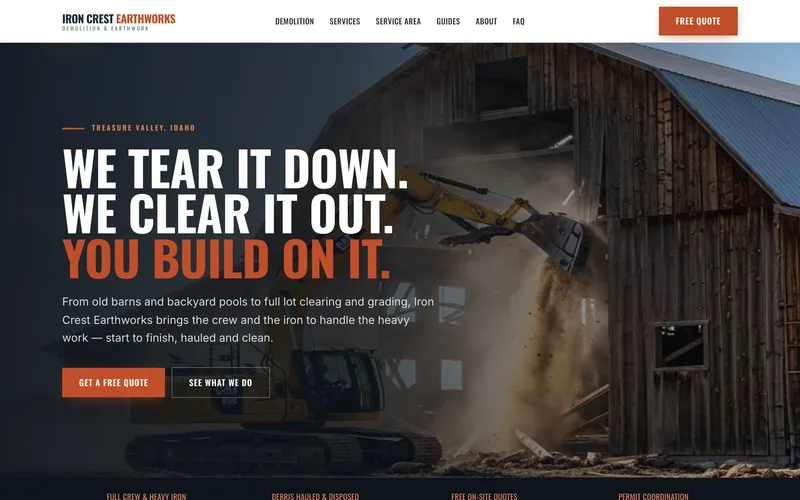
Here is what it does and how it works.
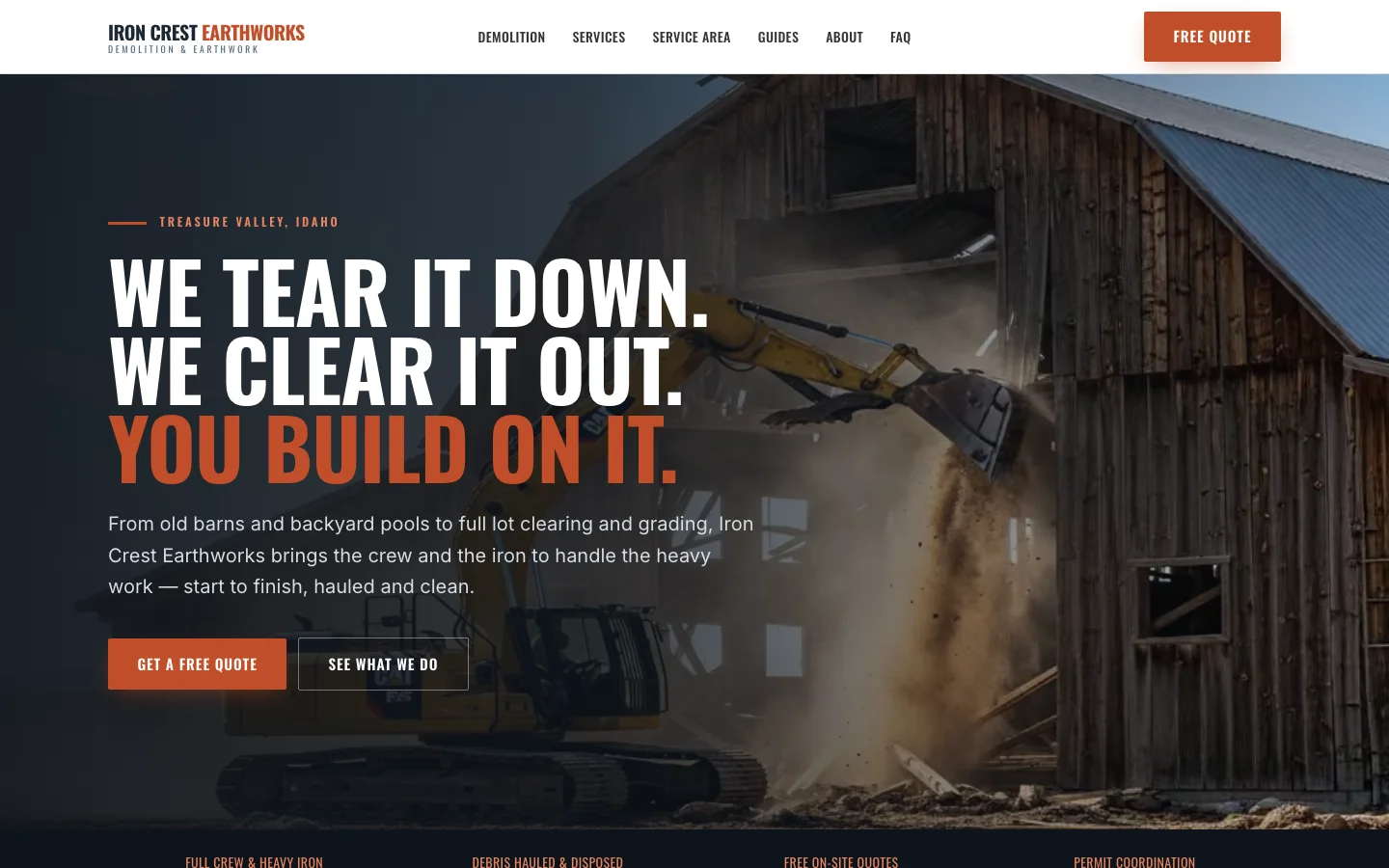
Iron Crest Earthworks is an eSEOspace client: we work on its website and search marketing. This guide uses the company's own published information, checked on 22 October 2026, plus one public record from the Idaho Secretary of State, and every source is listed at the end. We don't rate or score our clients. Details change, so confirm them on ironcrestearthworks.com or by phone before you hire.
The short answer
Iron Crest Earthworks is a demolition and earthwork contractor serving the Treasure Valley in Idaho, from Boise, Meridian and Nampa out to Emmett, Mountain Home and Payette. It tears down barns, houses, pools, shops, garages, mobile homes and concrete, hauls the debris, and then does land clearing, excavation, grading, site prep, drainage and foundation digs. It also offers junk removal and roll-off dumpsters from 10 to 40 yards. The site says it is a division of Iron Crest Remodeling Group LLC. Prices are not published: quotes are free and given after an on-site look. Call (208) 247-3329, Monday to Friday, 7 AM to 6 PM.
| Business | Iron Crest Earthworks |
|---|---|
| What it does | Demolition first, then land clearing, excavation, grading, site prep, drainage and foundation earthwork; also junk removal and dumpster rental |
| Service area | Treasure Valley, Idaho: Boise, Meridian, Nampa, Caldwell, Eagle, Kuna, Star, Garden City, Middleton, Emmett, Mountain Home, Payette |
| Legal name | Iron Crest Earthworks, a division of Iron Crest Remodeling Group LLC (as published) |
| Registration | Idaho RCE-6681702, as published on the site; the company says it is licensed and insured |
| Price range | Not published; free on-site quotes with a written price |
| Hours | Monday to Friday, 7 AM to 6 PM; closed Saturday and Sunday |
| Phone / email | (208) 247-3329 · info@ironcrestremodel.com |
| Website | ironcrestearthworks.com |
What is Iron Crest Earthworks?
Iron Crest Earthworks is a heavy-equipment contractor for the ground stage of a project in the Treasure Valley of southwest Idaho. Its own short description is "demolition-first earthwork." In practice that means two halves of one job: first something comes down (a leaning barn, an old house, a cracked pool, a shop), and then the ground underneath is cleared, dug, graded and compacted so the next project can start on it.
The company's pitch is that you hire one crew instead of three. Its services page puts it this way: "you're not stitching together a demolition contractor, a hauler, and a dirt crew." It says it brings a full in-house crew and its own heavy equipment, and describes itself as "not a one-truck operation that subs out the hard part." It also says one trip with the machines can clear several structures at once, so you don't pay twice to bring equipment in.
The site lists eight service lines, summarized in the services table below.
It works on both open rural acreage and tight residential lots. The demolition page names "wide-open rural acreage in Canyon County" and "tight residential lots in Boise and Meridian where access, fences, and neighbors all matter."
Who owns or runs Iron Crest Earthworks?
The site does not name an owner, manager or any individual staff member. What it does publish, on its about page and in the footer of every page, is the legal structure: "Iron Crest Earthworks, a division of Iron Crest Remodeling Group LLC." The about page describes the parent company as "Iron Crest Remodeling Group, full-service remodeling," and the footer links the parent name to ironcrestremodel.com. The published contact email also sits on the parent company's domain (info@ironcrestremodel.com).
The Idaho Secretary of State's business search shows Iron Crest Remodeling Group LLC as a domestic limited liability company with the status "Active-Existing" and "Good Standing," with a filing date of 23 February 2026. If it matters to you who will run your job, ask at the site walk who the project lead will be.
Is Iron Crest Earthworks legit?
People ask this before letting a crew with excavators onto their property. Here is what can be checked:
- A registered parent company. The site names Iron Crest Remodeling Group LLC as the legal entity, and the Idaho Secretary of State lists that LLC as active and in good standing.
- A published registration number. The site lists "Idaho RCE-6681702" on every page. Idaho registers construction contractors through the Division of Occupational and Professional Licenses (DOPL), and the company's own hiring guide tells readers to ask any contractor for this number and check it with DOPL. We did not confirm the number in DOPL's lookup, so check it yourself before you sign.
- Stated insurance. The company's FAQ says it carries "liability and workers' compensation coverage." Ask for the certificates; its own guide says "a legitimate contractor expects these questions."
- A phone line, an email and set hours. (208) 247-3329, info@ironcrestremodel.com, Monday to Friday 7 AM to 6 PM.
- Written, free quotes. The company says it comes out, looks at the structure and lot, and gives "a straight, written price with no pressure and no obligation."
The site does not publish a street address, customer reviews, project photos with addresses, or a founding year, so those cannot be checked from the site itself. Asking for recent local references is reasonable for any demolition contractor.
Services at a glance
Each line has its own page with a scope list, a four-step process and an FAQ. This table pulls the main points from each.
| Service | What the company lists | Notes from its page |
|---|---|---|
| Demolition | Barns, houses, garages, shops, pole barns, pools, mobile homes, interiors, concrete, decks, sheds and fences | Includes debris haul-off and rough grading of the footprint; permits and disconnects coordinated |
| Junk removal | Estate, hoarding and foreclosure cleanouts; garage and shop clear-outs; construction debris; appliances, scrap metal, yard and storm debris | Crew does the lifting; leaves the space "broom-clean" |
| Dumpster rental | 10, 15, 20, 30 and 40-yard roll-offs | Driveway-safe placement, swap-outs when full |
| Land clearing | Brush, trees and stumps, lot and acreage clearing, fence lines and ditches, fire breaks and defensible space | Material mulched on site or hauled away, your choice |
| Excavation and grading | Site and mass excavation, cut and fill, rough and finish grading, trenching and backfill, dirt import and export, compaction | Works to plans and elevations |
| Site prep and pad work | Building and shop pads, driveway and road base, gravel, sub-grade prep, culverts and approaches | Base placed and compacted in lifts |
| Drainage and utilities | French drains, area drains, utility trenching, culverts and ditches, erosion control, swales | Drains piped to an outlet; surface restored |
| Foundation and retaining | Foundation and footing digs, basement and crawlspace digs, retaining-wall excavation and base, paver base, backfill | Coordinates with your concrete or wall crew |
Demolition, structure by structure
Every demolition job, according to the company, includes sorting, loading and hauling debris off-site, and rough grading of the footprint. The FAQ says you're left with "a clean, level site rather than an open hole or a pile." Here is what each demolition page says it covers.
| Demolition type | Included, per the company |
|---|---|
| Barn demolition | Timber, pole and metal barns; leaning and fire-damaged structures; salvage of usable lumber on request; foundation and slab breakout; full sorting and haul-off |
| House and structure demolition | Full house and addition teardowns; commercial and light-industrial structures; fire and flood-damaged buildings; utility disconnect coordination; foundation removal and site grading |
| Pool removal | In-ground concrete and gunite, vinyl-liner and fiberglass pools; above-ground pools; partial or full removal; engineered backfill and compaction |
| Garage and shop demolition | Detached garages and carports; shops, pole barns and lean-tos; metal and wood-frame; slab and footing removal; site leveled |
| Concrete removal | Driveways, patios and sidewalks; slabs and foundations; footings and retaining structures; reinforced concrete with rebar; recycling and haul-off |
| Mobile-home removal | Single and double-wides; manufactured and modular homes; skirting, decks and add-ons; piers, anchors and pad |
| Interior and selective demolition | Whole-interior strip-outs; partial demolition; drywall, flooring and cabinetry removal; tenant-improvement demo |
| Deck, shed and fence removal | Wood and composite decks; sheds; fencing and gates; hot tubs and gazebos; buried posts and footings |
Barns. The company calls barns "deceptively tricky": heavy old timbers, hidden hardware, partial collapses and stored junk underneath. If you want the weathered barnwood or hardware saved, tell the crew up front and it will be set aside before the rest comes down. It says a leaning or collapsed barn "can cost more" because unstable structures take extra care, and it can clear out the contents as part of the job.
Houses and other buildings. The site calls structure demolition "the most permit- and utility-sensitive work we do." The sequence it describes is disconnects confirmed, permits in hand, then a controlled teardown, then foundation and slab removal and rough grading. It says it takes down fire- and flood-damaged structures and assesses the specific hazards on site first.
Garages and shops. Any power run to the building is disconnected first. The slab and footings are normally broken out and hauled, but the company says that if the slab is sound and you want to reuse it, it can leave the slab in place.
Concrete. The company says reinforced concrete is "routine for us." Broken concrete goes to a recycler where possible, and the exposed sub-grade is leveled for new concrete, gravel, pavers or landscaping. It can take out part of a driveway rather than all of it.
Mobile homes. Skirting, decks and porches come off first, then the home is demolished and removed, then the piers, anchors and pad are dealt with. On rural lots the company says it accounts for old hookups, wells and septic.
Foundation in or out? The FAQ says this is your call and that it changes the scope and the price. The company can leave the slab and footings, or break out the foundation, backfill the hole and grade it over. Its cost guide says most teardowns that lead to new construction end up at the most complete tier, "because the next contractor on site needs a pad, not a hole."
Pool removal: full or partial?
Pool removal has its own page and its own guide, because the choice between the two methods affects what you can do with the yard later. The company removes concrete and gunite, vinyl-liner and fiberglass in-ground pools, plus above-ground pools.
| Partial removal | Full removal | |
|---|---|---|
| What happens | Top of the shell broken off below grade, bottom drilled or punched to drain, cavity filled and compacted | Entire shell (walls and floor) broken out and hauled, hole backfilled with engineered fill in compacted lifts |
| Cost, per the company | "Generally the lower-cost option" | Costs more |
| Building over it later | Material stays buried, which "usually rules out" building over the area | Leaves ground you can build on later |
| Resale | "Often must be disclosed to future buyers" | "Typically nothing to disclose about a buried pool" |
| Suits | Space becoming lawn or garden | A future patio, shop or addition is possible |
For fenced backyards, the company says it plans equipment routing and, if needed, works around or temporarily removes fencing. Backfill goes in compacted lifts so the ground "won't sink."
Junk removal and dumpster rental
Junk removal is full service: the crew lifts and carries from wherever the items are, inside, in the garage or out back, so nothing has to go to the curb. The company says it is built for "heavy, awkward items other haulers refuse," naming appliances, scrap metal, hot tubs and lumber. Metal, appliances and recyclables are separated out, and the space is left broom-clean. It handles estate, hoarding and foreclosure cleanouts and says it can clear the contents and then tear down the building in one project. It avoids certain hazardous materials, naming wet paint, chemicals and asbestos, and says it will point you to the right disposal route.
Dumpster rental covers five roll-off sizes. The company's sizing advice:
| Size | What the company recommends it for |
|---|---|
| 10-yard | Concrete, dirt and heavy debris |
| 15-yard | Small demo and remodels |
| 20-yard | Garage cleanouts and roofing tear-offs |
| 30-yard | Large remodels and cleanouts |
| 40-yard | Major demolition and construction |
Its sizing guide explains why heavy material goes in the small box: concrete, dirt, tile and shingles hit the weight limit "while the box still looks half-empty." It says it places containers to protect the driveway surface, swaps a full container for an empty one if you fill it early, and goes over the list of what can't go in when you book.
Rental periods, weight allowances and dumpster prices are not published. Ask for them when you book.
Land clearing
The company clears brush, trees, stumps and overgrowth on lots and acreage, plus fence lines, ditches and fire breaks. It says it brings mulchers, skid steers and excavators "matched to the terrain and density," and that you choose whether material is chipped on site (which it describes as a low-cost option that helps with erosion) or hauled away. Stumps can be ground, pulled, or cut and mulched at grade. It flags trees and areas you want kept before work starts.
Its land clearing guide makes a distinction worth knowing when you ask for a quote: clearing leaves open ground, not necessarily buildable ground. If a building is going up, full removal with stumps and root balls out is needed, "because buried organic material decomposes and settles under whatever you put on top of it." It also says open burning in Idaho is seasonal and permit-controlled, which is why chip-and-haul is often simpler, and that clearing has to respect setbacks around waterways and wetlands.
Excavation, grading, site prep, drainage and foundations
Excavation and grading. The company says it works "to plans and elevations, not by eye," imports fill when a site needs to come up and hauls spoils when there's excess, and compacts the sub-grade to spec. It says it coordinates with your builder or engineer on engineered projects.
Site prep and pad work. This covers building and shop pads, driveway and road base, gravel placement and sub-grade prep. The company says it typically uses crushed road base or gravel sized to the load, placed in compacted lifts, and that driveway base depth depends on traffic and soil. Where a driveway meets a county road or ditch, it installs the culvert and builds the approach.
Drainage and utilities. For wet crawlspaces and yards that won't drain, the company says it finds where the water comes from, then installs French drains, area drains, swales or culverts piped to "daylight, drywell, or storm system." It also digs and backfills trenches for service lines. It says it backfills, compacts and restores the surface so the yard "looks finished, not torn up."
Foundation and retaining. This is the earthwork that concrete and wall crews depend on: foundation and footing digs, basement and crawlspace excavation, retaining-wall excavation and base, paver base, and backfill in compacted lifts after the foundation is in. The company says it works from your foundation or wall plans and coordinates with your concrete or wall contractor.
Where its work stops
The about page is direct about scope. The company says its work is "the ground stage of a project: everything from the first teardown through the finished grade," taking a site "from standing structure to clean, level, build-ready dirt" and handing off there. It lists what it does not do:
- Concrete, framing and vertical construction are "your builder's scope." (It digs the footings and backfills, but does not pour or build.)
- Well decommissioning is licensed work. Its rural demolition guide says an abandoned well in Idaho generally has to be decommissioned by a licensed well driller, and that the company identifies the well and coordinates.
- Asbestos abatement, if a building needs it, is done by a licensed abatement contractor, not the demolition crew.
The company says it coordinates that sequencing "so nothing lands out of order." Septic abandonment, according to its rural guide, follows the local health district's rules, usually pumping and then collapsing or filling the tank.
Where it works, and when
The site lists twelve communities, each with its own page: Boise, Meridian, Nampa, Caldwell, Eagle, Kuna, Star, Garden City, Middleton, Emmett, Mountain Home and Payette. The service-area page says coverage spans Ada and Canyon County and reaches into Gem, Elmore and Payette County on the edges. For projects just outside that area, the FAQ says to ask.
The Boise page calls Boise "the busiest market we work" and names the North End, the Bench, Southeast Boise and Warm Springs, Harris Ranch and Downtown.
Hours: Monday to Friday, 7 AM to 6 PM; closed Saturday and Sunday. No street address or office location is published, and the company works on site at your property. Quotes are given on site.
How much does Iron Crest Earthworks cost?
Prices are not published. The company does not list rates for demolition, clearing, grading or dumpsters. It says it can "ballpark a range" by phone, but gives a written price only after an on-site look, because access, what's inside and what's below grade vary too much to quote blind. The quote is free and comes with no obligation.
Its cost guide explains what moves the price:
- The structure. Size, number of stories and material. A single-story pole barn is simpler than a two-story house with a basement; concrete, masonry and steel take more breaking than wood frame.
- Access. Open acreage is straightforward; a tight infill lot means smaller machines, careful sequencing and dust control.
- What's inside and underneath. Pre-1980s buildings may need asbestos testing; foundations and buried slabs add breakout and haul-off.
- Debris weight. Disposal is priced by weight at the scale. The company notes that "a modest slab or a masonry chimney can outweigh an entire truckload of framing lumber."
- Permits and site conditions, such as erosion control or care around wells and septic on rural sites.
The guide also lists four scope tiers and says to make sure any quotes you compare are for the same one:
- Structure only: the building comes down and is hauled; foundation and slab stay.
- Structure plus foundation: footings, slab and basement walls come out; the hole is backfilled.
- Structure plus foundation plus full debris removal: everything above and below grade is hauled; ground left rough.
- Complete demolition plus rough grading or site prep: the footprint is graded, compacted and left build-ready.
Other price notes from the service pages: a leaning or collapsed barn can cost more; partial pool removal is generally cheaper than full; mulching in place is the lower-cost clearing option; and combining several structures in one trip avoids paying to bring equipment back. Payment methods, deposits, financing and warranty terms are not published. Ask about all four with your quote, and ask whether disposal fees are inside the quoted price (the company's own hiring guide recommends asking every contractor this).
What happens, step by step
The home page sums it up as three steps ("Tell us the job, We bring the iron, Hauled and cleared"). The service pages and guides fill in the detail:
- Call or send the quote form. The form asks what you need and the project city, both optional. The company says none of the details are required to start the conversation, but a few photos help.
- Site walk and written quote. The crew looks at the structure, access, utilities and hazards, and gives a written price. On rural properties it says it walks the whole parcel to find wells, septic, irrigation and outbuildings before quoting.
- Permits and disconnects. The company coordinates the demolition permit and the shut-off of power, gas, water and sewer or septic. It says it opens these early, because permit issuance and utility schedules, not its crew, usually set the start date.
- Teardown and sorting. The structure comes down with dust and debris controlled, and concrete, metal and wood are sorted. Salvage you asked for is set aside first.
- Haul-off. Material goes to recyclers or the right disposal facility.
- Grading. The footprint is rough-graded. Full grading to plan elevations, pads and drainage is separate work the company also does, "usually in the same mobilization."
How long it takes. The company's timeline guide says a structure "can come down in a day or two," and the teardown stage is "often measured in days, not weeks." Permits, utility disconnects, asbestos testing on older buildings, tight access and weather are what stretch it. If you have a hard date, such as a closing or a build start, the company asks you to say so at the site walk so the schedule can be planned backward from it. It gives a start window with the written quote "instead of a number we can't hold." You don't need to be home on demolition day, as long as the crew has access and a way to reach you.
What to have ready. The company's prep guide asks for the address, what's coming down and how big, how a machine reaches it, which utilities are connected, whether the foundation should go, anything known about asbestos in pre-1980s buildings, what you want left afterward, your timeline and a few photos.
Permits, utilities and asbestos
The company says it coordinates the demolition permit your city or county requires and the utility disconnects, so you aren't "left navigating the city or county process on your own." Your part, per its prep guide, is making sure utility accounts in your name are set up to be shut off.
Its permit guide gives this general picture, which it calls "orientation, not legal advice":
- Demolishing a permanent structure (house, barn, garage, shop, commercial building) generally needs a permit. Small non-structural items such as a small shed, deck or fence often don't, but thresholds vary.
- Inside city limits, the city building department issues the permit; on unincorporated land, the county does.
- Power, gas, water and sewer or septic must be disconnected and verified first.
- Some older buildings must be checked for asbestos before demolition, with notification to Idaho DEQ for qualifying projects.
The Boise page adds local detail: it says the City of Boise requires a demolition or deconstruction permit with a material and waste management plan and a diversion report after completion, and that Idaho law requires a free 811 locate request at least two business days before digging. It links to the official city, county landfill, Idaho 811 and Idaho DEQ pages and notes they were verified on 21 August 2026. Requirements change, so the linked authority is the current source.
How it compares with other options
There are several ways to get a structure down and a lot ready. This compares the general categories, not specific companies.
| Option | Typical strengths | Things to weigh |
|---|---|---|
| Iron Crest Earthworks (demolition plus earthwork in one crew) | One contract from teardown to graded pad; can combine several structures and the dirt work in one mobilization; coordinates permits and disconnects | No published prices; work stops at finished grade (no concrete, framing or abatement); Treasure Valley only |
| A demolition-only contractor | Focused on teardown | You may need a separate hauler and a separate grading crew, and someone has to coordinate them |
| A general junk hauler | Quick for furniture and household items | Often not set up for structures, slabs or heavy scrap |
| Dumpster rental and DIY | Lowest labor cost for small jobs | You do the work and the loading; weight limits, prohibited items and permits are on you |
| Your builder or general contractor arranging subs | One point of contact for the whole build | The demo and dirt work is subcontracted; ask who actually does it |
Who it suits, and who should look elsewhere
A good fit if you…
- Have a barn, house, shop, mobile home or pool to remove anywhere in the Treasure Valley
- Want the teardown, haul-off and grading handled by one crew
- Are clearing a rural parcel with several outbuildings, old concrete or brush
- Need a pad, driveway base, culvert or drainage fix before a builder starts
- Want the company to coordinate the permit and utility disconnects
- Are a builder or homeowner who needs foundation digs and backfill to plan
Look elsewhere if you…
- Need someone to pour concrete, frame or build (the company hands off at finished grade)
- Need asbestos abatement or well decommissioning done directly (both are licensed specialty work it coordinates but does not perform)
- Want a price list before anyone visits
- Need weekend work hours or emergency service (hours are weekdays only)
- Are outside southwest Idaho
Questions to ask before you hire
The company published its own list of questions to ask any earthwork contractor, itself included. These build on it:
- Does the written quote say exactly what comes down, whether the foundation comes out, where debris goes and what condition the ground is left in?
- Can I see your Idaho contractor registration and certificates of liability and workers' compensation insurance?
- Are disposal and tipping fees inside the price or billed on top?
- Who calls in the 811 locates, who pulls the permit and who schedules the disconnects?
- How do you price surprises such as a buried tank or a second foundation, and does work pause until I approve a change?
- Do you want asbestos testing first, and who would do it?
- What deposit and payment terms apply, and is there any warranty on backfill, compaction or drainage work?
How to get started
- Gather the basics: address, what needs to come down or be cleared, rough size, access, utilities, and what you want the ground to look like afterward. Take a few photos.
- Call (208) 247-3329 (Monday to Friday, 7 AM to 6 PM), email info@ironcrestremodel.com, or use the quote form on the contact page.
- Book the free site walk and get the written quote and start window.
- Compare any other quotes tier for tier (structure only, plus foundation, plus haul-off, plus grading).
- Clear out anything you want to keep, flag salvage, and arrange utility shut-offs on accounts in your name.
Terms you'll see on the site
- Earthwork: moving and shaping soil: digging, filling, grading and compacting.
- Rough grading vs finish grading: rough grading shapes the ground roughly level; finish grading brings it to the exact elevations and slopes on a plan.
- Cut and fill: removing soil from high spots and placing it in low spots to reach a target grade.
- Compaction in lifts: placing fill in thin layers and compacting each one so it doesn't settle later.
- Selective demolition / strip-out: removing only part of a building, such as interior finishes, while protecting what stays.
- Roll-off: an open-top dumpster delivered and picked up by truck, measured in cubic yards.
- Defensible space: cleared ground around a structure that reduces wildfire fuel.
- French drain: a gravel-filled trench with a perforated pipe that carries water away.
- Idaho 811: the free utility-locate request required before digging in Idaho.
- RCE: the prefix on an Idaho contractor registration number.
Frequently asked questions
What does Iron Crest Earthworks do?
Iron Crest Earthworks is a Treasure Valley, Idaho contractor that does demolition first (barns, houses, pools, shops, garages, mobile homes, concrete) and then land clearing, excavation, grading, site prep, drainage and foundation earthwork. It also offers junk removal and 10 to 40-yard roll-off dumpsters.
How much does Iron Crest Earthworks charge for demolition?
Iron Crest Earthworks does not publish prices. It gives a free, written quote after an on-site look, and says the price depends on the structure, access, what's below grade, debris weight and permits.
Is Iron Crest Earthworks licensed and insured?
Iron Crest Earthworks says it is a division of Iron Crest Remodeling Group LLC, registered in Idaho as RCE-6681702, and carries liability and workers' compensation coverage. The parent LLC is listed as active and in good standing with the Idaho Secretary of State; you can check the contractor registration with Idaho DOPL and ask for insurance certificates.
Who owns Iron Crest Earthworks?
The site says Iron Crest Earthworks is a division of Iron Crest Remodeling Group LLC, a full-service remodeling company. It does not name an individual owner or manager.
What areas does Iron Crest Earthworks serve?
Iron Crest Earthworks serves the Treasure Valley: Boise, Meridian, Nampa, Caldwell, Eagle, Kuna, Star, Garden City, Middleton, Emmett, Mountain Home and Payette. It says to ask about projects just outside that area.
Does Iron Crest Earthworks haul away the debris?
Yes. Iron Crest Earthworks says every demolition and earthwork job includes sorting, loading and hauling debris off-site, with concrete and metal recycled where possible, and the footprint rough-graded.
Does Iron Crest Earthworks pull the demolition permit?
Iron Crest Earthworks says it coordinates the demolition permit your city or county requires and the shut-off of power, gas, water and sewer or septic before work starts. Your part is making sure utility accounts in your name can be shut off.
Can Iron Crest Earthworks remove an in-ground pool?
Yes. Iron Crest Earthworks removes concrete, gunite, vinyl-liner, fiberglass and above-ground pools, with partial or full removal, and backfills and compacts the area. It says full removal is what lets you build over the spot later.
Does Iron Crest Earthworks remove the foundation too?
It can. Iron Crest Earthworks says you choose whether the slab and footings stay or are broken out, backfilled and graded over, and that the choice changes the scope and price.
How long does a demolition take with Iron Crest Earthworks?
Iron Crest Earthworks says the teardown itself can take a day or two, and that permit issuance and utility disconnect scheduling usually set the start date. It gives a realistic window with the written quote.
What size dumpsters does Iron Crest Earthworks rent?
Iron Crest Earthworks rents 10, 15, 20, 30 and 40-yard roll-offs. It recommends a 10-yard for heavy material such as concrete and dirt and a 40-yard for major demolition; prices and rental periods are not published.
Does Iron Crest Earthworks pour concrete or build foundations?
No. Iron Crest Earthworks says its work ends at clean, level, build-ready dirt; concrete, framing and vertical construction are the builder's scope. It does dig foundations and footings and backfills after the pour.
Does Iron Crest Earthworks handle asbestos?
Iron Crest Earthworks says suspected asbestos in pre-1980s buildings is assessed before demolition and that abatement is licensed work done by an abatement contractor. Its junk removal service avoids asbestos.
What are Iron Crest Earthworks' hours?
Iron Crest Earthworks lists its hours as Monday to Friday, 7 AM to 6 PM, closed Saturday and Sunday. The phone number is (208) 247-3329.
Sources
All pages checked on 22 October 2026.
- Home page: ironcrestearthworks.com
- About: ironcrestearthworks.com/about
- Contact and quote form: ironcrestearthworks.com/contact
- FAQ: ironcrestearthworks.com/faq
- Services overview: ironcrestearthworks.com/services
- Service pages: Demolition, Junk Removal, Dumpster Rental, Land Clearing, Excavation & Grading, Site Prep & Pad Work, Drainage & Utilities, Foundation & Retaining
- Demolition pages: Barn, House & Structure, Pool Removal, Garage & Shop, Concrete Removal, Mobile-Home Removal, Interior & Selective, Deck, Shed & Fence
- Service area: ironcrestearthworks.com/service-area, Boise, Demolition in Boise
- Guides: Cost of demolition, Demolition permits, Pool removal full vs partial, Debris disposal, How long demolition takes, Rural demolition, wells and septic, Dumpster sizing, Preparing for demolition, Choosing a contractor, Removing concrete, Land clearing, Site prep before building
- Idaho Secretary of State business search (Iron Crest Remodeling Group LLC): sosbiz.idaho.gov
- Idaho Division of Occupational and Professional Licenses (contractor registration): dopl.idaho.gov



