
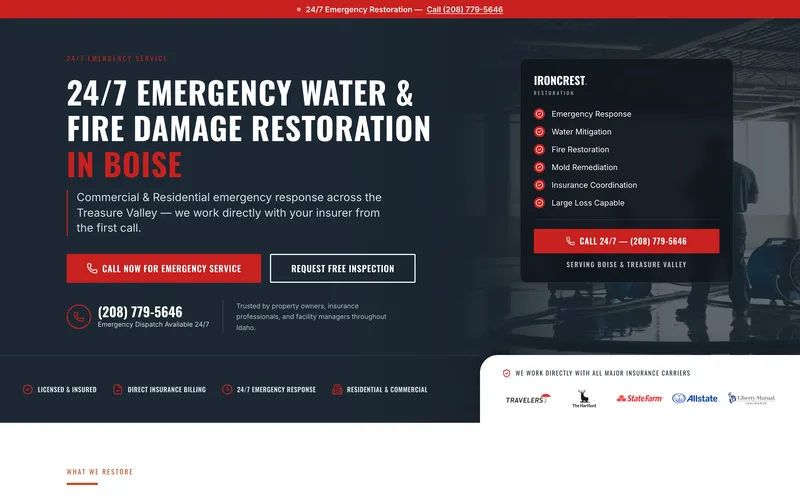
Here is what it does, how pricing and insurance work, and where it serves.
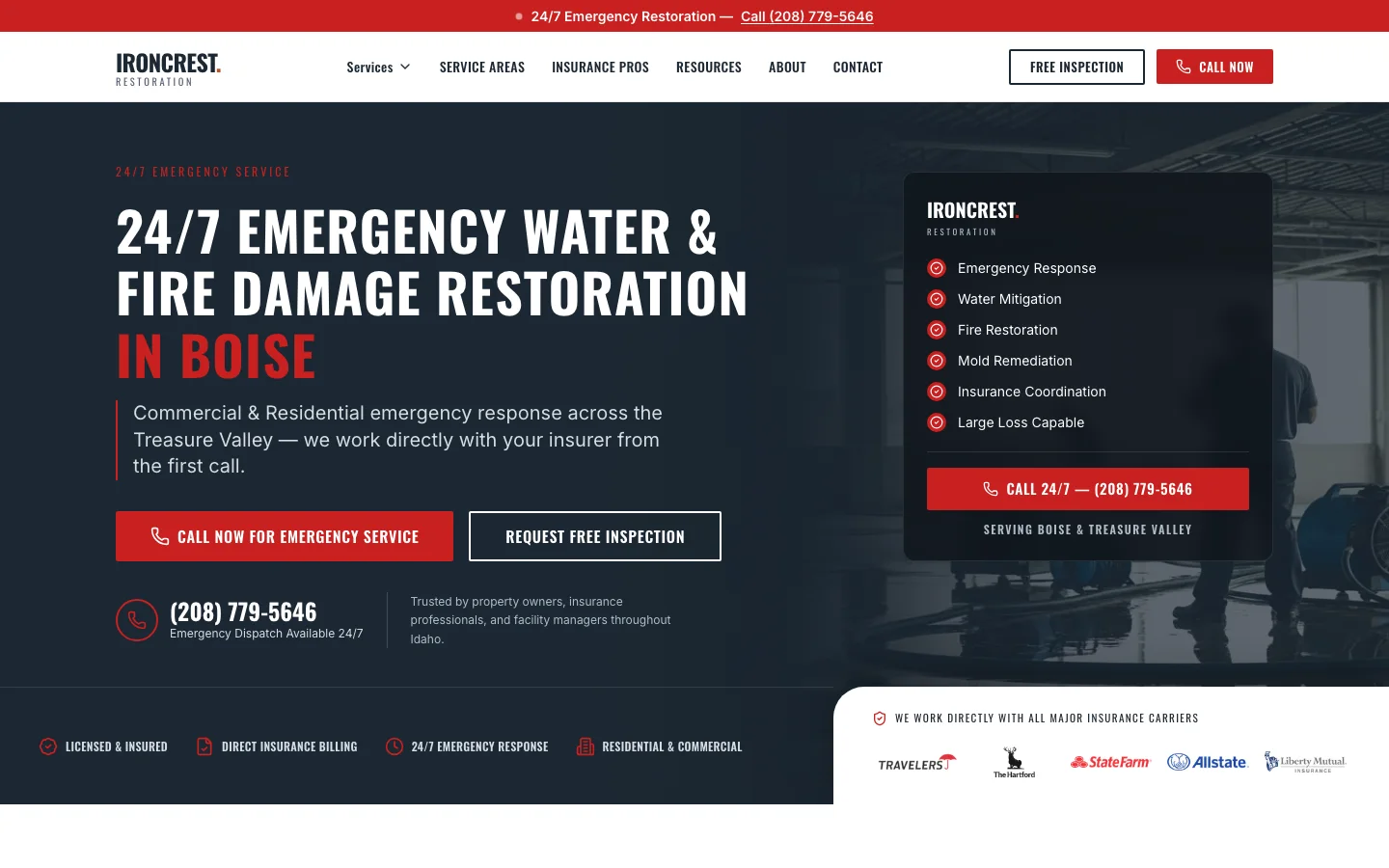
IronCrest Restoration is an eSEOspace client: we work on its website and search marketing. This guide uses the company's own published information, checked on 22 October 2026, and every source is listed at the end. We don't rate or score our clients. This guide is not insurance or legal advice: read your own policy and talk to your insurer or agent about coverage. Details change, so confirm them on ironcrestrestoration.com or by phone.
The short answer
IronCrest Restoration is a property damage restoration company based in Boise, Idaho, and the company says it is a division of Iron Crest Remodeling Group. It handles water, fire, smoke, mold, sewage and storm damage for homes and businesses across Boise and the Treasure Valley, with a 24/7 emergency line. Its stated model is one team from the emergency call through drying, cleanup and full reconstruction. It offers free inspections and says it works directly with insurance adjusters and bills carriers directly. Prices are not published; the company gives itemized estimates after an inspection. Call (208) 779-5646 or email info@ironcrestremodel.com.
| Business | IronCrest Restoration |
|---|---|
| What it does | Emergency mitigation and restoration after water, fire, smoke, mold, sewage, storm and biohazard losses, plus reconstruction |
| Based in | Boise, Idaho (no street address is published) |
| Service area | Boise, Meridian, Nampa, Eagle, Caldwell, Star, Kuna, Garden City and 13 surrounding towns in the Treasure Valley and neighboring counties |
| Parent company | Iron Crest Remodeling Group (company's statement) |
| Licenses or credentials | The company says it is licensed and insured and will provide credentials on request; no license number is published |
| Price range | Not published. Free inspection, then an itemized estimate |
| Hours | 24/7 emergency line; office Mon to Fri, 8:00 AM to 5:00 PM |
| Phone / email | (208) 779-5646 · info@ironcrestremodel.com |
| Website | ironcrestrestoration.com |
What is IronCrest Restoration?
IronCrest Restoration is an emergency restoration contractor for the Boise area. It is the company you call when a pipe bursts, a water heater fails, a fire or storm damages a building, mold shows up behind a wall, or sewage backs up into a basement. Its site describes the work in two halves: mitigation (stopping the damage, removing water, drying, cleaning, securing the building) and reconstruction (rebuilding drywall, floors, cabinets, paint and finishes afterwards).
The company's main selling point, repeated on most pages, is that one team handles both halves. Its about page puts it this way: "no gap between the company that dries your home and the one that rebuilds it." It also stresses three things a property owner tends to need after a loss:
- A phone answered at any hour, by "a real person," the site says.
- Documentation for the insurance claim from the first inspection.
- Local knowledge of Treasure Valley losses: winter pipe bursts, spring runoff, high groundwater, wildfire smoke and severe storms.
It works on both residential and commercial property. The commercial page lists offices, retail spaces, restaurants, multi-unit residential and other commercial buildings.
Who owns or runs IronCrest Restoration?
The site does not name an owner, manager or any individual staff member. What it does say, on the about page and in the footer of every page, is that IronCrest Restoration is a division of Iron Crest Remodeling Group, "bringing the same standards of quality and accountability to emergency restoration across the Treasure Valley." The footer links that name to ironcrestremodel.com, and the restoration company's published email address uses the same domain (info@ironcrestremodel.com).
The site does not publish a founding year, team size or crew bios. If it matters to you who will be in your home, ask on the first call who the project lead will be and who will be on site.
Is IronCrest Restoration legit?
Here is what can be checked from the company's own published information:
- A working phone line and email. The same number, (208) 779-5646, appears on every page and in the site's business markup, along with info@ironcrestremodel.com.
- A named parent business. The company identifies itself as a division of Iron Crest Remodeling Group and links to that company's site.
- Licensing and insurance, on request. The about page says the company "operates as a licensed and insured restoration contractor serving the Treasure Valley" and is "happy to provide credentials on request." No license or registration number is printed on the site, so ask for it. Idaho contractor registration is handled by the state's Division of Occupational and Professional Licenses (DOPL), where you can check a number once you have it.
- Clear statements of what it is not. The insurance page and the terms of service both say IronCrest Restoration is "a restoration contractor, not a public adjuster or insurer." The terms also say a form submission "does not create a contract" and that work is governed by "a separate written agreement provided before work begins."
The site does not show customer reviews, review scores, industry certifications or a written workmanship warranty. If any of those matter to you, ask for them directly, and ask for references from a recent job like yours.
Services at a glance
The services page groups the work into four sets. Each service below has its own page on the site except the two marked "ask," which the company lists with an "Ask Us" button instead.
| Group | Service | What the company says it includes |
|---|---|---|
| Damage restoration | Water damage restoration | Extraction, structural drying, moisture mapping, removal, antimicrobial treatment, rebuild |
| Fire damage restoration | Board-up and tarping, soot removal, odor treatment, firefighting-water cleanup, contents, rebuild | |
| Smoke damage cleanup | Soot removal, odor treatment, HVAC cleaning, air scrubbing, surface sealing | |
| Mold remediation | Inspection, containment, HEPA filtration, removal, moisture-source correction, rebuild | |
| Sewage cleanup | Protected extraction, removal of porous materials, disinfection, drying, deodorizing, rebuild | |
| Storm damage restoration | Board-up and roof tarping, water extraction, debris and tree removal, stabilization, rebuild | |
| Mitigation and drying | Emergency board-up | Window and door board-up, roof tarping, stabilization, site security |
| Structural drying | Moisture mapping, air movers, dehumidifiers, daily monitoring, documented completion | |
| Crawl space drying | Water removal, drying, source correction, vapor barrier recommendations, mold treatment | |
| Cleanup and specialty | Biohazard and trauma cleanup | Containment, removal, disinfection, disposal, odor treatment, repairs |
| Contents cleaning and pack-out | Inventory, pack-out, cleaning, secure storage, pack-back | |
| Air duct and HVAC cleaning | Duct and vent cleaning, component cleaning, filter replacement | |
| Odor removal (ask) | "Source-based deodorization for smoke, water, biohazard, and persistent odors" | |
| Rebuild, commercial, insurance | Reconstruction services | Drywall, insulation, flooring, paint, cabinetry, trim, structural repairs |
| Commercial restoration | All of the above, scaled and phased around a business | |
| Insurance claim assistance | Documentation, adjuster coordination, itemized scope, contents inventory | |
| Commercial Emergency Ready Plan (ask) | "A no-cost readiness plan for commercial properties" |
Water damage, structural drying and crawl spaces
Water damage restoration is the company's lead service. The page lists the causes it sees most in the Treasure Valley: winter pipe freezes and bursts, failed water heaters and supply lines, dishwasher and washing-machine overflows, roof leaks during spring storms, and groundwater in basements and crawl spaces. The work it describes:
- Emergency extraction with truck-mounted and portable units, which the company calls "the single most important step in limiting damage."
- Moisture detection behind walls and under floors using moisture meters and thermal imaging, then daily monitoring.
- Removal and cleanup of materials that can't be saved, and cleaning and protecting contents that can.
- Mold prevention with antimicrobial treatment and fast drying. The site notes that mold can take hold within 24 to 48 hours.
- Repair and reconstruction once everything is dry.
Warning signs it lists include wet or sagging drywall, buckling floors, a musty smell that won't go away, and an unexplained jump in the water bill.
Structural drying has its own page because, as the company puts it, "surface-dry is not the same as dry." Water wicks into framing, drywall and subfloor. The company says it sizes and places commercial air movers and dehumidifiers for the space, logs moisture readings every day, uses cavity and hardwood-floor drying systems where needed, and does not remove equipment until materials reach target readings, which it documents for the insurer. Its estimate is that most structures dry "within several days." A separate article puts typical structural drying at about 3 to 5 days.
Crawl space drying covers standing water and chronic damp under the house from spring runoff, high groundwater, plumbing leaks or poor drainage. The company explains the "stack effect": air from the crawl space rises into the living space, so moisture and musty odor below affect the whole home. Its service includes pumping out water, drying soil, joists and subfloor, treating mold on framing, finding what is letting water in, and recommending a vapor barrier where it fits.
Fire, smoke, board-up and duct cleaning
Fire damage restoration starts, in the company's description, with securing the building: boarding broken windows and doors and tarping roof openings against weather and intruders. Then comes cleanup. The site says soot is acidic and keeps etching metal, glass and finishes, and that different residues (it names dry, wet, protein and fuel-oil) need different cleaning methods. For odor, it lists HEPA filtration, thermal fogging, ozone and hydroxyl treatment "as appropriate," and says it removes the source rather than masking it. Fire jobs also include drying out the water used to put out the fire, cleaning and inventorying contents, and full reconstruction. The company's advice before it arrives: don't try to clean soot yourself, because improper cleaning can drive it deeper.
Smoke damage cleanup is offered even when there was no fire on the property. The site points to Treasure Valley wildfire smoke and fires in neighboring units, which can leave soot and odor through windows and HVAC systems, and says it can test surfaces and air. The service covers surface cleaning, odor treatment, HVAC and duct cleaning, contents cleaning, air scrubbing, and sealing surfaces before repainting where residue can't be fully removed. The company's explanation for a smell that keeps coming back is that odor hides in porous materials, ductwork, attics and wall cavities and returns with heat and humidity if those sources aren't treated.
Emergency board-up and roof tarping is sold on its own as well as part of fire and storm jobs. The company says it prioritizes board-up because "every hour an opening stays exposed risks more damage," and that it documents both the original damage and the protective steps for the claim.
Air duct and HVAC cleaning covers supply and return ducts, registers, vents and accessible components, plus filter replacement. The company presents it mainly as a finishing step after fire, smoke or water losses, and also as a service you can book on its own for dust and indoor air.
Mold, sewage and biohazard cleanup
Mold remediation. The company's framing is that "mold is a moisture problem first and a cleaning problem second." Its process: inspect and find the moisture source, set up physical barriers and negative air pressure, run HEPA air scrubbers, remove and bag contaminated porous materials, clean and treat surfaces that can be saved, fix the leak, condensation or humidity behind the growth, then rebuild. It says it always looks for why the mold is there. On timing, it says small areas may take "a day or two" and larger projects with reconstruction take longer. The site also advises against cleaning mold yourself with bleach, since surface cleaning may not reach growth inside materials and disturbing mold can release spores. Any health questions about mold exposure belong with a doctor; this guide does not cover them.
Sewage cleanup. The company treats sewage as a biohazard ("black water") and lists main-line backups, overflowing toilets and failed sump pumps as common sources. Technicians wear protective equipment and use dedicated extraction equipment. Porous materials that touched sewage, such as carpet, pad and often some drywall, are typically removed; non-porous items can usually be cleaned and disinfected. After disinfection the space is dried, deodorized and rebuilt. The company's safety advice is to keep people and pets away from the area until it is cleaned.
Biohazard and trauma cleanup. The site lists accidents, unattended deaths, hoarding and bodily-fluid contamination. It describes containment and removal by trained technicians in protective equipment, disinfection, compliant disposal, odor treatment and repairs, and stresses discretion. It responds 24/7 for these calls too, and strongly discourages doing this kind of cleanup yourself.
Storm damage and commercial properties
Storm damage restoration covers high winds, hail, heavy rain and rapid snowmelt, and the roof damage, broken windows, fallen trees and water intrusion that follow. The first step, in the company's words, is stabilization: tarping roofs and boarding up openings. Then it extracts and dries any water, clears storm debris and fallen limbs that threaten the structure, stabilizes compromised areas, documents everything, and rebuilds. The reconstruction list on this page includes roof, siding, windows, drywall and finishes.
Commercial restoration handles the same losses for businesses, with the added problems the company names: larger floor plans, occupancy and liability concerns, business interruption and the need to keep operating. It says it phases the work and contains affected areas "so unaffected parts of your operation can continue where it's safe," planned with you up front. It names one point of contact for owners and managers and says it coordinates with owners, property managers, tenants and adjusters. The services page also lists a Commercial Emergency Ready Plan, described as "a no-cost readiness plan for commercial properties." There is no separate page for it, so ask the company what the plan contains.
Reconstruction and contents pack-out
Reconstruction is the phase after drying, when a home has been, in the site's words, "dried out and gutted." The company lists replacing insulation and drywall (taped, textured and prepped), flooring of all common types (carpet, hardwood, tile, vinyl and laminate), priming and painting, rebuilding cabinets, baseboards and trim, framing and structural repairs, and final fixtures and doors. Its steps are: scope and itemized estimate, plan and schedule with you and your insurer, rebuild, detail and finish, then a final walkthrough. It says it works to match existing finishes "as closely as possible." It does not publish a reconstruction timeline; it gives one after mitigation, based on the scope.
Contents cleaning and pack-out is for larger losses where belongings are at risk or in the way. The company inventories and photographs your contents, packs and moves them off-site, cleans and deodorizes what can be saved, stores items securely while the building is restored, then brings them back and places them ("pack-back"). It also advises on what can't be saved so those items can be documented for the claim.
Where does it work, and when?
The company calls Boise its "home base" and says that is where it does its highest volume of emergency work. Its service-area page lists eight main cities with their own pages and 13 surrounding communities:
| County | Cities and towns listed |
|---|---|
| Ada | Boise, Meridian, Eagle, Star, Kuna, Garden City |
| Canyon | Nampa, Caldwell, Middleton, Parma, Wilder, Greenleaf, Notus, Melba |
| Elmore | Mountain Home |
| Gem | Emmett |
| Payette | Fruitland, Payette, New Plymouth |
| Owyhee | Homedale, Marsing |
The Boise page names neighborhoods including the North End, East End, Southeast Boise, Harris Ranch, West Boise, the Bench, Downtown, Columbia Village, Hidden Springs and Warm Springs. The Mountain Home page says the company also responds to rural acreage around town. If your town isn't listed, the site says to call and confirm coverage for your address.
Hours. The emergency line runs 24/7. The contact page lists office hours of Monday to Friday, 8:00 AM to 5:00 PM, for non-urgent questions. The company does not publish a guaranteed arrival time; it says it will give you "a realistic arrival window" when you call.
How much does IronCrest Restoration cost?
IronCrest Restoration does not publish prices, and its own cost article explains why it won't quote a firm number by phone: the cost "depends on the water category, how much is affected, and the materials involved," which need an inspection. What it does publish:
- Free inspections. The site offers a free on-site inspection and a free photo-based damage assessment, where you describe the damage, mention photos you can send, and the team explains next steps and schedules a visit if needed.
- Itemized estimates. After inspection, the company says it provides "detailed, itemized estimates."
- A written agreement before work. Its terms say work is governed by a separate written agreement provided before work begins.
The company's cost article lists what drives the price of a water job:
| Factor | Why it changes the cost, per the company |
|---|---|
| Category of water | Clean water is least involved; grey and especially black water need more removal, disinfection and protective work |
| Size and spread (class) | How many rooms, floors and materials are affected |
| Materials | Hardwood, plaster and tile take more to dry or replace than carpet and drywall |
| Speed of response | Delay increases both damage and cost |
| Reconstruction | Cosmetic repairs are minor; rebuilding rooms is "the largest variable" |
The article also splits a job into two phases: mitigation (extraction, drying, cleanup), which it calls "usually the more standardized cost," and reconstruction, which "varies widely with finishes and scope."
Payment methods and financing are not described on the site. Ask about them when you get your estimate, along with what you'll owe if a claim is denied or only partly approved.
Does IronCrest Restoration work with insurance?
Yes, according to the company, and insurance coordination is a large part of how it presents itself. Its insurance claim assistance page lists what it does:
- Documentation from the first inspection: photos, moisture logs, measurements and a detailed scope, captured before mitigation changes the scene.
- Direct adjuster coordination: sharing documentation and working so the scope "reflects the true extent of the loss."
- An itemized scope and estimate for mitigation and reconstruction, laid out the way insurers evaluate claims.
- A contents inventory of damaged belongings and materials.
- Direct billing. The company says it bills the insurance carrier directly. What you still owe depends on your policy, starting with your deductible, and on what the insurer approves.
Just as important is what the company says it does not do. It is "a restoration contractor, not a public adjuster or insurer." You file the claim and stay in control of it. In its words: "We explain your options and support you; we don't take over your relationship with your insurer." It does not promise any claim outcome, and neither does this guide: coverage depends on your policy and the insurer's decision.
The site's articles also explain some general points worth knowing, with the company's own caveat that "every policy is different":
- Many homeowners' policies cover sudden, accidental water damage such as a burst pipe or failed water heater; gradual leaks and neglected maintenance are often excluded; outside flooding usually needs a separate flood policy; sewer or drain backup is often a separate endorsement.
- Most policies expect prompt reporting and reasonable steps to prevent further damage.
- In general, you can choose your own licensed restoration company rather than the one your insurer suggests.
For any question about what your own policy covers, ask your insurer or agent.
What happens after you call, step by step
The home page sets out the company's five-step process, and each service page follows a version of it.
- Emergency call. Day or night, you reach a person who gathers details, gives safety guidance and dispatches a crew. You get an arrival window.
- Damage inspection. Technicians assess the damage, find the source and document it with photos and moisture readings.
- Mitigation and containment. They stop the source and take immediate steps such as board-up, water extraction and containment.
- Drying, cleanup and removal. Commercial drying equipment runs with monitoring until the property is dry; unsalvageable materials are removed and areas are cleaned and sanitized.
- Reconstruction and final walkthrough. Damaged areas and finishes are rebuilt, and the team walks the finished work with you.
What to do before the crew arrives. The home page lists four steps: stay safe (keep away from standing water near outlets, sagging ceilings and contaminated water, and shut off power to wet areas only if it is safe to do so); stop the source (close the local valve or the main); call; and photograph and video the damage and belongings before any cleanup.
How long it takes. For water losses, the company's timeline article gives: extraction the same day, structural drying of typically about 3 to 5 days, cleanup overlapping with drying, and reconstruction taking "days to weeks." It gives a specific timeline after inspection.
For adjusters, carriers and property managers
The site has a separate page for insurance professionals. It offers a 24/7 priority dispatch line (the same (208) 779-5646 number), a claims email (info@ironcrestremodel.com) and an online assignment form that asks for the adjuster's name, carrier, the insured's name, claim number, loss type, property address and notes on scope.
The assignment process runs from dispatch and mitigation through an itemized estimate, reconstruction, and closeout with "final documentation that matches the work performed," with a single point of contact throughout.
Do you have to move out during the work?
The company's article on this says it depends on safety, which areas are affected and the type of work. It says you can often stay if the damage is contained to one area, power, water and heat are working, and there is no health hazard, especially with containment around the work zone. Reasons to move out, per the article, include sewage or significant mold, fire damage with air-quality concerns, loss of power, water or heat, and extensive work in the kitchen or the only bathroom.
On cost, the article notes that many homeowners' policies include "Additional Living Expenses" or "Loss of Use" coverage when a covered loss makes a home uninhabitable. Keep receipts and confirm with your insurer how your policy applies.
How it compares with other options
This table compares the way IronCrest Restoration describes its model with other common routes after a property loss. It uses general categories, not named companies.
| Option | What you typically get | Things to weigh |
|---|---|---|
| IronCrest Restoration (as the company describes itself) | 24/7 local mitigation, cleanup and reconstruction from one team; claim documentation; direct carrier billing | No published prices, reviews, certifications or warranty; ask for credentials, references and the written agreement |
| A national restoration franchise location | Brand-standard processes and often insurer program relationships | Ask whether the same local office does the rebuild or refers it out |
| A vendor your insurer suggests | A contractor already familiar with that carrier's process | Per the company's articles, you can generally choose your own licensed contractor instead |
| Separate mitigation company, then a general contractor | Specialists for each phase | Two scopes and two schedules to coordinate; possible gap between drying and rebuild |
| Do it yourself | No contractor bill for small, clean-water spills | The company's articles caution that fans don't reach hidden moisture, and that sewage, soot, mold and biohazards carry real risks |
Who it suits, and who should look elsewhere
A good fit if you…
- Own or manage a home or commercial building in Boise or the Treasure Valley towns listed above
- Have an active emergency (water, fire, storm, sewage) and need someone at any hour
- Want one company to handle drying through rebuild instead of hiring two
- Expect to file an insurance claim and want help documenting it
- Are an adjuster or property manager who needs a local vendor with an assignment process
- Need discreet biohazard or trauma cleanup
Look elsewhere if you…
- Are outside southwest Idaho
- Want a published price list or a firm price over the phone
- Need a public adjuster to negotiate your claim for you (the company says it is not one)
- Require a specific industry certification or written warranty that the company can't show you on request
- Only want a cosmetic remodel unrelated to a damage event
Questions to ask before you hire
- What is your Idaho contractor registration number, and can you send a certificate of insurance?
- Who will lead my project, and who will be in my home?
- What is your realistic arrival window right now?
- Can I see the written agreement before work starts? What does it say about payment if my claim is denied or reduced?
- Will you send me copies of the photos, moisture logs and scope you share with my adjuster?
- How will I know the structure is dry, and will I get the final readings?
- Does your reconstruction carry a workmanship warranty? For how long?
- If my belongings are packed out, where are they stored and how are they inventoried?
- Do you take card payments or offer payment plans for anything insurance doesn't cover?
How to get started
- If it's an emergency, make the area safe, stop the water source if you can, and call (208) 779-5646. The company says calling is the fastest route for an active emergency.
- Photograph and video the damage and affected belongings before cleanup.
- If it's not urgent, use the free inspection form on the contact page, or the free photo assessment on the home page (name, phone, city, type of damage and a description).
- Notify your insurer if you plan to claim; the company can help with documentation, but you file and control the claim.
- Review the itemized estimate and written agreement before work begins.
- Adjusters can assign a loss through the form on the For Insurance Professionals page, by phone or by email.
Terms you'll see on the site
- Mitigation: the emergency phase that stops damage getting worse: extraction, drying, board-up, containment.
- Remediation: correcting a specific hazard, most often mold.
- Restoration: the umbrella term for returning a property to its pre-loss condition, start to finish.
- Reconstruction: the rebuild phase: drywall, flooring, paint, cabinetry and finishes.
- Category 1, 2, 3 water: clean water (supply line), grey water (appliance overflow, sump failure), and black water (sewage, outside flooding, long-standing water). The company notes clean water can degrade to a higher category over hours to days.
- Class 1 to 4: how far water has spread, from a small area (Class 1) to water trapped in dense materials like hardwood, plaster and concrete (Class 4, "specialty drying").
- Structural drying: drying framing, drywall and subfloor to target moisture readings, not just the surface.
- Negative air / containment: barriers and air pressure that keep spores or dust from spreading to clean areas.
- HEPA air scrubber: a machine that filters fine particles and spores from the air during work.
- ALE (Additional Living Expenses) / Loss of Use: policy coverage that may help with temporary lodging after a covered loss.
- Public adjuster: a licensed claims representative a policyholder can hire; the company says it is not one.
Frequently asked questions
What is IronCrest Restoration?
IronCrest Restoration is a Boise, Idaho restoration company that handles water, fire, smoke, mold, sewage, storm and biohazard damage for homes and businesses in the Treasure Valley, from emergency mitigation through reconstruction. The company says it is a division of Iron Crest Remodeling Group.
Is IronCrest Restoration open 24 hours?
Yes. IronCrest Restoration says its emergency line is answered 24/7. Office hours for non-urgent questions are Monday to Friday, 8:00 AM to 5:00 PM.
How much does IronCrest Restoration charge?
IronCrest Restoration does not publish prices. It offers a free inspection and then an itemized estimate, and says cost depends on the water category, how much is affected, the materials and how much reconstruction is needed.
Does IronCrest Restoration work with my insurance company?
IronCrest Restoration says it coordinates directly with adjusters from most carriers and bills the carrier directly. You file and control the claim, and what is covered depends on your policy and your insurer's decision.
Is IronCrest Restoration a public adjuster?
No. IronCrest Restoration says it is a restoration contractor, not a public adjuster or insurer; it supports your claim with documentation and coordination while you make the policy and claim decisions.
Who owns IronCrest Restoration?
The site does not name an owner. It says IronCrest Restoration is a division of Iron Crest Remodeling Group.
Is IronCrest Restoration licensed and insured?
IronCrest Restoration says it is a licensed and insured restoration contractor and will provide credentials on request. No license number is published on its site, so ask for it and check it with Idaho's Division of Occupational and Professional Licenses.
What areas does IronCrest Restoration serve?
IronCrest Restoration serves Boise, Meridian, Nampa, Eagle, Caldwell, Star, Kuna and Garden City, plus Middleton, Mountain Home, Emmett, Fruitland, Payette, Homedale, Parma, New Plymouth, Marsing, Wilder, Greenleaf, Notus and Melba. Call to confirm other addresses.
Does IronCrest Restoration rebuild after water or fire damage?
Yes. IronCrest Restoration says the same team that dries and cleans the property rebuilds it, including drywall, insulation, flooring, paint, cabinetry, trim and structural repairs.
How long does water damage restoration take with IronCrest?
IronCrest Restoration's guide says extraction happens the same day, structural drying typically takes about 3 to 5 days, and reconstruction takes days to weeks. It gives a specific timeline after inspection.
Does IronCrest Restoration handle commercial buildings?
Yes. IronCrest Restoration works on offices, retail, restaurants and multi-unit properties, and says it phases work so unaffected parts of a business can keep operating where safe. It also lists a no-cost Commercial Emergency Ready Plan.
Can I choose IronCrest even if my insurer recommends another company?
IronCrest Restoration's articles say that, in general, you have the right to choose your own licensed restoration company. Check your policy or ask your insurer if you are unsure.
Does IronCrest Restoration clean smoke damage from wildfires?
Yes. IronCrest Restoration says wildfire smoke can leave soot and odor in a home with no fire on the property, and it offers soot cleaning, odor treatment and HVAC duct cleaning for it.
Sources
All pages checked on 22 October 2026.
- IronCrest Restoration: home page
- About IronCrest Restoration
- Contact
- Services
- Service areas
- Boise
- Meridian
- Mountain Home
- Water damage restoration
- Fire damage restoration
- Smoke damage cleanup
- Mold remediation
- Sewage cleanup
- Storm damage restoration
- Commercial restoration
- Emergency board-up
- Structural drying
- Crawl space drying
- Reconstruction services
- Biohazard and trauma cleanup
- Contents cleaning and pack-out
- Air duct and HVAC cleaning
- Insurance claim assistance
- For insurance professionals
- How much does water damage restoration cost?
- How to file a water damage insurance claim
- How to choose a restoration company
- How long does water damage restoration take?
- Mitigation vs. restoration vs. remediation
- Water damage categories and classes explained
- Do you have to move out during restoration?
- Water damage: the first 24 hours
- Terms of service
- Privacy policy
- Idaho Division of Occupational and Professional Licenses



