
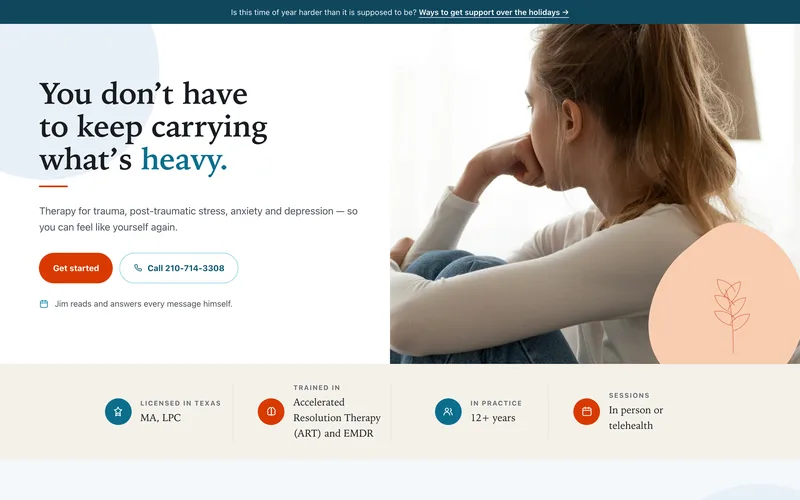
Here is what he offers, what it costs and how starting works.
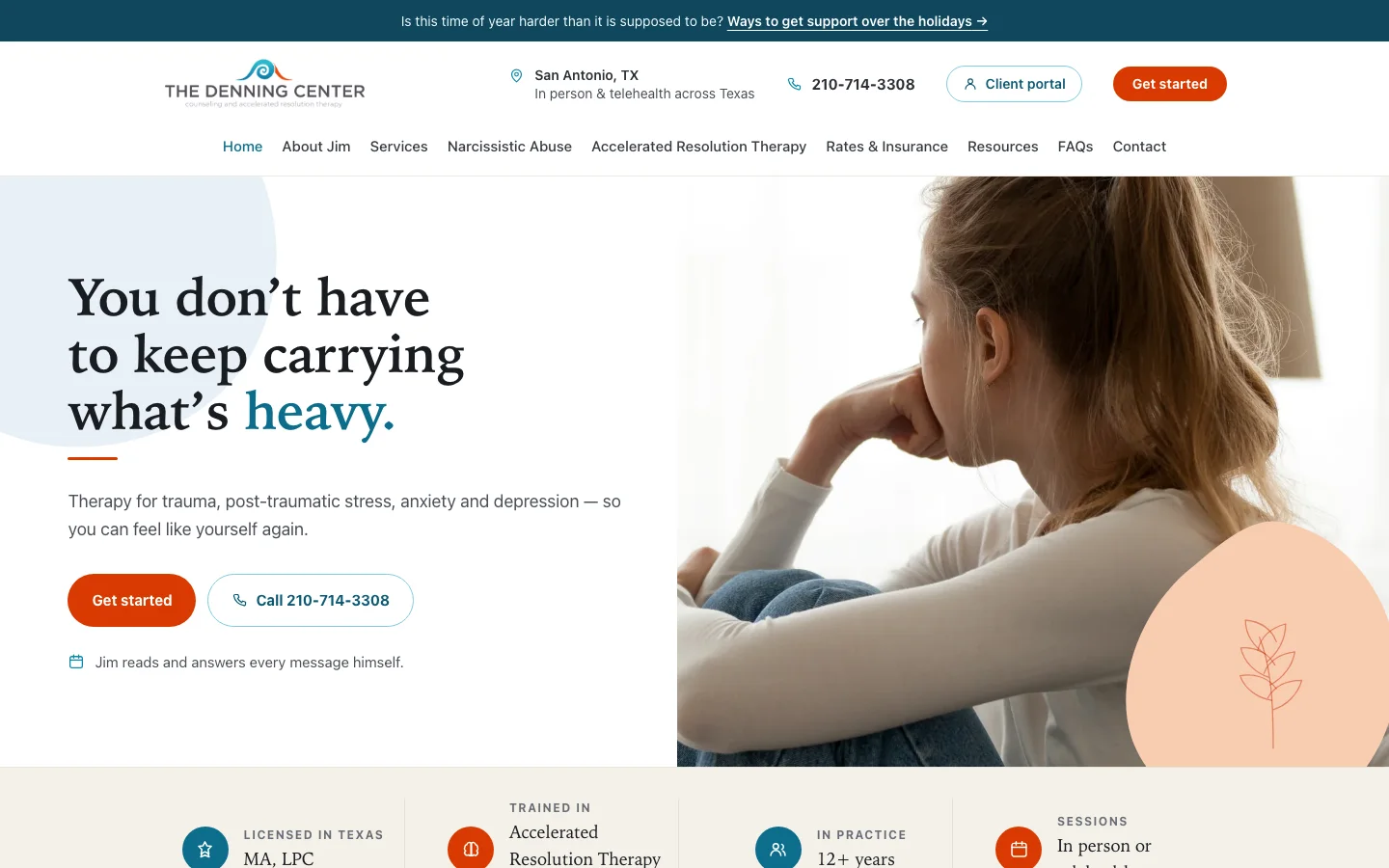
The Denning Center is an eSEOspace client: we work on its website and search marketing. This guide uses the practice's own published information, checked on 22 October 2026, plus one public registry, and every source is listed at the end. We don't rate or score our clients. Fees, insurance panels and availability change, so confirm them with the practice on jimdenninglpc.com before you book. This guide is not medical or mental health advice; talk to a licensed clinician about your own situation. If you are in crisis, call or text 988, or call 911 if you are in immediate danger.
The short answer
The Denning Center is the solo counseling practice of Jim Denning, MA, LPC, a Licensed Professional Counselor in San Antonio, Texas. It sees adults only, in person at 8626 Tesoro Drive, Suite 205 (North Central San Antonio) or by telehealth anywhere in Texas. The site lists six areas of work: trauma, narcissistic abuse recovery, PTSD, anxiety, depression and compulsive sexual behavior. Jim Denning says he is trained in Accelerated Resolution Therapy (ART) and EMDR. A standard 50-minute session is $130 private pay, and the practice says it is in network with Aetna, UnitedHealthcare, Blue Cross and Blue Shield of Texas, TRICARE, Humana Military and TriWest. Call 210-714-3308 or use the form on jimdenninglpc.com.
| Business | The Denning Center (website: jimdenninglpc.com) |
|---|---|
| What it does | Outpatient counseling and psychotherapy for adults: trauma, PTSD, narcissistic abuse recovery, anxiety, depression and compulsive sexual behavior |
| Based in | 8626 Tesoro Drive, Suite 205, San Antonio, TX 78217 |
| Service area | In person in San Antonio; telehealth for clients physically located in Texas |
| Who it serves | Adults 18 and over (no child or adolescent clients) |
| In practice since | 2013 (practice's statement on the About page) |
| Clinician | Jim Denning, MA, LPC (solo practice) |
| License | Licensed Professional Counselor, Texas, #73687 (as published on the site; the same number appears in his federal NPI Registry record) |
| Price | $130 per 50-minute individual session, private pay; ART session length and fee agreed in advance |
| Insurance | In network with Aetna, UnitedHealthcare, Blue Cross and Blue Shield of Texas, TRICARE, Humana Military and TriWest (practice's list) |
| Hours | By appointment; no after-hours or crisis coverage |
| Phone / email | 210-714-3308 · info@TheDenningCenter.com |
| Website | jimdenninglpc.com |
What is The Denning Center?
The Denning Center is a small outpatient counseling practice in North Central San Antonio. It is a solo practice: the contact page says "You will not be handed between clinicians," and every session is with Jim Denning, MA, LPC. The practice brands itself as The Denning Center, and its website lives at jimdenninglpc.com. Its email address uses the older thedenningcenter.com domain (info@TheDenningCenter.com).
The practice describes its focus as trauma and the problems that often travel with it. Its home page lists what people come in for as "a list of problems, not a menu of diagnoses":
- Trauma, recent or long past, and post-traumatic stress
- Anxiety and constant worry
- Depression and grief
- Phobias
- Narcissistic abuse and coercive control
- Sexual, emotional and physical abuse
- Compulsive sexual behavior
- Substance and alcohol misuse
- Suicidal thoughts
The site says you do not need a label before you get in touch: "Working out what is actually going on is the first part of the job." It also says plainly what it is not. It is not a crisis service, it does not prescribe medication, it does not see children or teenagers, and it does not provide after-hours coverage. Every page ends with the same emergency note pointing to 911 and the 988 Suicide & Crisis Lifeline.
The tone of the site is unusually direct about limits. The terms of use say no therapy described on the site "is guaranteed to work," no number of sessions is promised, and accepting an insurance carrier is not a guarantee that your plan will pay. Most service pages close with a line saying that if the practice is not the right fit, "you will be told so and pointed somewhere better."
Who is Jim Denning?
Jim Denning is the only clinician at the practice. His About page and the site's other pages give this background (all in the practice's own words or close to them):
- License: Licensed Professional Counselor (LPC) in Texas, license number 73687.
- Education: two master's degrees, an MA in Counseling and an MA in Ministry.
- Training: Accelerated Resolution Therapy, Eye Movement Desensitization and Reprocessing (EMDR) and cognitive behavioral approaches. Christian counseling is offered on request.
- In practice since: 2013, according to the About page. The home page describes it as "12+ years" in practice.
- Before counseling: the site says he was a technical trainer at NASA's Jet Propulsion Laboratory, and that his path also ran through prison ministry and "conversations shared across a bar."
- Work with veterans: the About page says he has used ART "to support veterans through the Lone Survivor Foundation."
- Author: he wrote Make It to Midnight: Learning to Live When You Want to Die, a first-person book about his own experience (more below).
The About page describes his clinical focus as trauma therapy, and says he is interested in where psychology, spirituality and meaning meet, including Carl Jung's ideas on synchronicity. He describes the working relationship as "warm, non-judgmental, and collaborative." On the book page he is quoted as saying: "I had no intention of becoming a counselor. But after fixing me, I felt I had to." The site's crisis page adds that he has "been on the other side" of suicidal feelings, and is careful to say that his story "is not evidence that any particular treatment will work for you."
The practice's press page lists one outside article so far: a July 2026 profile of Jim Denning published by Psychreg. The practice notes that wording and headlines in press pieces belong to the outlet, and points readers to the About page for how he describes his own background.
Is Jim Denning licensed? What can be checked
For any therapist, the first thing to check is the state license. Here is what the published record shows:
- A published license number. The About page lists "Licensed Professional Counselor (LPC), Texas, #73687." In Texas, LPCs are licensed by the Texas Behavioral Health Executive Council (BHEC), which has a free online license lookup. Search by name (his legal first name may appear as James) or by the number.
- A federal NPI record. The National Provider Identifier (NPI) Registry run by the Centers for Medicare & Medicaid Services lists James David Denning, LPC, NPI 1609386382, under the taxonomy "Counselor, Professional," with Texas license number 73687, enumerated in October 2017. NPI data is reported by the provider, so it confirms the number on file rather than the license status. For current status, use the BHEC lookup.
- A physical office and a single phone line. The site publishes one street address (8626 Tesoro Drive, Suite 205, San Antonio, TX 78217) and one number, 210-714-3308. The contact page says that if you find a different phone number for Jim Denning online, "the one on this page is the correct one."
- Written policies. The site publishes a privacy policy (last updated 1 October 2026), terms of use and an accessibility statement. Clinical pages carry a "Written and clinically reviewed by Jim Denning, MA, LPC" line with a review date (1 September 2026 on the pages we checked) and list their outside sources, such as the National Institute of Mental Health and the VA/DoD PTSD guideline.
- Insurance panels. The practice says it is credentialed with six plans and bills them directly. Insurers only contract with licensed providers, and you can confirm network status by calling the number on your own insurance card.
What does The Denning Center help with?
The services page organizes the work by "what you are dealing with" rather than by method, and lists six starting points. Each has its own page, and every one is offered "in person in San Antonio, or by telehealth within Texas" at the same $130 private-pay rate.
| Service | Who it is for, in the site's words | What the page says the work involves |
|---|---|---|
| Trauma therapy | People "carrying something that happened to them, recently or decades ago," that still shapes sleep, reactions and relationships | Understanding what you are dealing with and stabilizing first; then talk-based work, or ART or EMDR to work on how the memory is held, without having to describe details aloud |
| Narcissistic abuse recovery | People leaving, or still inside, a relationship built on control, blame-shifting and being told their own perception is wrong | Working out where you are (out, half out or still in), "restoring your own testimony," trauma work on specific incidents, contact decisions and grief. Individual work only |
| PTSD treatment | People with intrusive memories, avoidance, hypervigilance and mood changes after a traumatic event | Assessment with structured measures, a discussion of the main guideline-supported therapies, and ART as one option; sleep and grounding skills alongside |
| Anxiety therapy | People whose worry "starts running the day": generalized anxiety, panic, social anxiety, health anxiety | Cognitive behavioral approaches, testing anxious predictions at your own pace, work on sleep and physical symptoms, and checking for trauma underneath |
| Depression therapy | People with flatness, exhaustion and loss of interest lasting long enough "that you have started calling it normal" | Behavioral and cognitive work in parallel; a plain recommendation for a medical review when it seems worthwhile |
| Sex addiction therapy | Adults whose sexual behavior has become compulsive, continuing despite real consequences | Assessment of control, consequence, function and escalation; reducing access; working on what the behavior regulates; relapse planning; guidance on partner disclosure |
A few details from the individual pages are worth knowing before you call:
- Trauma: the page lists what brings people in, including assault and sexual assault, serious accidents, combat and service-related experience, childhood abuse and neglect, sudden loss, medical trauma and years in a controlling relationship. It says single-incident trauma "sometimes shifts quickly," while trauma that ran for years "generally does not."
- Narcissistic abuse: the page says "narcissistic abuse" is not a DSM diagnosis, and that Jim Denning will not diagnose your ex-partner, parent or boss from your account. If you are still in the relationship, he says nobody "will issue you an ultimatum." For anyone weighing physical safety, the page lists the National Domestic Violence Hotline (1-800-799-7233, or text START to 88788).
- PTSD: the page names the three trauma therapies with the strongest support in the VA/DoD and American Psychological Association guidelines (prolonged exposure, cognitive processing therapy and EMDR) and says ART has "smaller trial evidence." It says courses are set after assessment, not quoted in advance.
- Sex addiction: the page notes that "sex addiction" is not a DSM-5-TR diagnosis, while ICD-11 includes compulsive sexual behaviour disorder. A 12-step group is optional, not required. Forensic evaluations, court reports and sex-offender-specific programs are not offered, and requests to change sexual orientation or gender identity are declined.
- Medication: Jim Denning does not prescribe. The services page says that when medication is worth considering, he refers clients to a psychiatric nurse practitioner at a separate San Antonio practice, booked directly with her.
The site also has a page on therapy for veterans and military families, covered in its own section below.
Which therapy methods does Jim Denning use?
The services page separates two questions: what you are dealing with, and which method is used. It says you only need to answer the first, and that the method "is a clinical decision we make together after I understand what is going on," which can change as the work goes on. The methods listed:
- Accelerated Resolution Therapy (ART): a structured, eye-movement based therapy that works on the imagery attached to a difficult memory. You do not have to describe the event aloud in detail. See the next section.
- EMDR (Eye Movement Desensitization and Reprocessing): described on the site as "a widely researched trauma therapy recommended in major clinical guidelines," with an eight-phase protocol.
- Talk therapy and cognitive approaches: understanding a pattern, testing beliefs and practicing something different. The site calls this "often the container that reprocessing work sits inside."
- Christian counseling, on request: he holds a master's in ministry and "will work within a client's faith when that is what they want." The site says it is "offered, never assumed, and never a condition of being seen."
Accelerated Resolution Therapy, as the site describes it
ART is the method the site features most, with a main page and a separate ART library. Here is how the practice describes it. This is a summary of the site, not a recommendation; whether any therapy suits you is for you and a clinician to decide.
What it is. The site calls ART "a structured, brief therapy developed in the United States in 2008," in the same family as EMDR: both use sets of eye movements while a person holds a distressing memory in mind. What it says sets ART apart is that, after the body sensations settle, the client replaces the distressing imagery with an image of their choosing. "The facts of what happened are untouched."
What a session involves, per the ART page:
- Agreeing on one specific memory or theme to work on.
- Noticing physical sensations.
- Sets of eye movements (he moves his hand across your field of vision, "in sets of roughly forty"), with check-ins between sets.
- Reworking the imagery, using your own choices.
- Checking the memory again and closing the session properly.
Session length. An ART session "commonly runs longer than a standard therapy hour," and the expected length is given in advance.
What the practice says about the evidence. The page is candid. It says ART has been studied mostly with military and veteran groups, that it was listed in 2015 in a federal registry SAMHSA discontinued in 2018, and that it is "newer and less studied" than EMDR, prolonged exposure or cognitive processing therapy. It notes that the 2023 VA/DoD guideline found the evidence insufficient to recommend for or against ART. It tells readers to be skeptical of anyone quoting a success rate or a guaranteed number of sessions.
What the practice says it will not claim: that ART is a cure, that results are permanent for everyone, that it works in a fixed number of sessions, or that it works for every person or every kind of trauma.
Who it may not suit. Screening comes before a first ART session. The page lists active psychosis, current intoxication, certain neurological or eye conditions, and not being currently safe as reasons ART may be inadvisable or may need to wait.
Online ART. For a first course of ART, the practice "generally recommend[s]" meeting in person, because the eye movements are directed in real time.
Where is the office, and is there telehealth?
Office: The Denning Center, 8626 Tesoro Drive, Suite 205, San Antonio, TX 78217. The contact page places it in North Central San Antonio, off Tesoro Drive near the US-281 corridor. Parking is on site. If you need a ground-floor room or step-free access, the practice asks you to say so in advance so it can be arranged.
Hours: by appointment. Sessions are scheduled individually, and the contact page invites you to ask about evening availability. The intake form asks whether you are usually free on weekday mornings, afternoons or evenings. No weekend hours are published.
Telehealth: available anywhere in Texas. The FAQ explains that licensure is state based, so telehealth is limited to people physically located in Texas at the time of the session. Some work, ART in particular, is generally recommended in person for a first course.
Who you will see: Jim Denning, every time. It is a solo practice.
How much does therapy at The Denning Center cost?
The practice publishes its fee, which many therapy sites do not.
| Service | Published fee | Notes from the site |
|---|---|---|
| Individual session, private pay | $130 | Standard 50-minute session |
| Accelerated Resolution Therapy (ART) session | Discussed in advance | Often runs longer than a standard hour; length and fee agreed before you book |
| First contact | Not priced on the site | The first step is described as a short phone call about fit, "not a booked session"; ask whether there is any charge |
The insurance page says rates are current as of September 2026 and may change, and asks you to confirm the fee for your situation before your first session.
Good Faith Estimate. The site notes that under the federal No Surprises Act, people who are uninsured or not using insurance can get a written estimate of what their care will cost before it begins, and says "you will be offered one."
Superbills for out-of-network claims. Not answered on the site. The insurance page says to ask when you get in touch.
Payment methods, sliding scale and packages. Not published. Ask the practice. The site asks you not to send payment details through the website form.
Cancellations. The policy is not published online. The FAQ says it "is given to you in writing before your first session."
Does The Denning Center take insurance?
Yes, according to the practice. The insurance page says it is in network and bills directly with six plans, each with its own page on the site:
- Aetna
- UnitedHealthcare
- Blue Cross and Blue Shield of Texas
- TRICARE
- Humana Military
- TriWest Healthcare Alliance
The page says the list was "verified with the practice on 9 September 2026," and that panels change, so the practice re-checks your plan before your first session anyway.
The site stresses one point more than any other: being in network is not the same as your sessions being covered. A deductible you have not met, a benefit design that excludes something, or a missing authorization can leave you owing the full contracted rate. Its advice is to give the practice your plan name (never the member ID) when you get in touch; it says it will check the plan and tell you what it is told before you commit.
The insurance page also lists questions to put to your insurer, including whether you have outpatient mental health benefits, whether this provider is in network for your specific plan, how much of your deductible you have met, your copay or coinsurance per session, whether you need a referral or prior authorization, any yearly session limit, and whether telehealth is covered at the same rate as in-person.
Two plan-specific notes from the carrier pages: the Aetna page says Aetna Medicare Advantage plans are contracted separately, so the answer is plan-specific; and it says some plans "carve out" mental health to a separate administrator with its own network. Medicaid and original Medicare are not on the published list; ask the practice if you have either.
The FAQ also points out a privacy trade-off: if you use insurance, your insurer receives the information needed to process a claim, which typically includes a diagnosis and dates of service. It says this is "one legitimate reason some people choose to pay privately."
Veterans, TRICARE and military families
The site has a page for veterans and military families and a TRICARE page. Notable points:
- Check your benefits first. The veterans page opens with "Check your benefits before you pay me," and points to VA health care, VA Vet Centers and TRICARE before private pay.
- TRICARE Prime vs Select. The TRICARE page explains that the two plans handle referrals differently, that active duty service members are "the strictest case," and that authorization obtained afterward does not cover sessions that already happened. It gives a script for calling your regional administrator.
- Using the VA and a private therapist. The veterans page says many people do both, and that with your consent he will communicate with your VA provider.
- Spouses and family members. The page says yes, he works with them.
- Clearances. The page discusses fears about security clearances and tells readers to verify their own situation with their security manager.
- What it does not do. Compensation and pension exams, inpatient or residential care, and letters to support a claim rather than treatment.
The trauma page lists combat and service-related experience among the reasons people come in, and the About page says Jim Denning has used ART with veterans through the Lone Survivor Foundation.
What happens when you get in touch
The appointment page sets out four steps:
- Someone reads it. "Jim reads and answers every message himself, usually within one to two business days. Not a call centre, not an auto-responder."
- A short call. You describe what is going on in whatever detail you are comfortable with. The page invites you to ask "how many people with your situation I have actually worked with."
- An honest answer about fit. If he is not the right person, the page says he will say so and point you somewhere better.
- If you go ahead, you get access to the secure client system, where intake paperwork, scheduling and anything confidential is handled.
The form asks only for a name and one way to reach you. Optional fields cover whether it is safe to leave a voicemail or email, a broad reason (trauma, post-traumatic stress, anxiety, depression, grief or loss, "I'd rather not say yet," or something else), when you are usually free, and your insurance carrier's name. If you would rather call, the page says Jim is often in session, so leave a message and say when it is safe to call you back.
Existing clients use the client portal for scheduling, documents and messages, not the website form.
The first session and how therapy runs
From the FAQ and service pages:
- The first full session is "mostly listening and history": what brought you, what has been going on, what you have tried and what you want to be different. Confidentiality and its limits are covered, and you agree on what to work on. "You are not expected to arrive with an account of the worst thing that has happened to you."
- Length and frequency: standard sessions are 50 minutes, usually weekly at first. ART sessions often run longer, agreed in advance. Frequency is reviewed as you go.
- How long therapy lasts: the practice will not quote a number before assessment. It says goals are agreed at the start "so that we can both tell whether we are getting anywhere."
- Talking about trauma: the site says both ART and EMDR are designed to work without requiring a spoken account of what happened, and that you set the pace.
- Feeling worse first: the FAQ says trauma work can stir things up and symptoms can "bump upward early on," which is discussed and planned for, and that sessions are structured to close properly.
- Medication: counselors do not prescribe. With your consent, he will coordinate with your physician or psychiatrist.
- If it is not a fit: the FAQ says he will say so and help you find someone better suited.
Confidentiality, privacy and the contact form
- Confidentiality has limits. The FAQ says you will be told the limits in writing before you share anything. In Texas the main exceptions are serious risk of harm to you or someone else, suspected abuse or neglect of a child, an elderly person or a person with a disability, and court orders.
- The website form is not secure. The site says so on the form itself: "It is ordinary email underneath." It asks you never to send a member ID, a photo of an insurance card, a date of birth, payment details, clinical history or a description of a traumatic event. The privacy policy says the server rejects submissions that try to include fields like dates of birth or member numbers.
- Treatment records are covered by a separate HIPAA Notice of Privacy Practices given to clients, not by the website privacy policy.
- Who sees an inquiry. The privacy policy says the website host and email provider process form messages, and that a blind copy of each inquiry reaches eSEOspace (the agency that builds and looks after the site) so that someone checks inquiries arrive. It says the copy is used for that and nothing else.
- Analytics. The site uses Google Analytics with its advertising features switched off, according to the privacy policy, and says it has no advertising or social media tracking pixels.
- Employers: the FAQ says your employer does not receive your records.
What the practice does not offer
The site is specific about what is outside its scope. According to its pages, The Denning Center does not offer:
- Crisis, emergency or after-hours care. "This is a solo practice and it does not provide crisis or after-hours coverage." In immediate danger, call 911 or go to an emergency department; for suicidal thoughts, call or text 988 (veterans: 988, then press 1).
- Care for children or teenagers. It is an adult practice.
- Prescriptions or medication management. He refers out when medication is worth considering.
- Couples counseling. It is not listed among the services, and the narcissistic abuse page says joint sessions are not offered where one person is controlling the other.
- Forensic work: court-ordered evaluations, risk assessments, custody documentation, sex-offender-specific treatment, or letters to support a benefits claim.
- Inpatient or residential care, or a VA compensation and pension exam.
- Conversion therapy. Requests to change sexual orientation or gender identity are declined.
How it compares with other options
A general comparison by type of provider, not a ranking. Your plan, location and needs will decide what fits.
| Option | What it tends to offer | Trade-offs |
|---|---|---|
| A solo private practice like The Denning Center | The same clinician every session, a published fee, direct contact with the therapist, and specific methods such as ART and EMDR | No crisis or after-hours cover, no prescriber on site, limited appointment slots, adults only |
| A large group practice | Several clinicians, sometimes a psychiatric prescriber in house, broader hours, child and couples services | You may see a different clinician than the one you read about; intake often goes through a coordinator |
| A national online therapy platform | Fast matching, messaging, and video sessions | Less choice of method; in-person work such as a first ART course may not be available |
| VA mental health care or a Vet Center | Care at low or no cost for eligible veterans and families | Eligibility rules and waits vary; less choice of clinician |
| A community mental health center | Services for uninsured and Medicaid clients, crisis services and psychiatry | Waits and eligibility rules; caseloads can be high |
| An intensive outpatient or residential program | Several hours of treatment a day, medical oversight | A much bigger time and cost commitment; meant for higher levels of need |
Who it suits, and who should look elsewhere
A good fit if you…
- Are an adult in Texas, near San Antonio or open to telehealth
- Are dealing with trauma, PTSD, anxiety, depression, a controlling relationship or compulsive sexual behavior
- Want to ask about ART or EMDR, including approaches that do not require describing a trauma aloud
- Want to work with one clinician throughout, rather than a team
- Have Aetna, UnitedHealthcare, Blue Cross and Blue Shield of Texas, TRICARE, Humana Military or TriWest, or can pay $130 a session
- Would like faith included in counseling, or prefer that it is not
Look elsewhere if you…
- Are in crisis right now (call or text 988, or call 911)
- Need care for a child or teenager
- Want couples counseling
- Need a prescriber or medication management in the same office
- Need a forensic evaluation, court report or documentation for a claim
- Need inpatient, residential or after-hours support
- Live outside Texas and want telehealth
Questions to ask before you book
The site itself says these are "entirely fair" questions. Useful ones to raise on the first call:
- How many people with a situation like mine have you worked with?
- Is ART, EMDR or talk-based work more likely to be suggested for me, and why?
- For ART, how long will a session be and what will it cost?
- Is the first call free?
- Have you confirmed my specific plan, and do I need a referral or authorization first?
- What is the cancellation policy, and can I see it before I book?
- Can I get a Good Faith Estimate, or a superbill if I go out of network?
- Which sessions can be telehealth, and which do you recommend in person?
- What happens between sessions if things get worse?
- Do you have evening appointments?
The book and the free reading on the site
Make It to Midnight: Learning to Live When You Want to Die (ISBN 1642582239) is Jim Denning's book. The site describes it as a first-person account of learning to live when the day feels "unfinishable," built around the conflict between "the thinking brain and the feeling brain," with tools for "staying in the present long enough to choose the next hour." The book page is explicit that it "is not a treatment plan, not a substitute for therapy or medical care, and not a crisis service," and warns readers not to stop or change prescribed medication because of anything in it. A seven-page companion journal is described on the book page as a free download; the resources page lists it as being reformatted for accessibility and "in preparation."
The site also publishes, all free with no email sign-up:
- An ART library on how sessions run, the research, comparisons with other trauma therapies, uses, and costs and access.
- Resource centers on narcissistic abuse and coercive control, and on compulsive sexual behavior (including help for partners).
- Guides on finding help in San Antonio and Texas, books, grounding techniques, sleep, crisis lines and support groups.
- A blog of articles on trauma and related topics.
- A holiday support page for people who find the season harder than expected.
- A crisis page ("If you are having suicidal thoughts") with 988, the Veterans Crisis Line, the Crisis Text Line (text HOME to 741741) and steps for the next hour.
The resources page lists more guides "in preparation," including one on what to expect in a first consultation and a safety-plan guide that it says is held until clinical review is complete.
How to get started
- If you are in danger or thinking about suicide, do not wait for a reply: call or text 988, or call 911.
- Call your insurer if you plan to use insurance, and note your plan name.
- Send a short message through the "Get started" form on jimdenninglpc.com, or call 210-714-3308 and leave a message with a safe time to call back.
- Expect a reply from Jim Denning, usually within one to two business days.
- Have the short fit call and ask your questions (see the list above).
- If you go ahead, complete intake paperwork in the secure client portal and book your first session.
Terms you'll see on the site
- LPC (Licensed Professional Counselor): a master's-level mental health license issued in Texas by the Behavioral Health Executive Council. LPCs provide counseling but do not prescribe.
- ART (Accelerated Resolution Therapy): an eye-movement based therapy that works on the imagery attached to a distressing memory and includes replacing that imagery.
- EMDR (Eye Movement Desensitization and Reprocessing): an eight-phase trauma therapy using bilateral stimulation such as eye movements.
- CPT and PE: cognitive processing therapy and prolonged exposure, two trauma therapies the site names as having the strongest guideline support alongside EMDR.
- PTSD and complex PTSD: post-traumatic stress disorder; complex PTSD is a term in ICD-11 for the picture after prolonged, repeated trauma.
- Coercive control: a pattern of controlling behavior in a relationship, the subject of the narcissistic abuse pages.
- In network: the practice has a contracted rate with the insurer. It does not by itself mean your sessions are covered.
- Good Faith Estimate: a written cost estimate that uninsured or self-pay clients can ask for under the No Surprises Act.
- Telehealth: sessions by secure video; here, only for people physically in Texas.
- 988: the 988 Suicide & Crisis Lifeline, by call or text, free and available 24 hours a day.
Frequently asked questions
What is The Denning Center in San Antonio?
The Denning Center is the solo counseling practice of Jim Denning, MA, LPC, at 8626 Tesoro Drive, Suite 205, San Antonio, TX 78217. It sees adults for trauma, PTSD, narcissistic abuse recovery, anxiety, depression and compulsive sexual behavior, in person or by telehealth anywhere in Texas.
How much does a session with Jim Denning cost?
The Denning Center lists $130 for a standard 50-minute individual session, private pay, current as of September 2026. ART sessions often run longer, and their length and fee are agreed before you book.
What insurance does The Denning Center accept?
The practice says it is in network and bills directly with Aetna, UnitedHealthcare, Blue Cross and Blue Shield of Texas, TRICARE, Humana Military and TriWest. Being in network does not guarantee coverage, so give the practice your plan name and also check with your insurer.
Is Jim Denning a licensed therapist?
His site lists him as a Licensed Professional Counselor in Texas, license #73687, and the federal NPI Registry lists James David Denning, LPC, with the same Texas license number. You can check current status on the Texas Behavioral Health Executive Council license lookup.
Does The Denning Center offer online therapy?
Yes, by telehealth for people physically located in Texas at the time of the session. For a first course of Accelerated Resolution Therapy, the practice generally recommends meeting in person.
Does Jim Denning do Accelerated Resolution Therapy (ART)?
Yes. The Denning Center's site says Jim Denning is trained in ART and EMDR, and whether ART suits you is decided after screening. The site says ART does not require you to describe a trauma aloud and does not promise a set number of sessions.
Does The Denning Center see children or teenagers?
No. The Denning Center is an adults-only practice, and the FAQ says it is glad to point families toward clinicians who work with young people.
Does The Denning Center offer couples counseling?
No. Couples counseling is not among its listed services, and its narcissistic abuse page says joint sessions are not offered where one partner is controlling the other.
Can Jim Denning prescribe medication?
No. Jim Denning is a counselor and does not prescribe. The Denning Center refers clients to a psychiatric nurse practitioner at a separate practice when medication is worth considering, and will coordinate with your doctor with your consent.
What are The Denning Center's hours?
Appointments are by arrangement, scheduled individually; ask about evening availability. The practice has no after-hours or crisis coverage.
How fast will The Denning Center reply to a message?
The site says Jim Denning reads and answers every message himself, usually within one to two business days. If you cannot wait that long, call or text 988 or call 911.
Does The Denning Center work with veterans and military families?
Yes. The site has a page for veterans and military families, lists TRICARE, Humana Military and TriWest among its plans, and says Jim Denning has used ART with veterans through the Lone Survivor Foundation. It also advises checking VA and TRICARE benefits before paying privately.
Is the contact form on jimdenninglpc.com confidential?
No. The Denning Center says its website form is ordinary email, so it asks only for a name and a way to reach you. Clinical details, insurance IDs and payment information should go through the secure client portal once you begin.
Does Jim Denning offer Christian counseling?
Yes, on request. Jim Denning holds a master's in ministry, and The Denning Center says faith-based counseling is offered when a client wants it, never assumed and never a condition of being seen.
How do I contact The Denning Center?
Call 210-714-3308, email info@TheDenningCenter.com, or use the "Get started" form on jimdenninglpc.com. The office is at 8626 Tesoro Drive, Suite 205, San Antonio, TX 78217.
Sources
All pages checked on 22 October 2026.
- Home page: jimdenninglpc.com
- About Jim Denning: jimdenninglpc.com/about
- Therapy services: jimdenninglpc.com/services
- Accelerated Resolution Therapy: jimdenninglpc.com/art
- Rates and insurance: jimdenninglpc.com/insurance
- Insurance carrier pages: Aetna, UnitedHealthcare, Blue Cross and Blue Shield of Texas, TRICARE, Humana Military, TriWest
- Frequently asked questions: jimdenninglpc.com/faq
- Get started (appointment form): jimdenninglpc.com/appointment
- Contact: jimdenninglpc.com/contact
- Service pages: Trauma therapy, Narcissistic abuse recovery, PTSD treatment, Anxiety therapy, Depression therapy, Sex addiction therapy, Veterans and military families
- Make It to Midnight: jimdenninglpc.com/make-it-to-midnight
- Featured in: jimdenninglpc.com/featured-in
- Resources: jimdenninglpc.com/resources
- Guides: jimdenninglpc.com/guide; blog: jimdenninglpc.com/blog
- If you are having suicidal thoughts: jimdenninglpc.com/suicidal-thoughts-help
- Privacy policy: jimdenninglpc.com/privacy-policy; terms of use: jimdenninglpc.com/terms
- NPI Registry record 1609386382 (James David Denning, LPC), Centers for Medicare & Medicaid Services: npiregistry.cms.hhs.gov
- Texas Behavioral Health Executive Council, license verification: bhec.texas.gov



