
Here is what it buys, how offers are priced, how pickup and payment work, and what to ask.
MachineryBarn is an eSEOspace client: we work on its website and search marketing. This guide uses the company's own published information, checked on 22 October 2026, and every source is listed at the end. We don't rate or score our clients. Offers depend on the machine and the market, so confirm anything that matters with MachineryBarn at machinerybarn.com before you sell.
The short answer
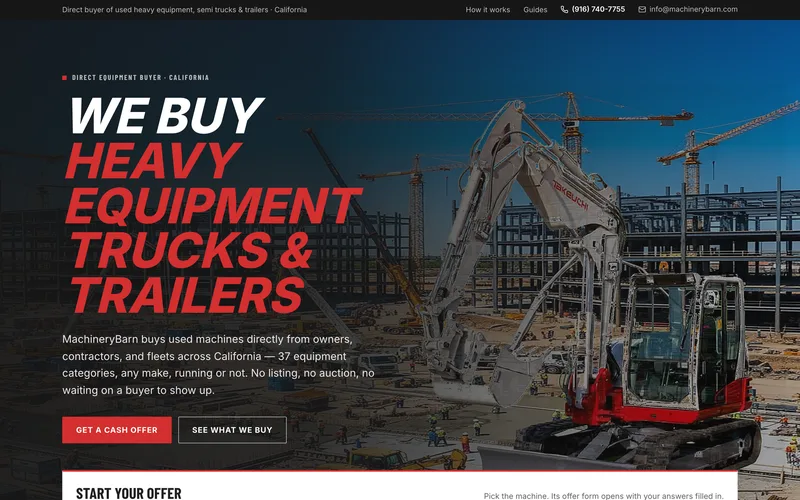
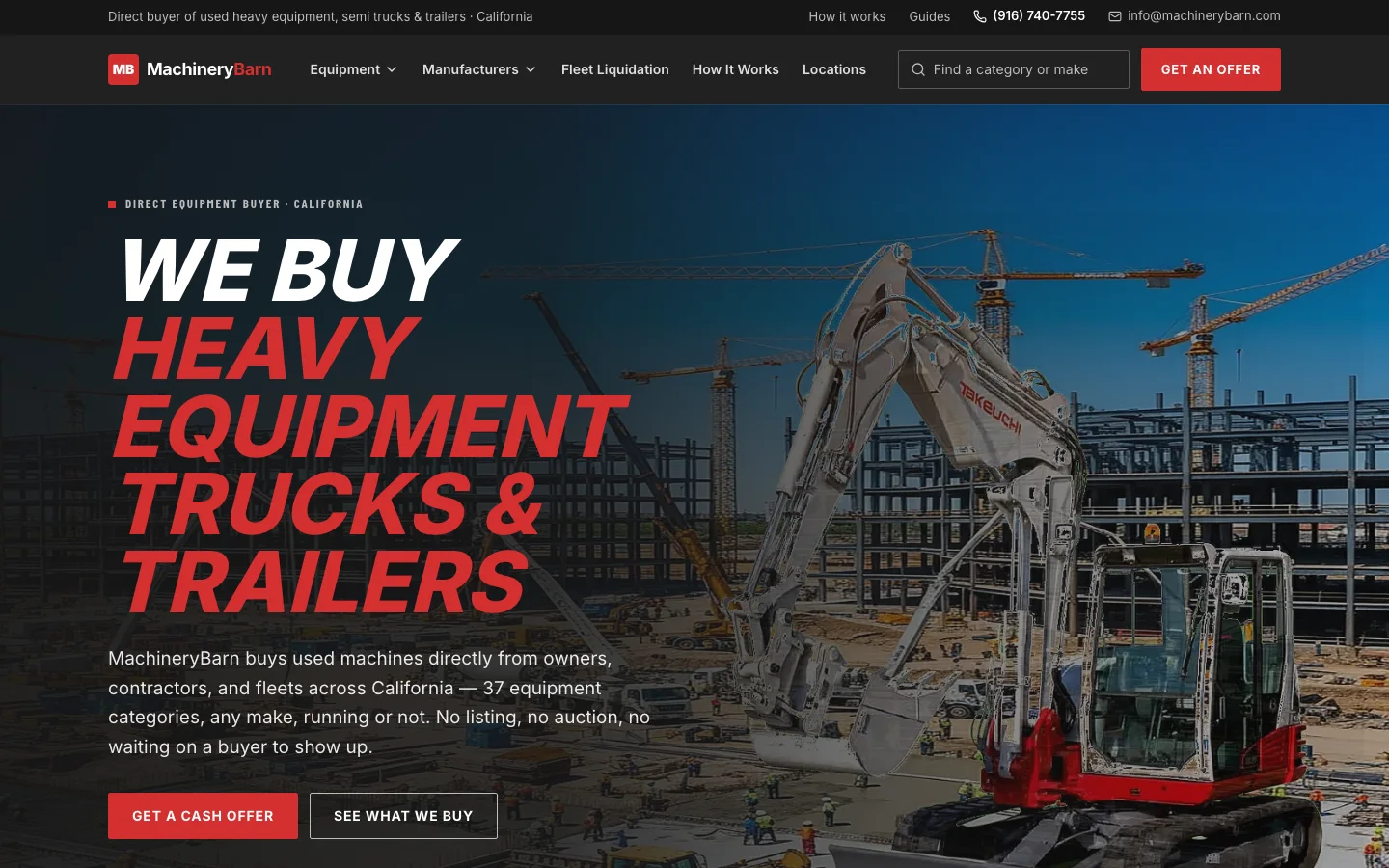
MachineryBarn is a California company that buys used heavy equipment, semi trucks and trailers directly from owners, contractors and fleets. It describes itself as a direct buyer, not an auction house, dealer or listing service. It says it buys 37 categories, from excavators, dozers and forklifts to flatbed and reefer trailers, RV trailers and camper vans, running or not. You send the details and photos, it sends a written cash offer, and if you accept it arranges transport and pays by wire transfer or certified check once the machine is collected and verified. Its closest coverage is the Sacramento Valley and Placer, Nevada and Yuba counties. Offers are free; reach it at (916) 740-7755 or info@machinerybarn.com.
| Business | MachineryBarn |
|---|---|
| What it does | Buys used heavy equipment, semi trucks, trailers, parts, attachments, RV trailers and campers for cash |
| Who it buys from | Owners, contractors, owner-operators, rental yards, trucking fleets and public agencies with surplus |
| Service area | California, with coverage closest in the Sacramento Valley and Placer, Nevada and Yuba counties |
| Street address | Not published (the company works by phone, email and online form and collects from your site) |
| Owner / lead | Not named on the site |
| In business since | Not published |
| Price | Free, no-obligation written offer; what it pays depends on the machine and is not published |
| Payment | Wire transfer or certified check, once the equipment is collected and verified |
| Hours | Not published |
| Phone / email | (916) 740-7755 · info@machinerybarn.com |
| Website | machinerybarn.com |
What is MachineryBarn?
MachineryBarn is a buyer, not a seller. It does not list your machine, run an auction or take it on consignment. It makes you a written cash offer for the machine itself, and if you accept, it arranges to collect it and pays you. Its site puts it this way: "We are a direct buyer, not an auction house, dealer, or listing service."
The company says it buys 37 categories of equipment, any make, in any condition. That covers three broad groups:
- Heavy equipment: excavators, mini excavators, skid steers, wheel loaders, dozers, loader backhoes, cranes, forklifts, telehandlers, motor graders, boom lifts, off-highway trucks, compactors and rollers, wood chippers, trenchers, drill rigs, forestry machines, sweepers, aggregate equipment, asphalt pavers, attachments and parts.
- Trucks and trailers: semi trucks (sleeper cabs and day cabs), dump trucks, and flatbed, dry van, reefer, lowboy, step deck, dump, car hauler and enclosed car hauler trailers.
- Recreational units: RV trailers (travel trailers, fifth wheels, toy haulers), truck campers and Sprinter-style camper vans.
It buys single machines and whole fleets. Its sellers, as the site describes them, include contractors winding down a project or a fleet, owner-operators, trucking companies, equipment rental yards, county agencies disposing of surplus, and private owners with one machine sitting idle.
The selling points it repeats across the site are a written offer rather than a verbal estimate, transport arranged by the company with its cost built into the offer, no listing fees or commissions, and "the amount quoted is the amount paid."
Is MachineryBarn legit?
People ask this before handing a machine worth tens of thousands of dollars to a company they found online. Here is what the site lets you check, and what it doesn't publish.
- Direct contact details. A phone number, (916) 740-7755, and an email address, info@machinerybarn.com, appear on every page. The 916 area code covers the Sacramento region, which matches the area the company says it serves most closely.
- Offers in writing. The company says every offer is written and that it does not give verbal-only quotes. A written offer is something you can compare with other options and hold the company to.
- Payment methods you can verify. It pays by wire transfer or certified check. Both can be confirmed with your bank before you release the machine.
- Paperwork on every purchase. The site says every purchase is documented with a bill of sale, the title or ownership transfer, and a payment record.
- Detailed, specific guidance. The category pages explain in detail how each type of machine is valued and inspected, and its guide to selling with a lien cites the Uniform Commercial Code and the California DMV and is labeled as general information, not legal or financial advice.
What isn't published: a street address, the names of the owners or staff, a founding date, business hours, and any license or registration numbers. We did not find a public record to add. If those matter to you, ask the company directly for its legal business name and where it is registered, and ask who will be your contact. You can also look the business up yourself in the California Secretary of State's business search.
A practical safeguard with any buyer: get the offer in writing, confirm how and when payment is made, and don't sign over a title or release a machine until you know payment is arranged as agreed.
Who owns or runs MachineryBarn?
The site does not name an owner, founder or manager. It speaks as "we" throughout. For fleet sales it says "the same person handles the list from first call to final payment," and it describes "direct communication" with "no marketplace and no middleman." If you want to know who you'll be dealing with, ask for a name when you call.
What heavy equipment does MachineryBarn buy?
The site has a page for each category. These are the published descriptions of what it covers.
| Category | What the company says it buys |
|---|---|
| Excavators | Tracked and wheeled, zero-tail-swing, long-reach and demolition machines, from 10-tonne class up to mass-excavation size |
| Mini excavators | Compact machines; it asks what attachments come with it |
| Skid steers | Skid steers and compact track loaders, with attachments |
| Wheel loaders | All sizes, from compact to 10-yard production loaders |
| Dozers | Crawler dozers from D3 to D11 size classes, priced on undercarriage and hours |
| Loader backhoes | All makes and models |
| Cranes | From 15-ton boom trucks to 500-ton crawler cranes |
| Forklifts | Warehouse, rough terrain and reach trucks |
| Telehandlers and boom lifts | Telescopic handlers; boom lifts, scissor lifts and aerial platforms from 19 ft to 185 ft |
| Motor graders and compactors | Road graders; vibratory, padfoot and pneumatic rollers |
| Off-highway trucks | Articulated dump trucks and rigid-frame haul trucks |
| Forestry and chippers | Feller bunchers, skidders, forwarders, mulchers, harvesters; brush and whole tree chippers, stump grinders |
| Trenchers and drill rigs | Walk-behind, ride-on and chain trenchers; directional drills, auger rigs and foundation drills |
| Sweepers, aggregate, paving | Broom, regenerative air and vacuum sweepers; crushers, screeners, conveyors and wash plants; track and wheel pavers |
| Attachments | Buckets, hammers, grapples, thumbs, augers and couplers, with or without the machine |
| Parts | Engines, transmissions, final drives, hydraulic pumps, cylinders, undercarriage, cabs and whole parts machines |
The site also mentions specialty rigs such as concrete pumps and cold planers, and says that if a machine is used in construction, mining, forestry or demolition, it is interested.
Parts sellers get specific advice: photograph every tag and plate, and tell the company which machine the parts came from. The site explains that identified parts can be sold as inventory, while unidentified parts, or parts from models nobody runs any more, may only be worth scrap. It collects parts on a flatbed or in a container and asks whether there is a forklift or loader on site and whether items are on pallets.
Semi trucks, trailers, RVs and campers
Semi trucks. MachineryBarn buys Class 8 tractors, sleeper cabs, day cabs, vocational and heavy-spec tractors, yard tractors and dump trucks, running or not. Its truck page says that in California, engine year and emissions equipment often matter more than the odometer, because state rules limit which heavy diesel trucks can be registered and run here. A truck that can't be registered for California use still has a market out of state and for export, and the company says its offer reflects that buyer. It asks owners to say up front if a truck is a glider (a new chassis with a rebuilt older drivetrain) or if the aftertreatment system has been deleted, since both change who can legally buy it. It buys trucks that have failed a DOT inspection or have expired registration.
Trailers. It buys flatbeds (48 ft, 53 ft, combo, aluminum and steel), dry vans, reefers with working or non-working Carrier or Thermo King units, lowboys from 35 to 100 tons, step decks, end, belly and side dump trailers, and open and enclosed car haulers. It values trailers on floor, tires, frame and rust, brakes, lighting and DOT status, and cosmetics, and buys trailers with expired registration or planned non-operation status.
RV trailers and campers. It buys travel trailers, fifth wheels, toy haulers and pop-ups, plus truck campers and camper vans (Mercedes Sprinter, Ford Transit and Ram ProMaster builds, professional or DIY). The RV page is blunt that these are "valued almost entirely on water": soft floors, roof and seal condition, and delamination matter more than appliances. It still buys water-damaged trailers and asks sellers to say where any soft spots are and how long the unit has been parked. For campers, it asks whether all four jacks work, since that decides how the camper is loaded.
Which brands does MachineryBarn buy?
The site has manufacturer pages for 20 makes: Caterpillar, John Deere, Komatsu, Volvo, Bobcat, Kubota, Freightliner, Peterbilt, Kenworth, Case, Hitachi, Liebherr, JCB, Vermeer, Bandit, JLG, Great Dane, Utility Trailer, Wabash and Fontaine. It says it buys other makes too, and its truck pages also list International, Mack and Western Star. On the excavator page it names the model families it sees most often, such as the Caterpillar 300 series, Komatsu PC series, John Deere G and P series and Volvo EC and ECR series.
Where does MachineryBarn buy?
MachineryBarn says it buys across California. Its home page adds that coverage is closest in the Sacramento Valley and in Placer, Nevada and Yuba counties, "where most of our collection routes run," and that if your machine is elsewhere in the state it will "say plainly whether we can reach it."
- Placer County: Roseville, Rocklin, Lincoln, Auburn, Colfax, Loomis and the Lake Tahoe area.
- Nevada County: Grass Valley, Nevada City, Truckee, Penn Valley and nearby communities.
- Yuba County: Marysville, Wheatland, Olivehurst, Linda, Browns Valley and foothill communities.
The site also has pages for cities well beyond those counties, including Sacramento, Fresno, Los Angeles, San Diego and Riverside, and one page says it serves 62 cities across California. If you are outside the core counties, ask early whether collection is possible at your location.
Remote and mountain sites. The company says transport is matched to the site, with winch trucks and lowboys for steep ranch roads, timber landings and remote job sites. It notes that remote mountain sites and steep or single-track access take longer to arrange, so describe the access when you send the details.
Hours and office. The site does not publish business hours or a street address. You start by phone, email or the online form, and the company collects the machine from where it sits: a yard, job site, farm, truck stop, repair shop or storage lot.
How much will MachineryBarn pay, and what does it cost you?
There are no published prices for what MachineryBarn pays, and there can't really be: every offer is built from the specific machine. Its guide on non-running equipment makes the same point, saying any fixed percentage figure "would be invented."
What the company does publish is what selling to it costs you:
| Item | What the company says |
|---|---|
| Getting an offer | Free, with no obligation |
| Listing fees or commission | None |
| Transport or pickup | Arranged by the company; the cost is priced into the offer, not deducted from it |
| Deductions at collection | None: "the amount quoted is the amount paid" |
| Holdbacks or payment terms | "No net-30 terms and no holdbacks" |
| Repairs or cleaning before sale | Not needed; it buys as-is |
One thing to read correctly: "transport priced into the offer" means the company's hauling cost is part of how it arrives at its number. The figure you're offered is already net of that. When comparing it with an auction, compare the offer against the auction's likely result minus commission, transport to the yard and any listing or cleaning costs.
To find out what your machine would bring, send the details through the form on the site or call (916) 740-7755. The company says that if a number looks low, you can ask and it will tell you which factor drove it.
How the offer is priced
Across the site, the company says it prices from what you report: make, model, year, meter reading (hours or miles), condition, attachments and where the machine sits. It also mentions current market demand and parts availability for the model. Some of the specific factors it calls out:
- Tracked machines: undercarriage first. The excavator page calls it "usually the largest single wear cost," followed by hydraulic health, hours and emissions tier.
- What the hours were spent on: it says 6,000 hours of trenching is gentler on an excavator than 3,000 hours running a hydraulic breaker, so tell it what the machine has been doing.
- Emissions tier in California: it notes that older Tier 3 machines often draw stronger interest from out-of-state or export buyers, because of California's CARB rules for off-road diesel fleets, and suggests checking your own reporting obligations with CARB directly.
- Trucks: engine model year and emissions equipment, aftertreatment condition, engine make, transmission type, mileage and engine hours, axle ratio, tires, DOT inspection status, and on sleepers, the APU and interior.
- Trailers: floor condition, tires, frame and rust, brakes, lighting and DOT status, then cosmetics.
- RVs: water intrusion, roof, frame and running gear, slide-outs, then appliances.
- Records: documented service history "answers questions that otherwise get priced as risk."
The company's repeated advice is to describe faults honestly and precisely. Its reasoning: a named fault is a known repair cost, while an unexplained one has to be priced as an unknown, and an accurate description "avoids the offer changing later." It also says that if the machine turns out differently than described, "we talk to you before anything changes."
How selling to MachineryBarn works, step by step
- Send the details. Use the online form (pick the equipment type, make, year and condition), call, or email. Give make, model, year, hours or miles, condition, location and photos if you have them. The company suggests including the serial number or VIN, noting damage, modifications and attachments, and mentioning service records.
- The company reviews it. It may ask about anything that affects the price. There is no appraisal appointment to book.
- Get a written offer. It sends a firm, no-obligation written cash offer. If the number seems low, ask what drove it.
- Accept and schedule. If you accept, collection is scheduled around your operation, and title and paperwork are worked through before collection.
- Collection. The company arranges transport suited to the machine and site, including winching non-running units and any permits a wide or heavy load needs. A running truck with current registration and insurance can be driven to the company; others are towed or trailered.
- Payment. Payment is issued by wire transfer or certified check once the equipment is collected and verified.
How long does it take? The company doesn't promise a number of days. It says the timeline is "set by paperwork, not a sale date." A single unit with a clean title and clear photos is the quickest path. What slows things down is almost always paperwork: a lien to clear, a title in a prior owner's name, or an estate that hasn't been settled. Tell the company at the start if one of those applies so it can be worked on in parallel.
What to have ready
The company lists these, and says you don't need everything to get started:
- Proof of ownership: title, registration or bill of sale.
- Photos: overall condition, the serial plate and any damage.
- Meter reading: hours or mileage, and whether the meter has ever been replaced.
- Service records: optional, but the company says they can increase the offer.
- For machines: attachments and coupler type, auxiliary hydraulics, undercarriage percentage if measured, what the machine mostly did, and whether it can be loaded under its own power.
- For trucks: engine make, model and emissions model year, transmission, sleeper or day cab, DOT inspection status, any fault codes or derate, and title status.
Titled vs untitled. The site explains a point many sellers miss. Construction equipment such as an excavator is generally not titled in California; ownership transfers by bill of sale against the serial number, so photograph the serial plate early. Semi trucks, dump trucks, trailers and RV trailers are titled and transfer through the California DMV, with an odometer disclosure for trucks. Missing, salvage, rebuilt or out-of-state titles are workable, the company says, but add steps and should be raised before an offer.
Business, estate or insolvency sales. If the equipment belongs to a company, the site says to confirm who is authorized to sell it, usually through a corporate resolution or operating agreement. In probate or insolvency, the authority to sell may sit with an executor, administrator or trustee, and that needs to be established first. The company says it can work from the serial plate when an estate's paperwork is thin.
Selling equipment you still owe money on
MachineryBarn says it buys equipment and trucks with outstanding finance. Its published process: you get a written payoff quote from your lender (it states what is owed and is valid to a set date), the payoff goes to the lender from the sale, the lender releases its interest, and you receive the balance. You don't need to pay off the loan before selling.
- Equipment: the lender's interest usually shows as a UCC-1 filing with the Secretary of State. It is cleared when the lender files a termination statement.
- Trucks and trailers: the lien is recorded on the California title, and the lender often holds the title until payoff.
- Owing more than it's worth: the company's guide says the sale alone won't clear the debt in that case, and the shortfall is a discussion to have with your lender first.
- Leases: if the paperwork says lease or rental-purchase, the lessor owns the machine and it isn't yours to sell. Start with the lessor.
The company's main advice is to tell it about any finance at the start, because a release runs "on the lender's schedule, not yours." Its own guide says it is general information, not legal or financial advice; neither is this guide. Your finance contract governs, and for insolvency, probate or disputed ownership, talk to a qualified professional.
Selling non-running or damaged equipment
MachineryBarn says it buys equipment that is non-running, damaged, partially dismantled or abandoned, including seized engines, blown hydraulics, fire damage and flood units. It explains that non-running machines are bought for repair and resale, for parts, for export, and as cores for rebuild programs.
Its guidance for sellers in that position:
- Describe what happened and when it stopped, rather than guessing at a diagnosis.
- Send photos of the machine, the problem area and any fault codes.
- Point out what still works: good tracks, a clean cab, recent repairs.
- Don't pay for repairs before getting a quote. On undercarriage specifically, it says you rarely recover the cost of replacing it to sell.
Non-running units are collected with winch trucks, tilt decks or lowboys, and the company says that cost is in the offer.
Fleet liquidation
For sellers with several units, MachineryBarn offers what it calls fleet liquidation, from downsizing five units to closing out 100 or more. Its process:
- Send the list in any format: spreadsheet, photos or a simple list with make, model, year, hours or mileage and condition. For trucks, include VINs and engine years.
- Get one package offer covering every unit, rather than unit-by-unit haggling.
- Logistics are handled across yards, job sites and storage locations, including permitting and scheduling, and pickups can be scheduled around your operation rather than all at once.
- Payment on collection by wire or certified check; large fleets can be settled in stages as units are released.
It names construction companies, trucking operations, rental yards and municipal or government fleets as typical sellers, and says one person handles the list from first call to final payment. Its fleet guide also reminds sellers to check tax-year timing with their accountant, since the disposal year affects depreciation recapture.
How it compares with other ways to sell
This table uses generic categories. The trade-offs in the first row are the company's own description; MachineryBarn's own guide also says an auction can beat a direct offer when a machine is scarce and bidding is strong.
| Option | What you get | Typical trade-off |
|---|---|---|
| Direct buyer (MachineryBarn) | A written offer before you commit, transport arranged, no commission, buys non-running units | No upside if demand is strong; the offer is the offer |
| Equipment auction (live or online) | Competitive bidding, which can exceed a private offer for in-demand machines | Price unknown until the sale; seller commission, transport to the yard, often listing or cleaning costs; you wait for the sale and settlement |
| Dealer trade-in | Convenience when you're buying a replacement machine from that dealer | Trade value and new-machine price are one negotiation; only works if you're buying |
| Dealer consignment | A dealer markets the machine for you | Commission, and the machine may sit for a while |
| Private sale or online listing | You set the price and keep the full sale amount | Listing fees, calls from casual buyers, test drives, buyer financing, and you handle paperwork and transport |
A sensible approach with any high-value machine is to get a written offer from a direct buyer and compare it with what you would realistically net through another channel after fees and time.
Who it suits, and who should look elsewhere
A good fit if you…
- Own equipment, a truck or a trailer in California, especially around Sacramento or in Placer, Nevada or Yuba County
- Want a firm written number before you commit, rather than waiting for an auction result
- Have a machine that doesn't run, is damaged, or has sat for years
- Don't want to arrange hauling, especially from a remote or steep site
- Are winding down a fleet, a business or an estate and want one point of contact
- Still owe money on the machine and want the payoff handled within the sale
Look elsewhere if you…
- Want to buy equipment: MachineryBarn buys, it doesn't sell to the public through its site
- Have a scarce, in-demand machine and are willing to wait and take on auction risk for a possibly higher price
- Are trading up at a dealer and want the trade-in folded into that deal
- Have equipment outside California
- Need to deal with a business that publishes a street address, named staff and opening hours before you'll engage
- Lease the machine: the lessor owns it, so start there
Questions to ask before you accept an offer
- What is your full legal business name, and who will be my contact through collection and payment?
- Which factors drove this number, and what would change it?
- What exactly is verified at collection, and what happens if something differs from my description?
- Will payment be a wire or a certified check, and when exactly is it issued relative to pickup?
- Can you collect from my location, and what does the access need to look like?
- Which attachments, extras and records are included in this offer?
- How long is the offer good for?
- If there is a lien, who contacts the lender, and when do I receive the balance?
How to get started
- Find your category on the equipment categories page, or use the offer form on the home page.
- Gather photos of the machine, the serial plate and any damage, plus the meter reading and proof of ownership.
- If there is finance on it, get a written payoff quote from your lender first (see the company's guide to selling with a lien).
- For several units, send a list through the fleet liquidation page.
- Or call (916) 740-7755 or email info@machinerybarn.com.
Terms you'll see on the site
- Undercarriage: the tracks, chains, links, rollers, idlers, sprockets and shoes on a tracked machine. They wear as a set and are a major cost.
- Meter reading: engine hours on equipment, or miles (and engine hours) on a truck.
- Emissions tier: the EPA engine emissions standard a machine was built to, such as Tier 3 or Tier 4 Final.
- CARB: the California Air Resources Board, which regulates in-use diesel fleets and trucks in the state.
- Aftertreatment (DPF, DEF, SCR): the exhaust systems on modern diesel trucks that cut emissions.
- Derate: when a truck's engine limits its own power, often because of an emissions fault.
- Glider: a new truck chassis fitted with a rebuilt older engine and drivetrain.
- Class 8: trucks over 33,000 lb gross vehicle weight rating, which covers over-the-road tractors.
- Lowboy: a low trailer used to haul heavy equipment.
- Reefer: a refrigerated trailer.
- UCC-1 filing: the public record a lender files to claim an interest in equipment that has no title.
- Payoff quote: a lender's written statement of what is owed to release its interest, valid to a set date.
Frequently asked questions
What does MachineryBarn do?
MachineryBarn buys used heavy equipment, semi trucks, trailers, parts, RV trailers and campers directly from owners and fleets in California. It makes a written cash offer, arranges transport and pays by wire transfer or certified check.
Where is MachineryBarn located?
MachineryBarn does not publish a street address. It says it buys across California, with coverage closest in the Sacramento Valley and Placer, Nevada and Yuba counties, and it collects machines from where they sit.
Does MachineryBarn charge a fee to sell?
No. MachineryBarn says the offer is free and no-obligation, with no listing fees, commissions or deductions at collection. Its transport cost is built into the offer.
How much will MachineryBarn pay for my equipment?
It depends on the machine. MachineryBarn prices each offer from the make, model, year, hours or miles, condition, attachments and location, and does not publish price lists. Send the details or call (916) 740-7755 for a written offer.
How does MachineryBarn pay?
By wire transfer or certified check, issued once the equipment is collected and verified. The company says there are no net-30 terms and no holdbacks.
How fast can I sell to MachineryBarn?
MachineryBarn doesn't publish a set number of days. It says a single unit with a clean title and clear photos is quickest, and that liens, titles in a prior owner's name or unsettled estates are what usually slow a sale.
Does MachineryBarn buy equipment that doesn't run?
Yes. MachineryBarn says it buys running, non-running, damaged, dismantled and flood- or fire-damaged equipment, and arranges winch trucks, tilt decks or lowboys to collect it.
Can I sell equipment to MachineryBarn if I still owe money on it?
Yes. MachineryBarn says the lender's payoff is settled from the sale and you receive the balance. Get a written payoff quote from your lender and mention the finance at the start.
Does MachineryBarn pick up the equipment?
Yes. MachineryBarn arranges transport from your yard, job site, farm or storage lot, including remote and steep sites, and prices that cost into the offer.
Does MachineryBarn buy semi trucks that can't be registered in California?
Yes. MachineryBarn says older trucks still have a market out of state and for export, and its offer reflects that buyer. Tell it the engine model year up front.
Does MachineryBarn buy RVs and campers?
Yes. MachineryBarn buys travel trailers, fifth wheels, toy haulers, pop-ups, truck campers and camper vans, including units with water damage, valued mainly on floors, roof and seals.
Can MachineryBarn buy a whole fleet?
Yes. MachineryBarn prices a fleet list as one package with one point of contact, schedules pickups around your operation and can settle large fleets in stages.
Does MachineryBarn sell equipment?
MachineryBarn's site is about buying from owners; it does not list machines for sale. It describes itself as a direct buyer, not a dealer, auction or listing service.
Who owns MachineryBarn?
The MachineryBarn website does not name its owner or staff. Ask for your contact's name and the company's legal business name when you call (916) 740-7755.
Sources
All pages checked on 22 October 2026.
- MachineryBarn home page: machinerybarn.com
- How it works: machinerybarn.com/how-it-works
- Why sell to us: machinerybarn.com/why-sell-to-us
- Locations: machinerybarn.com/locations
- Equipment categories: machinerybarn.com/sell
- We buy heavy equipment: machinerybarn.com/we-buy-heavy-equipment
- Sell heavy equipment: machinerybarn.com/sell-heavy-equipment
- Sell semi trucks: machinerybarn.com/sell-semi-trucks
- Sell trailers: machinerybarn.com/sell-trailers
- Fleet liquidation: machinerybarn.com/fleet-liquidation
- Category pages: Excavator, Semi truck, RV trailer, Camper, Parts
- Caterpillar brand page: machinerybarn.com/brands/caterpillar
- Fresno excavator page: machinerybarn.com/sell-excavator-fresno-ca
- Selling equipment with a lien: resource page
- Guides: Sell vs. trade-in vs. auction, Selling non-running equipment, How much is my excavator worth, Preparing equipment for sale, Fleet liquidation guide
- California Secretary of State business search: bizfileonline.sos.ca.gov



