
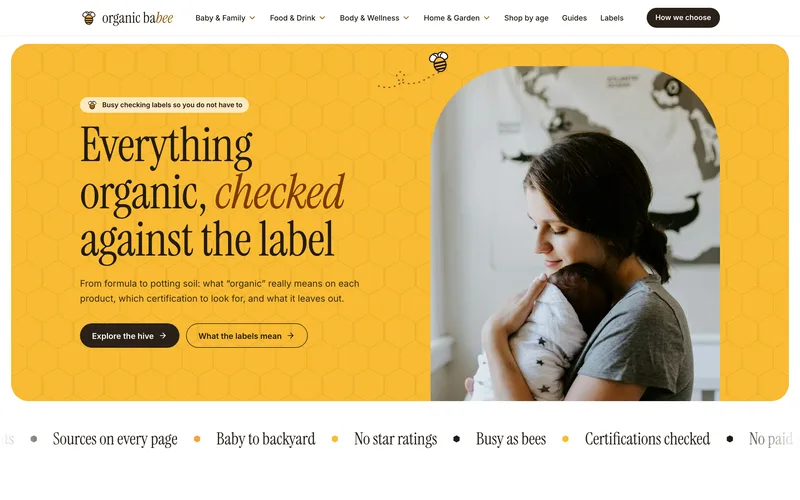
It checks labels against certifier records instead of testing products. Here is what it covers and how it works.
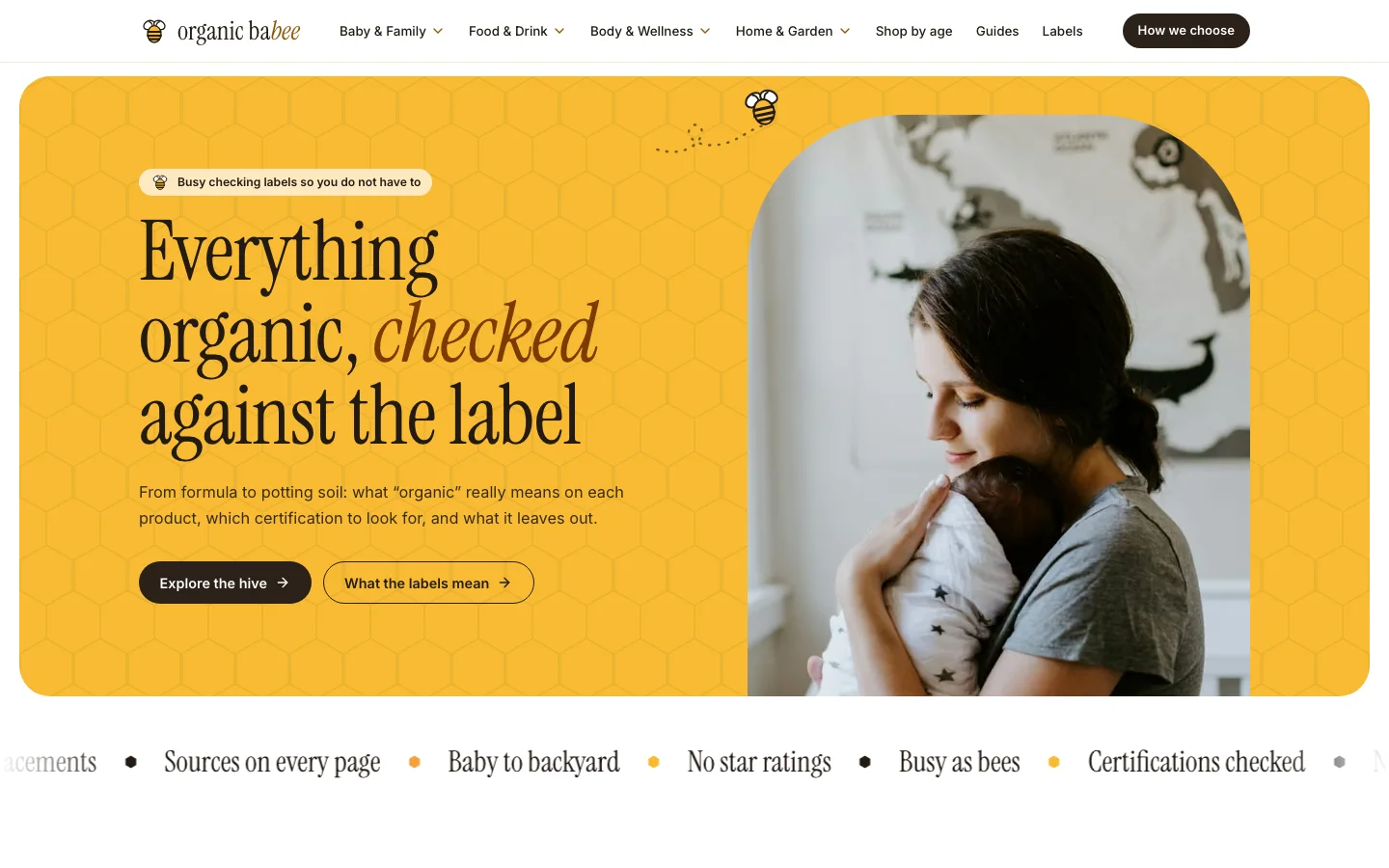
Organic Babee is an eSEOspace project: we built and run its website. It is run by eSEOspace (it is not an outside eSEOspace client), so read this guide as a description written by the people behind the site. It uses the site's own published pages, checked on 22 October 2026, and every source is listed at the end. We don't rate or score the sites we work on. Pages and product listings change, so confirm details on organicbabee.com before you buy anything.
The short answer
Organic Babee (organicbabee.com) is a free online guide to certified organic products for babies, families and the home. It does not sell anything and does not test products. Instead it checks each listed product against the brand's own page and the certifier's public records, then says what the certification covers and what it leaves out. The site lists 465 products from 271 brands across 126 categories in 18 departments, from crib mattresses and baby clothes to coffee, cleaners, potting soil and pet food. It also explains 16 labels such as USDA Organic and GOTS. It earns money from affiliate links and publishes no prices, ratings or rankings.
| Business | Organic Babee |
|---|---|
| What it does | Online consumer guide that explains organic labels and lists products whose certifications it has checked |
| Based in / Service area | Online only; no street address published. Pages are written around US rules (USDA, FDA, CPSC) |
| Run by | eSEOspace (the site itself names no owner or editor) |
| Size, as published | 18 departments, 126 categories, 465 products, 271 brands, 16 label pages, about two dozen guides |
| Price | Free to read; no accounts, no checkout. The site does not list product prices |
| How it is paid for | Affiliate links on some product buttons |
| What it does not do | Test products, give star ratings or scores, accept payment for listings, give medical advice |
| Phone / email | Not published when we checked |
| Website | organicbabee.com |
What is Organic Babee?
Organic Babee is a reference website about the word "organic" on everyday products. Its starting point is that the word means different things on different products. In its own words: "On food it is a legal term with a federal seal behind it. On a bottle of lotion it may mean very little." The site's job is to close that gap: for each kind of product it explains what organic can mean, names the certification worth looking for, and lists products that carry it.
The site says it "started with babies, because that is where parents ask the question most urgently, and kept going through the rest of the house." That is where the name comes from, and why the site still opens with baby and family departments before food, body care, home and garden. The look follows a bee theme (honeycomb panels, a bee logo, lines such as "We do not test products. We bee-line for the paperwork."), but the content itself is plain and sourced.
It is a publication, not a shop. You can't buy anything on organicbabee.com. Each product card ends with a button that takes you to the brand's own site or a retailer, where the price, stock and checkout live.
Three features set the format:
- A certification check, not a product test. The site says plainly that it does not buy, test, taste or use the products it lists.
- A "what it does not cover" note on each product. For example, a crib mattress card points out that GOLS covers the latex layer only, and a diaper page says no disposable diaper is certified organic at all.
- Sources on every page. Category, label and guide pages end with a list of the outside pages they were written from (USDA, FDA, CPSC, the American Academy of Pediatrics, certifiers), with the date those pages were read.
Who owns or runs Organic Babee?
Organic Babee is run by eSEOspace, the web and search agency that publishes this guide. eSEOspace built the website and operates it. The site itself does not name an owner, editor or writer, and its pages carry no personal bylines. Its footer reads "© 2026 Organic Babee."
The site's About page describes it as "an independent publication" that "is not owned by a brand, a retailer or a certifier." That matches what we know as the people running it: no product brand, store or certification body owns the site. If you want to raise a correction, the site's own pages invite readers to "tell us" when a listing is out of date.
Is Organic Babee legit and independent?
This is a fair question to ask about any site that links to products. Here is what you can check on the site yourself, without taking anyone's word for it:
- The source of every certification is linked. Each product card has a "Checked against" line that links to the page the claim was confirmed on: the brand's product or certifications page, or the certifier's public database. You can open it and see the same thing.
- The method is published. The How we choose page lists four checks every product goes through (covered below).
- The money is disclosed. An affiliate notice sits in the footer of every page and above each product list, and a full affiliate disclosure page explains which links can earn a commission.
- It says what it will not claim. The site lists four things it will not say: that a product is the safest, healthiest or purest; that anything is chemical-free or toxin-free; that an organic product treats, prevents or cures anything; or what something costs.
- No paid placements or sponsored posts. The disclosure page says: "We do not accept payment to list a product, and we do not publish sponsored articles." It also says it does not accept free samples in exchange for coverage.
What you won't find: a named editor, a phone number, an email address or a street address. The site is also new: its privacy policy is dated effective 11 October 2026, and its pages say their sources were read on 11 and 12 October 2026. If those things matter to you, treat each card as a starting point and follow its "Checked against" link before you buy.
How does Organic Babee make money?
Through affiliate links. The disclosure page says: "If you click one and buy something, the brand or retailer may pay us a commission. You pay the same price as you would otherwise."
The rules it publishes around those links:
- Which links can pay. Only the buttons on product cards ("View at" followed by the brand name, or "Buy at" on the age list). Links in the Sources and "Checked against" lists are never affiliate links, and links between pages on the site are ordinary links.
- Not every button pays. "Many brands we list have no affiliate program, or we have not joined it. They are listed all the same."
- What a commission does not buy. A place on a page, a better position, or silence: "If a certification covers only part of a product, the card says so whether or not the link pays."
- Order. The checks come first and "the link is added afterwards." Products on a category page are listed in no ranked order; those with a photo are shown first.
The privacy policy adds that the site does not use advertising pixels or session recording.
How Organic Babee chooses products
The How we choose page sets out four checks every product goes through:
- The product exists and is named correctly. The brand's own page for the product or product line is opened. "If the brand no longer sells it, it is not listed."
- Each certification is confirmed. "A seal is listed only if we found it on a page we can link to": the brand's product or certifications page, or the certifier's public database. Those pages appear under each product as "Checked against."
- What the certification applies to is checked. "A certified organic cotton cover does not make a mattress organic. 'Made with organic oats' is not the same as a USDA Organic product." Where a seal covers only part of a product, the card says so under "Good to know."
- The category sets the bar. Each department states the standard it accepts. For food that is the USDA Organic seal; for clothing and bedding it is GOTS. For things that can't be certified organic, the page says which third-party standard stands in.
Each department page has a short "Our standard here" box. The Nursery & Sleep department, for example, accepts "GOTS for cotton and wool, GOLS for latex, and GREENGUARD Gold or MADE SAFE for mattresses and furniture, which are assembled products rather than crops."
Each category page then follows the same pattern: a plain answer to what organic means for that product, a "Look for" list, a "Be wary of" list, the products, a section on the rules that apply (for crib mattresses, the federal crib mattress rule and the AAP's safe sleep guidance), a "Questions people ask" section, and sources.
How to read a product card
Every product on a category page is shown as a card with the same parts:
| Part of the card | What it tells you |
|---|---|
| Brand and a short descriptor | Who makes it and one line on what sets it apart, such as "No latex, wool or polyurethane foam" |
| Product name | The exact product or product line that was checked |
| Label chips | The certifications confirmed for that product, such as GOTS, MADE SAFE or GREENGUARD Gold |
| Description | What the brand states about the product and its materials, in the site's words |
| Good to know | What the certification does not cover, plus practical notes (for example a latex or wool allergy warning on a mattress) |
| Checked against | Links to the brand page or certifier record used |
| View at button | A link to the brand or retailer; it may be an affiliate link |
A typical "Good to know" note, from the crib mattress page: "GOLS covers the latex only, as [the brand's] own certifications page says. Contains natural rubber latex and wool, which matter if your family has a latex or wool allergy." Under each list the site adds: "Certifications can lapse: check the certifier's database before you buy."
What it covers, department by department
The All categories page groups 18 departments under four headings. A sample of what each holds, as listed on the site:
| Group | Departments | Example categories |
|---|---|---|
| Baby & Family | Baby Formula & Feeding, Baby & Kids Clothing, Diapering & Baby Care, Nursery & Sleep, Toys & Play, Maternity & Postpartum, Organic Gifts | Bodysuits, sleep sacks, swaddles, cloth and disposable diapers, wipes, diaper cream, crib mattresses and sheets, wooden toys, teethers, play mats, baby shower gifts |
| Food & Drink | Organic Food & Pantry, Organic Drinks | Produce delivery, meat and poultry, dairy and eggs, grains and pasta, spices, snacks, frozen foods, meal kits, coffee, tea, juice, plant milks, kombucha, wine, beer and spirits |
| Body & Wellness | Supplements & Wellness, Skincare & Beauty, Personal Care, Organic Clothing | Face care, body lotion, mineral sunscreen, makeup, deodorant, toothpaste, period care, underwear, T-shirts, activewear, denim |
| Home & Garden | Bedding & Bath, Home & Kitchen, Cleaning & Laundry, Garden & Outdoor, Organic Pets | Mattresses, sheets, pillows, towels, cookware, food storage, rugs, curtains, cleaners, laundry detergent, seeds, potting soil, fertilizer, dog and cat food, cat litter |
The category pages we read list three to five products each. The home page totals are 465 products and 271 brands across 126 categories, "each confirmed on the brand's own page and the certifier's records."
Some categories are about things to avoid as much as things to buy. The organic dairy and eggs page, for instance, explains that "cage-free" with no organic seal means the hens "can be indoors for life and the feed need not be organic," and that "grass-fed" milk with no certifier named may still involve grain.
Products that can't be certified organic
A large part of the site covers products where the word organic has nothing behind it. The How we choose page explains: "A wooden toy, a stainless steel bottle or a compost bin cannot be certified organic by anyone." The site still covers those categories "because people look for them," and each product there carries a note saying it holds no organic certification and why it is on the page: the material, the disclosed ingredients, or a third-party test.
Examples from the pages we read:
- Wooden toys. "No wooden toy is certified organic, because organic rules cover crops and textiles, not lumber." The page tells readers to check FSC for where the wood came from, the named finish, and safety testing to the US toy standard, ASTM F963.
- Disposable diapers. "No disposable diaper is certified organic, because most of it is wood pulp, absorbent polymer and plastic film." The page accepts diapers with a named third-party mark such as OEKO-TEX Standard 100 or EWG Verified plus a full materials list.
- Bottles and feeding gear. Judged on material (glass, stainless steel, silicone), with a plain statement that they carry no organic certification.
- Cribs and nursery furniture. Listed for emissions testing (GREENGUARD Gold), wood sourcing and what the maker discloses.
The 16 labels it explains
The Labels section gives each seal its own page with the same layout: who runs it, what it certifies, what it does not, and how to check a claim yourself. The site's one-line summaries:
| Label | Used on | The site's summary, shortened |
|---|---|---|
| USDA Organic | Food, farm products, some personal care | The federal seal: at least 95 percent organic ingredients, yearly inspection; a production standard, not a nutrition or safety rating |
| GOTS | Textiles | Organic fiber plus every processing step; 95 percent for the "Organic" grade, 70 percent for "made with" |
| GOLS | Latex | Organic natural rubber latex foam; covers the latex, not the rest of the product |
| OEKO-TEX Standard 100 | Textiles | A lab test for harmful substances; not an organic certification |
| MADE SAFE | Household and personal products | Ingredient screening against a banned list of more than 15,000 substances |
| EWG Verified | Personal care, cleaning, baby products | EWG's mark for avoiding its ingredients of concern and full disclosure |
| GREENGUARD Gold | Furniture, mattresses | Chemical emissions into indoor air; not what a product is made of |
| FSC | Wood and paper | Where the wood came from, not what it was finished with |
| Non-GMO Project Verified | Food and supplements | Met the Non-GMO Project Standard; not an organic claim |
| Regenerative Organic Certified | Food and fiber | USDA Organic first, then added soil, animal welfare and worker rules |
| Demeter Biodynamic | Food, wine, body care | Whole-farm certification built on organic rules |
| COSMOS Organic | Cosmetics | Private standard: 95 percent of plant ingredients organic, at least 20 percent of the whole product |
| NSF/ANSI 305 | Personal care | "Contains organic ingredients": at least 70 percent organic content by weight |
| EU Organic | Food made or sold in the EU | The green leaf logo: at least 95 percent organic ingredients |
| OMRI Listed | Garden and farm inputs | Allowed for use in organic growing; does not mean the product is organic |
| EPA Safer Choice | Cleaning products | Every ingredient passed an EPA hazard review; not about organic content |
The section also lists other marks that appear on product cards but are not organic certifications, such as Fair Trade Certified, Leaping Bunny, Certified B Corporation, Certified Humane, UL Formaldehyde Free and Cradle to Cradle Certified. The site explains that these answer different questions: "how workers were paid, whether animals were used in testing, or whether a lab checked the contents."
The USDA Organic page, for example, walks through the four label tiers (100 percent organic, organic, "made with organic," and organic named only in the ingredient list), notes that only the top two may show the seal, and tells readers to look for the "Certified organic by" line on the package and then look the company up in the USDA Organic INTEGRITY Database.
The buy list by age
The Shop by age page is a short list for people who want one starting point per need rather than a whole category. It covers six ages:
| Age | Items listed | What the list covers |
|---|---|---|
| Newborn (0 to 6 months) | 14 | Crib mattress, fitted sheets, mattress protector, sleep sack, swaddles, bodysuits, sleepers, caps, diapers, wipes, diaper cream, changing pad, baby wash, laundry detergent |
| 6 to 12 months | 8 | Arms-out sleep sack, teether, play mat, bath toy, mineral sunscreen, sun hat, lotion, first blocks |
| 1 to 5 years | 10 | Everyday clothes, pajamas, socks, blocks, stuffed animal, crayons, play dough, bath toys, sunscreen, snacks |
| 5 to 10 years | 8 | Kids mattress, school clothes, pajamas, lunch box, snacks, paint, sport sunscreen, socks |
| 10 to 18 years | 10 | Deodorant, period care, body wash, shampoo, lip balm, sunscreen, underwear, T-shirts, leggings, shaving soap |
| 18 and up | 11 | Mattress topper, mattress, sheets, pillow, towels, a first pan, food storage, laundry detergent, dryer balls, all-purpose cleaner, coffee |
Each row shows one product picked from the matching category page, its label chips, a "Buy at" button and a link to the other options. Safety notes are built in: the newborn section repeats that "a baby sleeps on their back on a firm, flat mattress with only a fitted sheet: no blankets, pillows or bumpers in the crib," and the 18-and-up section reminds readers that most dorm beds are Twin XL.
The page answers a question many parents ask: why car seats, gates and strollers are missing. The site says these are "safety equipment, judged on crash and fit standards we do not review, so they are left to the specialists."
The brand directory
The Brands page lists all 271 brands that appear on category pages, with the certifications confirmed for the specific products listed, "not for everything the brand sells." Brands with two or more listed products also get their own page titled "Is [brand] organic?" The sitemap listed 73 of these when we checked.
Each brand page repeats a point the site makes often: "A seal belongs to a product, not a brand, so check the one you buy." The page shows each listed product, which category it appears on, what was confirmed, and how to check the certification yourself (for USDA Organic, the USDA Organic Integrity Database; for GOTS, the GOTS public database).
The guides
The Guides section holds the background reading that doesn't fit on a product page. Every guide lists its sources. The public guides fall into four groups:
- Reading labels: what "organic" legally means, organic vs natural vs non-GMO, how to read a USDA Organic label, how to spot greenwashing, GOTS vs OEKO-TEX, an A to Z organic glossary, and how product scanner apps work.
- Baby and kids: a non-toxic nursery checklist and an organic baby registry checklist.
- Food and budget: the 2026 Dirty Dozen and Clean Fifteen lists, organic on a budget, whether organic food is healthier, and organic store brands.
- Home and garden: switching to an organic home, choosing an organic mattress, non-toxic cleaning basics, indoor air quality, starting an organic garden, and home composting.
The guides keep the same careful tone as the product pages. The budget guide, for example, says the USDA Organic seal "means the same thing at every price," suggests store brands, frozen, canned and dry foods, and adds: "If the choice is conventional fruits and vegetables or fewer fruits and vegetables, buy the conventional ones." The guide on what organic means points out that the FDA does not define "organic" for cosmetics, and that for goods not made from crops "no organic standard applies."
Formula, supplements and pregnancy topics
The site's menu also includes departments for baby formula and feeding, supplements and wellness, and maternity and postpartum. The How we choose page sets the rule for these: they "describe labels and certifications only. They are general information, they are not medical advice, and each one tells you to make the decision with your pediatrician, doctor or midwife."
The About page says the same: "We are not doctors, dietitians or product testers, and nothing here is medical advice." The site will not say that an organic product treats, prevents or cures anything.
This guide is not medical advice either. For questions about infant formula, supplements, pregnancy or your child's health, talk to your pediatrician, doctor or midwife.
Does Organic Babee show Yuka scores?
No. Yuka is a barcode scanner app that gives food and cosmetic products a score out of 100. Organic Babee has a page about Yuka scores that explains why it doesn't print them: Yuka's terms allow use of its ratings for personal, non-commercial purposes and forbid collecting its data automatically, and because the site earns affiliate commissions, "printing those scores next to product links is not ours to do without Yuka's permission." The page states that Organic Babee is not affiliated with Yuka, is not endorsed by it, and does not use its data.
The same page explains why a certified organic food can still score low in the app. According to Yuka's published method, as summarized on the page, a food's score is 60 percent nutritional quality, 30 percent additives and 10 percent organic certification, so "organic cookies are still cookies." The site's suggestion is to use both: start with the certification, scan the barcode yourself, and read the reason for the score, not only the color.
Does it cost anything, and does it list prices?
Reading the site is free. There are no accounts, no subscriptions and no checkout: the privacy policy says, "You can read every page without telling us who you are, and we do not ask for your name, email address or payment details anywhere on the site."
The site also does not publish product prices, discounts or stock, by policy: "They change by the hour and you will see them on the brand's page." To see what a product costs, click its button and check the brand or retailer page. If you buy through an affiliate link, the site says you pay the same price you would otherwise.
Privacy, cookies and corrections
- What is collected. No accounts, comments or checkout. The hosting provider keeps standard server logs (IP address, browser type, the page requested and the time).
- Analytics. The privacy policy says the site may use Google Analytics to count visits and see which pages are read and which product buttons are clicked. It says it does not use advertising pixels or session recording.
- Affiliate cookies. When you follow a product link, the brand, retailer or affiliate network may set cookies to record that you came from Organic Babee. The site says it receives sales reports in aggregate and does not receive your name, address or payment details.
- Children. The site is written for adults and is not directed at children under 13.
- Corrections. "Brands reformulate and certifications lapse. Each page shows the date its sources were last read." The site asks readers to tell it about a product that has lost a certification or a claim that is out of date, and says it will check and correct the page. When we checked, no contact email was listed.
How it compares with other ways to check a product
| Option | What you get | Typical trade-off |
|---|---|---|
| Organic Babee | Label explanations, a short list of products per category with confirmed certifications, a note on what each seal leaves out, linked sources | No hands-on testing, no prices, short lists rather than full catalogs; certifications can lapse after the check date |
| Product-testing review site | Hands-on impressions of comfort, durability or taste | Often ranks or scores products; may say less about what a certification covers |
| Barcode scanner app | An instant score for the exact product in your hand | Each app uses its own formula; a score is not a certification |
| Certifier databases (USDA Organic Integrity Database, GOTS database) | The official record of who is certified | Lists companies and product types, not buying advice; takes some practice to search |
| The brand's own website | Full product details, prices, the brand's claims | Written to sell; may blur "made with organic" and certified organic |
| A large retailer's "organic" or "clean" filter | Convenience and prices in one place | Filters may rely on the seller's own claims rather than a named certifier |
Who it suits, and who should look elsewhere
A good fit if you…
- Want to know what "organic," "GOTS" or "made with organic" actually means on a label
- Are setting up a nursery or registry and want certified textiles and mattresses explained
- Prefer a short, checked list over hundreds of options
- Want to see the source behind every certification claim
- Are switching a household gradually and want a sensible order (food, cleaners, bedding, then big purchases)
Look elsewhere if you…
- Want hands-on testing, star ratings or a single "winner" in each category
- Want to compare prices or find deals
- Need medical, nutrition or feeding advice for a child or a pregnancy: ask a clinician
- Are shopping for car seats, gates or strollers, which the site does not cover
- Want a named expert author or a phone line to call
Checks to make before you buy
Organic Babee's own pages suggest a few checks worth doing on any product, listed or not:
- Does the certification cover the whole product, or one part (a cover, a layer, one ingredient)?
- Is a certifier named on the package or product page, with a certification or licence number you can look up?
- Is the certification still current in the certifier's database today, not only on the date the site checked it?
- Does the label say "organic" or only "made with organic," and does it carry the seal?
- For anything a baby sleeps on: does it also meet the federal safety rules and the AAP's safe sleep guidance? An organic label does not replace them.
- For allergies: does the product contain latex, wool or plant ingredients your family reacts to?
How to get started
- New to the topic? Read the guide to what "organic" legally means first.
- Shopping for a baby or a new home? Open the buy list by age.
- Looking for one kind of product? Find its category on the All categories page and read the "Look for" and "Be wary of" lists before the products.
- Unsure about a seal on a package? Look it up in the Labels section.
- Before you buy, open the card's "Checked against" link and confirm the certification is still current.
Terms you'll see on the site
- USDA Organic: the federal organic seal for farm products; at least 95 percent organic ingredients, not counting water and salt.
- "Made with organic": a USDA label tier for products with at least 70 percent organic ingredients; it may not carry the seal.
- GOTS: the Global Organic Textile Standard, which certifies organic fiber and every processing step after the farm.
- GOLS: the Global Organic Latex Standard, for organic natural rubber latex.
- OEKO-TEX Standard 100: a lab test of finished textiles for harmful substances; not an organic label.
- GREENGUARD Gold: a UL Solutions certification for low chemical emissions into indoor air.
- FSC: the Forest Stewardship Council label for wood and paper sourcing.
- Good to know: the line on each product card that says what the certification does not cover.
- Checked against: the links on each card to the brand or certifier pages used to confirm a claim.
- Greenwashing: vague or misleading environmental claims; the site has a guide on spotting them.
Frequently asked questions
What is Organic Babee?
Organic Babee (organicbabee.com) is a free online guide to certified organic products for babies, families and the home. It explains organic labels and lists products whose certifications it has checked against the brand's page and the certifier's records.
Who owns Organic Babee?
Organic Babee is run by eSEOspace, the web and search agency that built the site. The site says it is not owned by a brand, a retailer or a certifier.
Does Organic Babee test the products it lists?
No. Organic Babee says it does not buy, test, taste or use the products on the site. It checks each product's certifications against linked sources and says what each certification covers.
Is Organic Babee legit?
Organic Babee publishes its method, links the source for every certification it lists, and discloses its affiliate links. It does not name an editor or publish an email address, phone number or street address, so check each product's linked source yourself.
How does Organic Babee make money?
Through affiliate links on some product buttons. If you buy through one, the brand or retailer may pay Organic Babee a commission, and the site says you pay the same price either way.
Can brands pay to be listed on Organic Babee?
No. Organic Babee says it does not accept payment to list a product, does not publish sponsored articles and does not accept free samples in exchange for coverage.
Does Organic Babee rank or rate products?
No. Organic Babee gives no star ratings, scores or winners. Products on a category page are in no ranked order, with those that have a photo shown first.
Does Organic Babee list prices?
No. Organic Babee does not publish prices, discounts or stock because they change quickly; you see the price on the brand's or retailer's page after clicking through.
Is it free to use Organic Babee?
Yes. Organic Babee has no accounts, subscriptions or checkout, and every page can be read without giving any personal information.
Can you buy products on Organic Babee?
No. Organic Babee is a guide, not a store. Each product card links to the brand or a retailer, where you buy.
Does Organic Babee show Yuka scores?
No. Organic Babee says Yuka's terms limit its ratings to personal, non-commercial use, so it does not print them on an affiliate-funded site without permission. Its Yuka page suggests scanning the barcode yourself.
How many products and brands does Organic Babee cover?
When we checked on 22 October 2026, the Organic Babee home page listed 465 products from 271 brands across 126 categories in 18 departments.
Is Organic Babee medical advice?
No. Organic Babee says its pages on formula, supplements and pregnancy describe labels only and are not medical advice. Decisions about those belong with your pediatrician, doctor or midwife.
Why are car seats not on Organic Babee?
Organic Babee covers products that can carry organic or material certifications. It says car seats, gates and strollers are safety equipment judged on standards it does not review.
How do I report an error on Organic Babee?
Organic Babee asks readers to tell it when a product has lost a certification or a claim is out of date. When we checked, the site did not yet list a contact email.
Sources
All pages checked on 22 October 2026.
- Organic Babee, home page: organicbabee.com
- About: organicbabee.com/about/
- How we choose products: organicbabee.com/how-we-choose/
- Affiliate disclosure: organicbabee.com/affiliate-disclosure/
- Privacy policy: organicbabee.com/privacy-policy/
- Yuka scores and organic labels: organicbabee.com/yuka/
- All categories: organicbabee.com/departments/
- Shop by age: organicbabee.com/shop-by-age/
- Labels index and label pages: Labels, USDA Organic, GOTS
- Brand directory and a brand page: Brands, Is aden + anais organic?
- Department and category pages: Nursery & Sleep, Organic Crib Mattresses, Cleaner Disposable Diapers, Wooden Toys, Organic Dairy & Eggs
- Guides: Guides index, What "organic" legally means, Organic on a budget, Product scanner apps explained
- Site index for AI tools and sitemap: llms.txt, sitemap.xml



