
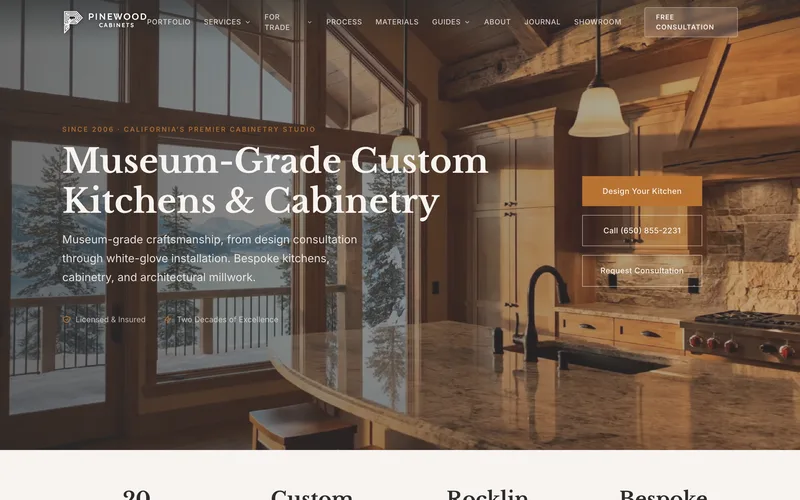
Here is what it builds, what it costs and how a project runs.
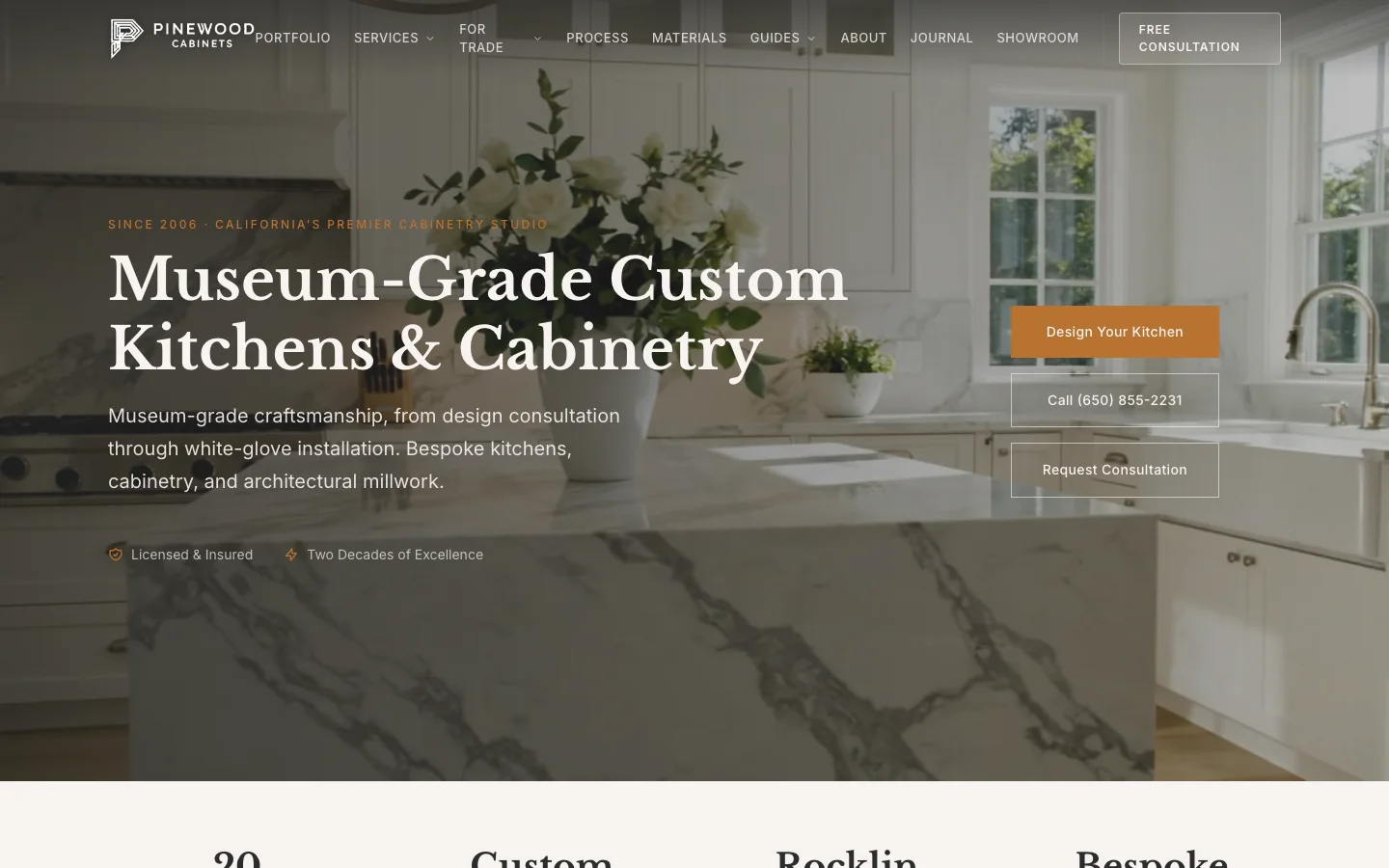
PineWood Cabinets is an eSEOspace client: we work on its search marketing. This guide uses the company's own published information, checked on 22 October 2026, and every source is listed at the end. We don't rate or score our clients. Prices, timelines and policies change, so confirm them on pinewoodcabinets.com before you commit.
The short answer
PineWood Cabinets is a custom cabinet maker with a workshop at 4271 Duluth Ave in Rocklin, California, in Placer County. It says it has designed, built and installed custom kitchens, built-in cabinetry, wine rooms, vanities, paneling and architectural millwork since 2006, and it works for homeowners, builders, architects and interior designers across California. Everything is built in the one Rocklin shop and installed by its own crews. The company says projects start at $25,000, and its own calculator prices fully custom cabinetry at roughly $1,550 to $2,600 per linear foot before options. It lists California contractor license #1095293. To reach it, call (650) 855-2231 or email info@pinewoodcabinets.com.
| Business | PineWood Cabinets, which the site describes as a division of Voronenko & Ethen Associates |
|---|---|
| What it does | Designs, builds and installs custom kitchens, built-in cabinetry, wine rooms, vanities, closets, libraries, paneling and architectural millwork |
| Based in | 4271 Duluth Ave, Rocklin, CA 95765 (workshop) |
| Service area | California, from Placer County, Sacramento and Lake Tahoe to the Bay Area, Monterey Bay, Santa Barbara and Southern California; supply only on the Nevada side of Lake Tahoe |
| In business since | 2006 (company's figure) |
| People named | Andrey Voronenko (master cabinetmaker, project lead) and Grigoriy Shvaya (founder, office manager) |
| License | California contractor license #1095293, as published on the site (check it with the CSLB) |
| Price range | Projects start at $25,000 (company's minimum); cabinetry about $1,550 to $2,600 per linear foot for fully custom work, before options |
| Hours | Monday to Friday 9 AM to 6 PM, Saturday 10 AM to 4 PM, Sunday closed; visits by appointment |
| Phone / email | (650) 855-2231 · info@pinewoodcabinets.com |
| Website | pinewoodcabinets.com |
What is PineWood Cabinets?
PineWood Cabinets is a design-build cabinet shop. That means the same company designs the cabinetry, builds it in its own workshop, finishes it, delivers it and installs it. Its site puts it simply: "The team that measures your kitchen designs it, builds it, and installs it." It is not a showroom that resells factory cabinets, and it is not a general contractor that handles a whole remodel. It is the cabinet and woodwork part of a project.
The company is based in Rocklin, in Placer County, northeast of Sacramento. Its service-area page says there is "no second shop and no showroom in another city." Designers travel to the house for the first meeting and the site measure, the cabinetry is built and finished in Rocklin, and the company's own crews deliver and install it, whether the house is in nearby Roseville or a day's round trip away in Marin County or the Napa Valley.
The site aims at high-end homes in places such as Atherton, Pacific Heights, Montecito and Lake Tahoe, but its cost guide shows ordinary kitchens fit too, as long as the project clears the stated $25,000 minimum.
Who owns and runs PineWood Cabinets?
The site's footer and contact page describe PineWood Cabinets as "a division of Voronenko & Ethen Associates." Its permits guide says the contractor license, #1095293, is held by Voronenko & Ethen Associates. The about page says the company "is led by two principals."
- Andrey Voronenko. The home page calls him "General Partner & Master Cabinetmaker" and "Your Project Lead," and the about page lists him as a founder and master craftsman. According to the site, he trained in his grandfather's woodworking shop in Latvia, where doors and cabinets were built by hand, moved to the United States in the late 1990s, worked for other cabinetmakers around Sacramento, and started his own shop in 2006. The site says he has more than 20 years of experience building and installing custom cabinetry, works on site as well as in the shop, and personally oversees each project "from the first cut to the final install." His listed specialties include stacked moulding, coffered ceilings and work with designers and builders.
- Grigoriy Shvaya. The about page lists him as "Founder & Office Manager" and says he founded PineWood Cabinets and partnered with Andrey. It describes him as "a thinker, designer, and researcher" with a particular interest in rare wood species.
The site does not publish a full staff list, but it refers to a design team, craftsmen and installers.
Is PineWood Cabinets legit?
This is a fair question before a project that starts at $25,000. Here is what the company publishes that you can check:
- A contractor license number. The site lists California Contractor License #1095293 on its home page, contact page and trade pages, and invites anyone to "confirm our license standing directly through the California Contractors State License Board." The CSLB lookup is an interactive search, so we have not reproduced the record here. Enter the number at the CSLB license check to see the license record, which the CSLB says includes complaint disclosure.
- A physical workshop and phone line. The company publishes a street address (4271 Duluth Ave, Rocklin, CA 95765), a phone number, (650) 855-2231, and an email address, info@pinewoodcabinets.com, plus business hours.
- Insurance. The company describes itself as "Licensed & Insured" and says it can provide insurance documentation when it joins a project. Ask for a certificate of insurance before work starts.
- Published reviews figure. The site shows "5.0 on Google." It does not show the number of reviews on its own pages, so look at the Google listing yourself to see how many there are.
- Written terms. Its terms of service say every project is defined by a written proposal and contract covering timeline, materials, price, payment and warranty.
One thing worth knowing as you browse: the site separates "design studies" from built work. Its visual showroom holds 138 "concept renderings from our design library," and at least one detailed portfolio page (the Atherton estate kitchen) describes itself as a "design concept." If you want to see finished jobs, ask the company which portfolio projects were built and installed, and ask for references from clients with a similar project.
What does PineWood Cabinets build?
The services overview lists five core services with starting prices and timelines, plus several more specialized services. These are the company's published figures.
| Service | What it covers | Listed starting price |
|---|---|---|
| Custom kitchens | Full custom kitchen cabinetry with inset doors, soft-close hardware, grain-matched veneers and hand-applied finishes | From $150,000 |
| Bespoke cabinetry | Built-ins for other rooms: libraries, entertainment centers, closets, offices, specialty storage | From $75,000 |
| Architectural millwork | Coffered ceilings, moldings, wainscoting, built-in bookcases | From $50,000 |
| Wine cellars and storage | Custom racking, display and tasting-room millwork | From $100,000 |
| Pantry design | Pull-out shelves, custom organization, spice storage | From $25,000 |
| Kitchen remodeling | Cabinet replacement, layout redesign, full renovation (tiers below) | From $25,000 |
| Vanities, paneling, closets, offices, media rooms | Room-specific cabinetry and wall treatments | Not listed separately; the $25,000 project minimum applies |
Two other services support the kitchen work: a kitchen design consultation (including a review of a design you already have) and appliance integration, building cabinetry and panels around built-in appliances. The site also has an AI design visualizer, free with no account, that generates three concept images from your choices of door style, finish and material and sends them to the design team.
Custom kitchens
Kitchens are the company's main line. The custom kitchens page describes four style families: modern contemporary (frameless, hidden hardware, integrated appliances), traditional inset, transitional, and Mediterranean (warm woods, rustic finishes, open shelving).
The company calls inset door construction its "signature" detail: each door and drawer front sits flush inside the cabinet frame, which takes tighter tolerances than overlay doors. Its kitchens also feature soft-close hardware, grain matched across doors, drawers and panels, cabinets sized to the room rather than built from standard boxes, and "multiple hand-applied coats" of lacquers and oils. Walnut is named as its most popular kitchen wood; oak, cherry, mahogany, teak and maple are also offered.
Remodels. The kitchen remodeling page publishes four starting tiers:
| Remodel type | Starting price | Listed time |
|---|---|---|
| Cabinet replacement in the existing footprint | From $25,000 | 4 to 6 weeks |
| Kitchen layout redesign | From $45,000 | 6 to 8 weeks |
| Complete kitchen renovation | From $75,000 | 8 to 12 weeks |
| Luxury kitchen upgrade (premium materials, custom features) | From $150,000 | 12 to 16 weeks |
The company says you can usually stay at home during a remodel, but the kitchen will be "partially or completely unusable" during construction.
Appliance integration. The company builds cabinetry and panels to each appliance maker's specifications and coordinates the hookups with the trades on site. It publishes typical integration costs: refrigerator $2,000 to $8,000, dishwasher $800 to $3,000, range and oven $1,500 to $6,000, and microwave $600 to $2,500. These cover the cabinetry work around the appliance, not the appliance.
Built-ins beyond the kitchen: closets, libraries, vanities and wine rooms
Libraries, closets, offices and media rooms. Libraries range from floor-to-ceiling bookcases to reading nooks, with rolling ladders, integrated lighting and hidden storage; walnut, oak and cherry are the usual woods, with oak preferred for heavily loaded shelves. Walk-in closets are built "as custom furniture rather than modular components," in solid wood rather than particleboard, with options such as felt-lined jewelry drawers, LED lighting, island storage, tie and belt racks, watch winders and pull-out mirrors. Cedar is offered for its insect resistance. Home offices get built-in desks and file storage laid out so the things you use most are in easy reach, and media rooms get concealed equipment storage, ventilation and cable management.
Vanities. The company builds master bath, guest bath, double and floating vanities, sized to the room and planned around the plumbing. Because bathrooms are humid, it says moisture resistance drives both wood and finish choices; teak is suggested for wet bathrooms, walnut for master baths and pine for painted vanities. Any vanity can be stained or painted. The page says installation, including the plumbing connection, takes one to two days.
Wine rooms. The site describes four kinds: a climate-controlled cellar for long-term storage, a tasting room that combines storage and entertaining, a wine wall as a display piece, and a wine closet for small collections. It is specific about who does what. The insulated, vapor-sealed room and the cooling unit are built and sized by your general contractor and a conditioning (cooling) contractor. PineWood designs the millwork, coordinates with those trades and builds "everything from the wall covering inward." Lighting is low-heat and UV-filtered and installed by your electrician; any alarm or access system is installed by your security contractor. Redwood and cedar are named as traditional racking woods, with mahogany and walnut for display areas. Wine-room timelines are "confirmed at quoting for the specific project."
Architectural millwork and paneling
Millwork is woodwork that becomes part of the house itself rather than a cabinet that sits in it. The company's millwork page covers coffered ceilings, crown molding, wainscoting, built-in bookcases, and in its FAQ also stairs and railings, mantels, and door and window casings. It says it studies historical styles so profiles match the house, naming Victorian, Craftsman and Art Deco among the periods it works from, and that its team includes restoration specialists who can repair or recreate damaged or missing pieces.
Coffered ceiling costs. The millwork page publishes a typical range of $40 to $150 per square foot, depending on complexity, wood, finish and ceiling height. It says simple painted coffers start around $40 per square foot, elaborate hand-carved walnut or mahogany can exceed $150, and a typical 300-square-foot living room ranges from $12,000 to $45,000.
Millwork timing. The company recommends starting to plan at least three months before you want millwork installed; a full coffered ceiling takes one to two weeks to install, after shop fabrication.
Paneling. Four styles are offered: raised panel (traditional, for dining rooms, libraries and bedrooms), flat panel (cleaner and more modern), beadboard (powder rooms, kitchens, mudrooms) and board and batten (a rustic, country look). Pine and poplar are used for painted paneling; oak, walnut and cherry for natural wood. New paneling can be color-matched to existing woodwork.
What woods and materials does it use?
The materials page says the company's library includes "over 40 species of domestic and exotic hardwoods." The woods it names most often are:
| Wood | How the company describes it | Typical uses it lists |
|---|---|---|
| Black walnut | Rich warmth, dramatic or figured grain; its most popular kitchen wood | Door panels, drawer fronts, veneers, libraries, coffered ceilings |
| Quarter-sawn white oak | Stable, with "ray fleck" figure; rift-sawn reads calm and linear | Face frames, doors, millwork, load-bearing wine racking |
| American cherry | Smooth grain that deepens in color with light | Traditional cabinetry, raised panels |
| Hard maple | Light, fine grain, hard-wearing | Painted cabinetry, drawer boxes, contemporary kitchens |
| Teak | Natural oils resist moisture | Coastal kitchens, wet bathrooms |
| Reclaimed American chestnut | Salvaged from old barns, mills and other buildings | Paneling and accent work |
On sourcing, the company says it prefers lumber from responsibly managed forests, "including stock carrying Forest Stewardship Council (FSC) chain-of-custody documentation," and works with family-owned mills and reclaimed material. If FSC-certified wood matters to you, ask for the chain-of-custody paperwork for your specific order. For hardware, its standard is concealed full-extension soft-close undermount drawer slides and concealed soft-close hinges, and its portfolio page names European hinge and slide makers and custom-forged pieces from local artisans.
How the cabinets are built and finished
The trade specifications page is the most precise description of construction on the site:
- Construction type: both inset face-frame (doors flush in a solid-wood frame) and frameless or "full-access" (no face frame, more interior space, a cleaner modern look).
- Cabinet boxes: furniture-grade veneer-core hardwood plywood, chosen for stability and screw-holding over particle-core panels. Solid wood is used for face frames, doors, moldings and structural parts.
- Joinery: mortise-and-tenon and dowelled face frames; boxes joined with dadoes, rabbets, glue and mechanical fasteners.
- Doors: five-piece frame-and-panel or slab, in solid wood or veneered panel.
- Drawers: solid hardwood drawer boxes with dovetail joints and captured plywood bottoms as standard.
- Finishes: hand-applied stains and paints, and sprayed conversion-varnish systems for moisture and wear resistance. Finish samples are made on the actual project wood for approval before production.
The process page describes four quality checkpoints in the shop: material inspection (wood moisture content of 6 to 8 percent), machining checks to a stated ±1/64 inch tolerance, assembly inspection, and finish inspection. Finishing happens in a 2,000-square-foot room with filtered air and climate control, and the about page puts the whole workshop at 15,000 square feet. Cabinets are assembled and inspected in the shop before installation.
How much does PineWood Cabinets cost?
PineWood publishes detailed pricing. Here is what it says, checked on 22 October 2026.
Minimum project. "Projects start at $25,000," according to the cost guide. The contact page FAQ says the minimum is "typically $25,000, though we occasionally take on smaller projects that align with our design philosophy."
Per-foot cabinetry rates. The company's cost calculator and its cost guide use the same "pricing engine," which prices cabinetry per linear foot of run:
| Construction and box material | Published base rate per linear foot |
|---|---|
| Stock, MDF (the floor of the range) | $400 to $520 |
| Semi-custom, plywood | $850 to $1,100 |
| Fully custom, plywood (the calculator's default) | $1,550 to $2,000 |
| Fully custom, solid wood | $2,000 to $2,600 |
On top of the base rate, the engine multiplies for layout (L-shape ×1.15, island ×1.22, U-shape ×1.28), door style (slab ×1.10, raised panel ×1.20), finish (natural ×1.10, painted ×1.15, stained ×1.28) and hardware level (premium ×1.10, designer ×1.22). Then it adds soft-close hardware at $55 to $95 per door, pull-out organizers at $350 to $650 each, and crown molding at $65 to $125 per linear foot. The result is widened into a planning range (8 percent below the low, 12 percent above the high).
Worked examples from the company. The cost guide says a 20-foot single-wall kitchen with no upgrades comes to $31,372 to $49,280 in fully custom plywood, and $40,480 to $64,064 in fully custom solid wood. A 20-foot L-shaped kitchen with the calculator's default selections comes to $44,360 to $71,310 for cabinetry.
What those figures leave out. The calculator covers cabinetry only. Countertops, appliances, plumbing, electrical, flooring, lighting, demolition and a general contractor are separate. The cost guide also says the calculator has no option for inset construction, grain-matched runs or curved and oversized pieces, which add labor; if your design includes them, it suggests reading the calculator's figure as "the floor of the conversation." That is one reason the services overview lists higher starting points for complete projects (from $150,000 for a custom kitchen, for example; see the services table). The process page gives an overall investment range of "$150,000 - $800,000+" for its full design-build projects.
Does price change by county? Not for the cabinetry, according to the company: the engine "applies no county multiplier," because everything is built in Rocklin. What changes by location is permits, site access, elevation and design review.
Getting an exact price. Use the cost calculator or the fuller online configurator for a planning range, then book a consultation. The company says it provides detailed cost estimates during design development, and that its pricing includes design, materials, labor, installation and project management.
Financing and payment. The FAQ says the company works "with several financing partners" and discusses options at the consultation; it does not name them or publish rates. Its terms say payment terms are set in each contract, generally a deposit to begin, progress payments at milestones and a final payment on completion. Deposit amounts are not published, so ask how the deposit is calculated.
What happens step by step, and how long it takes
The company runs projects through six phases. The durations below are from its process page, which says a full project typically takes four to seven months from first consultation to completion, depending on complexity and scope.
- Discovery and consultation (2 to 3 weeks). An in-home consultation about how you cook, entertain and use the room, plus a study of the space: laser measurements and 3D scanning, photos of existing conditions, and mapping of electrical, plumbing and HVAC. A budget framework and timeline are set before design starts. The kitchen page says the first session itself runs two to three hours. Virtual consultations are offered for early discussions, but the company recommends an on-site visit for real planning.
- Conceptual design (2 to 4 weeks). Several layout options and style directions, with early material and finish ideas.
- Design development (3 to 5 weeks). Detailed drawings, specifications, 3D renderings and virtual walkthroughs, and hardware selection.
- Final specifications (2 to 3 weeks). Shop drawings, physical material and finish samples, and final approvals. The company says nothing is cut until shop drawings are approved, and that the price attached to the approved drawings "is the figure." Changes after this point cost more.
- Fabrication (8 to 12 weeks). Building, finishing and pre-assembly in the Rocklin workshop, with the quality checks described above.
- White-glove installation (1 to 2 weeks). Home protection, installation, hardware adjustment, a final inspection and a walkthrough with you. You get care instructions and warranty information at the end.
Smaller jobs move faster. The bespoke cabinetry page says installation of a built-in typically takes three to five days, and the remodeling tiers above run from four weeks for a straight cabinet replacement. The company's trade pages say every timeline is confirmed for the specific job at quoting.
One planning tip from the company: countertops are measured (templated) after the base cabinets go in, so book your countertop fabricator against the installation date during final specifications, or their lead time gets added to the end.
After installation. The company offers optional annual maintenance, repair service and matching additions.
Where is it, what areas does it serve, and when is it open?
Address. 4271 Duluth Ave, Rocklin, CA 95765. This is the workshop, and the contact page says it also holds a design studio where you can see materials and finishes. Studio visits and private consultations are by appointment.
Hours. The contact page lists Monday to Friday 9:00 AM to 6:00 PM, Saturday 10:00 AM to 4:00 PM, and Sunday closed. It lists phone consultations Monday to Friday, 9 AM to 6 PM Pacific, and says email inquiries get a reply within 24 hours.
Service area. The company says it works across California. Its area pages cover the Sacramento region and foothills (Rocklin, Roseville, Granite Bay, Folsom, El Dorado Hills, Auburn, Grass Valley, Nevada City), Lake Tahoe and Truckee, Napa and Sonoma wine country, San Francisco, Marin, the East Bay, the Peninsula and Silicon Valley, Monterey Bay, Santa Barbara and Montecito, and Southern California from Los Angeles and Malibu to Orange County, San Diego County and Palm Springs.
Nevada side of Lake Tahoe. In Incline Village, Crystal Bay and Zephyr Cove, the company says it supplies the cabinetry and a Nevada-licensed contractor installs it, "because our CSLB licence covers California only."
Does a cabinet project need a permit, and who pulls it?
The company's permits guide (reviewed by Andrey Voronenko, according to the page) explains the general rule this way: replacing cabinets and countertops in place, with the same walls, fixtures and circuits, is usually finish work that does not need a building permit. Moving a wall, adding or moving a pipe or wire, or changing the outside of the house makes it a permitted remodel, with separate electrical and plumbing permits. Who issues the permit depends on whether the address is inside a city's limits or in unincorporated county land, and the Tahoe Basin adds a regional agency on top.
On who pulls the permit, the guide says the permit holder is whoever runs the construction. When a general contractor manages a remodel, the contractor holds the building permit and the electrical and plumbing trades hold theirs. PineWood says it "can hold a building permit as a licensed contractor where the project scope calls for it" but does not do electrical or plumbing work itself. It says it identifies the right jurisdiction at the first site visit and designs with the permit path in mind. Ask at the start who will pull which permits on your project.
The guide's jurisdiction pages are general information; your local building department has the final word.
Warranty, payment and contract terms
- Warranty. The company does not publish a warranty length. Its process and trade pages say it stands behind its workmanship, and that "what is covered (construction, finishes, and installation) is defined in writing as part of your project agreement." Hinges and slides carry their makers' own warranties. Ask for the written warranty terms with your proposal.
- How problems are handled. According to the trade warranty page, you contact the same person who ran your project; the concern is documented, assessed against the approved shop drawings, and a remedy is agreed.
- Payment. Deposit to begin, progress payments at milestones, final payment on completion, with details in the contract.
- Design ownership. The terms say designs, drawings and specifications created by PineWood remain its intellectual property unless agreed otherwise in writing.
- Liability and disputes. The terms limit liability to the cost of services and exclude consequential damages, and say disputes go to binding arbitration under California law. Read these clauses in your actual contract.
- Cancellation and refunds. Not published on the site. Ask how deposits are handled if you cancel before fabrication.
Working with builders, architects and designers
A large part of the site is aimed at trade partners: custom home builders, general contractors, developers, architects and interior designers. The company's pitch is one shop for "kitchens, pantries, wine rooms, libraries, offices, closets, vanities, paneling, and architectural millwork" on a whole house. Its trade workflow has seven steps: scope and drawings review, site measure, shop drawings for approval, fabrication in Rocklin, hand-applied finishing, delivery and installation coordinated with the general contractor, and a walk-through and punch list. The fixed rule is that no material is committed until the shop drawings are approved.
On lead times, the trade page gives no fixed number. It says shop-drawing approval turnaround is "the single biggest lever" and advises bringing the shop in during design rather than after framing.
How it compares with other ways to get cabinets
| Option | What you get | Typical trade-off |
|---|---|---|
| PineWood Cabinets (design-build custom shop) | Design, shop-built custom cabinetry, finishing and installation by one company; inset or frameless; any size | $25,000 minimum; four to seven months for a full project; cabinetry only, so a general contractor is still needed for the wider remodel |
| A big-box store or stock cabinet line | Pre-made boxes in set sizes, often in stock or quick to order | Fillers instead of exact sizing, limited finishes and wood; the company's own calculator puts stock MDF at $400 to $520 per foot |
| A general contractor who subcontracts cabinets | One contract for the whole remodel | You may not deal directly with the cabinet maker; quality depends on who the contractor hires |
| A local finish carpenter or one-person shop | Personal attention, sometimes lower cost on small jobs | Capacity limits on large or multi-room jobs; finishing may be done on site |
Who it suits, and who should look elsewhere
A good fit if you…
- Want fully custom cabinetry sized to your room, including inset doors, grain-matched wood or period-accurate millwork
- Have a project of $25,000 or more in California
- Prefer one company to design, build and install the cabinetry
- Are a builder, architect or designer who needs shop drawings and a cabinet package built to your specification
- Own an older house and need new woodwork to match existing millwork
- Want to see detailed published pricing logic before the first meeting
Look elsewhere if you…
- Have a budget below about $25,000 for the cabinetry or millwork
- Need cabinets in a few weeks: a full custom project runs four to seven months
- Want one company to handle plumbing, electrical and the rest of the remodel: PineWood does the cabinetry and woodwork
- Are outside California (or on the Nevada side of Tahoe and want the same company to install)
- Want flat-pack or stock cabinets to install yourself
Questions to ask before you hire
- Can you send a copy of your license record and a certificate of insurance for my project?
- Which projects in your portfolio were built and installed, and can I speak with a client who had similar work done?
- What exactly does your written warranty cover, and for how long?
- How large is the deposit, when are progress payments due, and what happens to the deposit if I cancel before fabrication?
- Will you or my general contractor pull the building permit, and who handles electrical and plumbing?
- Is my design inset or frameless, and how do inset doors and grain matching change the calculator's price?
- What is the confirmed timeline for my project, and when should I book the countertop fabricator?
- If FSC-certified wood matters to me, can you provide chain-of-custody documentation for my order?
How to get started
- Measure your cabinet run (along the wall at counter height, plus any island) and try the cost calculator for a planning range.
- Browse the portfolio and the visual showroom, or try the AI visualizer on the service pages, and save the looks you like.
- Request a consultation through the contact page form, call (650) 855-2231, or email info@pinewoodcabinets.com. The company says it replies within 24 hours.
- For a trade project, send your drawings and target dates through the trade program page.
Terms you'll see on the site
- Inset: doors and drawer fronts set flush inside the cabinet's face frame. Takes tighter tolerances than overlay doors.
- Frameless (full-access): cabinets without a face frame; doors cover the box edge, giving more interior space and a cleaner look.
- Linear foot: one foot of cabinet run measured along the wall; the unit the company prices by.
- Shop drawings: detailed, dimensioned drawings of exactly what will be built, approved before fabrication.
- Grain matching (book-matched, slip-matched, sequential): laying out wood or veneer so the grain flows across neighboring doors and panels.
- Quarter-sawn and rift-sawn: ways of cutting a log that give straighter, more stable boards; quarter-sawn oak shows "ray fleck."
- Conversion varnish: a sprayed, catalyzed finish that resists moisture and wear.
Frequently asked questions
Where is PineWood Cabinets located?
PineWood Cabinets' workshop and design studio are at 4271 Duluth Ave, Rocklin, CA 95765, in Placer County. Visits are by appointment, and the company's designers travel to homes across California.
How much does PineWood Cabinets charge for a custom kitchen?
PineWood Cabinets says projects start at $25,000. Its calculator prices fully custom cabinetry at $1,550 to $2,000 per linear foot in plywood and $2,000 to $2,600 in solid wood before options, and its example 20-foot L-shaped kitchen comes to $44,360 to $71,310 for cabinetry alone.
What is PineWood Cabinets' minimum project size?
The company states a $25,000 minimum. Its contact page says it occasionally takes smaller projects that fit its design approach.
How long does a PineWood Cabinets project take?
The company's process page says four to seven months from first consultation to completion, with fabrication taking 8 to 12 weeks and installation 1 to 2 weeks. Smaller built-ins and cabinet replacements take less time.
Is PineWood Cabinets licensed?
PineWood Cabinets publishes California contractor license #1095293, which it says is held by Voronenko & Ethen Associates. You can check the license's status on the CSLB website.
Who owns PineWood Cabinets?
The site describes PineWood Cabinets as a division of Voronenko & Ethen Associates, led by two principals: Andrey Voronenko, master cabinetmaker and project lead, and Grigoriy Shvaya, founder and office manager.
Does PineWood Cabinets install the cabinets it builds?
Yes. The company says its own crews deliver and install everything built in its Rocklin shop. The exception is the Nevada side of Lake Tahoe, where it supplies cabinetry and a Nevada-licensed contractor installs it.
Does PineWood Cabinets work outside the Sacramento area?
Yes. It lists service areas across California, including Lake Tahoe, wine country, the Bay Area, Silicon Valley, Monterey Bay, Santa Barbara and Southern California.
What warranty does PineWood Cabinets offer?
It does not publish a warranty length. The company says coverage for construction, finishes and installation is written into each project agreement, and hardware carries its makers' warranties.
Does PineWood Cabinets offer financing?
Its FAQ says it works with several financing partners and discusses options at the consultation. It does not name the lenders or publish rates.
Does PineWood Cabinets pull permits?
The company says it can hold a building permit as a licensed contractor when the scope calls for it, but it does not do electrical or plumbing work. When a general contractor runs the remodel, the contractor usually holds the permit.
Can PineWood Cabinets match existing woodwork in an older home?
The company says it matches existing cabinetry and millwork, including historical molding profiles from periods such as Victorian, Craftsman and Art Deco, and color-matches finishes to existing woodwork.
Sources
All pages checked on 22 October 2026.
- PineWood Cabinets, home page: pinewoodcabinets.com
- About: pinewoodcabinets.com/about
- Contact (address, hours, FAQ, business details): pinewoodcabinets.com/contact
- FAQ: pinewoodcabinets.com/faq
- Process: pinewoodcabinets.com/process
- Services overview: pinewoodcabinets.com/services
- Service pages: Custom Kitchens, Kitchen Remodeling, Kitchen Design Consultation, Appliance Integration, Bespoke Cabinetry, Libraries, Closets & Offices, Vanities, Wine Rooms, Architectural Millwork, Paneling
- Materials: pinewoodcabinets.com/materials
- Kitchen cost calculator: pinewoodcabinets.com/kitchen-cost-calculator
- Cost and planning guide: pinewoodcabinets.com/guides/cost-and-planning
- Permits and process guide: pinewoodcabinets.com/guides/permits-and-process
- Guides index: pinewoodcabinets.com/guides
- Service areas: pinewoodcabinets.com/service-areas
- Portfolio and project page: Portfolio, Atherton Tech Executive Estate
- Visual showroom: pinewoodcabinets.com/showroom
- Online configurator: pinewoodcabinets.com/estimate
- Trade pages: Trade Program, Trade Process, Lead Times, Specifications, Warranty, Licensing & Insurance, Interior Designers
- Terms of Service: pinewoodcabinets.com/terms
- California Contractors State License Board, license check: cslb.ca.gov



