
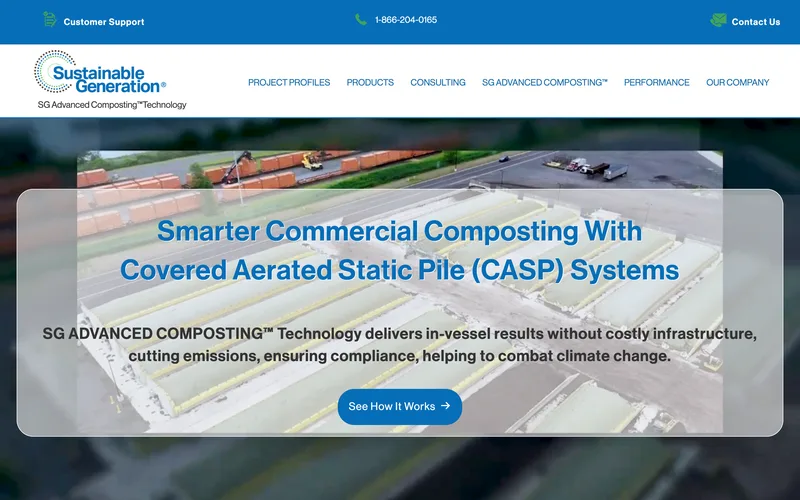
Petersburg, Florida company supplying covered aerated static pile composting systems built on the GORE Cover, plus pilots, leasing, design help and support. Here is what it offers and how projects work.
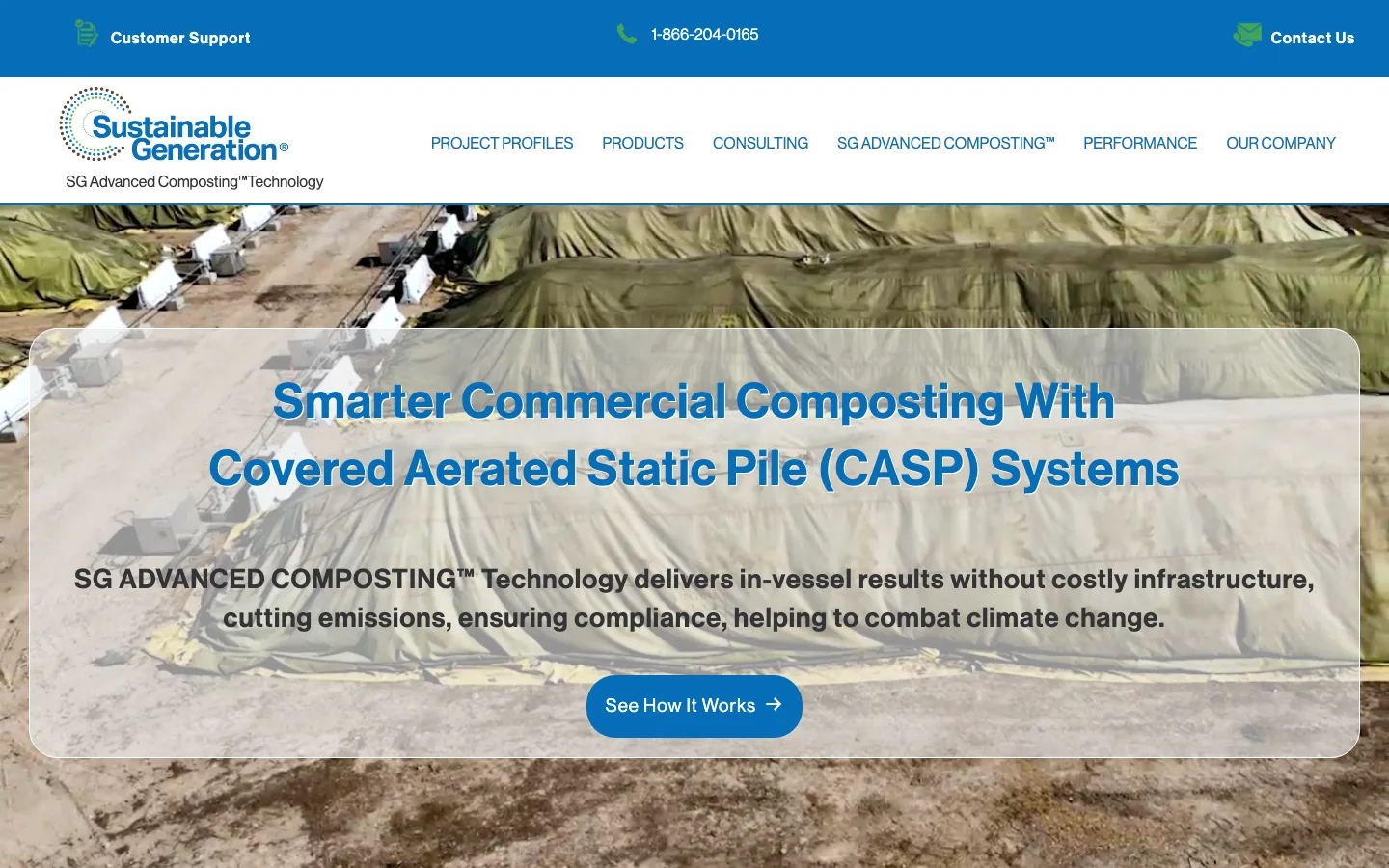
Sustainable Generation is an eSEOspace client: we work on its website and search marketing. This guide uses the company's own published information, checked on 19 October 2026, and every source is listed at the end. We don't rate or score our clients. Product details and project figures change, so confirm them with the company on sustainable-generation.com before you rely on them.
The short answer
Sustainable Generation (Sustainable Generation, LLC, often shortened to SG) is a commercial composting technology company with its contact address in St. Petersburg, Florida. It sells covered aerated static pile (CASP) composting systems built around the GORE® Cover, in three layouts: SG MOBILE®, SG BUNKER® and SG HEAP®, plus SG SOLAR® power and the SG COMPOST CONTROL™ monitoring platform. It also offers consulting, facility design, pilots, leasing, training and long-term support. Its customers are municipalities, waste haulers, wastewater utilities, farms and private compost operators. It does not publish prices; quotes are project-specific. Call 1-866-204-0165 or email info@sustainable-generation.com.
| Business | Sustainable Generation, LLC (brand: Sustainable Generation®, SG) |
|---|---|
| What it does | Covered aerated static pile composting systems, monitoring software, solar power for compost sites, and consulting, design, training and support |
| Based in | 2877 20th Avenue N, St. Petersburg, FL 33713 (contact page) |
| Service area | Projects across North America and Oceania, according to the company; profiled sites in the US and Canada |
| Founder / lead | Scott Woods, Founder & CEO |
| Key partner | W. L. Gore & Associates; SG says it is the exclusive GORE® Cover partner for North America and Oceania |
| Who it serves | Municipalities, waste haulers and authorities, wastewater utilities, farms and food processors, private composters |
| Price range | Not published. Systems are quoted per project; leasing and financing are offered |
| Hours | Not published |
| Phone / email | 1-866-204-0165 · info@sustainable-generation.com |
| Website | sustainable-generation.com |
What is Sustainable Generation?
Sustainable Generation is a company that supplies the equipment, software and know-how to run a commercial composting facility. It does not collect food scraps or sell bagged compost to the public. Its customers are the organizations that run compost sites: cities and counties, waste haulers, wastewater treatment plants, landfill operators, farms and private composters.
Its product is a method its site calls SG ADVANCED COMPOSTING™ Technology: a large pile on an aeration floor, under a breathable membrane (the GORE® Cover), fed air by a computer-controlled blower. The industry name is a covered aerated static pile, or CASP. The company's pitch is that this gives the process control of an enclosed "in-vessel" system without the cost of a building and biofilter.
The business has two sides: technology (three system layouts, solar power and monitoring software) and services (feasibility, grants, permitting help, design, pilots, training and long-term support).
The company says its team has "over 200 years of combined industry experience" and that it has helped "dozens of public and private waste services entities" reduce the cost and complexity of composting. Those are its own figures.
Is Sustainable Generation legit?
People ask this before they put a vendor on a shortlist or an RFP. Here is what can be checked from public pages:
- A named company, address and phone line. The site footer identifies the business as Sustainable Generation, LLC. Its contact page lists 2877 20th Avenue N, St. Petersburg, FL 33713, a toll-free number (1-866-204-0165) and info@sustainable-generation.com.
- Named leadership. The team page names eight people with titles, led by founder and CEO Scott Woods (details below).
- Named public-sector projects. The project profiles describe installations for public bodies you can contact yourself, including the New York City Department of Sanitation's Staten Island Compost Facility, the Prince George's County, Maryland organics composting facility, the City of Florence, Oregon wastewater plant, and Santa Barbara County's site in Goleta, California.
- Named customer references. The testimonials page quotes Justin Green (Executive Director and Founder, Big Reuse), Jonathan Kalpakoff (VP, Mid Valley Disposal) and Mike Miller (Public Works Director, City of Florence, Oregon).
- A known technology partner. The GORE® Cover is made by W. L. Gore & Associates. SG describes itself as Gore's exclusive cover partner for North America and Oceania.
- Industry memberships. The company says it belongs to the US Composting Council and AORA.
- Site tours. Its FAQ says you can ask for a virtual or in-person tour of an active project.
For equipment of this size, the most useful check is to call two or three facilities from its project profiles and ask how the system and support have worked for them.
Who owns and runs Sustainable Generation?
The company's team page names Scott Woods as Founder & CEO. His bio says he has more than 30 years of experience across technology, government services and sustainable infrastructure; that before SG he was CEO of a compost facility development company and Global Remote Services Vice President at Sun Microsystems; and that he holds an electrical engineering degree from Montana State University and an MBA from the University of Denver. The site does not publish ownership shares or a founding year.
The rest of the team as listed on the site:
| Name | Title | Background the site gives |
|---|---|---|
| Brett Hoyt | VP of North American Sales | Composting enthusiast and entrepreneur focused on new markets and underserved communities |
| Scott Saari | CFO / COO | 20+ years building and scaling businesses; joined SG in 2022 |
| Waylon Pleasanton | Director of Operations | 25+ years in landfill, recycling and composting operations; described as a longtime GORE® Cover expert |
| Jason Stumm | Business Development and Sales Manager | Nearly a decade in sales and business development in solid waste and environmental services |
| Aaron Osczevski | Technical Manager, Service and Sales, Canada | 10+ years of landfill and composting work, including subarctic sites; the site describes him as a certified PME trainer |
| Justis Mendoza | Technician, Service & Operations | Background in logistics; studying computer programming |
| Ernest (Rozco) Orozco | Warehouse Coordinator | 20+ years in customer support, logistics and operations |
How SG Advanced Composting Technology works
All SG systems share one process. The company's How It Works page describes it this way:
- Mix. Feedstocks (food scraps, yard trimmings, biosolids, manure and so on) are ground and mixed into a recipe. The page says the right starting moisture is 55% to 65%, and that the process typically carries that moisture through without adding water.
- Build the pile. The mix is placed on an aeration floor, either in-ground trenches or on-grade pipe.
- Cover. A GORE® Cover goes over the pile. SG describes it as a breathable membrane that holds back odors, VOCs, bioaerosols and rain while letting water vapor escape.
- Aerate. A blower pushes air up through the pile (positive aeration). The SG COMPOST CONTROL™ System adjusts airflow from oxygen and temperature readings.
- Monitor and record. Probe data is stored in the cloud, so operators can watch piles remotely and export records for regulators.
- Finish. Project profiles typically describe an 8-week treatment in 3 phases, followed by screening into finished compost.
Points the company stresses on that page and others:
- No building or biofilter. SG says the cover replaces the enclosed building and biofilter that many in-vessel systems need.
- Speed and footprint. It describes a 4 to 8 week treatment time against 8 to 12 months for an open windrow, and no turning in the active phase.
- Stormwater kept apart from leachate. Rain runs off the cover, so clean stormwater is separated from the liquid that drains from the compost.
- All climates. The company says the system works from desert heat to subzero snow.
- Compost quality. SG says finished compost meets US (USCC STA), Canadian (CCME) and Australian (AS 4454) standards.
The GORE® Cover partnership
The GORE® Cover is central to every SG system. SG's partnership page calls the company "the exclusive North American and Oceania partner for the GORE® Cover" and says it works with W. L. Gore & Associates. The home page puts it as "Trusted GORE® Cover Supplier for North America and Oceania."
In practice, if you are in those regions and want a GORE® Cover composting system, the site says SG is who you buy it through. SG adds its own aeration design, controls, solar option and services around the cover. For the cover's claimed benefits, see regulations and performance claims.
The systems, one by one
SG sells one process in three layouts, plus a power option and a software layer. The How It Works page sums up the layouts as: SG MOBILE for "pilots, small-medium sites, or off-grid use", SG BUNKER for "high-throughput permanent installations", and SG HEAP for "simple, scalable processing".
| System | What it is | Stated capacity | Typical use (per SG) |
|---|---|---|---|
| SG MOBILE® | A portable CASP unit: blower, piping, GORE® Cover and controls, which the company calls a "composting system in a box" | No annual range stated; grows by adding modules | Pilots, demonstrations, seasonal or temporary capacity, small sites, moving between sites |
| SG BUNKER® | A permanent, walled CASP system with integrated SG COMPOST CONTROL | 5,000 to 500,000 tons per year (product page) | Large municipal, industrial and commercial facilities; space-limited, compliance-driven sites |
| SG HEAP® | A low-infrastructure CASP layout for heaps under the GORE® Cover | 1,000 to 100,000+ tons per year (product page) | Farms, municipal green waste yards, transfer stations, rural collection points, pilots moving to full scale |
| SG SOLAR® Power | Solar panels, smart inverter and battery storage that power an SG system off-grid | Not a composting system; an add-on | Landfill tops, rural or undeveloped sites without grid power |
| SG COMPOST CONTROL™ | Cloud-based monitoring and control platform | Works with all SG systems | Every SG installation |
SG MOBILE®
The company describes SG MOBILE as an easily deployable CASP system "for fast and flexible organics recycling, without the need for costly infrastructure." It is the unit SG uses for its pilot and leasing programs. The product page says it needs 60% to 80% less space than in-vessel or windrow composting, that capacity grows by adding modules ("add piles, not buildings"), and that each unit comes with SG COMPOST CONTROL. SG also positions it for replacing windrows when a site starts accepting food waste. It is described as quick to set up; ask SG for a schedule for your site.
SG BUNKER®
SG BUNKER is the permanent, high-capacity layout. The product page says it handles "virtually all types of feedstocks," including food waste, green waste, yard trimmings, biosolids, agricultural manures, source-separated organics and anaerobic digestion digestate. It lists positive aeration in place of turning, no biofilters, full remote monitoring, and all-weather operation without an enclosed building. Examples the page gives include the 16-unit DSNY system on Staten Island, the Prince George's County facility in Maryland, and A1 Organics in Eaton, Colorado.
SG HEAP®
SG HEAP is for operators who want covered composting with the least fixed construction. The page calls it "a low-infrastructure, high-throughput solution designed for farms, municipal yards, and commercial sites" and says SG engineers support each project from pilot design to full scale.
SG SOLAR® Power
SG SOLAR is a power package, not a composting method: solar panels, a smart inverter and battery storage, a weatherproof enclosure and integration with SG COMPOST CONTROL. The Otay Landfill profile says it powered that whole facility, from blowers and probes to office air conditioning.
The SG COMPOST CONTROL™ System
SG COMPOST CONTROL is the company's own monitoring and control software, which it says was "built in-house for composting workflows" rather than adapted from a generic SCADA product. According to its page, it lets operators:
- See temperature, oxygen, airflow and blower data in real time from a phone, tablet or computer.
- Get alerts by email, text or dashboard when readings move outside set limits.
- Set up "recipes" for different feedstocks and climates, and configure each bunker or heap as its own batch.
- Export hourly, daily, weekly or regulatory reports for permit compliance.
- Review blower metrics and pile trends for troubleshooting.
The page says it works "whether you're managing one pile or 100" and helps with EPA Part 503, California air district and state or county permit reporting. You can request a demo from the page.
What can it compost?
SG's feedstock page groups the materials it designs for into four families, and the home page adds what each customer type is usually after:
| Feedstock | How SG describes it | Typical customer |
|---|---|---|
| Source-separated organics (SSO / FOGO) | Residential and commercial food waste, often mixed with yard waste; high moisture, high nitrogen | Cities and haulers meeting diversion rules |
| Municipal solid waste organics (MSWO) | The organic fraction of mixed waste; may carry contamination and variable moisture | Waste authorities, landfills |
| Biosolids | Wastewater treatment residuals; pathogen-rich and odor-sensitive | Wastewater utilities aiming for Class A compost |
| Animal waste / manure | High-ammonia material from farms or CAFOs; needs nitrogen retention and runoff control | Dairies, feedlots, farms |
SG also lists anaerobic digestate (Goleta and Arthur, Ontario), yard and green waste, wood chips and depackaged food waste. For an unusual feedstock, the feedstock page invites you to ask.
Consulting and services, phase by phase
The company's services page groups its work into five project milestones. This is the list it publishes:
| Phase | Services SG lists |
|---|---|
| 1. Project initiation | Pre-project checklist, feasibility studies, site selection, financial evaluation, technical evaluation, environmental compliance, grant support, RFP assistance |
| 2. Facilities planning | Permitting, demonstration / proof of concept, pre-design, retrofit of an existing facility |
| 3. Facilities construction | Design / engineering, installation guidance |
| 4. Facilities operations | Operations training, commissioning, on-site and remote technical support, feedstock evaluation, end product sales and marketing |
| 5. Ongoing support | Troubleshooting, new feedstock requirements, meeting regulations, facility maintenance and repair |
The consulting page adds that pre-design sets facility requirements (bunker or heap count and size, equipment, material flow) before engineers start, that SG helps prepare solid waste, air quality and stormwater permit documents ("We speak the language of regulators"), and that it can convert an existing compost yard to SG technology.
The services pages do not say that SG acts as the general contractor or holds permits. For construction they list design, engineering and installation guidance, so agree in the contract who handles civil works, electrical and water connections.
Where SG systems are running
The company's project profiles describe a dozen sites. The ones below have the most detail on the site. Figures are SG's, as published on each profile.
| Project | System | Feedstock | What SG's profile says |
|---|---|---|---|
| Staten Island Compost Facility, New York (DSNY; operated by Denali Water Solutions) | 16 SG BUNKER® units | Food waste, wood chips, grass/straw, yard waste | 60,000 tons per year input; construction completed May 2023; SG gave on-site operator training and remote monitoring from July 2023; compost sold as Big Apple Compost® |
| Prince George's County Organics Composting Facility, Upper Marlboro, Maryland | SG MOBILE®, then 12 SG BUNKER® units | Food scraps and yard waste | Pilot in 2013; grew to about 12,000 tons per year on mobile units; 12 bunkers added in 2018; now 57,000 tons per year; compost sold as Leafgro GOLD® |
| Otay Landfill, Chula Vista, California (Republic Services) | SG MOBILE® with SG SOLAR® | Residential food waste and yard waste | Announced by Republic Services as California's first fully solar-powered compost facility; NWRA 2022 Organics Management Facility of the Year award |
| Mid Valley Disposal, Kerman, California | SG MOBILE® pilot, then SG BUNKER® | Food waste and yard waste | Started with a demonstration; later full scale and an expansion, funded in part by CalRecycle grants |
| City of Florence, Oregon wastewater treatment facility | SG MOBILE® | Biosolids | Pilot led to a permanent system producing Class A EQ compost sold locally as FloGro® |
| Goleta, California (Santa Barbara County) | SG MOBILE® | Anaerobic digestate | Composting co-located with anaerobic digestion |
Other sites in the profile list include Walker All Treat Farms (Arthur, Ontario), the Grand Forks Compost Facility (British Columbia), the City of San Diego's Miramar Greenery, Natural Soil Products (Tremont, Pennsylvania), the West Maui GreenCycle Compost Facility (Lahaina, Hawaii) and Happy Trash Can community composting (Bozeman, Montana). SG's pages also mention A1 Organics in Colorado and Cedar Grove in Washington, and a blog post on the Shafter-Wasco Compost Facility opening in Kern County, California.
How much does Sustainable Generation cost?
Prices are not published. Sustainable Generation does not list prices for any system, lease, consulting service or support contract on its site. Every project is quoted after the company learns about your tonnage, feedstock and site.
What drives the price, based on how the company describes its systems:
- Layout. A permanent SG BUNKER build with walls and in-floor aeration is a bigger investment than SG HEAP or leased SG MOBILE units.
- Tonnage. More tons means more bunkers, heaps or modules, more covers and more blowers.
- Site work. Pads, drainage, power and water connections, usually outside the system price.
- Extras. SG SOLAR, design and permitting help, training and support agreements.
The company's cost argument is total cost of ownership rather than a low sticker price. Its pages say SG systems need no building or biofilter, use little power, need less labor because piles are not turned, and that treatment cost per ton is lower than other systems because of the simple design. Those are SG's claims; ask for a lifecycle cost comparison for your own tonnage.
Financing and grants
The financing page lists three kinds of help:
- Grant and incentive support. Help finding and applying for local, state and federal programs (it names USDA, EPA and CalRecycle as examples).
- Flexible financing. Low-interest loans, leasing and purchase structures, according to the page. Terms are not published.
- Revenue support. The company says its systems can create potential for carbon offsets and income from compost sales, and helps with ROI modeling.
Its Kerman and Florence profiles both describe grant-funded projects (CalRecycle and Lane County grants).
Pilots, demos and leasing
Pilot and demo program
SG's pilot program uses SG MOBILE units on your site with your feedstocks. The company says it suits municipalities testing ways to meet diversion mandates, private composters trialing new mixes, farms and processors managing waste on site, and institutions running zero-waste pilots. According to the page:
- You run real batches and get performance data for permits, grants or board approval.
- The pilot uses the same core technology as the full-scale systems.
- On-site commissioning and training are included.
The company's main example is Prince George's County (pilot in 2013, 12 SG BUNKER units in 2018). Mid Valley Disposal, Florence and Otay also began as pilots.
Leasing program
The leasing program covers the SG MOBILE System. According to the page, a lease includes delivery, setup, system training and ongoing technical assistance, and you can add units, move systems or move to a permanent SG BUNKER System later. SG names four typical lessees: startup facilities, municipal programs bridging grant phases or near-term mandates, private operators adding seasonal capacity, and agricultural or food processors handling surges. Lease terms and prices are not published; the page asks you to request leasing information.
How a project works, step by step
Based on the company's services, consulting, pilot and support pages, a typical project runs like this:
- First contact. You call 1-866-204-0165 or use the contact form, which asks for your location and a question or comment. The site's support form also asks what kind of help you need (technical assistance, product information, warranty inquiry, site visit, pilot or demo, maintenance or repair, or general inquiry).
- Project initiation. SG reviews your feedstocks, tonnage, site and budget.
- Pilot (optional). If a regulator, board or grant program wants data first, SG sets up SG MOBILE units on site.
- Planning and permits. Pre-design sizes the system; SG helps prepare permit documents.
- Design and installation. SG provides design, engineering and installation guidance; your contractors build the pad and utilities.
- Commissioning and training. SG supports startup and trains your operators, who then run the site.
- Ongoing support. Under a support agreement or à la carte (see support).
The site gives few firm durations. Ask for a written schedule for your site, including permitting time, which depends on your regulators.
Regulations and performance claims
Compliance is a big part of how SG sells its systems, and its pages make many specific claims. The main ones, as the company states them:
- Pathogen reduction. The company says its process meets the EPA Part 503 pathogen reduction (PFRP) and vector attraction reduction (VAR) requirements and supports Class A biosolids compost, and that it meets the EU Animal By-Products Regulation (ABPR).
- Air quality. SG says its systems are compliant with South Coast AQMD Rule 1133.3 and San Joaquin Valley APCD Rules 4565 and 4566, and its SG BUNKER page also lists SCAQMD Rule 1133.2. It publishes VOC and odor reduction figures from third-party and emission studies.
- Organics laws. It says its systems support California's SB 1383 organics mandates.
- Water. It says the cover keeps stormwater separate from leachate.
- Greenhouse gases. It cites published research on lower greenhouse gas emissions from covered composting.
Keep in mind that a permit is issued to your site, not to a technology: your regulators decide what your facility must do, and you keep the records. Emission results also depend on feedstock and operation, so ask SG for the study behind any figure you plan to use in a permit application or RFP evaluation.
Training, support and warranty questions
SG's professional support page says it offers annual support agreements and à la carte options, such as monthly remote support, seasonal tune-ups or full system audits. Listed services:
- Operator training on feedstock handling, aeration control, compost monitoring and quality assurance.
- On-site and remote technical support, including live troubleshooting and performance tuning.
- Commissioning and launch assistance.
- Remote reviews or on-site audits, help with new feedstocks, and regulatory reporting help.
- Preventive maintenance scheduling, OEM spare parts and consumables.
The page states a 4-hour response time for support contracts and support for all SG systems. The operator support page says SG technicians offer support for the life of the system, with an optional extended service contract.
Warranty terms are not published. The support form includes a "Warranty Inquiry" option, so warranties exist, but coverage and length for systems, covers and blowers are not on the site. Ask for them in writing with your quote.
How it compares with other ways to compost
This table uses general categories, not named companies. It reflects how SG describes its own approach; the right choice depends on your site, feedstock and regulators.
| Option | How it works | Where it tends to fit | Trade-offs to weigh |
|---|---|---|---|
| Sustainable Generation (covered ASP with GORE® Cover) | Static piles under a membrane cover, positive aeration controlled by sensors | Food waste, biosolids and mixed organics where odor, VOC and water rules are strict; sites that want to avoid a building | Single cover supplier in the region; equipment and support from one vendor; pricing only by quote |
| Open windrow composting | Long rows turned by machine, no cover | Clean yard trimmings on large rural sites with little regulatory or neighbor pressure | Low equipment cost; needs more land and time; harder to control odor, VOCs and runoff with food waste |
| In-vessel or enclosed building systems | Composting inside tunnels, containers or a building, with air treated by biofilters | Dense urban sites or very strict air permits | High capital and energy cost; building and biofilter maintenance |
| Anaerobic digestion | Breaks down organics without oxygen to make biogas | Projects that want energy recovery from wet feedstocks | Large capital project; still leaves digestate to manage (which SG says it can compost) |
| Hauling to an outside facility | Pay tipping fees to send organics elsewhere | Small volumes, or no suitable site | No capital; ongoing fees and transport; no control over the end product |
Who it suits, and who should look elsewhere
A good fit if you…
- Run or are planning a commercial, municipal or utility compost facility.
- Handle food waste, biosolids, manure or digestate and face strict air, odor or stormwater rules.
- Want covered composting without building an enclosed facility.
- Want to pilot on your own site before committing capital, or lease capacity while grants come through.
- Want one vendor for technology, permitting help, training and long-term support.
Look elsewhere if you…
- Want a backyard or home composter, or want to buy compost (SG sells systems to facilities, not compost to the public).
- Need a food scrap collection service; SG does not collect waste.
- Want a turnkey general contractor to build and run your site; SG lists design and installation guidance, not construction or operation.
- Need published prices to compare before talking to a vendor.
- Run a small clean yard waste site with plenty of land and no regulatory pressure, where open windrows may be enough.
Questions to ask before you buy
- Which layout do you recommend for our tonnage and site, and why not the other two?
- What is the total installed cost, and which site works (pad, power, water, drainage) are excluded from your quote?
- What are the lease terms, length and purchase options for SG MOBILE units?
- What does the warranty cover for the cover, blowers, controls and probes, and for how long? What is the expected life of a GORE® Cover?
- Which emission and odor studies match our feedstock and air district, and can we see the full reports?
- Who prepares and who signs the permit applications? Who is the engineer of record?
- What does an annual support agreement cost, and what does the 4-hour response time cover?
- Is there a fee for SG COMPOST CONTROL, and who owns the data?
- Can we speak to two or three operators running a similar system and feedstock?
- If federal grant money is involved, can you help with our RFP without being excluded from bidding on it?
How to get started
- Gather the basics: feedstock types, tons per year now and expected, candidate sites, power and water availability, and funding sources.
- Read the system pages and the company's Commercial Composting Guide to narrow down MOBILE, HEAP or BUNKER.
- Call 1-866-204-0165, email info@sustainable-generation.com, or use the contact form.
- Ask for a site visit or a virtual tour of an operating project.
- Decide whether you need a pilot or lease first, or are ready to design a permanent system.
- Get a written quote with scope, schedule, warranty and support terms.
Terms you'll see on the site
- ASP / CASP: aerated static pile / covered aerated static pile. A pile that is not turned but is fed air through the floor; "covered" means it sits under a cover.
- Positive aeration: air is blown up into the pile, as opposed to negative aeration, which pulls air down through it.
- GORE® Cover: a breathable multi-layer membrane cover made by W. L. Gore & Associates.
- Biofilter: a bed of organic material that treats exhaust air from enclosed composting.
- PFRP: Process to Further Reduce Pathogens, the EPA Part 503 time-and-temperature standard for Class A biosolids.
- VAR: vector attraction reduction, rules to make biosolids less attractive to flies and rodents.
- Class A / Class A EQ: biosolids products that meet the strictest EPA pathogen standards ("EQ" is exceptional quality).
- SSO / FOGO: source-separated organics / food organics and garden organics.
- Digestate: the material left after anaerobic digestion.
- Leachate: liquid that drains from compost, kept separate from clean stormwater.
- SCAQMD / SJVAPCD: the South Coast and San Joaquin Valley air districts in California.
- SB 1383: California's law requiring organic waste to be diverted from landfills.
Frequently asked questions
What does Sustainable Generation do?
Sustainable Generation supplies covered aerated static pile composting systems that use the GORE® Cover, along with monitoring software, solar power and consulting, training and support for commercial and municipal compost facilities.
Where is Sustainable Generation located?
Its contact page lists 2877 20th Avenue N, St. Petersburg, FL 33713. The company says it has active projects across North America and Oceania.
Who is the CEO of Sustainable Generation?
Scott Woods is the founder and CEO of Sustainable Generation, according to the company's team page.
How much does a Sustainable Generation composting system cost?
Sustainable Generation does not publish prices. Systems, leases and support are quoted per project based on tonnage, feedstock and site; call 1-866-204-0165 for a quote.
What is the difference between SG MOBILE, SG BUNKER and SG HEAP?
They are three layouts of the same covered, aerated process. SG MOBILE is portable and used for pilots and smaller or temporary sites, SG BUNKER is a permanent high-capacity system, and SG HEAP is a low-infrastructure layout for farms and green waste yards.
Is Sustainable Generation the same company as Gore?
No. The GORE® Cover is made by W. L. Gore & Associates. Sustainable Generation says it is Gore's exclusive cover partner for North America and Oceania and builds its systems around the cover.
Can I lease a Sustainable Generation system?
Yes. Sustainable Generation leases SG MOBILE units, with delivery, setup, training and technical help included, according to its leasing page. Lease terms are not published.
Does Sustainable Generation offer pilot projects?
Yes. Its pilot program puts SG MOBILE units on your site to run your own feedstocks, with on-site commissioning and training included.
Does a Sustainable Generation system need a building?
No, according to the company. Its systems are designed to work outdoors under the GORE® Cover, without an enclosed building or biofilter.
Can Sustainable Generation systems compost biosolids?
Yes. Sustainable Generation says its process meets EPA Part 503 pathogen and vector attraction requirements for Class A biosolids compost, and the City of Florence, Oregon uses one for its biosolids.
How long does composting take in a Sustainable Generation system?
Sustainable Generation's project profiles typically describe an 8-week treatment in three phases, and its How It Works page gives 4 to 8 weeks compared with 8 to 12 months for open windrows.
Does Sustainable Generation help with grants and permits?
Yes. Sustainable Generation says it helps clients find and apply for grants and helps prepare documents for solid waste, air quality and stormwater permits. The permits are issued to the facility.
Does Sustainable Generation work outside the United States?
Yes. Its project profiles include sites in Ontario and British Columbia, Canada, and the company says it is the GORE® Cover partner for North America and Oceania.
Can I visit a Sustainable Generation facility?
Sustainable Generation's FAQ says you can contact the company for a virtual or in-person tour of an active project.
What support does Sustainable Generation offer after installation?
Sustainable Generation offers annual support agreements or à la carte help, including training, troubleshooting, maintenance and parts, and states a 4-hour response time for support contracts.
Sources
All pages checked on 19 October 2026.
- Home page: sustainable-generation.com
- Contact us: sustainable-generation.com/contact-us/
- Our Company: sustainable-generation.com/our-company/
- SG Team: team page and Scott Woods bio
- Customer testimonials: sustainable-generation.com/our-company/testimonials/
- GORE® Cover partnership: sustainable-generation.com/the-gore-partnership/
- Products: overview, SG MOBILE®, SG BUNKER®, SG HEAP®, SG SOLAR®
- SG Advanced Composting™: overview, How It Works, SG COMPOST CONTROL™, Professional Support Services, FAQs
- Performance: overview and feedstocks
- Consulting: overview, Pilots / Demos, Leasing Program
- Commercial composting services: services by milestone, project initiation, facilities construction
- Operator training and support: sustainable-generation.com/our-service/operator-training-support/
- Financing and grants: sustainable-generation.com/financing-grants/
- Project profiles: Staten Island (DSNY), Prince George's County, Otay Landfill, Mid Valley Disposal, City of Florence
- Commercial Composting Guide: sustainable-generation.com/commercial-composting-guide/



