
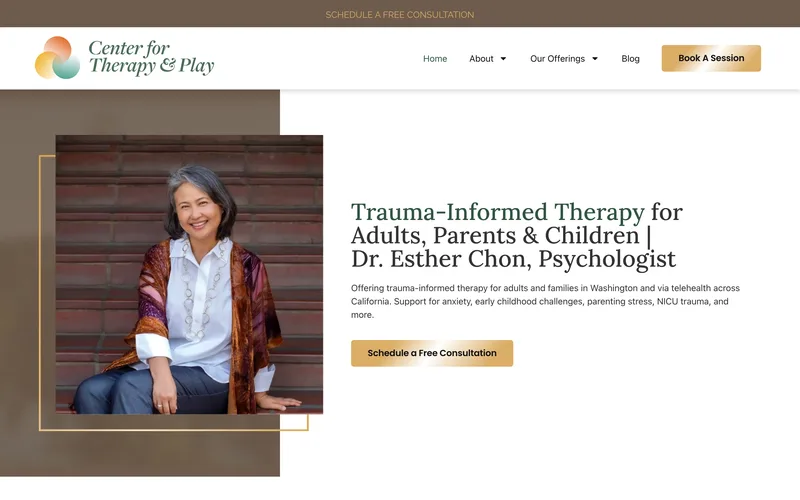
Esther Chon, offering trauma-informed therapy for adults, perinatal clients and young children with their parents, in person or by video in WA and CA.
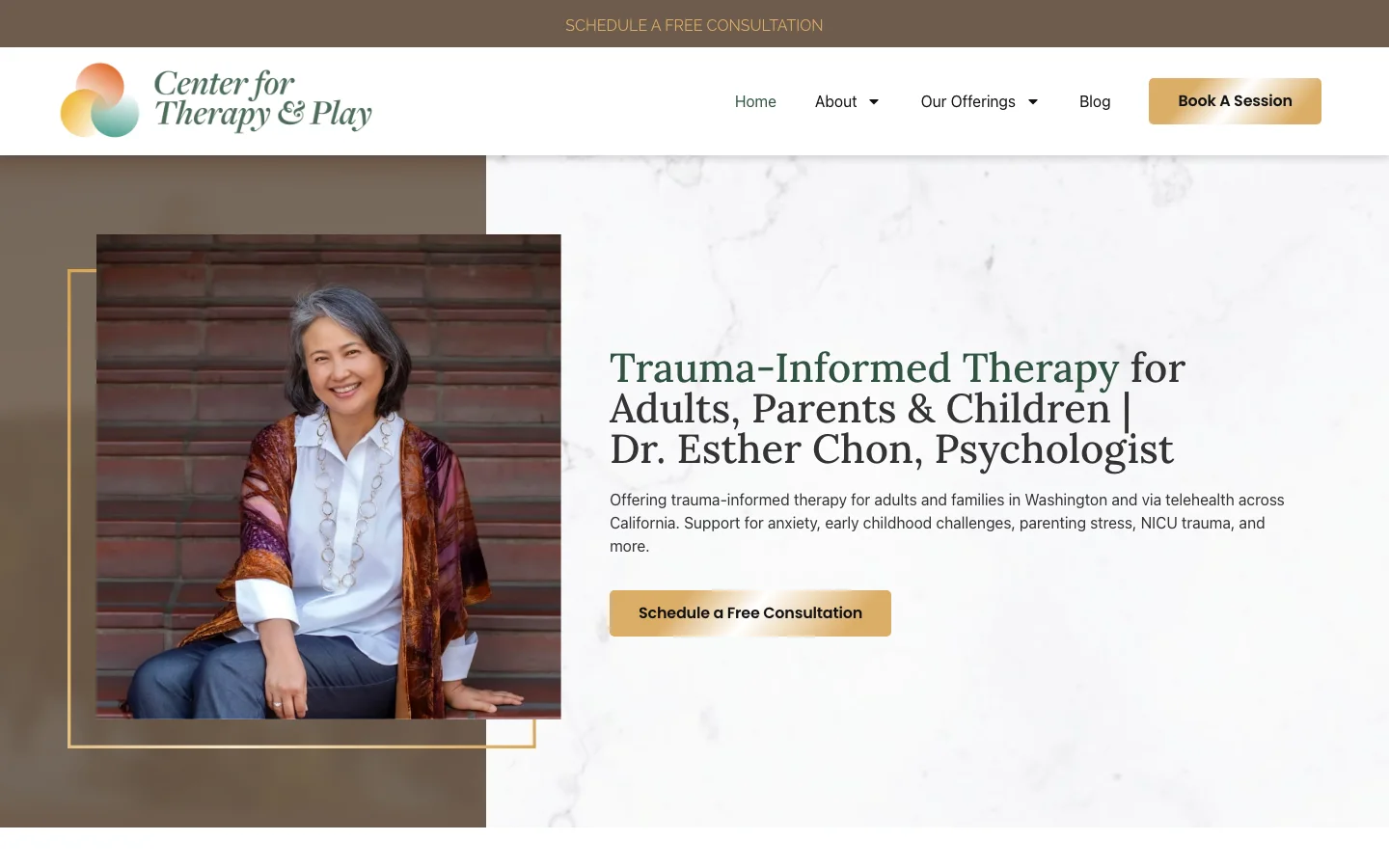
Brain Smart Therapy and Play is an eSEOspace client: we work on its website and search marketing. This guide uses the practice's own published information, checked on 22 October 2026, plus two public license records, and every source is listed at the end. We don't rate or score our clients. This guide is not medical or mental health advice; talk to a licensed clinician about your own situation. Details change, so confirm them on therapyandplay.com before you book.
The short answer
Brain Smart Therapy and Play is the private psychology practice of Dr. Esther Chon, PhD, a licensed psychologist with an office at 34617 11th Place S, Suite 201, Federal Way, Washington. She offers trauma-informed, attachment-based therapy to three groups: adults, parents of young children (ages 0 to 8) together with their children, and people who are pregnant, postpartum or in the wider perinatal period. Sessions are in person in Federal Way or by secure video for people in Washington and California. Fees and insurance are not published on the site. Every new client can start with a free 20-minute phone or video consultation: call 626-590-9285 or email dresther@proton.me.
| Business | Brain Smart Therapy and Play (footer name: Esther Chon, Ph.D. Psychological P.C.) |
|---|---|
| What it does | Trauma-informed, attachment-based psychotherapy for adults, parents and young children; perinatal therapy; a parent play program called Play with Purpose |
| Based in | 34617 11th Place S, Suite 201, Federal Way, WA 98003 |
| Service area | In person in Federal Way, WA; secure video therapy for people in Washington and California |
| Lead clinician | Dr. Esther Chon, PhD, licensed psychologist |
| Licenses | Washington psychologist license PY61248037 and California psychologist license PSY 24817, both shown as active or current in state records on 22 October 2026; NPI 1972648921 |
| Ages served | Adults, and children from birth to age 8 with their caregivers; the site says it does not currently see teens or older children |
| Price range | Not published; first 20-minute consultation is free |
| Hours | By appointment only |
| Phone / email | 626-590-9285 · dresther@proton.me |
| Website | therapyandplay.com |
What is Brain Smart Therapy and Play?
Brain Smart Therapy and Play is a small private therapy practice run by one psychologist, Dr. Esther Chon. The website brands it as Brain Smart Therapy and Play, the copyright line names the professional corporation Esther Chon, Ph.D. Psychological P.C., and its tagline is "Soul Food: Nurturing Relationships Feed Our Souls."
The practice describes its work as trauma-informed, attachment-based and brain-based. In plain terms, that means the therapy pays close attention to how early relationships and difficult experiences shape the way a person handles stress, emotions and closeness today. The site says its approach "blends neuroscience, developmental psychology, and whole-person healing," and that therapy is "always personalized," with methods chosen together with the client rather than applied the same way to everyone.
The practice focuses on three groups of people:
- Adults dealing with anxiety, the effects of childhood or complex trauma, self-doubt, relationship patterns, or the wish to parent differently from how they were raised.
- Parents of young children, from birth to age 8, often seen together with the child, for behavior, emotional or relationship concerns.
- Expecting and new parents, including people affected by a difficult birth, a baby's stay in the neonatal intensive care unit (NICU), pregnancy loss, or the identity changes of early parenthood.
Alongside therapy, the site promotes Play with Purpose, a newer program that coaches parents on "brain-smart play" with their young children, either one-to-one or in a small group. It also runs a blog with more than 60 articles on topics such as attachment, NICU stress, child anxiety, EMDR and neuroplasticity.
Who runs it? About Dr. Esther Chon
The practice is Dr. Esther Chon's own. The site does not list any other therapists, so you should expect to work with her directly. Her published background:
| Item | As published on the site |
|---|---|
| Bachelor's degree | B.A. in Psychology, University of California, Berkeley |
| Master's degree | Ed.M., Harvard Graduate School of Education, focused on child development and global education systems |
| Doctorate | Ph.D. in Clinical Psychology, California School of Professional Psychology, with a focus on trauma-informed and systems-focused clinical work |
| Postgraduate training | Postgraduate Certificate in Parent-Infant Mental Health, University of Massachusetts Boston (the "Napa Program"), covering early brain development, trauma and the nervous system, infant-caregiver relationships and relational healing in early life |
| Work settings | Hospitals and NICUs, schools and early childhood programs, community mental health centers, the foster care system, and private practice |
She describes her style as relational ("centered on safety, connection, and co-regulation"), brain-based, collaborative and compassionate, and says the work "will unfold at a pace that feels right to you." On the home page she puts her view this way: "The way we're treated early in life shapes the way we treat ourselves, and others." Her stated specialties are early parent-child attachment, intergenerational healing, emotional and behavioral support for young children, therapy for parents dealing with stress, trauma or loss, and trauma recovery for adults.
Is Brain Smart Therapy and Play legit?
For a therapy practice, "legit" mostly means: is the clinician actually licensed, and can you find and reach the practice? Here is what we checked:
- Washington psychologist license. The site lists WA license PY61248037. Washington State Department of Health credential data shows a Psychologist License, status Active, for Esther E. Chon under credential PSYC.PY.61248037, first issued 19 October 2023, with an expiration date of 21 December 2026 (licenses are renewed periodically).
- California psychologist license. The site lists CA license PSY24817. The California Department of Consumer Affairs license lookup shows license 24817 for Esther Chon, type Psychologist, status "License Renewed & Current," issued 30 January 2012 and expiring 31 December 2027. Its address of record is the same Federal Way suite the site lists.
- National Provider Identifier. The site lists NPI 1972648921. The federal NPI registry shows that number as an active individual NPI for Dr. Esther Chon, Ph.D., with the taxonomy "Psychologist, Clinical" and California license PSY24817.
- A real office and direct contact. The site publishes a street address in Federal Way with a map link, a phone number (626-590-9285) and an email address on every page.
- Clear limits. The site's terms say that browsing, emailing or filling in the contact form does not create a therapist-patient relationship, which only starts after a clinical assessment and signed consent and confidentiality paperwork. It also says plainly that it is not a crisis service.
The site does not show client reviews or ratings, which is common for therapy practices because of confidentiality rules. You can check both licenses yourself through the links in the sources.
Who the practice works with
The "Who We Serve" page opens with: "You don't need to be in crisis to benefit from therapy." It then splits clients into three groups, each with its own page. The practice's FAQ adds an important limit: "We currently do not offer therapy for teens or older children." So the age range for children is birth to 8, and everyone else seen is an adult (including parents).
| Group | Examples of concerns the site lists | How sessions are set up |
|---|---|---|
| Adults | Anxiety, chronic worry, panic attacks; self-doubt and "imposter syndrome"; low self-worth; trauma (physical, emotional, relational); effects of early caregiver relationships; breaking generational cycles; birth trauma or a baby's NICU stay | Individual therapy |
| Parents and young children (0 to 8) | Tantrums and meltdowns; defiance or shutdown; withdrawn or anxious behavior; sleep problems and nightmares; trouble with a new sibling, school or caregiver; aggression; making friends; regression after a stressful event; exposure to trauma, loss, violence or frightening medical procedures; a difficult NICU stay | Sessions "often include both the child and caregiver(s)" |
| Pregnancy, postpartum and perinatal | Anxiety in pregnancy; birth trauma or NICU stays; feeling alone or numb postpartum; intrusive thoughts; pregnancy loss or infertility; difficulty bonding; identity shifts; relationship strain; fear of repeating patterns from your own childhood | Individual therapy for the parent; parent-infant work where it fits |
Therapy for adults
The adult page is titled "Therapy for Adults Healing from Childhood Trauma and Complex Emotional Wounds." Its starting point is that many adult struggles (chronic anxiety, self-doubt, emotional numbness, trouble trusting or connecting) are "often rooted in early life experiences or complex trauma," and that these can shape how you relate to others, manage stress, make decisions, set boundaries and feel safe.
The page lists six methods used with adults: trauma-informed cognitive behavioral therapy (CBT), EMDR, Acceptance and Commitment Therapy (ACT), inner child work, sandtray therapy and somatic therapy. Each is described in the methods section below. The practice says healing "is not about 'fixing' you," and that sessions move at the client's pace "no judgment, no pressure."
Several groups of adults come up repeatedly across the site:
- People whose lives look fine from the outside but who feel stuck or "haven't fully 'shown up'" in their own lives.
- Adults working through the effects of a difficult childhood, including the blog's articles on adult children of emotionally immature or narcissistic parents.
- Parents and parents-to-be who want to avoid passing on patterns from their own upbringing (what the site calls intergenerational or generational cycles).
- Parents still affected by a traumatic birth or a baby's NICU stay.
A separate "Brain-Based Healing" page explains the practice's interest in neuroplasticity, the brain's ability to change with experience, and names EMDR, somatic and mindfulness-based practices, inner child work and trauma-informed CBT as the methods it draws on for this work. That page describes the practice's philosophy; it is not a separate service with its own price or booking.
Therapy for parents and young children
This is the work most tied to Dr. Chon's training in parent-infant mental health. The page is titled "Services for Parents & Young Children: Building Connection, Co-Regulation & Emotional Safety." Its main idea is that when a young child struggles, "it's rarely about 'bad behavior'" and is often a sign that the child needs more support, co-regulation and connection.
The parent is part of the work. The practice says it supports children ages 0 to 8 "while actively involving you, the parent, in the healing process," and that sessions often include both child and caregiver, using play, reflective practice and gentle structure. It stresses that "you are not the problem," that the work is "never about blame," and that the goal is "good-enough connections," not perfect parenting.
Parents' own feelings count too. The page lists signs in the parent as well as the child: feeling overwhelmed by a child's emotions, unsure how to help with big feelings, triggered by the child in ways you don't fully understand, worried about repeating patterns from your own childhood, or feeling disconnected from your child.
Methods named for this group: Dyadic Parent-Child Therapy, Child-Parent Psychotherapy (CPP, for children 0 to 6 who have experienced trauma or loss), play therapy, mentalization-based parenting, sandtray therapy, EMDR adapted for children, the Brazelton Touchpoints model, and Video Intervention Therapy (VIT). On VIT, the site notes that short clips of real parent-child interactions are reviewed with the therapist, and that "Video footage is not stored after session."
The site's EMDR-for-children article explains how this looks in practice: sessions for young children are often shorter, and instead of asking a child to tell a story, the therapist may use puppets, drawings or sand play, with the parent often in the room as a calming presence. It also notes that the Federal Way office has play therapy materials, which can matter for younger children who do better in person.
Pregnancy, postpartum and perinatal therapy
The perinatal page is subtitled "Supporting the Emotional Lives of New and Expecting Parents." It makes the point that perinatal mental health "includes more than postpartum depression" and that "you don't need a formal diagnosis to seek support."
Dr. Chon offers support during:
- Preconception and fertility journeys
- Pregnancy, including high-risk pregnancies
- Birth trauma and NICU stays
- Postpartum adjustment
- Parenting in the first year and beyond
The methods listed are maternal and paternal mental health approaches (the page explicitly includes fathers), parent-infant mental health approaches for times when early separation, attachment ruptures or medical complications have affected the bond, EMDR, inner child work and somatic therapy. Her background in hospitals and NICUs is relevant here, and the blog has a long run of articles on NICU stress, intrusive thoughts after birth, birth trauma, feeling disconnected after birth and why new parents feel lonely.
For new parents the format matters: the site's perinatal article lists "Do you offer virtual sessions?" as a question worth asking any therapist, and this practice does offer video sessions, so you do not have to travel with a newborn.
The therapy methods, one by one
The practice says methods "are selected based on your needs, goals, and nervous system, not applied rigidly," and that the plan depends on your history, what your nervous system can tolerate, and whether you prefer structure, creativity or body-based work. You do not need to choose a method before you call. Here is what each one is, as the site describes it:
| Method | Used with | What it involves |
|---|---|---|
| EMDR (Eye Movement Desensitization and Reprocessing) | Adults and children | A structured therapy for processing distressing memories; with children it can use tapping, drumming or passing a ball instead of eye movements |
| Trauma-informed CBT | Adults, children and caregivers | Noticing thoughts, feelings and behaviors shaped by trauma, using cognitive tools adapted to be trauma-sensitive |
| ACT (Acceptance and Commitment Therapy) | Adults | Mindfulness and values-driven living; learning to make room for hard feelings rather than fighting them |
| Inner child work / parts work | Adults, including parents | Connecting with younger "parts" of yourself that carry old pain or unmet needs |
| Somatic therapy | Adults and children | Body-based work on regulation and on stress held in the body |
| Mindfulness-based interventions | Adults | Attention and body-awareness practices |
| Sandtray therapy | Adults and children | Building scenes with miniature figures in a sandbox, a nonverbal way to express hard-to-name feelings |
| Play therapy | Children 0 to 8 | Developmentally suited play, with caregiver involvement |
| Dyadic Parent-Child Therapy | Parents with children 0 to 8 | Helping parents read a child's cues and use attunement and play to reduce conflict |
| Child-Parent Psychotherapy (CPP) | Children 0 to 6 after trauma or loss, with a parent | Parent and child working through an experience together through play and interaction |
| Mentalization-based parenting | Parents | Reflecting on the child's inner world, and your own |
| Touchpoints model (Brazelton) | Parents | A preventive, strengths-based model for anticipating developmental challenges |
| Video Intervention Therapy (VIT) | Parents and young children | Reviewing short video clips of parent-child interaction with the therapist; footage not stored after the session |
These descriptions summarize what the practice says each method involves. Whether a method is right for you or your child is a clinical question for the consultation, and this guide does not suggest any method will produce a particular result.
Play with Purpose, the parent play program
Play with Purpose is presented as "a brain-smart play program" for parents of young children, separate from therapy. It is aimed at parents who are "mostly confident" but want to be more intentional about play during the early years, including parents who wonder how to prepare a child for a world changing quickly, "especially with AI."
What the site says you learn: what secure attachment looks like in daily life, how co-regulation works, what "brain-smart play" means, the "micro-moments" in play, how to support confidence and adaptive thinking, how to help a child build pattern recognition and problem-solving, and how to adjust as the child grows. Parents practice at home with their child, then come back for feedback. The site calls it a "Play Laboratory."
| Track | Format | Suits parents who |
|---|---|---|
| Private sessions | 1:1 with Dr. Esther | Want individual feedback, prefer private discussion, or have specific developmental goals |
| Small group cohort | 2 to 3 parents you bring yourself | Value shared learning and hearing other parents' perspectives |
The interest form also lists a Co-Regulation Focus, a Brain-Smart Play Intensive and a Micro-Moments in Play Workshop. Price: no fee is published. As a launch offer, the practice says it is offering "a limited number of low- to no-cost introductory play sessions," and that spots are limited. Play with Purpose has its own contact form and a free 20-minute consultation.
Where is it, and is telehealth available?
Office: 34617 11th Place S, Suite 201, Federal Way, WA 98003. In-person sessions happen here. Hours are listed as "By appointment only."
Telehealth: the site says Dr. Chon offers "secure, HIPAA-compliant online therapy sessions" to people "located anywhere in California or Washington." Both state licenses were active or current when we checked (see above).
| Where you are | Options the site lists | Areas named on the site |
|---|---|---|
| Washington | In person in Federal Way, or secure video | Seattle, Tacoma, Federal Way, Vancouver, Ridgefield, Camas, Kirkland, Renton, University Place, Browns Point, Dash Point, Lynnwood, Bothell, Everett |
| California | Secure video only | Pasadena, South Pasadena, Arcadia, San Gabriel, Glendale, Burbank, Silver Lake, North Hollywood, Duarte, Beverly Hills, Santa Monica (statewide by video) |
Because telehealth rules depend on where the client is physically located during the session, tell the practice where you will be when you meet. If you live outside Washington and California, ask during the consultation whether a video session is possible for your state.
How much does it cost, and does it take insurance?
Session fees are not published on the site, and neither is an insurance list. The FAQ page has a heading "What are your fees? Do you take insurance?" but, when we checked on 22 October 2026, it did not show a fee or insurance answer. What is published:
| Item | Published price |
|---|---|
| Initial phone or video consultation | Free, 20 minutes |
| Individual, parent-child or perinatal therapy sessions | Not published |
| Play with Purpose introductory sessions | "Low- to no-cost" during the launch offer (limited spots) |
| Insurance accepted | Not published |
| Session length and frequency | Not published |
How to find out: ask during the free consultation, or by phone (626-590-9285) or email. Useful questions: the fee per session for an individual adult and for a parent-child session, whether the practice bills any insurance plan directly, and, if not, whether it can give you a receipt (often called a superbill) to send to your insurer for possible out-of-network reimbursement. Your own plan decides what it reimburses, so check with your insurer too.
What happens when you reach out, step by step
- Get in touch. Call 626-590-9285, email dresther@proton.me, or fill in the contact form (name, email, phone and a message). The site's "Book a Session" and "Schedule Online" buttons lead to that contact page; there is no self-booking calendar.
- Free 20-minute consultation. A short phone or video call. The site says it is to learn about your needs and goals, answer your questions about therapy, and "explore whether we are a good fit for working together." It adds: "You don't need to have it all figured out."
- Clinical assessment and paperwork. According to the site's terms, a formal therapy relationship begins only "after a clinical assessment and the signing of a separate, comprehensive treatment agreement (informed consent) and HIPAA/Confidentiality documentation."
- A plan that fits you. Methods are chosen together based on your goals, history and preferences. For a young child, expect the parent to be closely involved, often in the room.
- Ongoing sessions, in person or by video. In Federal Way or online. The site stresses working at your pace; it does not publish a set number of sessions.
Privacy, crisis support and other policies
- Not a crisis service. The site says: if you are in a mental health crisis or may harm yourself or someone else, dial 988 or go to the nearest emergency room. Its terms also say not to use the contact form in an emergency and to call 911.
- Website vs therapy confidentiality. The website privacy policy covers information sent through the site's forms (name, email, phone, message). Therapy records are covered by the separate HIPAA and confidentiality paperwork you sign when you start. If privacy is a concern, keep the first message brief and save details for the call.
- Video recordings. For Video Intervention Therapy, the site says footage is not stored after the session.
- Cancellation and refunds. The FAQ lists a cancellation policy question and there is a Refund Policy page, but neither showed policy text when we checked. Ask for the cancellation and late-cancel terms in writing before your first session.
- Who is not seen. Teens and older children. Parents of older children can still come for their own adult therapy.
How it compares with other options
| Option | What you typically get | Typical trade-off |
|---|---|---|
| Brain Smart Therapy and Play | One licensed psychologist with parent-infant mental health training; adults, perinatal clients and children 0 to 8 with parents; in person in Federal Way or video in WA and CA | Fees and insurance not published; no teens or older children; one clinician, so availability depends on her schedule |
| A large group practice or national therapy platform | Many clinicians, quick matching, often in-network with insurers | Less specialized in early childhood and parent-child work; you may not choose your clinician |
| A hospital or health-system outpatient clinic | Access to psychiatry and other medical services; insurance billing | Waitlists are common; less flexible scheduling |
| A community mental health center | Lower-cost or publicly funded care | Eligibility rules and waitlists; less choice of method |
| A pediatrician or early-intervention program | Developmental screening and referrals | Not ongoing psychotherapy for parent and child |
| Parenting books, classes or apps | Low cost, flexible | Not therapy; no individual assessment of your child |
Who it suits, and who should look elsewhere
A good fit if you…
- Have a child aged 8 or younger and want help as a parent and child together
- Are pregnant, postpartum, or still affected by a difficult birth or a NICU stay
- Are an adult working on the effects of childhood or relational trauma, or on anxiety and self-doubt
- Want to parent differently from how you were parented
- Live in Washington (in person or video) or California (video)
- Prefer a slower, relationship-focused approach with body-based and play-based methods available
Look elsewhere if you…
- Need therapy for a teenager or a child older than 8
- Are in crisis right now: dial 988 or go to the nearest emergency room
- Need medication management: the site lists psychotherapy, not prescribing
- Must use an in-network insurance plan and want that confirmed before calling: it is not published
- Want a large practice with many clinicians to choose from
- Want in-person sessions in California: California is video only
Questions to ask in the free consultation
- What is the fee per session for me (or for a parent-child session), and do you bill my insurance or provide a superbill?
- How long are sessions, and how often do you usually meet?
- What is your cancellation and late-cancel policy?
- For my child: will I be in the room, and which method do you expect to start with?
- For video sessions: does it matter which state I am in on the day?
- Do you have openings at times that work for me, and is there a waitlist?
- If I need something you don't offer (medication, care for an older child), can you suggest where to go?
How to get started
- Read the page for your situation: adults, parents and young children, or pregnancy and postpartum.
- Call 626-590-9285, email dresther@proton.me, or use the contact form to request the free 20-minute consultation.
- Have your questions about fees, insurance and scheduling ready for the call.
- For the parent play program, use the separate Play with Purpose contact form.
Visit Brain Smart Therapy and Play
Terms you'll see on the site
- Trauma-informed: care that takes into account how past difficult experiences can affect a person's reactions, and avoids re-traumatizing them.
- Attachment: the emotional bond between a child and caregiver, and the patterns of closeness and safety it shapes later in life.
- Co-regulation: one person's calm helping another person's nervous system settle, as a parent soothes a baby.
- Perinatal: the period around pregnancy and birth, usually from pregnancy through the first year after birth.
- NICU: neonatal intensive care unit, the hospital unit for newborns who need intensive care.
- Dyadic therapy: therapy with two people together, here a parent and child.
- Intergenerational patterns: ways of relating passed down from parents to children.
- Neuroplasticity: the brain's ability to change in response to experience.
- Telehealth: therapy by secure video rather than in person.
- NPI: National Provider Identifier, a federal ID number for health care providers.
Frequently asked questions
Who owns Brain Smart Therapy and Play?
Brain Smart Therapy and Play is the practice of Dr. Esther Chon, PhD, a licensed psychologist. The site's copyright line names the business as Esther Chon, Ph.D. Psychological P.C.
Where is Brain Smart Therapy and Play located?
Its office is at 34617 11th Place S, Suite 201, Federal Way, WA 98003. It also offers secure video therapy for people in Washington and California.
Is Dr. Esther Chon a licensed psychologist?
Yes. Washington Department of Health data shows psychologist license PY61248037 as active, and California's license lookup shows psychologist license PSY 24817 as renewed and current, both checked on 22 October 2026.
How much does therapy at Brain Smart Therapy and Play cost?
Session fees are not published on the site. The first 20-minute phone or video consultation is free, and you can ask about fees then.
Does Brain Smart Therapy and Play take insurance?
The site does not say which insurance plans, if any, it accepts. Ask during the free consultation whether it bills your plan or can provide a receipt for out-of-network reimbursement.
Does Brain Smart Therapy and Play offer online therapy?
Yes. It offers secure video sessions for people in Washington and California, and in-person sessions at its Federal Way office.
What ages does Brain Smart Therapy and Play work with?
Adults, and children from birth to age 8 together with their caregivers. The site says it does not currently offer therapy for teens or older children.
Does Dr. Chon offer postpartum or NICU-related therapy?
Yes. Brain Smart Therapy and Play has a dedicated pregnancy, postpartum and perinatal service, which includes support after birth trauma, NICU stays, pregnancy loss and difficulties bonding.
Does Brain Smart Therapy and Play offer EMDR?
Yes. EMDR is listed for adults and, in an adapted form, for children. Whether it suits you is decided with Dr. Chon.
Will I be in the room during my young child's therapy?
Usually, yes. Brain Smart Therapy and Play says sessions for children 0 to 8 often include both the child and caregiver, and that parents are actively involved.
What is Play with Purpose?
Play with Purpose is Brain Smart Therapy and Play's parent coaching program on "brain-smart play" with young children, offered one-to-one or in a small group of 2 to 3 parents. It is introducing a limited number of low- to no-cost introductory sessions.
What are Brain Smart Therapy and Play's hours?
The site lists hours as by appointment only. Call 626-590-9285 or email dresther@proton.me to arrange a time.
How do I book a first appointment with Dr. Esther Chon?
Call 626-590-9285, email dresther@proton.me, or use the contact form at therapyandplay.com to request the free 20-minute consultation. There is no self-booking calendar on the site.
Does Brain Smart Therapy and Play prescribe medication?
The site describes psychotherapy only and does not list medication management. Ask your doctor or a psychiatric prescriber if you need medication.
Sources
All pages checked on 22 October 2026.
- Brain Smart Therapy and Play, home page: therapyandplay.com
- Meet Dr. Esther Chon: therapyandplay.com/about-us/
- Who We Serve: therapyandplay.com/who-we-serve/
- Our Modalities: therapyandplay.com/modalities/
- Services for adults: therapyandplay.com/services-for-adults/
- Services for parents and young children: therapyandplay.com/services-for-parents-young-children/
- Pregnancy, postpartum and perinatal therapy: therapyandplay.com/pregnancy-postpartum-perinatal-therapy/
- Brain-Based Healing (neuroplasticity): therapyandplay.com/neuroplasticity/
- Play with Purpose: therapyandplay.com/play-with-purpose/ and its contact page
- Contact: therapyandplay.com/contact/
- FAQs: therapyandplay.com/faqs/
- Terms of Use and Privacy Policy: terms, privacy
- Blog articles: EMDR for children, what perinatal therapy involves, blog index
- California Department of Consumer Affairs license lookup, psychologist license 24817: search.dca.ca.gov
- Washington State Department of Health, Health Care Provider Credential Data (credential PSYC.PY.61248037): data.wa.gov
- NPPES NPI Registry, NPI 1972648921: npiregistry.cms.hhs.gov



