
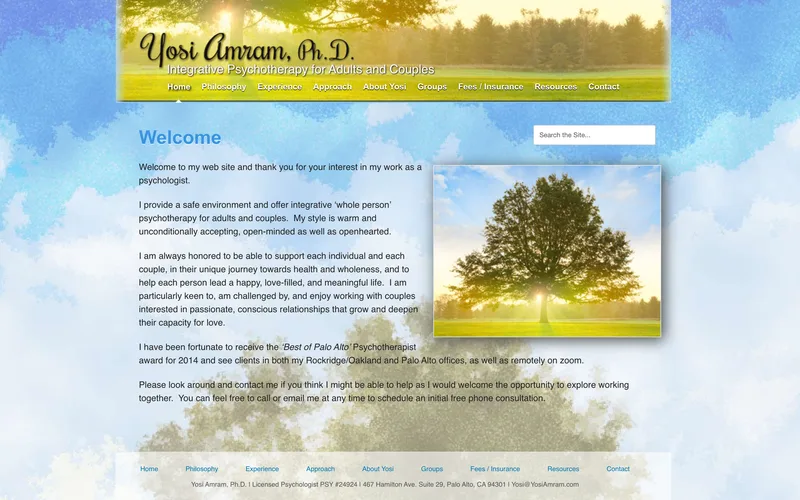
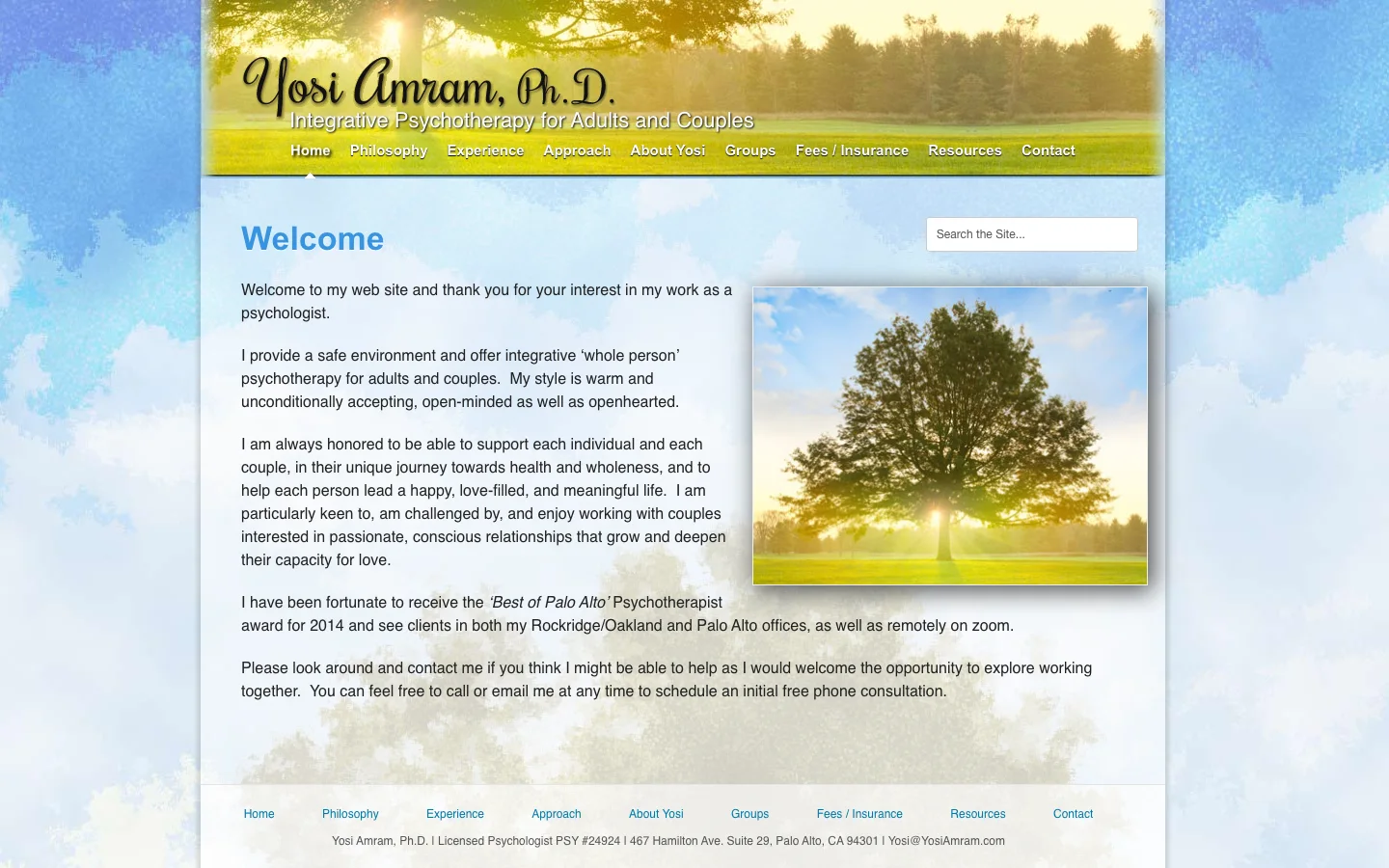
Yosi Amram, Ph.D. is an eSEOspace client: we work on his practice's website and search marketing. This guide uses the practice's own published information, checked on 19 October 2026, and every source is listed at the end. We don't rate or score our clients. Fees, offices and policies change, so confirm them on yosiamram.com or by phone before you book. This guide is not medical or mental health advice; talk to a licensed clinician about your own situation.
The short answer
Yosi Amram, Ph.D. is a licensed clinical psychologist in private practice in the San Francisco Bay Area (California license PSY 24924, as listed on his site). He offers integrative psychotherapy for couples and individual adults at an office at 467 Hamilton Ave., Suite 29 in downtown Palo Alto, an office in the Rockridge area of Oakland, and by phone or Zoom for some clients. Couples counseling is, in his words, "a major interest area and focus." His fee is not published, he offers a limited sliding scale, and he is out-of-network for insurance. You start with a free phone consultation: call 510-992-3670 or email Yosi@YosiAmram.com.
| Business | Yosi Amram, Ph.D. (solo private practice) |
|---|---|
| What it does | Integrative psychotherapy for couples and individual adults |
| Who runs it | Yosi Amram, Ph.D., licensed clinical psychologist |
| License (as published) | Licensed Psychologist, California, PSY 24924 |
| Based in | 467 Hamilton Ave., Suite 29, Palo Alto, CA 94301; second office in Rockridge, Oakland (street number by email) |
| Remote sessions | Phone or Zoom for some clients |
| Price | Not published; set at what the site calls the usual and customary rate for local psychologists. Sliding scale for some clients |
| Insurance | Out-of-network only; receipts provided for you to claim reimbursement |
| Hours | Not published |
| Phone / email | 510-992-3670 / Yosi@YosiAmram.com |
| Website | yosiamram.com |
Who is Yosi Amram, Ph.D.?
Yosi Amram is a clinical psychologist who runs a one-person private practice. There is no clinic team or intake department: the website is written in his own voice, and the person you talk to on the free phone consultation is the person you would see. His tagline is "Integrative Psychotherapy for Adults and Couples," and his Experience page says his focus and specialty is working with adults and couples.
He describes his style as "warm and unconditionally accepting, open-minded as well as openhearted," and says he aims to provide "a safe environment." Couples work gets particular mention. On the home page he writes that he is "particularly keen to, am challenged by, and enjoy working with couples interested in passionate, conscious relationships that grow and deepen their capacity for love."
Before becoming a psychologist he had a career in business and technology, and he says he still works as a leadership coach alongside his therapy practice. He presents that history as useful to clients: "These organizational experiences enable me to understand and relate to most work-place settings."
The practice is not a group practice, an online therapy platform or a clinic. It is closer to the traditional model of a private psychologist who sees a limited number of clients in his own offices and sets his own schedule.
Is Yosi Amram a licensed psychologist?
His site says he is. Here is what it publishes and how you can check it yourself:
- A license number. The About page and the footer of every page list "Licensed Psychologist PSY #24924." In California, psychologists are licensed by the Board of Psychology, part of the Department of Consumer Affairs (DCA).
- How to verify it. The California Board of Psychology links to the DCA license search at search.dca.ca.gov. Choose the Board of Psychology, enter license number 24924, and the record shows the license status and expiration date. The search uses a browser security check, so we could not pull the record automatically for this guide; it takes a minute to do by hand.
- A named, reachable person. The site gives a street address for the Palo Alto office, a phone number and an email address, and offers a free phone consultation before any commitment.
- Stated degrees. He lists an MA and a Ph.D. in Clinical Psychology from the Institute of Transpersonal Psychology, plus engineering degrees and an MBA (details below).
The site does not show client reviews or testimonials. If you want a sense of fit, the free consultation is the place to get it.
Training and background
According to his About page:
- Clinical training: MA and Ph.D. in Clinical Psychology from the Institute of Transpersonal Psychology.
- Earlier education: a BS and an MS in Engineering, and an MBA.
- Earlier career: business and technology.
- Current work besides therapy: leadership coaching.
- Therapy methods trained in: Acceptance and Commitment Therapy (ACT), psychodynamic therapy, existential-humanistic therapy, Emotionally Focused Therapy (EFT) for couples, the Psychobiological Approach to Couples Therapy (PACT), Internal Family Systems (IFS), Somatic Experiencing and Hakomi, and a transpersonal approach. His Approach page describes these as the modalities he has "been trained in, informed by, and integrate" in his practice. It does not say he holds a formal certification in any of them, so ask if that matters to you.
On a personal note, he writes that he has two children and enjoys poetry, the arts, movies, dance, time in nature, mountain biking, yoga, tai chi and meditation.
Couples counseling
Couples work is the area the site singles out most often. The Experience page lists "Couples counseling (a major interest area and focus of mine)," and the issues list includes several relationship topics:
- Gender, sexuality and relationship issues
- LGBTQ and same-sex couples (the site writes "GLBTQ"), and alternative and open relationships
- Divorce and relationship endings
- Life and relationship transitions
Two of the methods he lists are built specifically for couples:
- Emotionally Focused Therapy (EFT) for couples, which centers on the emotional bond between partners and the patterns that play out when that bond feels threatened.
- The Psychobiological Approach to Couples Therapy (PACT), which draws on attachment, the body's stress responses and in-the-room interaction between partners.
He also lists Internal Family Systems (IFS), and his reading list includes an IFS book on intimate relationships. The psychodynamic page explains how he thinks early relationships shape adult ones: "early relationships with our primary care givers form the template for our ways of attaching and relating to others, especially affecting our romantic relationships."
His Resources page recommends more than a dozen books on relationships, intimacy and sexuality, and a separate short list on separation and divorce, which gives a feel for the ideas he draws on. The site does not publish couples session length, how often couples usually meet, or whether he sees partners separately at any point. Ask about all three in the free consultation.
The site also says the free consultation can cover "your individual or need as a couple," so either partner can make the first call.
Therapy for individual adults: what he works with
For individuals, the Experience page says he has worked with "diverse groups of people with a wide range of ages, ethnic backgrounds, and sexual orientations." The issues he lists include:
| Area | Issues listed on the site |
|---|---|
| Mood and stress | Anxiety and stress; depression and mood difficulties |
| Connection | Loneliness and isolation |
| Work and money | Job burnout or job loss; finding meaningful work; new or second careers; financial stress |
| Life changes | Life, relationship and career transitions; midlife transitions |
| Loss | Grief and loss; aging and death |
| Identity and meaning | Existential and identity crises of meaning; spiritual questions and their place in daily life |
| Relationships | Gender, sexuality and relationship issues; divorce and endings (see couples counseling) |
The work-related topics connect with his business background and coaching. He writes about helping people find work "that stimulates the mind, and nourishes the heart and pocket book."
The site is an outpatient private practice. It does not describe crisis services, inpatient care, medication management or psychological testing, so ask before assuming any of them are available. If you think you may need medication, a psychiatrist or your primary care doctor is the usual route.
The therapy approaches he uses
Each approach has a short explanatory page on the site. Here is how he describes them, in plain terms:
| Approach | How the site describes it |
|---|---|
| Mindfulness-based cognitive behavioral (ACT) | Starts with open, non-judgmental awareness of thoughts, feelings and sensations, then self-acceptance, then clarifying your values and taking "committed action" that matches them. |
| Psychodynamic | Works with beliefs and patterns formed early in life that often stay unconscious (he gives examples such as "I am not lovable"), at times using dreams. |
| Existential-humanistic | Focuses on choice, freedom and self-responsibility, and on universal "givens" such as the finite nature of life and the tension between belonging and aloneness. |
| EFT for couples | Listed as a couples method on the Approach page. |
| PACT | Listed as a couples method on the Approach page. |
| Internal Family Systems (IFS) | Listed on the Approach page; IFS books appear on his reading list. |
| Somatic (Somatic Experiencing and Hakomi) | Brings attention to the body, breath, movement and sensation. For trauma, he notes that simply retelling events can be re-traumatizing, so he describes a careful, paced approach. |
| Transpersonal | Treats spirituality as a possible resource, and honors "all of the world's spiritual traditions." It is offered for those who want it. |
A separate page, "Qualities and Attitudes," describes three habits he encourages clients to build: mindfulness (noticing your experience without judging it), curiosity (approaching even painful feelings with interest), and self-compassion (meeting your own suffering with kindness rather than self-judgment or self-pity). He adds that "none of us are perfectly mindful, curious and self-compassionate," and that wherever you are "is the entry point."
What "integrative" means in his practice
Many therapists use one main method. Dr. Amram describes himself as integrative: he draws on several methods and fits them to the person. The Approach page puts it this way: "As each client is unique, my use and the application of different approaches is always individually tailored to each particular person."
In practice, the site describes two layers of work:
- The immediate issue first. "Our work together always begins by meeting exactly where you are, listening deeply, and addressing whatever immediate issues or difficulties you wish to address." His Philosophy page calls this the "pragmatic" side, aimed at near-term relief.
- Deeper work, if you want it. Once the urgent issues are addressed, and "depending on your interests," the work can extend to other areas: thoughts and feelings, relationships, the body, and for some clients spiritual questions.
The phrase he uses for this is "whole person" psychotherapy, covering "heart, mind, body and soul." If you want a narrow, structured program with a set number of sessions, ask how he would adapt to that, since the site describes a flexible, tailored process rather than a fixed protocol.
Groups
The Groups page says he has developed and "at times" run two groups:
- Work, Money and Meaning: for people trying to find their calling and work that feels meaningful and pays.
- Romantic Relationships: covering how to meet new people and date, deepening intimacy in an existing relationship, what commitment means, and dealing with painful endings.
No group dates or prices are published, and the page invites you to get in touch "if you are interested in joining one of these groups in the future." Treat groups as occasional rather than ongoing, and ask whether one is planned.
Where are the offices, and can you meet online?
The site lists two Bay Area offices and remote sessions.
| Location | Address | Getting there (as described on the site) |
|---|---|---|
| Palo Alto | 467 Hamilton Ave., Suite 29, Palo Alto, CA 94301 | Downtown Palo Alto. Free 2-hour and 3-hour street parking, "usually right in front of the building." Reachable by bus, and about a 10-minute walk from the University Ave Caltrain station. |
| Oakland (Rockridge) | Oakland, CA 94618; the site asks you to email for the exact street address | About a 10-minute walk from Rockridge BART, with free street parking. |
| Remote | Phone or Zoom | The About page says he works "with some clients by phone or Zoom video conferencing." |
Office days and hours are not published. Ask in the consultation which office has openings that suit you, and which days he is in each.
On remote sessions, the license the site lists is a California license. If you live outside California, or will be traveling, ask whether he can see you by video from where you are.
How much does therapy with Yosi Amram cost?
The fee is not published on the site. The Fees and Insurance page says: "My fee for a 50-minute session is based on and consistent with what is usual and customary for other psychologists in the area." So a standard individual session is 50 minutes, and the price is set to local norms for psychologists, but you have to ask for the actual figure. He says fees are discussed in the initial phone consultation.
| Item | What the site says |
|---|---|
| Initial phone consultation | Free |
| Standard session | 50 minutes; fee not published |
| Couples sessions | Length and fee not published |
| Sliding scale | Offered to some clients who are not covered by insurance and can't afford the standard fee; "a number of slots" are reserved for lower-fee clients |
| Groups | No current prices published |
The sliding scale is limited. Because only a set number of reduced-fee spots exist, ask early whether one is open if cost is a concern.
Your right to an estimate. Under the federal No Surprises Act, if you are not using insurance, a provider usually must give you a good faith estimate of expected charges when you schedule at least three business days ahead or when you ask for one. That applies to self-pay therapy, so you can request one in writing.
Does Yosi Amram take insurance?
Not directly. He is "not on any medical insurance preferred provider panels for direct billing," so he is an out-of-network provider for every plan. You pay him, and he gives you "a receipt for fees paid so your insurance can reimburse you directly." His site notes that "many plans provide for at least a partial reimbursement for psychotherapy."
How much you get back depends on your plan. Before you start, call your insurer and ask:
- Do I have out-of-network mental health benefits for outpatient psychotherapy?
- What is my out-of-network deductible, and how much of it have I met?
- What percentage of the "allowed amount" do you reimburse for a 50-minute session with a licensed psychologist?
- Do you cover couples therapy, and is any preauthorization needed?
- What do you need on the receipt (diagnosis code, procedure code, license number) and how do I submit it?
Coverage for couples sessions varies from plan to plan, so check that question specifically. Payment methods are not listed on the site; ask in the consultation.
What happens when you reach out
The site describes a simple path. It does not have an online booking form, so the first contact is by phone or email.
- Call or email. He writes, "You can feel free to call or email me at any time to schedule an initial free phone consultation." The number on the Contact page is 510-992-3670 and the email is Yosi@YosiAmram.com.
- Free phone consultation. A conversation about what you or you and your partner want help with. This is also when insurance and fees are discussed.
- First session. In Palo Alto, in Oakland, or by phone or Zoom. He says the work "always begins by meeting exactly where you are."
- Ongoing work. Standard sessions are 50 minutes. The approach is tailored, so the methods used and how deep the work goes depend on your goals.
The site does not say how quickly he replies, how often sessions usually happen, or what his cancellation policy is. Those are good questions for the first call.
If you are in crisis, do not wait for a callback from any private therapist. Call or text 988 (the Suicide and Crisis Lifeline), or call 911.
How it compares with other options
| Option | What you get | Typical trade-off |
|---|---|---|
| Solo private psychologist (this practice) | One doctoral-level clinician, a free consult, in-person or remote sessions, an integrative approach, couples and individual work | Self-pay or out-of-network; limited availability; no backup clinician on staff |
| In-network therapist through your insurance | Lower out-of-pocket cost per session | Narrower choice of clinicians; waitlists in many areas; the plan may limit sessions or couples work |
| Group practice or counseling center | Several clinicians, intake staff, sometimes evening slots | You may not choose your clinician as freely; approaches vary by person |
| Online therapy platform | Fast matching, messaging, video from anywhere in your state | Less continuity in some cases; little in-person option |
| Employer EAP | A few free short-term sessions | Usually capped at a small number of visits |
| Community clinic or training clinic | Low-fee or sliding-scale care | Waitlists; often seen by clinicians in training under supervision |
Who it suits, and who should look elsewhere
A good fit if you…
- Are a couple, including LGBTQ, same-sex or non-traditional couples, who want help with connection, conflict or a transition
- Are an adult dealing with anxiety, low mood, burnout, a career change, loneliness, grief or a midlife question
- Want one therapist who blends several methods rather than a fixed program
- Like the idea of a therapist with a business and technology background who understands workplace pressure
- Live near Palo Alto or Rockridge, or are comfortable meeting on Zoom
- Can pay out of pocket or have out-of-network benefits
Look elsewhere if you…
- Need a therapist who bills your insurance directly or is in your plan's network
- Are looking for help for a child or teen: the site focuses on adults and couples
- Need medication management (see a psychiatrist or your doctor) or psychological testing
- Need urgent or crisis care: call or text 988, or call 911
- Want online booking, published prices or evening hours listed up front
Questions to ask in the free consultation
- What is your fee for a 50-minute individual session, and for a couples session? How long are couples sessions?
- Is a sliding-scale spot open right now?
- Which office would I be seen in, and on which days? Do you have openings in Oakland?
- Can we meet by Zoom, and does it matter where I am located during sessions?
- For couples: which method would you likely use (EFT, PACT, IFS or a blend)? Do you ever meet partners separately?
- How often do clients usually meet, and how do you decide when we're done?
- What is your cancellation policy, and what payment methods do you accept?
- Will the receipt include what my insurer needs for out-of-network reimbursement?
- How quickly do you usually reply to calls or emails?
How to get started
- Read the Approach and Experience pages to see whether his methods and focus match what you're looking for.
- If you plan to use insurance, call your plan about out-of-network mental health benefits first (questions above).
- Call 510-992-3670 or email Yosi@YosiAmram.com to set up the free phone consultation. The Contact page has office and transit details.
- Use the consultation to ask about fees, office days and fit.
Terms you'll see on the site
- Integrative psychotherapy: therapy that combines methods from several schools and fits them to the person, rather than following one model.
- ACT (Acceptance and Commitment Therapy): a mindfulness-based form of cognitive behavioral therapy that focuses on accepting difficult thoughts and feelings and acting in line with your values.
- Psychodynamic therapy: therapy that explores how earlier experiences and unconscious patterns shape present feelings and relationships.
- Existential-humanistic therapy: therapy focused on meaning, choice, responsibility and personal growth.
- EFT (Emotionally Focused Therapy): a couples therapy model centered on emotional bonds and attachment between partners.
- PACT (Psychobiological Approach to Couples Therapy): a couples model that combines attachment theory, the body's stress responses and live interaction between partners in session.
- IFS (Internal Family Systems): a model that treats the mind as made up of different "parts" and works with them.
- Somatic Experiencing and Hakomi: body-centered approaches that use attention to physical sensation, breath and movement, often in trauma work.
- Transpersonal psychology: a school of psychology that includes spiritual experience and meaning in its view of the person.
- Out-of-network: a provider who has no contract with your insurance plan; you pay the provider and claim reimbursement yourself, if your plan allows it.
- Sliding scale: a reduced fee based on what a client can afford.
Frequently asked questions
Who is Yosi Amram?
Yosi Amram, Ph.D. is a clinical psychologist in solo private practice in the San Francisco Bay Area. He offers integrative psychotherapy for couples and individual adults in Palo Alto, in Oakland's Rockridge area, and by phone or Zoom.
Is Yosi Amram a licensed psychologist?
His website lists him as a Licensed Psychologist in California, license PSY 24924. You can check the license status yourself on the California DCA license search (search.dca.ca.gov) by choosing the Board of Psychology and entering 24924.
Where is Yosi Amram's office?
His Palo Alto office is at 467 Hamilton Ave., Suite 29, Palo Alto, CA 94301, about a 10-minute walk from the University Ave Caltrain station. He also lists an office in Rockridge, Oakland, about 10 minutes' walk from Rockridge BART; email for the exact street address.
Does Yosi Amram do couples therapy?
Yes. His site calls couples counseling "a major interest area and focus," and he lists two couples-specific methods: Emotionally Focused Therapy (EFT) and the Psychobiological Approach to Couples Therapy (PACT).
Does Yosi Amram work with LGBTQ or same-sex couples?
Yes. His Experience page lists LGBTQ and same-sex couples, as well as alternative and open relationships, among the areas he works with.
How much does Yosi Amram charge per session?
The fee is not published. His site says his fee for a 50-minute session is in line with what is usual and customary for psychologists in the area, and that fees are discussed in the free phone consultation.
Does Yosi Amram take insurance?
He is not on any insurance panels, so he is out-of-network. You pay him and he gives you a receipt so you can claim reimbursement from your insurer, if your plan has out-of-network mental health benefits.
Does Yosi Amram offer a sliding scale?
Yes, on a limited basis. His site says he offers a sliding scale to some people who are not covered by insurance and can't afford the standard fee, and reserves a number of lower-fee slots.
Can I see Yosi Amram online?
His site says he works with some clients by phone or Zoom video. His listed license is a California license, so ask whether he can see you by video if you are outside California.
Is there a free consultation with Yosi Amram?
Yes. The site invites you to call or email to schedule an initial free phone consultation, where you can talk about your needs, insurance and fees.
How long is a session with Yosi Amram?
A standard session is 50 minutes, according to his Fees and Insurance page. Couples session length is not published, so ask when you call.
What therapy approaches does Yosi Amram use?
He describes his work as integrative, combining ACT (mindfulness-based CBT), psychodynamic, existential-humanistic, EFT and PACT for couples, Internal Family Systems, somatic methods (Somatic Experiencing and Hakomi) and a transpersonal approach, tailored to each client.
Where did Yosi Amram train?
His site says he earned an MA and Ph.D. in Clinical Psychology from the Institute of Transpersonal Psychology, and also holds a BS and MS in Engineering and an MBA.
Does Yosi Amram see children or teenagers?
His site describes his focus as adults and couples and does not mention therapy for children or teens. Ask him directly, or look for a child and adolescent therapist.
How do I contact Yosi Amram?
Call 510-992-3670 or email Yosi@YosiAmram.com, the contact details on his website. There is no online booking form; the first step is a free phone consultation.
Sources
All pages checked on 19 October 2026.
- Home page
- About Yosi
- Experience
- Approach
- Philosophy
- Fees and Insurance
- Contact
- Groups
- Resources (reading list)
- Psychodynamic Approach
- Existential-Humanistic Orientation
- Somatic Trauma Resolution
- Mindfulness-Based Cognitive-Behavioral Therapy
- Transpersonal Approach
- Qualities and Attitudes
- California Board of Psychology and DCA License Search
- CMS: What is a good faith estimate?
- 988 Suicide and Crisis Lifeline



