



Blog
Key Takeaways
- Your therapy website is the online front door to your practice, shaping a vulnerable client's critical first impression.
- A clear, compassionate call-to-action like "Schedule a Free Consultation" reduces friction and empowers clients to reach out.
- Flawless mobile responsiveness is essential because most people search for therapy on their smartphones and Google favors mobile-friendly sites.
- A HIPAA-compliant contact form protects client privacy, avoids severe legal penalties, and signals professionalism from the first inquiry.
- Effective therapy websites focus on a handful of trust-building essentials rather than flashy, complex technology.
Your therapy website is more than a digital business card; it's the online front door to your practice. For a potential client who is feeling vulnerable and searching for support, this first impression is critical. A well-crafted website can build immediate trust, convey empathy, and make the process of reaching out feel safe and straightforward. A site that’s missing key elements, however, can create confusion and frustration, causing potential clients to look elsewhere.
Building an effective website doesn't require complex, flashy technology. Instead, it’s about focusing on a handful of essential features that create a seamless and reassuring experience for your visitors. This guide will walk you through the seven must-have features that will transform your website from a simple online brochure into a powerful tool for connecting with clients and growing your practice.
Get a FREE Audit
We'll perform a comprehensive SEO, AEO, GEO & CRO audit of your website — completely free — and show you exactly how to outrank your competitors.
Don't have a site yet? Get in touch →
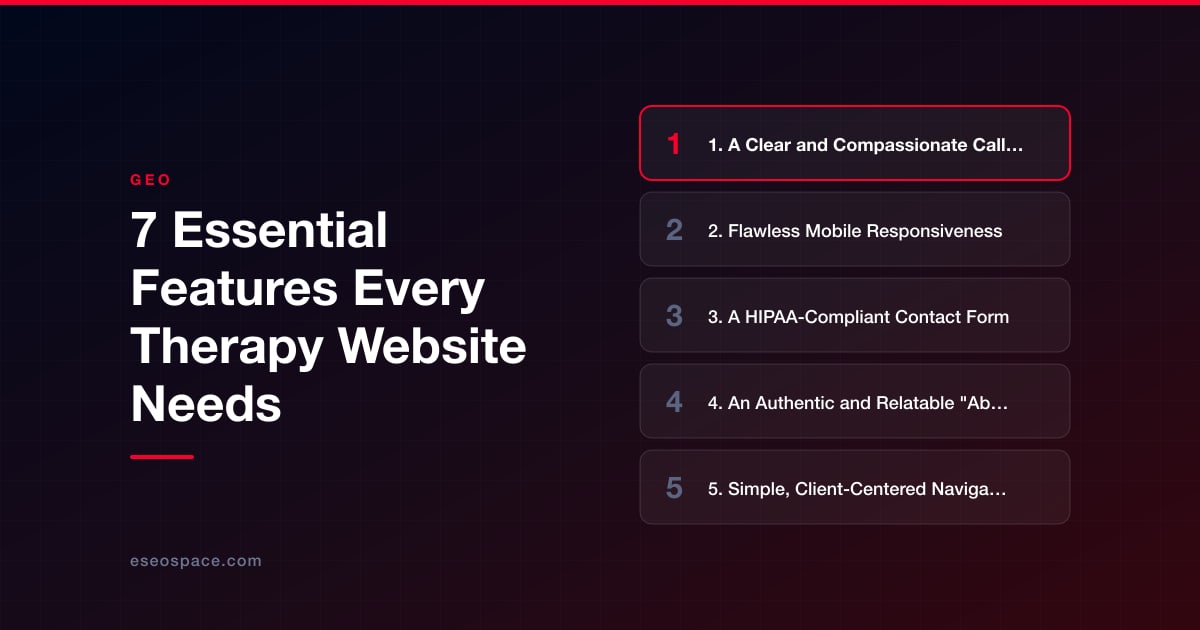
1. A Clear and Compassionate Call-to-Action (CTA)
A potential client lands on your site, reads about your services, and feels a connection. What do they do next? If the answer isn't immediately obvious, you risk losing them. A call-to-action (CTA) is a prompt that guides visitors toward their next step. For a therapy website, this is arguably the most important feature.
Your CTA should be clear, action-oriented, and easy to find. Vague phrases like "Contact Us" are less effective than more inviting and specific language.
Why it's essential: Making the decision to seek therapy is a significant step. A clear CTA reduces friction and anxiety, empowering the user to act at the moment they feel ready. It removes the guesswork and makes the process of getting help feel manageable.
How to implement it:
- Use prominent buttons with text like: "Schedule a Free Consultation," "Book an Appointment," or "Request a Call."
- Place your primary CTA in the top right corner of your website’s navigation bar so it's always visible.
- Repeat the CTA at the bottom of key pages, such as your "About" and "Services" pages.
2. Flawless Mobile Responsiveness
The majority of people searching for local services, including therapy, are doing so on their smartphones. They might be looking for help during a private moment at work, in their car, or late at night. If your website is not designed to work perfectly on a small screen—forcing users to pinch, zoom, and scroll horizontally—you are delivering a frustrating experience.
A responsive design automatically adjusts your website's layout to fit any screen size, from a large desktop monitor to a small smartphone. This is no longer an optional feature; it's a fundamental requirement.
Why it's essential: A poor mobile experience signals that your practice is outdated and can make potential clients feel that their needs are not being considered. Google also prioritizes mobile-friendly websites in its search results, so a non-responsive site will be harder for people to find in the first place.
How to implement it:
- Ensure your website is built on a responsive theme or template. Most modern platforms like Squarespace, Wix, and WordPress offer this by default.
- Regularly test your site on your own phone. Navigate it as a new client would. Is text easy to read? Are buttons easy to tap? Does the navigation menu work intuitively?
3. A HIPAA-Compliant Contact Form
Your standard website contact form is a major liability. Most default forms that come with website builders send submissions to your email inbox as unencrypted plain text. If your practice is a HIPAA covered entity, sending a prospective client's mental health details as unencrypted email creates a risk the HIPAA Security Rule requires you to address, which in practice usually means encrypting it.
Protecting client privacy is your ethical and legal duty, and this begins with the very first inquiry. You must use a contact form solution that is specifically designed to be HIPAA-compliant.
Why it's essential: Using a non-compliant form exposes you to severe legal penalties and destroys client trust. Demonstrating from the outset that you take privacy seriously is a powerful way to show your professionalism and build a sense of safety.
How to implement it:
- Use a third-party service that offers HIPAA-compliant forms and will sign a Business Associate Agreement (BAA).
- Popular options for therapists include Hushmail, Paubox, or HIPAA-compliant tiers of services like Jotform.
- Embed the secure form on your contact page and remove any old, non-compliant forms.
4. An Authentic and Relatable "About" Page
After the homepage, the "About" page is often the most visited page on a therapist's website. People don't just want to know what you do; they want to know who you are. This is where the therapeutic alliance begins. A sterile list of qualifications and degrees is not enough. Clients are looking for a human connection.
Your "About" page is your opportunity to share your therapeutic philosophy, convey your personality, and speak directly to your ideal client's struggles in a compassionate way.
Why it's essential: Therapy is a deeply personal relationship. A well-written "About" page helps a potential client decide if they can see themselves working with you. It builds rapport and helps them feel understood before they even pick up the phone.
How to implement it:
- Include a professional, warm, and friendly headshot. Your face builds trust.
- Write in the first person ("I" and "you") to create a direct and personal connection.
- Share a bit about your "why"—what led you to this work?
- Describe your approach in simple, jargon-free language, focusing on how it helps the client.
5. Simple, Client-Centered Navigation
When a visitor is feeling overwhelmed, the last thing they need is a confusing website. Your site's navigation menu should be incredibly simple and intuitive, guiding users to the information they need without any thought or effort.
A cluttered menu with too many options or vague labels creates stress. The goal is to provide a clear, predictable path to essential information.
Why it's essential: Effortless navigation shows respect for the visitor's time and emotional state. It makes the experience of learning about you and your services feel calm and organized, mirroring the sense of clarity you hope to provide in therapy.
How to implement it:
- Limit your main menu to 5-7 essential items: Home, About, Services, FAQ, Blog, and Contact.
- Use clear and descriptive labels. For example, "Anxiety Therapy" is better than a generic term like "Solutions."
- Ensure your contact information and primary CTA are always visible, either in the header or footer of every page.
6. Social Proof Through Testimonials
Ethically-sourced testimonials are a powerful form of "social proof." They provide validation from past clients that you can help people achieve real results. Of course, soliciting reviews as a therapist requires careful navigation of ethical guidelines to protect client confidentiality.
Testimonials should never feel coerced and should only be used with explicit, written consent. Many therapists find it appropriate to ask clients who have successfully completed therapy and are no longer in a vulnerable therapeutic relationship.
Why it's essential: Reviews build credibility and reduce the perceived risk for someone considering therapy. Hearing from others who have had a positive experience can be the final piece of encouragement a person needs to reach out.
How to implement it:
- Consult your licensing board's guidelines on testimonials.
- Ask former clients if they would be comfortable sharing a few sentences about their positive experience.
- Focus on the results, not just the process. A testimonial like, "I learned the tools I needed to manage my anxiety and feel in control again," is incredibly powerful.
7. An Informative and Empathetic Blog
A blog is the engine of your website. Each post you write is a new opportunity to show up in Google search results, answer a potential client's question, and demonstrate your expertise. It allows you to connect with people who may not be ready for therapy yet but are seeking information and resources.
Your blog establishes you as a trusted authority in your niche and builds a relationship with your audience over time.
Why it's essential: A blog drives traffic to your site, improves your SEO, and builds trust. By providing valuable content that addresses your ideal client's pain points, you are offering help and showcasing your therapeutic approach in a non-salesy way.
How to implement it:
- Create a list of common questions your clients ask and turn each one into a blog post.
- Write in a clear, compassionate, and jargon-free tone.
- Commit to a consistent, manageable schedule, such as one or two posts per month.
By incorporating these seven essential features, you create a website that not only looks professional but also serves as a compassionate and effective tool for connection. You build a digital space that welcomes potential clients, reassures them of your expertise, and makes their first step toward healing as simple as possible.
Frequently Asked Questions
What is the most important feature a therapy website needs?
Why isn't my standard website contact form HIPAA-compliant?
Why does mobile responsiveness matter for a therapy website?
What should my call-to-action button actually say?
Do I need complex technology to build an effective therapy website?
Put this into action with eSEOspace
We help businesses grow with website development that actually performs. Explore the services behind this guide:
Get a FREE GEO/AEO/SEO Audit
We'll analyze your site's SEO, GEO, AEO & CRO — completely free — and show you exactly how to get found across Google and AI answers.
Don't have a site yet? Get in touch →
Great — your audit is on the way!
We'll send your free SEO/GEO/AEO/CRO audit within the next few hours. Where should we send it?
You're all set! ✓
Your free audit is being prepared — check your inbox in the next few hours. Talk soon!


On this page
- Key Takeaways
- 1. A Clear and Compassionate Call-to-Action (CTA)
- 2. Flawless Mobile Responsiveness
- 3. A HIPAA-Compliant Contact Form
- 4. An Authentic and Relatable "About" Page
- 5. Simple, Client-Centered Navigation
- 6. Social Proof Through Testimonials
- 7. An Informative and Empathetic Blog
- Frequently Asked Questions






