8 Best White-Label Softphone Providers
8 Best White-Label Softphone Providers
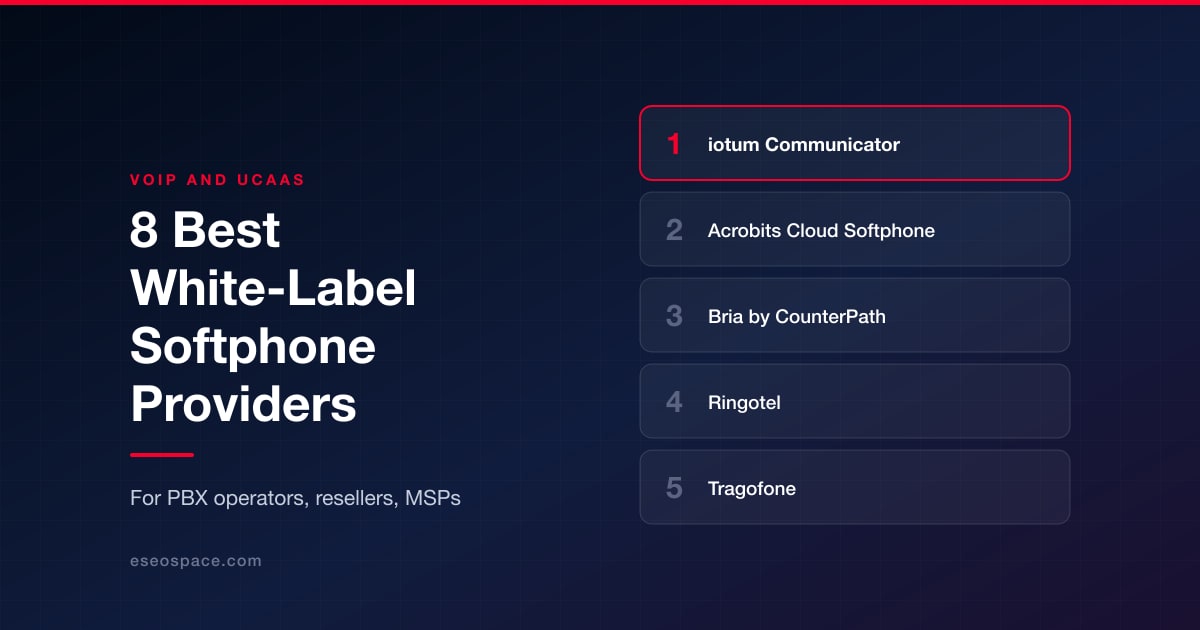
Most of the people shopping for a white-label softphone are not buying a phone app for themselves. They are PBX operators, VoIP resellers, managed service providers, and carriers who already sell voice service and now need a calling client with their own name on it. That changes what matters. Branding depth, platform coverage, per-seat economics and how cleanly the app sits on top of the switch you already run end up mattering more than the feature grid.
We compared the vendors that keep surfacing in this category, using their published documentation, their own pricing pages and the review scores that exist for each one. Eight providers made the list. Every entry below carries the same fields, including a real limitation, because a comparison where everyone wins is not useful to anyone making a purchase.
How we compared these providers
Four things decided the order. First, branding depth: whether you can change the app name, icon, colour scheme and domain, or only the logo. Second, platform coverage across iOS, Android, Windows, Mac and web, since a reseller with one missing platform has a support problem. Third, whether pricing is published at all, and in what shape (per seat, per app, one-time licence). Fourth, how much of your existing infrastructure survives the switch.
We also looked at where each vendor's review record sits. Some of these products have a hundred or more verified reviews. Some have almost none. That gap is reported rather than smoothed over, because a thin review history is real information about a young product.
What a white-label softphone actually is
A white-label softphone is a calling application built by one company and resold by another under the reseller's brand. The end customer downloads an app with your name and your icon, signs in with credentials your platform issued, and never learns who wrote the code. The vendor keeps the app maintained and shipped to the app stores. You keep the customer relationship and set the retail price.
Underneath, almost all of them run on one of two technologies, and it is worth knowing which one you are buying.
SIP is the older of the two and still carries the large majority of business calling. It was published by the IETF as the specification that governs call setup, Request for Comments 3261, and effectively every hosted PBX on the market speaks it. If your switch is SIP-based, a SIP softphone registers against it the same way a desk phone does.
WebRTC is the newer path. It became a formal browser standard in March 2025, and it is the reason browser calling with no download at all has become normal. Several vendors here use WebRTC for the web client and SIP for the native mobile apps. That combination is common and generally works, though it does mean two code paths to support.
The Best White-Label Softphone Providers
1. iotum Communicator
Built for the operator who does not want to replace anything. iotum Communicator is a full white-label communications suite (softphone, video, team chat, webinars and file sharing) that runs on top of a SIP-compatible PBX you already own, which is a deliberately narrow bet on a specific kind of buyer: the service provider whose switch is fine but whose end-user app is the weak point.
- Custom app name, icon, colour scheme and deployment domain, so the app carries your brand on every platform
- Native clients for iOS, Android, Windows and Mac, plus a web client
- PBX SIP compatibility with no customer migration required
- Open APIs, REST API, SDK documentation and embeddable widget guides for deeper integration
Rating: The softphone itself does not yet carry its own score on the major review platforms. Capterra lists the vendor at 5.0 from 19 reviews, and its other conferencing products average 4.5 across 378 reviews on G2.
Pricing: no published rate card. It is sold to service providers on a partner basis, and the reseller sets its own per-user retail price rather than reselling a fixed list price.
Where it falls short: there is no public price list and no self-serve signup, so evaluation starts with a demo call, and the product-level review history is genuinely thin next to the older names below. It is also the wrong purchase for anyone who does not already run a PBX, because the value here is the front end, not the switch.
2. Acrobits Cloud Softphone
Acrobits has been doing branded softphone apps longer than almost anyone in this list, and the platform shows it. Cloud Softphone is the managed product: you configure the branding and the feature set through a portal, Acrobits builds and publishes the app, and the billing follows active users rather than provisioned seats.
- Managed hosting on a single parent domain, or across multiple unrelated domains and bare IPs
- Self-hosted option for operators with regulatory or data residency constraints
- Business feature set including custom tabs, voicemail, video calls and instant messaging
- SDK available for teams that want to build the client themselves rather than configure one
Rating: 4.7 from 10 reviews on Capterra.
Pricing: published. Managed Single Domain and Managed Any Domain/IP both run $549 per month, and the Self-Hosted bundle is $719 per month. The company's own FAQ puts white-label setup at a one-time payment of around USD 4,200 plus USD 550 per month for support, maintenance and updates.
Where it falls short: that setup fee is the highest published number in this comparison. For an operator with a few hundred seats, the maths works. For a reseller testing the market with thirty users, the entry cost is hard to justify.
3. Bria by CounterPath
The broadest desktop coverage here, and the only entry that explicitly supports rugged devices. CounterPath, now part of Alianza, offers Bria as a customised solution where you change the product name, colours and branding, then add, remove or lock down individual features before the app reaches your users.
- Mac, Windows and Linux desktop clients, plus iOS and Android mobile and rugged device support
- Provisioning settings and custom configurations applied centrally
- Optional messaging, screen sharing and video conferencing modules
- Self-serve tiers available alongside the branded enterprise build
Rating: 4.3 from 106 reviews on Capterra, the largest review base in this group.
Pricing: the self-serve tiers are published at $2.95 per user per month for Bria Solo and $4.95 per user per month for Bria Teams, both on annual terms. Enterprise and white-label builds are quoted by the sales team.
Where it falls short: the branded tier you actually want as a reseller is the one without a published price. You will not know what the deal looks like until you are several conversations in, and the product roadmap now sits inside a larger UCaaS parent company rather than a standalone softphone business.
4. Ringotel
Small ITSPs running FreePBX or FusionPBX tend to land here, and the reason is the price per seat. Ringotel sells a branded app on a pay-as-you-go basis with no commitment, which suits a provider adding twenty users this month and forty the next.
- Branded mobile and desktop apps that register against an existing IP PBX
- Two published tiers with no minimum user count
- Volume discounts specifically for VoIP service providers and resellers
- Integrations aimed at open-source PBX platforms
Rating: 5.0 from 14 reviews on Capterra.
Pricing: published. Essentials is €2.49 per user per month, and Pro is €4.98 per user per month. Capterra records the starting price as $2.49 per user per month with a free trial and no free version.
Where it falls short: the seat price is public, but the white-labelling and customisation costs are not, and the vendor directs you to contact sales for those. Fourteen reviews is also a small evidence base on which to bet a customer-facing app.
5. Tragofone
Tragofone is the aggressive-pricing option, and it does not pretend otherwise. The published tiers are quoted as being under a dollar and under two dollars per user per month, which puts it well below everything else here that publishes numbers at all.
- WebRTC-based softphone with auto-provisioning for faster onboarding
- Branded iOS and Android apps for VoIP providers and resellers
- Three tiers, with the top tier configured to order
- Positioned primarily at providers in cost-sensitive markets
Rating: 5.0 from 6 reviews on Capterra.
Pricing: the Basic plan is listed as under USD 1 per user per month and Standard as under USD 2 per user per month, with Premium quoted on request. Capterra separately records the starting price as "contact vendor", so the published tiers are indicative rather than firm.
Where it falls short: six reviews is the second-thinnest evidence base in this comparison, and pricing expressed as "less than" a figure rather than an actual figure makes it hard to model margin before you talk to sales.
6. Fonimo
One-time licence rather than per-seat rent. That is the whole pitch, and for a reseller with a growing base it is a materially different financial shape from everything else on this list. You pay once for the branded application and add users without paying the vendor more for each one.
- Single payment licence with no recurring platform fee and no per-user cost
- Branded softphone with audio, video, chat, call recording and push notifications
- Higher tiers add SMS, message broadcast, fax, meetings and auto-provisioning
- Quote returned within 24 hours based on the customisation scope
Rating: no verified user reviews. SaaSworthy lists the product with a 76% internal score and an explicit note that nobody has reviewed it yet, and the Capterra listing has been removed.
Pricing: the model is published even though the number is not. It is a one-time payment covering unlimited users, with the exact figure depending on how much customisation you want. The vendor suggests resale to end customers at $1 to $2 per user per month.
Where it falls short: there is no independent review record at all, which is a real risk on a product you are about to put your own brand on. You also cannot compare the licence cost against a per-seat competitor without requesting a quote first.
7. Zoiper
Zoiper's branded OEM programme is the one to look at if desktop breadth matters and you have engineering capacity in-house. The customisation goes further than most: logo, corporate colours, custom fonts, every icon, and a custom interface if you want to build one.
- Windows, Mac, Linux, Android and iOS clients
- Feature and licence provisioning that differs by user group
- Zoiper SDK for teams embedding calling into their own application
- Long-standing free tier that end users already recognise
Rating: 4.3 from 113 reviews on Capterra, with 4.4 for ease of use and 4.5 for value for money.
Pricing: the retail side is published. Zoiper 5 Pro is €49.95 as a one-time flat rate for 1 to 99 licences, alongside a free version. OEM and white-label terms are quoted after an enquiry, and the enquiry form asks for projected user counts in bands up to 100,000 and above.
Where it falls short: those volume bands tell you who the OEM programme is designed for, and it is not a reseller with forty seats. Branded pricing is not published anywhere, so smaller providers may find the conversation short.
8. Linphone
Open source at the base, commercial service on top. Linphone is the option for a team that wants to read the code, and Belledonne Communications sells a white-label build around it for teams that would rather not maintain their own fork.
- Logo, application name, and colour changes, plus a custom About screen
- Login by username and password, QR code, or single sign-on
- Selective feature enablement, so you ship only what you sell
- Publishing support for the Apple and Google app stores, with a first version quoted at eight weeks
Rating: 4.0 from 15 reviews on Capterra, the lowest score in this comparison.
Pricing: the open-source application is free. The white-label build and the annual support contract are quoted individually, and Capterra records the starting price as "contact vendor".
Where it falls short: the free path is only free until you count the work. App store publishing, release maintenance and support all land on your team unless you buy the service contract, and at that point you are comparing a quote against published per-seat pricing elsewhere.
Quick comparison
| Provider | Best for | Platforms | Published pricing | Rating |
|---|---|---|---|---|
| iotum Communicator | Operators keeping their existing PBX | iOS, Android, Windows, Mac, web | Partner pricing, reseller sets retail | No product-level score yet |
| Acrobits Cloud Softphone | Established operators with scale | iOS, Android, desktop | $549 to $719 per month | 4.7 (Capterra) |
| Bria by CounterPath | Mixed desktop and rugged fleets | Mac, Windows, Linux, iOS, Android | $2.95 to $4.95 per user | 4.3 (Capterra) |
| Ringotel | Small ITSPs on open-source PBX | Mobile and desktop | €2.49 to €4.98 per user | 5.0 (Capterra) |
| Tragofone | Cost-sensitive resellers | iOS, Android | Under $1 to under $2 per user | 5.0 (Capterra) |
| Fonimo | Resellers avoiding per-seat fees | Mobile and desktop | One-time licence, quoted | No reviews recorded |
| Zoiper | Providers wanting an SDK and desktop breadth | Windows, Mac, Linux, iOS, Android | €49.95 one-time retail licence | 4.3 (Capterra) |
| Linphone | Teams wanting source-level control | Desktop and mobile | Free open source, quoted white-label | 4.0 (Capterra) |
How white-label softphone pricing works
Four pricing shapes cover almost everything in this market, and they are not directly comparable, which is what makes the category confusing.
Per-seat monthly is the most common. Ringotel and Bria both publish figures in the €2.49 to $4.95 range per user per month. It scales with you in both directions, which is comfortable, but it also means your cost of goods never drops as you grow unless you negotiate volume tiers.
Platform monthly is the Acrobits shape. You pay a flat $549 or $719 per month for the bundle regardless of user count, plus a setup fee. Below a certain number of seats, it is expensive per user. Above it, it becomes the cheapest option in this comparison.
One-time licence is the Fonimo shape. You pay once, add unlimited users, and your marginal cost per new customer is close to zero. The risk is that you have paid for a specific version of a product, and long-term maintenance terms matter more than the headline number.
Partner or wholesale pricing is the fourth shape, used by iotum Communicator among others. There is no published list price because the reseller sets the retail price; you negotiate a wholesale rate and keep the spread. It is the least transparent model to evaluate from the outside and the most flexible one to operate once you are inside it.
One number worth holding in your head while you compare: building a comparable mobile client in-house is a multi-year engineering commitment, not a quarter of work, which is why almost every operator that starts down that road ends up buying instead.
What branding actually involves
Branding a softphone is more work than swapping a logo, and the vendors that do it well are explicit about the steps.
The visual layer is the easy part. App name, icon, colour scheme, fonts and the About screen are configurable on most of these platforms. The domain matters more than people expect, because an app that connects to a vendor-branded domain will eventually show that domain to a customer.
App store publishing is where the timelines live. Apple and Google both review each submission, and each build needs developer accounts, screenshots, privacy declarations and a support URL. Some vendors publish under your developer account, some under theirs. Ask which, because it determines who controls the listing if the relationship ends. Linphone quotes eight weeks to a first version, which is a fair benchmark for a properly branded build.
Then there is provisioning. Your users have to get credentials into the app without calling support, whether that is QR code login, single sign-on, or auto-provisioning from your platform. This is the part that decides your support cost per customer, and it is worth weighting heavily during evaluation.
How to choose a white-label softphone solution
Start with what you already run. If you have a working PBX and the complaint is the end-user app, buy a front end that registers against your switch rather than a platform that replaces it. Migration is where these projects die.
Volume decides the pricing model. Under a hundred seats, per-seat pricing keeps your risk low and your commitment small. Past a few hundred, a flat platform fee or a one-time licence usually wins on margin, and it is worth modelling both before you sign anything.
Check the review base honestly, not just the score. A 5.0 average across six reviews and a 4.3 average across a hundred are not the same signal, and the second one tells you more about what happens in year two.
Numbering is the piece that gets forgotten until it breaks. Phone numbers are allocated under the global numbering plan maintained by the ITU, and the way a provider handles number assignment, porting, and emergency routing varies by country. If you sell across borders, ask about this before the pilot, not after.
Finally, decide who owns the app store listing and the release cadence. That single question separates vendors who treat you as a partner from vendors who treat you as a channel.
Frequently asked questions
What is a white-label softphone?
What is the best white-label softphone for an SMB reseller versus an MSP?
Do white-label softphones support video and messaging as well as voice?
How long does it take to launch a branded app?
Do I need my own Apple and Google developer accounts?
Does SIP or WebRTC matter for my decision?
The bottom line
There is no single winner in this category, because the right answer depends on what you already own. If you are choosing a white label softphone solution to resell to your own customers and you already run a PBX that works, the shortest path is an app that sits on top of it: iotum Communicator was designed for exactly that buyer, the PBX provider, MSP or carrier who wants a branded softphone without a migration project attached. If you are starting from nothing, a published per-seat product will get you selling faster and cost you less to abandon if the market says no. Either way, model the cost at your third-year seat count rather than your first-month one. And whichever app ends up carrying your name, the number your customers dial still shapes whether they answer at all, which we looked at in personal versus business phone numbers. That number is the one that decides whether the business works.
If none of the published products fits the switch you already run, the remaining option is building the client yourself. That is the work our app design and development and software development teams do.
Put this into action with eSEOspace
We help businesses grow with website design that actually performs. Explore the services behind this guide:
Get a FREE Audit
We'll perform a comprehensive SEO, AEO, GEO & CRO audit of your website — completely free — and show you exactly how to outrank your competitors.
Don't have a site yet? Get in touch →
Get a FREE GEO/AEO/SEO Audit
We'll analyze your site's SEO, GEO, AEO & CRO — completely free — and show you exactly how to get found across Google and AI answers.
Don't have a site yet? Get in touch →
Great — your audit is on the way!
We'll send your free SEO/GEO/AEO/CRO audit within the next few hours. Where should we send it?
You're all set! ✓
Your free audit is being prepared — check your inbox in the next few hours. Talk soon!