Do You Actually Need an RFP for a Website Redesign?
Do You Actually Need an RFP for a Website Redesign?
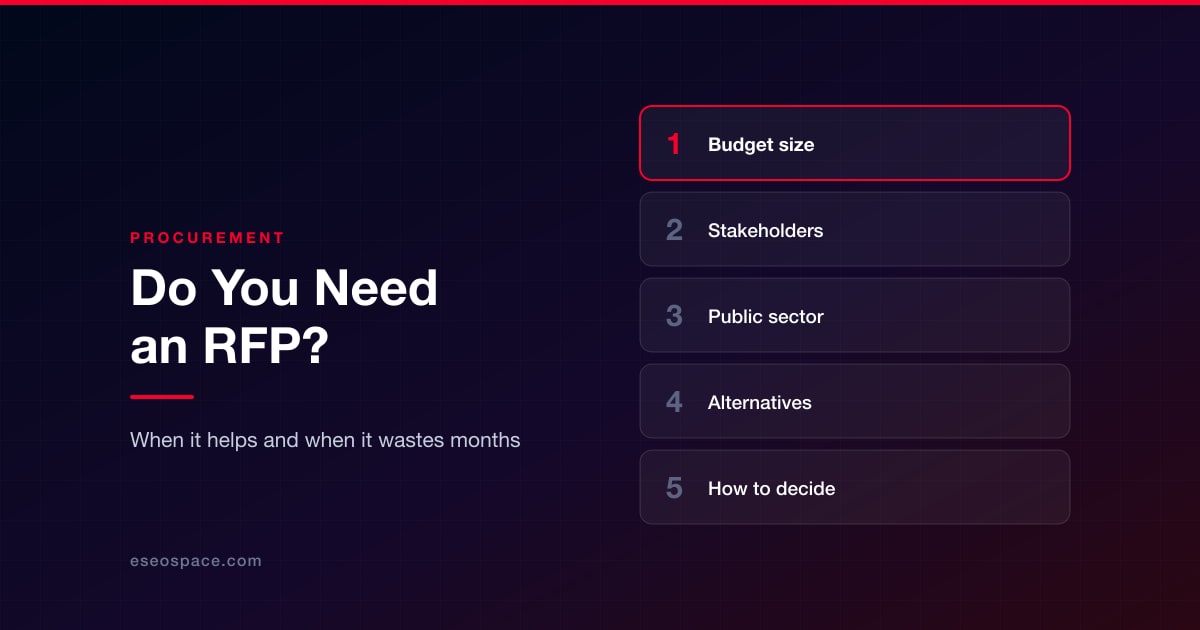
Almost everything written about website RFPs assumes you have already decided to run one, and then tells you how. That skips the more useful question, and it is usually skipped by people who benefit from the answer being yes.
An RFP is a tool with real costs. Sometimes it is clearly the right tool. Often it is not, and running one anyway produces a worse outcome than the informal process it replaced. Here is how to tell which situation you are in.
What an RFP actually costs
Not money, usually. Time and quality.
On your side: writing the document, agreeing it internally, publishing it, running a question period, reading proposals, scheduling presentations, scoring, and notifying. For a committee of five that is comfortably several weeks of elapsed time and a meaningful number of staff hours.
On the bidder's side: a serious proposal takes a week of senior time. That cost is real, and agencies decide whether to pay it based on their odds. This is the part organizations underestimate. A heavyweight process attached to a modest project does not attract more bidders — it attracts fewer and worse ones, because the firms with the most work on will decline, and the ones who respond will do so with a template.
There is a slower cost too. A formal RFP tends to freeze the specification early, before anyone has done discovery. You end up buying the solution you imagined at the start rather than the one that emerges from looking properly, and the change orders come later.
When an RFP is clearly right
You are required to run one. Public bodies, many nonprofits above a spend threshold, and organizations with formal procurement policies frequently have no discretion. If that is you, the question is answered — skip to writing a good one.
The project is large. Above roughly a hundred thousand dollars, the process cost is small relative to the decision, and the structure earns its keep.
The decision needs to be defensible. If a board, a funder or the public may ask why you chose a supplier, documented criteria and completed score sheets are what answer that. This matters even below the usual thresholds.
The requirements are genuinely complex. Multiple integrations, migration from an unusual platform, accessibility obligations with a deadline, multilingual content, single sign-on. Writing all of that down forces internal agreement you would otherwise discover you lacked halfway through the build.
Nobody internally agrees what the project is. This is an underrated reason. The act of writing an RFP is often the first time a group of stakeholders has to reconcile their different ideas of what the website is for. That value accrues whether or not you ever issue the document.
When it is the wrong tool
The project is small. Under about thirty thousand dollars, the process can consume a noticeable fraction of the project's value in staff time on both sides.
You already know who you want. If you have a supplier you trust and no procurement obligation, running an RFP to confirm a decision you have made is a discourtesy to the other bidders and a waste of their week. Negotiate directly. If you want a market check, ask two others for a rough range without asking for full proposals.
You cannot articulate the problem yet. An RFP written from an unclear brief produces incomparable proposals, because each bidder has to guess what you meant and they will guess differently. Do discovery first, even a paid one, then procure against what you learn.
You are hoping the responses will tell you what you need. They will not. Bidders answer the document in front of them.
The middle path most organizations should take
Between "formal RFP" and "phone a friend" there is an option that suits most small and mid-sized projects, and it is badly under-used.
Write a one-page project brief. Who you are, what is wrong with the current site, what you need it to do, your budget range, your timeline, and how you will decide. Send it to three agencies you have shortlisted yourself on evidence — comparable sector, comparable scale, work you can look at, references you can call.
Ask for a short written response and a conversation rather than a full proposal document. You will get comparable information, in about a fifth of the elapsed time, from firms that were willing to engage because the ask was proportionate.
Sections 1, 2, 3, 7 and 8 of the template in our RFP template pack are exactly this. Use those five and delete the rest.
Three things to do regardless
Whichever route you take, these matter more than the format of the document.
Publish a budget range. Withholding it is the single most common cause of proposals you cannot compare, because each bidder scopes to a different imagined scale. You are buying a defined scope at a price, not running a discovery exercise on your own budget.
Shortlist before you invite. Three to five well-chosen firms beats ten invitations every time, in both process cost and proposal quality.
Settle accessibility and ownership up front. These are the two areas organizations most often regret leaving vague, and both are far easier to agree before a supplier is selected than after. Our guides to accessibility requirements and who owns the code cover the wording, and they apply to a one-page brief just as much as to a formal document.
If you do decide to run one
Do it properly rather than half-heartedly. Our website RFP template covers the structure, the requirements list gives you the scope section, and evaluation criteria and scoring covers deciding. Public bodies should start with the government RFP guide.
And whichever route you take, you can send us the document — a formal RFP or a one-page brief, we will respond to either, and the RFP and procurement FAQ answers the questions we get most often.
Put this into action with eSEOspace
We help businesses grow with website design that actually performs. Explore the services behind this guide:
Get a FREE Audit
We'll perform a comprehensive SEO, AEO, GEO & CRO audit of your website — completely free — and show you exactly how to outrank your competitors.
Don't have a site yet? Get in touch →
Get a FREE GEO/AEO/SEO Audit
We'll analyze your site's SEO, GEO, AEO & CRO — completely free — and show you exactly how to get found across Google and AI answers.
Don't have a site yet? Get in touch →
Great — your audit is on the way!
We'll send your free SEO/GEO/AEO/CRO audit within the next few hours. Where should we send it?
You're all set! ✓
Your free audit is being prepared — check your inbox in the next few hours. Talk soon!