Legal Considerations Every eCommerce Website Owner Should Address Before Scaling
Legal Considerations Every eCommerce Website Owner Should Address Before Scaling
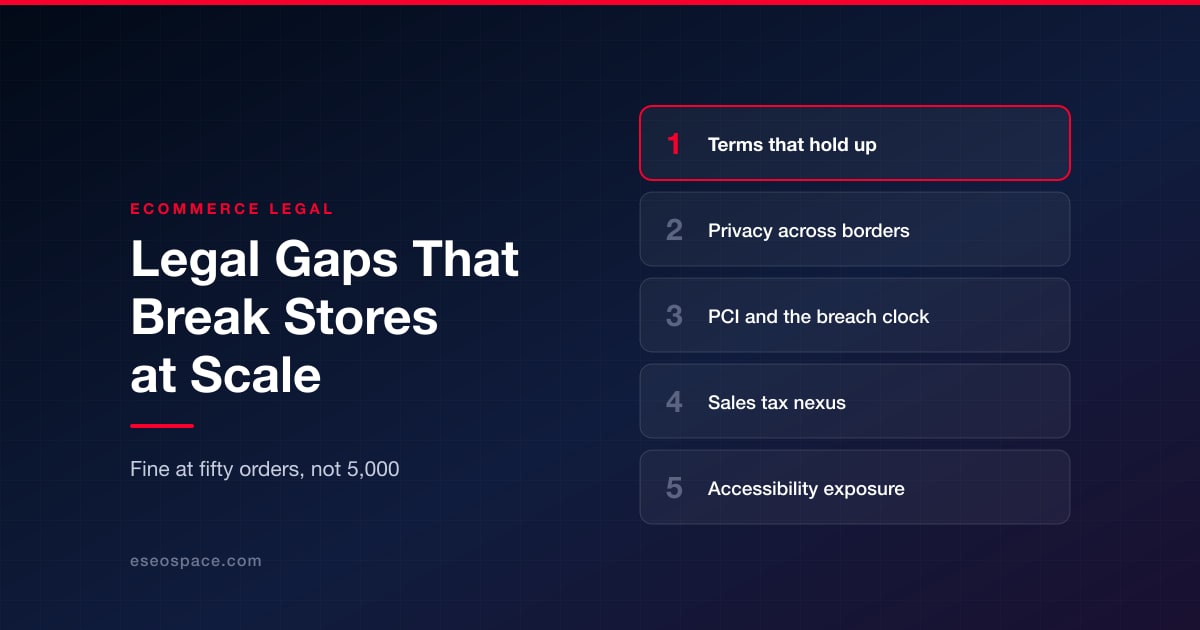
Most online stores don't get shut down by a bad ad campaign or a slow website. They get shut down, fined, or sued over paperwork nobody read closely the first time. Scaling makes every one of those gaps bigger. A policy that was fine at fifty orders a month becomes a liability at five thousand.
Here's what actually needs attention before growth turns a small oversight into a real problem. For the wider set of rules that can reach any site, not only a store, see website legal requirements.
Your Terms of Service Have to Actually Hold Up
A terms of service page isn't decoration. It's the contract between you and every customer who buys from you, and it only works if a court would recognize it as one. That means it has to be presented in a way customers actually see and agree to — a checkbox at checkout, not a link buried in a footer nobody clicks.
Weak terms pages tend to share the same problems: no clear limitation of liability, no dispute resolution clause, no language covering what happens when a shipment is lost or a product arrives defective. None of that matters much at low volume, because disputes are rare and usually end in a refund. At scale, disputes become routine, and a terms page with gaps is an invitation for every one of them to cost more than it needed to. Where that consent lives is a checkout design decision as much as a legal one — the agreement has to be visible without becoming one more reason to abandon the cart.
Privacy Policies Aren't the Same Everywhere You Sell
A single privacy policy written for one country stops being enough the moment a store ships internationally. The EU's GDPR sets one set of rules for collecting, storing, and sharing customer data. California's CCPA sets another. A growing list of state laws sets more, and none of them line up neatly. Get it wrong under GDPR and the penalties reach into the tens of millions of euros for serious violations.
The practical fix isn't writing a new policy per country. It's building one policy that meets the strictest standard the store is exposed to, then layering in region-specific disclosures where the law requires them — a cookie consent banner for EU visitors, an opt-out link for California residents. Skipping this rarely causes trouble at low traffic. It becomes real exposure once a customer base actually spans jurisdictions with regulators who enforce these rules.
Age-Restricted Products Need More Than a Checkbox
Selling anything with a legal age requirement — alcohol, tobacco and vape products, certain supplements, adult content, even some collectibles — comes with an obligation a birthdate field doesn't satisfy. Regulators in a growing number of states and countries now expect real age verification, not a self-reported checkbox a twelve-year-old can click through in two seconds.
This is where a lot of growing stores get caught flat-footed. A checkbox that says "I am over 18" worked fine when a store sold to a few hundred people a month and nobody was checking. It doesn't hold up under regulatory scrutiny once volume grows, and several US states have already passed laws requiring verifiable age checks for specific product categories. Stores in this position typically move to dedicated age verification software that checks a government-issued ID or uses another verifiable method, rather than relying on an honor system a court or regulator won't treat as sufficient.
Getting this wrong isn't a minor compliance footnote. Selling age-restricted products to minors can trigger fines, forced product delisting, and in some categories, criminal liability for the business owner directly.
Payment Processing Has Its Own Rulebook
Every store that accepts card payments falls under PCI DSS — the Payment Card Industry Data Security Standard. Size doesn't exempt anyone. A hosted checkout from Shopify or Stripe covers most of it automatically, which is why small stores rarely think about it. The problem starts when a store customizes checkout, stores card data directly, or builds a payment flow outside the processor's standard tooling.
A breach involving stored card numbers is a different category of problem than one involving email addresses. It carries mandatory notification requirements, processor penalties, and potential liability for fraudulent charges traced back to it. Non-compliant merchants can also face monthly fines from their acquiring bank until the gap is closed, on top of whatever the breach itself costs. Scaling usually means someone on the team wants more control over the checkout experience — that's exactly the moment PCI scope needs a second look, and the moment to decide whether the custom build is worth pulling card data into your own environment.
When a Breach Happens, the Clock Starts Immediately
Nearly every US state, along with the EU and UK, now has a data breach notification law, and most are strict about timing. Under GDPR, a business has 72 hours from becoming aware of a qualifying breach to notify the relevant supervisory authority — not 72 hours from working out exactly what happened. Affected customers are a separate obligation with its own trigger: they have to be told without undue delay when the breach is likely to put them at high risk. US state laws add their own deadlines on top, and they don't agree with each other.
A store with a few hundred customer records has a manageable notification job if something goes wrong. A store with half a million records, spread across states with different thresholds and different definitions of what counts as personal data, needs a response plan written down before an incident — not improvised during one. Regulators treat a fast, organized response very differently from a slow, confused one, even when the underlying breach is identical. Most of the work is preventative anyway; the basic security hygiene that keeps a small site out of trouble is the same hygiene that keeps a large one out of a notification letter.
Sales Tax Follows Where the Customer Is, Not Where You Are
The rules changed in 2018, when the Supreme Court's decision in South Dakota v. Wayfair established that states can require sales tax collection based on economic activity in the state rather than physical presence. A store based in one state can owe sales tax in dozens of others once it crosses each state's threshold.
At low volume this rarely triggers anything. The most common trigger is around $100,000 of sales into a state, sometimes paired with a transaction count — but the exact test varies, several states set the dollar bar considerably higher, and a growing number have dropped the transaction-count prong entirely since 2018. That churn is the real risk: a threshold a store checked once and filed away may not be the threshold that applies now. Retroactive tax liability, once discovered, comes with penalties and interest on top of the tax itself, and it can reach back years if a state audits and finds a threshold was crossed without anyone noticing. Selling internationally adds a second layer, with VAT registration thresholds in the EU and UK working on similar principles and carrying their own filing schedules.
Advertising Claims Need to Survive a Closer Look
The FTC has a simple standard: advertising claims need to be true, and provable. Endorsements and reviews need to disclose any material connection to the business behind them. A small store making an exaggerated claim rarely draws attention. A store spending real money on paid advertising and influencer partnerships is a different story — that's the volume level where regulators and competitors both start paying attention.
This extends to return and refund policies, which several states legally require to be disclosed clearly before purchase, not just referenced in a footer link. A vague refund policy nobody complained about at low volume becomes a pattern once complaint volume rises, and patterns are what trigger regulatory inquiries. Subscription and auto-renewal businesses face a sharper version of this: a growing number of states now require a clear, easy cancellation path and explicit consent before renewal, after years of complaints about subscriptions that were simple to start and deliberately hard to end.
Accessibility Isn't Optional Once You're a Real Target
Website accessibility lawsuits under the Americans with Disabilities Act have grown sharply over the past several years, and courts have increasingly held that the ADA applies to commercial websites, not just physical stores. Larger, more visible sites are simply bigger targets — plaintiffs' firms tend to focus on businesses with revenue worth pursuing.
Meeting WCAG guidelines — proper alt text, keyboard navigation, sufficient color contrast — costs far less to build in during a redesign than to retrofit after a demand letter arrives. It's one of the few risks on this list that shows up almost exactly in proportion to how successful the business becomes, and one of the few that a scheduled accessibility audit can close before anyone sends anything. Most demand letters resolve through a settlement plus a commitment to fix specific issues, but the legal fees and engineering time to respond properly add up fast when they arrive one after another instead of once.
Trademarks and Product Listings Carry Real Exposure
Growth usually means more products, more suppliers, and more content written faster. That's also where intellectual property problems creep in — product images pulled from a supplier without a license, brand names used in marketing copy without permission, or a store name that turns out to be trademarked already in a market it's expanding into.
A cease-and-desist over a trademark conflict is an annoyance at low volume. At higher volume, with more ad spend and more brand equity built up, a forced rebrand is expensive in ways that go well beyond legal fees — new packaging, new ad creative, and lost search ranking on a domain that has to change. A basic trademark search before committing to a name, and a supplier agreement that states plainly who owns the product photography, both take an afternoon and prevent most of this outright. The same discipline pays off on the listings themselves: many of the mistakes that cost product pages sales start with copy and images imported wholesale from a supplier feed.
Business Structure Decides Who Actually Pays
One decision underlies almost everything on this list: whether the business is set up as a sole proprietorship, an LLC, or a corporation. A sole proprietorship offers no separation between business liability and personal assets — a lawsuit over any of the issues above can reach a founder's personal bank account, house, or savings directly. An LLC or corporation, properly maintained, keeps that risk contained to the business in most circumstances.
This is cheap and quick to fix at low volume, and considerably more disruptive after a business has grown, signed contracts, or hired staff under the wrong structure. It's also one of the few items here a lawyer can usually resolve in a single conversation, which makes skipping it a strange place to cut corners.
The Common Thread
None of these issues are exotic. Every one is a known, well-documented requirement that a lot of stores treat as optional right up until it isn't. What changes with scale isn't the law — it's exposure. A gap that costs nothing when a hundred people see it can cost a great deal when a hundred thousand do. The stores that handle this well don't wait for a complaint, a fine, or a lawsuit to tell them which gap mattered most.
Plenty of what's on this list is a build problem before it's a legal one: where consent sits in the checkout, whether the site meets WCAG, how much card data the storefront ever touches. That part we can help with — our e-commerce SEO services and development work start from a store that's structurally sound, because the fixes are far cheaper before traffic arrives than after. For the rest of it, talk to a lawyer who practices in the jurisdictions you sell into; this article is general information, not legal advice.
Put this into action with eSEOspace
We help businesses grow with website development that actually performs. Explore the services behind this guide:
Get a FREE Audit
We'll perform a comprehensive SEO, AEO, GEO & CRO audit of your website — completely free — and show you exactly how to outrank your competitors.
Don't have a site yet? Get in touch →
Get a FREE GEO/AEO/SEO Audit
We'll analyze your site's SEO, GEO, AEO & CRO — completely free — and show you exactly how to get found across Google and AI answers.
Don't have a site yet? Get in touch →
Great — your audit is on the way!
We'll send your free SEO/GEO/AEO/CRO audit within the next few hours. Where should we send it?
You're all set! ✓
Your free audit is being prepared — check your inbox in the next few hours. Talk soon!


On this page
- Your Terms of Service Have to Actually Hold Up
- Privacy Policies Aren't the Same Everywhere You Sell
- Age-Restricted Products Need More Than a Checkbox
- Payment Processing Has Its Own Rulebook
- When a Breach Happens, the Clock Starts Immediately
- Sales Tax Follows Where the Customer Is, Not Where You Are
- Advertising Claims Need to Survive a Closer Look
- Accessibility Isn't Optional Once You're a Real Target
- Trademarks and Product Listings Carry Real Exposure
- Business Structure Decides Who Actually Pays
- The Common Thread