
Funnel content for behavioral health and ABA providers
Funnel content for behavioral health and ABA providers
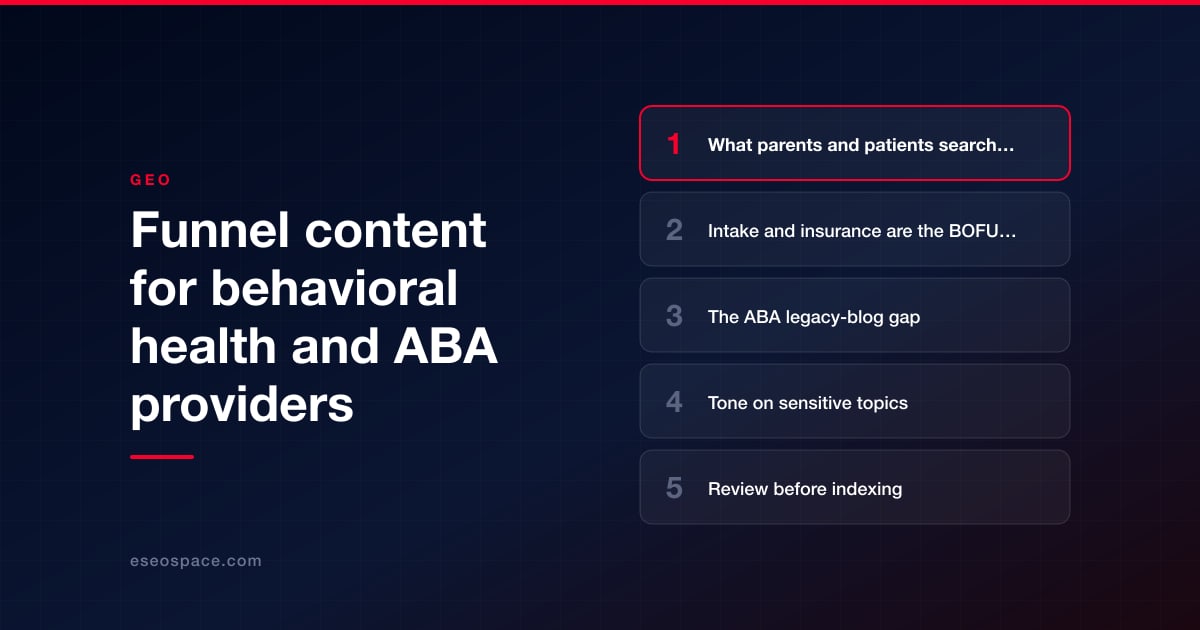
Funnel content for a behavioral health or ABA (applied behavior analysis) provider is a set of pages that follows a parent or patient from "what is going on" to "how do we start." TOFU (top of funnel, Learn) pages explain signs, conditions and therapies. MOFU (middle of funnel, Compare) pages compare approaches, settings, providers and how insurance generally works. BOFU (bottom of funnel, Decide) pages are the intake, insurance verification and first-appointment pages where someone takes the next step.
Two things set this market apart. The reader is often worried, sometimes in distress, and may be researching for someone else, such as a parent reading about their child. And intake is often a process rather than a single click: insurance checks, forms, assessments and sometimes a waitlist. So the BOFU stage is bigger than one contact page, and the tone of every page matters more than usual.
This playbook covers the questions at each stage, intake and insurance as BOFU, the gap we found on one ABA center's legacy blog, tone, review and measurement. It is not medical or legal advice.
Key Takeaways
- In this market, BOFU is often a sequence: intake, insurance verification, assessment and first appointment. Each step deserves a clear page or section.
- One ABA therapy center's 21 legacy blog posts split 14 TOFU, 5 MOFU and 2 BOFU. That shape shows the gap stage planning is meant to close.
- Publish insurance details only as the provider's billing team confirms them, with a date, and tell readers to confirm with their plan. Don't state what any law requires a plan to cover unless you have checked the source.
- Write calmly and without fear-based hooks or outcome promises, and show crisis information on pages where a reader may be at risk.
- Keep clinical pages noindex until a qualified clinician has reviewed them, and record who reviewed them and when.
- HIPAA-related rules on online tracking technologies exist, and part of HHS's guidance was vacated by a federal court in June 2024. Confirm the current status with counsel. This is not legal advice.
What parents and patients search at each stage
The person searching is not always the person who will receive care. Plan for both readers: the adult looking for help for themselves and the parent or family member looking on someone else's behalf. The searches below are hypothetical examples.
| Stage | What the reader wants to know | Hypothetical searches | Page type |
|---|---|---|---|
| TOFU (Learn) | What is this, and is it something to act on? | what is ABA therapy; signs of anxiety in teenagers | Explainers on signs, conditions and therapy types |
| MOFU (Compare) | Which approach or setting fits us? | in-home vs center-based ABA; therapy vs medication for anxiety | Fair comparisons of approaches, settings and formats |
| MOFU (Compare) | How does paying for this work? | how does insurance work for ABA therapy | General coverage and cost explainers |
| BOFU (Decide) | How do we start, and how long will it take? | ABA therapy intake [city]; [practice name] insurance accepted | Intake, insurance verification, first-visit and location pages |
Comparison pages in this field need extra fairness. Describe what each approach involves and who it may suit, and send readers to a clinician for the decision.
Intake and insurance are the BOFU stage
In many service businesses, BOFU is a contact form. Here it is often a short journey, and each step can lose a family who doesn't know what comes next. Map the provider's real intake process with the front desk, then give each step a clear page or section.
| Intake step | What the page should answer | Who confirms it |
|---|---|---|
| First contact | How to reach the team, when someone replies, what to have ready | Front desk |
| Insurance verification | Which plans the provider works with, what the verification form asks, what happens if coverage is unclear | Billing team |
| Paperwork and referrals | Which documents or referrals the provider asks for, if any | Intake coordinator |
| Assessment | What the first assessment involves and who attends | Clinical lead |
| Starting services | Scheduling, settings offered (home, center, telehealth), waitlist status if there is one | Clinical lead and front desk |
Insurance is where accuracy matters most and errors cost the most trust. Coverage depends on the plan, and the rules behind it can change. Publish only what the provider's billing team confirms, date it, and tell readers to confirm their own benefits with their plan. Don't write that a law requires plans to cover a service unless the statute or regulator page is in your research file with a check date.
Make each intake page easy to act on: a short form, a phone number, and a plain sentence about what happens after someone submits. Forms that ask "what are you struggling with?" collect sensitive information, so decide with counsel what the form should ask before launch.
The ABA legacy-blog gap
When eSEOspace inventoried an ABA therapy center's legacy blog, its 21 posts split 14 TOFU, 5 MOFU and 2 BOFU. Most posts answered learn-stage questions. Only 2 were aimed at a reader ready to take a next step with that center.
A blog like that can attract readers and still leave them with nowhere to go. The fix is not to delete the learning posts. It is to:
- Stage-tag every post. Give each one TOFU, MOFU or BOFU, and note the service page it should support.
- Find the missing questions. List what families ask on the phone and at intake that no page answers: settings, schedules, insurance steps, what the first weeks involve.
- Decide what to keep, merge or rewrite. Overlapping posts can be merged; thin ones rewritten with a next step. That decision is covered in refresh your old blog into a funnel or start over.
- Add the MOFU and BOFU pages the gap list calls for, and link each learning post forward to them.
The full method, with a template, is in how to run a funnel content gap analysis. The 14/5/2 split is the "before" picture, not a target.
Tone on sensitive topics
People reading about a child's diagnosis, a parent's decline or their own mental health are often anxious. Content that helps them is calm, specific and honest about uncertainty.
- No fear-based hooks. Skip headlines that dramatize symptoms to win the click.
- No outcome promises. Describe what a therapy involves and what the research file supports. Leave predictions for an individual to the clinician.
- Person-first, non-stigmatizing language, unless the community you serve prefers otherwise. Ask your clinicians and, where possible, the families you serve.
- Crisis information. On pages about suicide, self-harm or crisis, and near contact forms, say that the form is not for emergencies and point readers to emergency services and the 988 Suicide & Crisis Lifeline, which says it is "available 24/7/365" by call, text or chat.
- Write for the reader you have. A parent at 11 p.m. needs short sections, plain definitions and a clear next step, not jargon.
A short note that each page is general information, not medical advice, also sets the right expectation.
Review before indexing
Mental health content is YMYL (Your Money or Your Life): Google's rater guidelines describe YMYL topics as ones that "could significantly impact the health, financial stability, or safety of people." Google's people-first content guidance says such content "must be highly accurate and consistent with established expert consensus."
In eSEOspace's process, each topic area starts with a sourced research file, a second person fact-checks every claim, and clinical pages stay noindex and out of the sitemap until a qualified clinician has reviewed them. The reviewer and date are recorded. Use real clinicians as authors and reviewers: Google calls fabricating creator profiles, for example with "made-up names, or false credentials," "a form of deception." What this looks like on a mental health site is covered in YMYL and E-E-A-T, and the review workflow in expert review before indexing.
Tracking and privacy
HIPAA-related rules on online tracking technologies exist, and part of HHS's guidance on them was vacated by a federal court in June 2024. Because the status can change, confirm the current position with your counsel before adding analytics, ad tags or other tracking to intake forms, insurance verification forms or booking pages. This is not legal advice.
Measuring a behavioral health funnel
- Key events by intake step. Mark the intake form, the insurance verification form and booking as separate key events in GA4, so you can see where families stop. Marking an event doesn't change historic data, so set this up before launch.
- Leads by service. Tag leads by the service or topic they came from, so you can tell, for example, whether an ABA hub or an anxiety hub is producing inquiries.
- Stage groups. GA4 content groups can label pages Learn, Compare or Decide. That is a convention; GA4 has no built-in funnel-stage dimension.
- Search Console by hub. Filter the Performance report by page URL to see each hub separately.
- Ask at intake. A "how did you hear about us" question at intake catches what analytics misses, such as a parent who read three articles and then phoned.
Everything here sits inside the limits counsel sets for tracking. More detail on the medical side, including an anonymized psychiatry guide that came out compare-heavy, is in funnel content for medical practices.
Conclusion
Behavioral health and ABA funnels follow the same three stages as any other, but the BOFU stage is an intake journey, insurance details need confirmation and dates, and tone matters on every page. Start by stage-tagging what you have (the 14/5/2 ABA blog shows why), then build the compare and intake pages families actually need, with clinician review before anything is indexed. A funnel is a planning tool; most of the work is careful research and honest pages, and anyone promising a fixed number of new clients from a number of articles is selling something they can't deliver. The full method is in our guide to TOFU, MOFU and BOFU content strategy, AI search advice for practitioners is in AI visibility for therapists, and our content marketing services start from customer-journey topic mapping. More guides are in our GEO and AEO Guide.
Frequently asked questions
Should an ABA provider write for parents or for clinicians?
Mostly for parents and caregivers, since they are usually the ones searching and deciding. Clinicians should still review every clinical page for accuracy before it is indexed.
Can we say which insurance plans cover our services?
You can list the plans your billing team confirms you work with, with a date. Coverage depends on each family's plan, so tell readers to confirm their own benefits, and avoid stating what any law requires unless you have checked the source.
Is a waitlist something to mention on the site?
If there is one, yes. An honest note about current wait times, kept up to date, sets expectations and saves families a frustrating phone call. Remove it when it no longer applies.
Do we need crisis information on every page?
Not on every page. Put it where a reader may be at risk: pages on suicide, self-harm or crisis, and next to contact forms that people might use in an emergency.
How long before a behavioral health guide brings in new clients?
Nobody can promise a timeline. Indexing and impressions tend to show first; inquiries depend on demand, competition and how easy your intake pages are to use. Judge the guide on several months of data.
Put this into action with eSEOspace
We help businesses grow with seo, geo & aeo that actually performs. Explore the services behind this guide:
Get a FREE Audit
We'll perform a comprehensive SEO, AEO, GEO & CRO audit of your website — completely free — and show you exactly how to outrank your competitors.
Don't have a site yet? Get in touch →
Get a FREE GEO/AEO/SEO Audit
We'll analyze your site's SEO, GEO, AEO & CRO — completely free — and show you exactly how to get found across Google and AI answers.
Don't have a site yet? Get in touch →
Great — your audit is on the way!
We'll send your free SEO/GEO/AEO/CRO audit within the next few hours. Where should we send it?
You're all set! ✓
Your free audit is being prepared — check your inbox in the next few hours. Talk soon!