



How Digital Transformation Helps Businesses Stay Competitive
How Digital Transformation Helps Businesses Stay Competitive
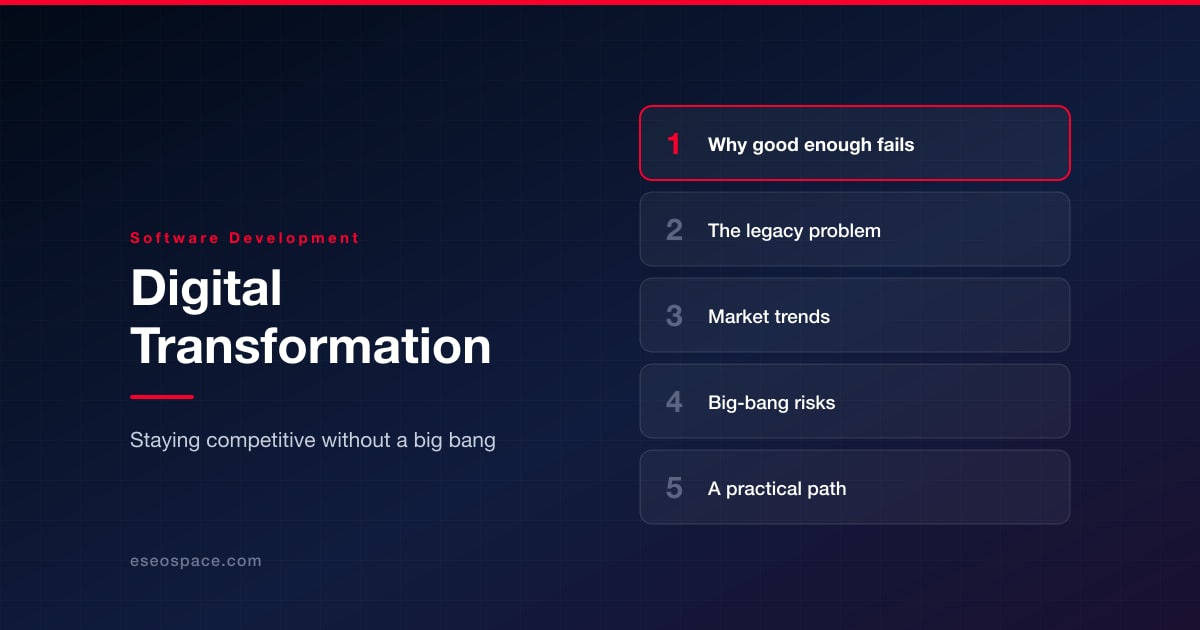
Blockbuster once had a chance to buy Netflix for $50 million and laughed. Today the story is a business-school cliché, yet plenty of companies still run on the same logic: if it works, don’t touch it. Digital transformation means rebuilding the systems, data and processes a company runs on, so it can ship faster and react sooner. The hard part isn’t the buzzword. It’s the 15-year-old system nobody dares to open.
Why “Good Enough” Stops Being Good Enough
Competition used to move at the speed of store openings and printed catalogs. Now a rival can launch a new pricing model on a Tuesday and a mobile app by Friday. Customers compare in three taps. Delivery windows shrink. Investors ask about margins and AI in the same breath.
Standing still looks safe. It isn’t.
Domino’s is the favorite example. Around 2008 the chain had a reputation problem. Instead of only fixing the dough, it built online ordering, a pizza tracker and its own apps. Executives started calling it a tech company that happens to sell pizza. Companies without that kind of in-house muscle often bring in a software development company to build the customer-facing pieces, so the first release ships in months instead of years.
What Transformation Really Includes
It’s wider than “there’s an app now”. In practice:
- Systems. Core platforms, ERP, e-commerce, integrations
- Data. One version of the truth, clean enough to report on and to feed models
- Processes. Fewer manual workarounds, fewer spreadsheets emailed around
- People. New skills, new ways of shipping, clearer ownership
Skip any of the four and the project wobbles. A shiny frontend on top of a broken back office is just makeup.
The Legacy Problem Nobody Puts on the Slide
Every old company has a system like this: it runs the business, it’s slow to change, and one or two people truly understand it. Knight Capital learned the price of that in 2012, when a botched deployment involving old code cost the firm roughly $440 million in 45 minutes. Southwest Airlines hit the same wall in December 2022, when its crew scheduling tools buckled during a winter storm and thousands of flights were cancelled. During the 2020 pandemic, several US states scrambled for COBOL programmers to keep unemployment systems alive.
So what to do about it? Replacing everything at once is the instinctive answer, and also the riskiest. Retailers and manufacturers more often pick legacy software modernization services to upgrade critical components gradually while keeping essential operations running. Slower on paper, calmer in practice.
Warning Signs a System Is Holding the Company Back
- Every new feature touches the same fragile core
- Reports from two departments never match
- Integrations slip by a quarter, then another
- Security findings pile up on unsupported versions
- Manual workarounds quietly employ three people
- Only one person understands pricing or stock logic
Three or more? The foundation needs attention before any shiny initiative.
What’s Happening on the Market
The toolbox changed a lot in the last few years. Some of it is mainstream, some still experimental.
Cloud Became the Default, With Caveats
Netflix started moving to AWS after a database corruption in 2008 froze DVD shipments for days, and the migration took until 2016. Not a weekend project, even for engineers like that. Microsoft rebuilt its business around Azure under Satya Nadella. Hybrid setups are common now, and cost control (“FinOps”) has become its own job title because cloud bills have a way of growing quietly.
Data Platforms and AI on Top
Snowflake, BigQuery and Databricks turned scattered tables into something analysts can use. On top of them sit forecasting models, recommendation engines and, lately, LLM-based assistants. Amazon’s Rufus and Klarna’s support assistant are public examples. The catch is the same as ever: a model fed with messy product or customer data produces messy answers. Plenty of AI pilots stall for exactly that reason.
Agents and Composable Commerce
The newest idea is agentic software: programs that read data, decide and act inside company systems. OpenAI’s Agentic Commerce Protocol with Stripe and Google’s Agent Payments Protocol (AP2) hint at shops being visited by bots as often as by people. Meanwhile “composable” architectures replace giant monoliths with APIs and services that can be swapped one by one. Both trends reward the same thing: a stack with clean interfaces.
Still Experimental
- Digital twins of factories and warehouses, in pilots at BMW and Siemens plants
- Autonomous code agents writing and testing parts of the product under human review
- Real-time supply chain platforms. Maersk’s TradeLens, backed by IBM, was shut down in early 2023, a reminder that technology alone can’t force an industry to share data
- Generative personalization in retail, from per-visitor product pages to virtual try-on
Which of these will last? Hard to say. The graveyard of “next big things” is large.
Why Big-Bang Projects Blow Up
Executives often quote that around 70% of transformations miss their goals. The number gets argued over, but the pattern is real. TSB in the UK migrated 5 million customers to a new platform in 2018, and for weeks up to 1.9 million of them were locked out of online and mobile banking, while some saw other people’s account details. Healthcare.gov in 2013 fell over on launch day. Different industries, same shape: a giant switch, a fixed date, no easy way back.
The Calmer Approach
Software people borrowed an idea from a Martin Fowler essay: the strangler fig pattern. A new service wraps the old system and takes over one function at a time. Old and new run side by side. Data migrates in slices. The old module is switched off only after the new one has been trusted in production for a while.
Sounds slower. Usually it reaches first value sooner, because something useful ships in the first quarter instead of month 22.
A Practical Path
Skip the grand vision deck. A workable order:
- Map what exists. Systems, data flows, dependencies, who owns what.
- Pick the pain with money attached. Slow order processing, failed integrations, expensive hosting.
- Cut one slice. A module, a data pipeline, a checkout flow.
- Run old and new in parallel. Compare results before cutting over.
- Write tests and docs as the work goes. Otherwise the new system becomes tomorrow’s legacy.
- Repeat, and measure.
Bintime builds its modernization offer around this logic. A two-to-three-week assessment and migration plan comes first, then phased delivery over roughly 12 to 24 months, so a business commits one phase at a time. The stated target is a cut of around 35% in maintenance drag. Scope covers replatforming, monolith-to-services work, technical-debt reduction, data pipelines and integration with ERP, PIM, WMS and CRM systems, delivered from the EU under ISO 27001 and GDPR.
Cases From That Portfolio
Eden Technology got custom ERP, PIM and an online shop, modernized phase after phase. Futurumshop, a Dutch cycling retailer and a client for more than 15 years, got a personalized webshop, mobile apps and a loyalty program, all updated while the store kept trading every day. Nothing glamorous. That’s the point.
Modernize Once, and AI Gets Easier
There’s a 2026 twist. Companies that clean up data flows and document their systems find the AI step much simpler, because agents need services they can safely call and data they can trust.
Put this into action with eSEOspace
We help businesses grow with website development that actually performs. Explore the services behind this guide:
Get a FREE Audit
We'll perform a comprehensive SEO, AEO, GEO & CRO audit of your website — completely free — and show you exactly how to outrank your competitors.
Don't have a site yet? Get in touch →
Get a FREE GEO/AEO/SEO Audit
We'll analyze your site's SEO, GEO, AEO & CRO — completely free — and show you exactly how to get found across Google and AI answers.
Don't have a site yet? Get in touch →
Great — your audit is on the way!
We'll send your free SEO/GEO/AEO/CRO audit within the next few hours. Where should we send it?
You're all set! ✓
Your free audit is being prepared — check your inbox in the next few hours. Talk soon!








