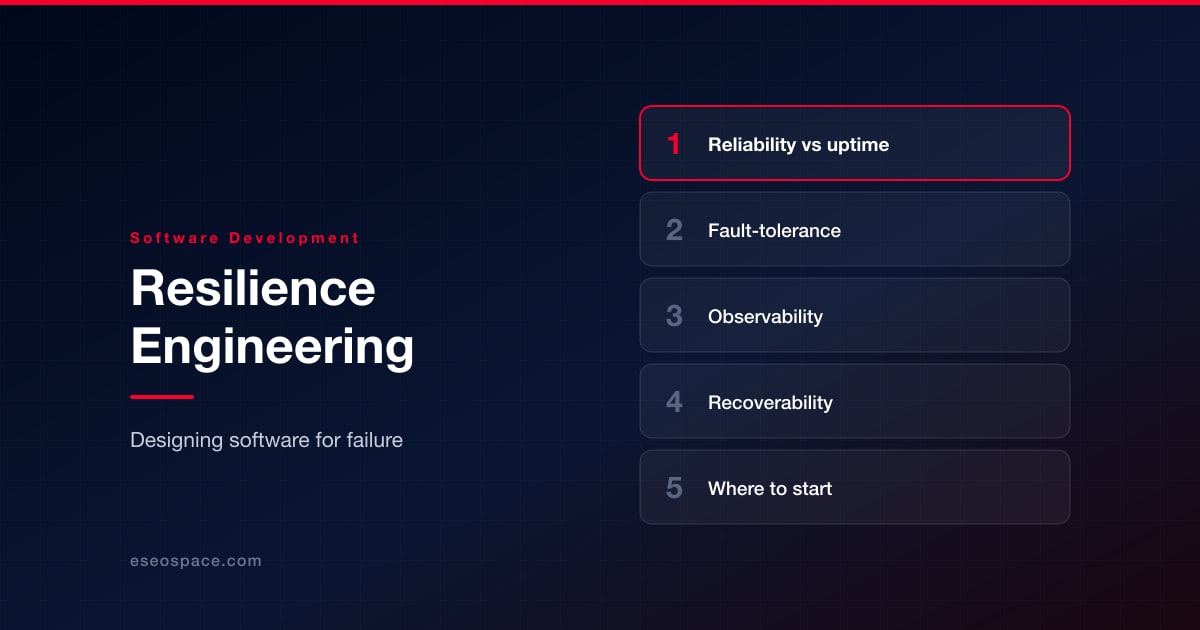
What Is Resilience Engineering in Software Development?
What Is Resilience Engineering in Software Development?
Every system fails eventually. A payment provider times out, a database runs out of connections, a third-party API returns nonsense for twenty minutes. The question is not whether these events happen, but what your software does while they are happening.
Resilience engineering is the discipline of designing for that reality. Instead of assuming a perfect environment, it assumes failure is normal and asks how the system keeps serving users through it.
Reliability Is Not the Same as Uptime
Most teams measure availability as a percentage and stop there. That number hides the part customers actually feel.
A service can be "up" while checkout silently fails for one payment method, or while reports load so slowly nobody waits. Reliability is about whether the system does its job correctly under real conditions, not whether the process is running.
Useful questions to ask about any critical path:
- What happens when this dependency is slow rather than down?
- Which parts of the request can still succeed if one step fails?
- How long can this run on stale data before it becomes wrong?
- Who finds out first — the monitoring, or the customer?
The Core Patterns of Fault-Tolerance
Fault-tolerance comes from a handful of patterns that have proven themselves across very different systems.
Timeouts and retries. Every external call needs a deadline. Retries help with transient errors, but without limits and backoff they turn a small outage into a self-inflicted flood of traffic.
Circuit breakers. When a dependency keeps failing, stop calling it for a while. This protects both systems and gives the failing one room to recover.
Graceful degradation. A product page that cannot reach the recommendations service should render without recommendations, not return an error. Decide in advance which features are essential and which can disappear quietly.
Redundancy and failover. Redundancy means no single machine, zone, or connection can take the product down, and failover means the switch happens without a human being woken up.
Idempotency. If a request can be retried, it must be safe to process twice. In payments and order handling this is the difference between a retry and a duplicate charge.
Observability Turns Incidents Into Information
You cannot make a system robust if you cannot see what it is doing. Observability is the practice of emitting enough signal — logs, metrics, traces — to answer questions you did not anticipate.
The practical test is simple: during an incident, can an engineer tell within minutes which component is failing and which users are affected? If answering that requires adding logging first, the system is not observable yet.
A serious development agency treats this as part of delivery rather than as an afterthought, because instrumentation added during a crisis is always worse than instrumentation designed in. This is how the team at software company Krasty Soft approaches production systems: monitoring, alerting and recoverability are scoped with the feature, not bolted on after launch.
Recoverability: The Test Most Teams Skip
Backups are common. Tested restores are rare. Durability only counts if you have proven you can get the data back within a time your business can survive.
Two numbers make this concrete, and every critical system should have both written down:
- Recovery point objective — how much data you can afford to lose, measured in minutes or hours.
- Recovery time objective — how long the business can operate while the system is being restored.
Once those numbers exist, architecture decisions become much easier to argue. A four-hour restore is fine for an internal reporting tool and unacceptable for order processing.
Resilience and Scalability Are the Same Conversation
Systems rarely fail on a quiet Tuesday. They fail when traffic spikes, which is why scalability and resilience belong in the same design discussion.
Load shedding, queueing, and rate limiting are resilience patterns as much as performance ones. They decide what the system sacrifices when demand exceeds capacity — and a system that degrades on purpose is far better than one that collapses by accident.
Where to Start
Resilience work does not require rebuilding anything. Any development agency can start with an honest inventory: list your external dependencies, then write down what happens to the user when each one fails. Most teams find two or three answers they are not comfortable with, and those become the roadmap.
From there, add a timeout where there was none, make one critical operation idempotent, and run one restore drill. The goal is not a system that never fails. It is a system whose failures are boring.
Put this into action with eSEOspace
We help businesses grow with website development that actually performs. Explore the services behind this guide:
Get a FREE Audit
We'll perform a comprehensive SEO, AEO, GEO & CRO audit of your website — completely free — and show you exactly how to outrank your competitors.
Don't have a site yet? Get in touch →
Get a FREE GEO/AEO/SEO Audit
We'll analyze your site's SEO, GEO, AEO & CRO — completely free — and show you exactly how to get found across Google and AI answers.
Don't have a site yet? Get in touch →
Great — your audit is on the way!
We'll send your free SEO/GEO/AEO/CRO audit within the next few hours. Where should we send it?
You're all set! ✓
Your free audit is being prepared — check your inbox in the next few hours. Talk soon!